
Walk around Tokyo. Talk to everyone in Japanese.
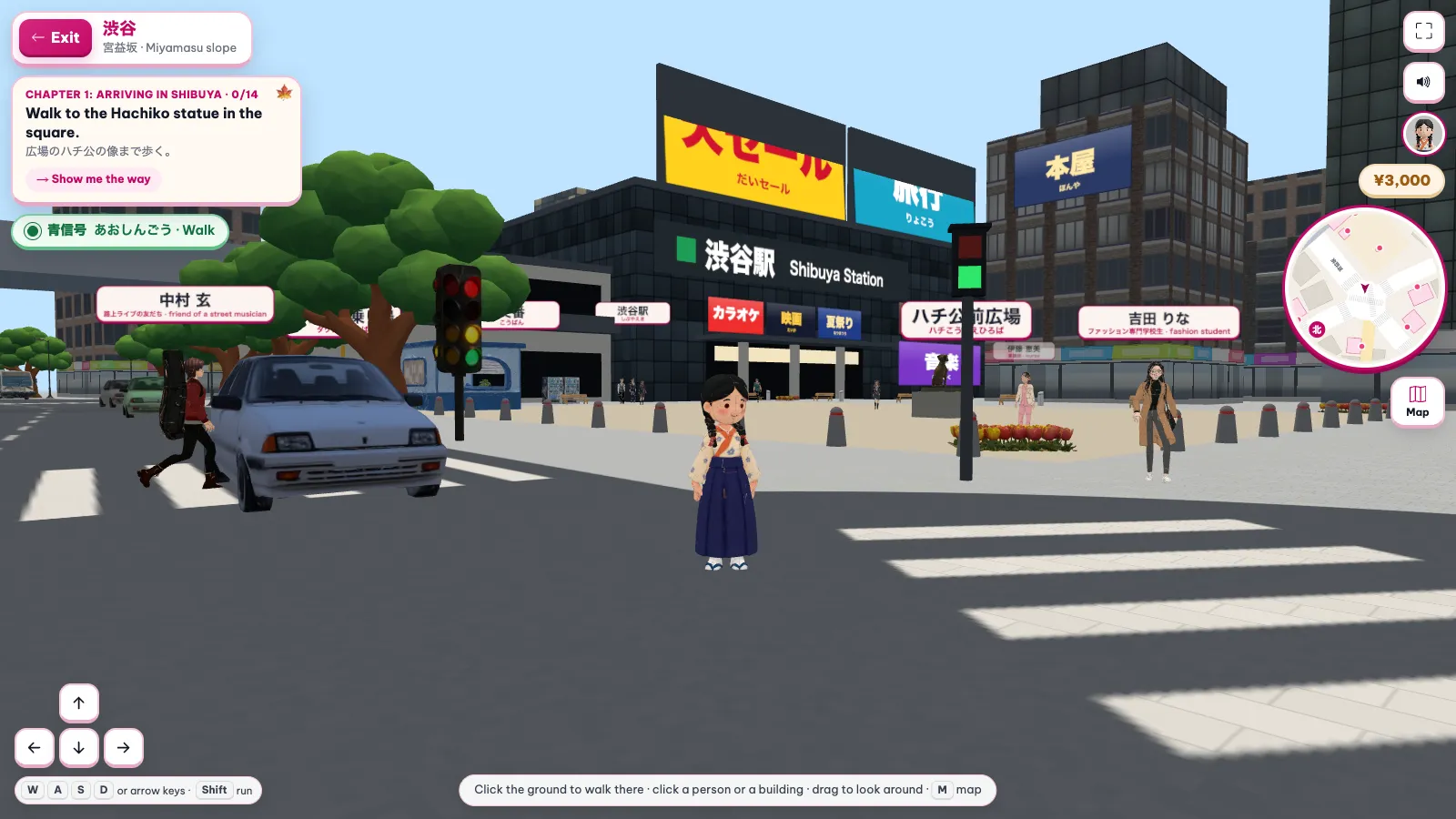
3D City is a small Tokyo that opens in your browser, from the Shibuya crossing to the temple lanes of Asakusa, and on by Shinkansen to Kyoto and Osaka. Walk up to the barista, the station attendant or the police officer, say what you need in Japanese, and they answer you out loud, the way people do in real life.
Walking around is free. It runs in the browser on a laptop or desktop computer: nothing to install.
- 6districts to walk
- 86places to visit
- 413real-life conversations
From your desk to a street in Tokyo in one minute
Choose where to start
Pick where to start, from Shibuya to Osaka, then choose the character you will walk as.
Walk the streets
Click the ground or use the arrow keys. The map shows every shop, office and station, and the way there, and you can walk inside many of them.
Talk to someone
Walk up to a person, choose a situation at your level, and speak. You can type instead whenever you like.
See how it went
You get stars, one thing you did well and one thing to fix, and the useful phrases go into your phrasebook.
They answer out loud, and they wait for you
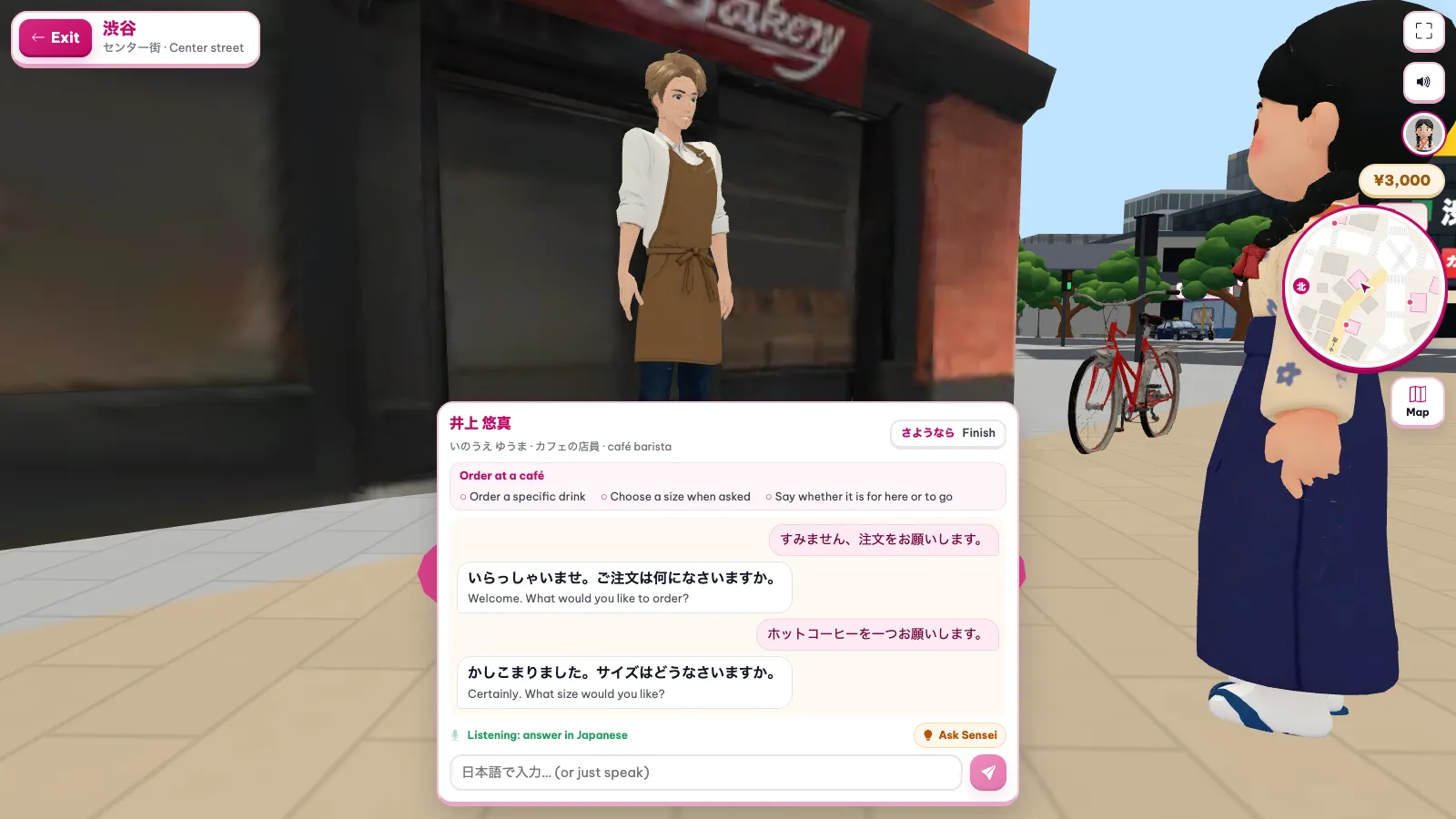
Every person in the city has a job, a personality and a voice of their own. Speak into your microphone and the conversation moves at your speed: nobody behind you in the queue, nobody who switches to English.
- A translation under every reply, so you are never lost
- Stuck? Ask Sensei gives you a line you can say next
- Prefer to type? Every conversation works with the keyboard too
The conversations you will really need in Japan
Order at a café, pay at the convenience store, report a lost wallet at the police box, open a bank account, explain your symptoms at the clinic, check in at a hotel, buy a Shinkansen ticket. Each one has three small goals, so you always know what to say next.
- Five levels, from beginner to advanced
- Start with one sentence and grow into long conversations
- Repeat any conversation as often as you like: it is different every time
Know exactly what to fix
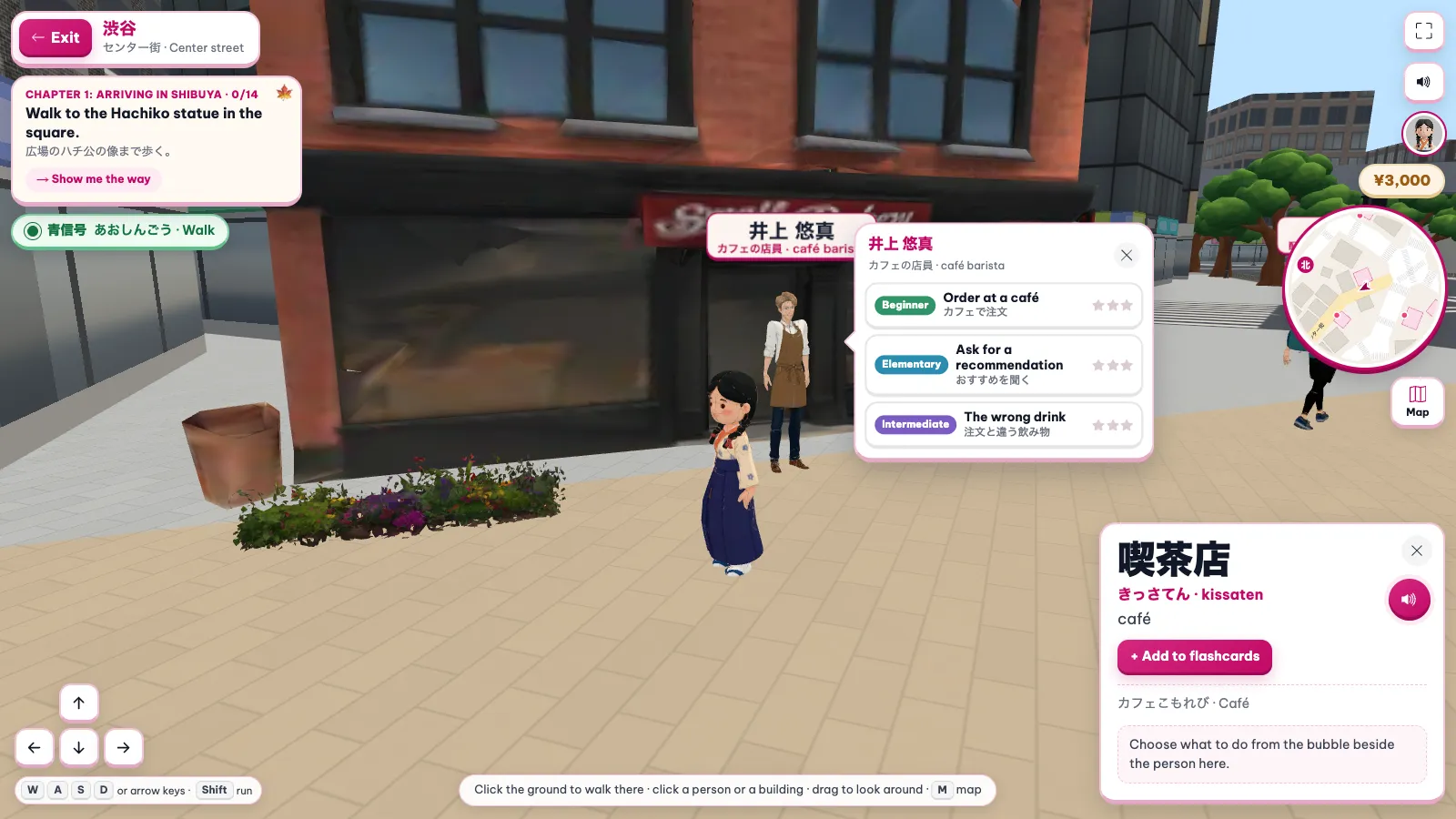
When a conversation ends, Sensei tells you how it went: which goals you reached, what you said well and the one correction that matters most. Good conversations earn stars and yen to spend on the train, the bus, the taxi and in the shops.
- Up to three stars for every conversation
- A clear correction in plain words, not a grammar lecture
- Save the phrases you want to keep to your phrasebook
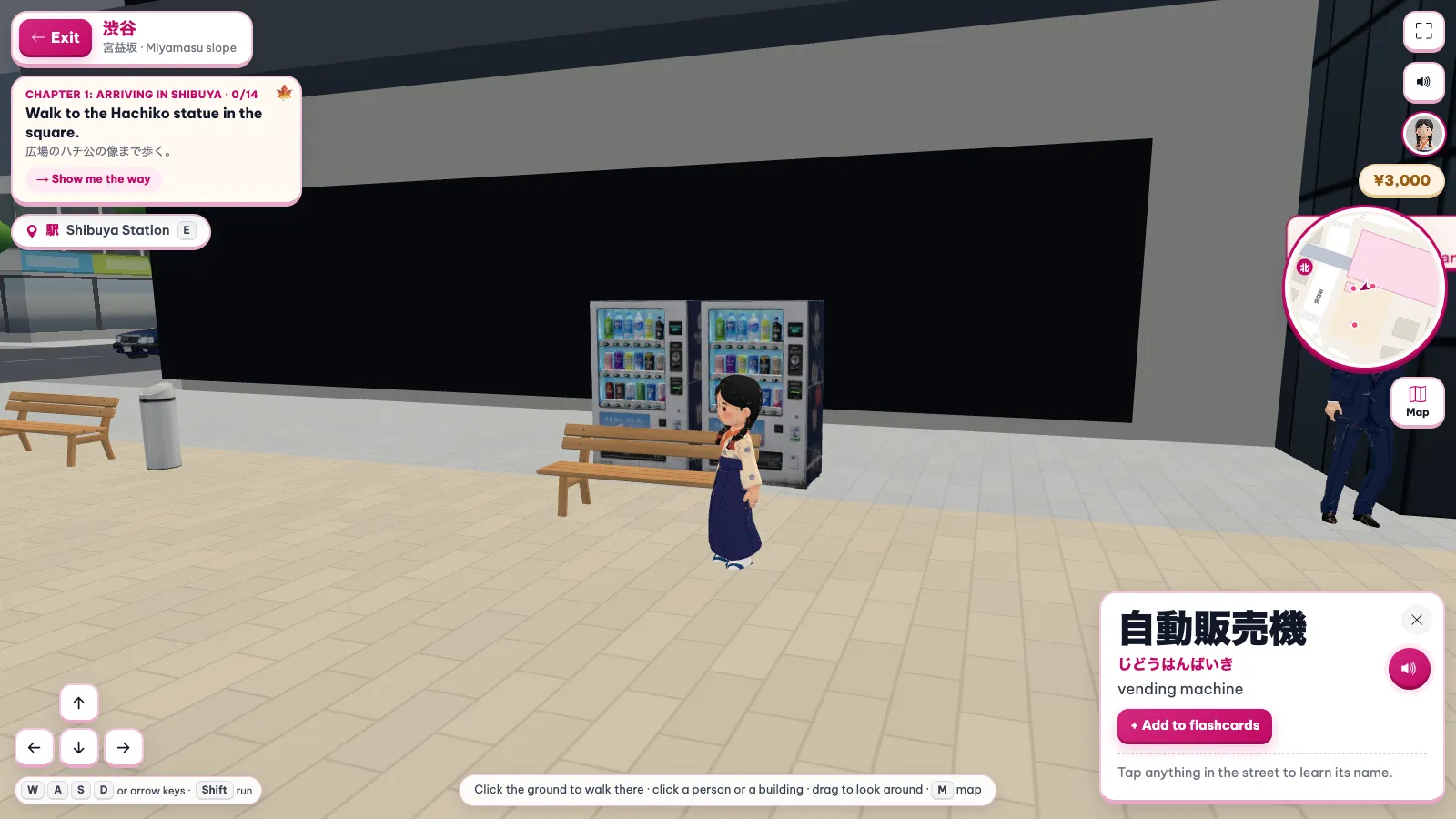
Tap anything to learn its name
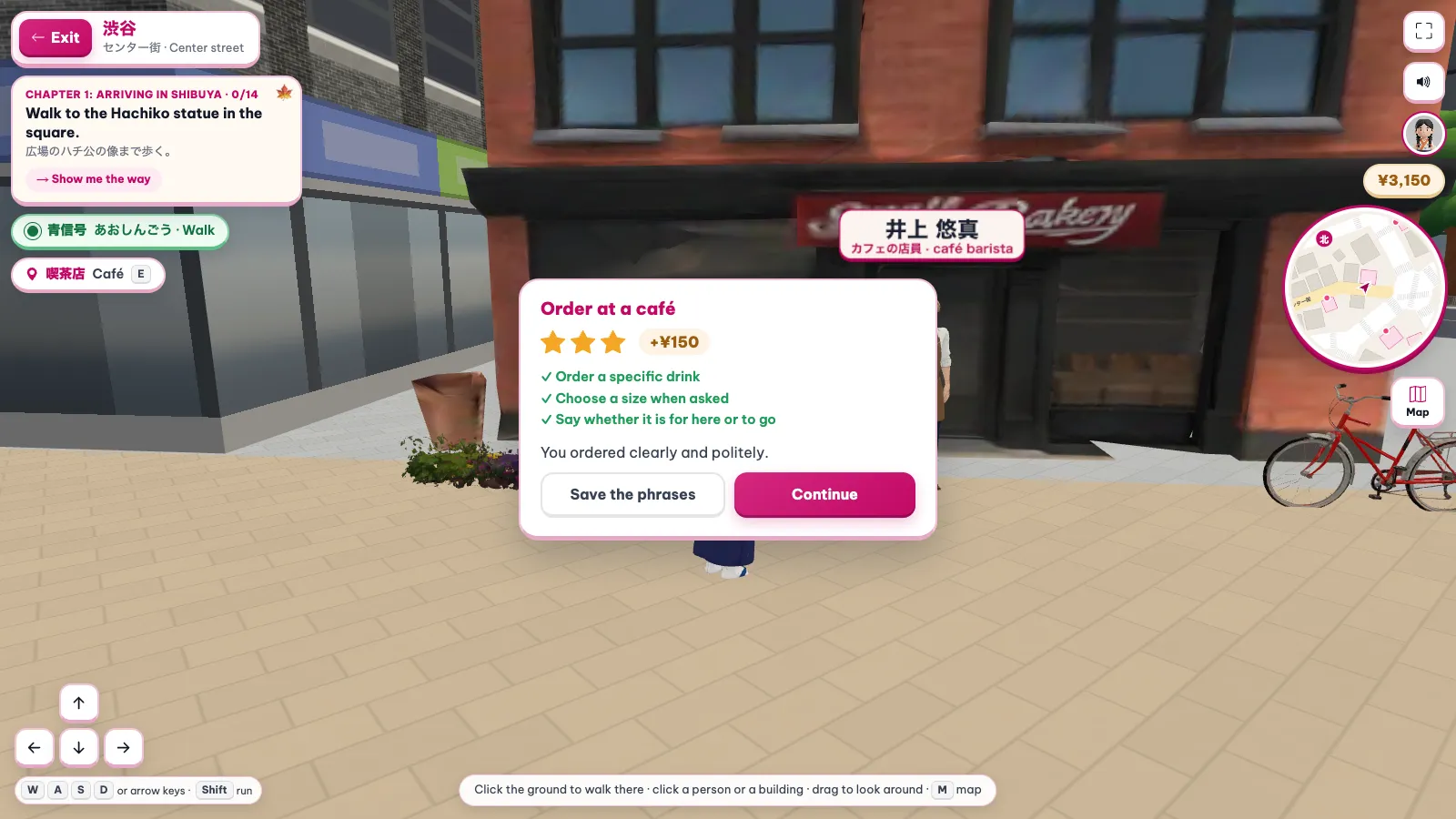
A vending machine, a post box, a traffic light, a shop sign: tap it and a card shows the Japanese word, how to read it and what it means. Listen to it, then add it to your flashcards with one more tap.
- Signs are written the way they are in Japan
- Hear every word spoken
- Words go straight to your Unihongo flashcards
Chat with the people walking by
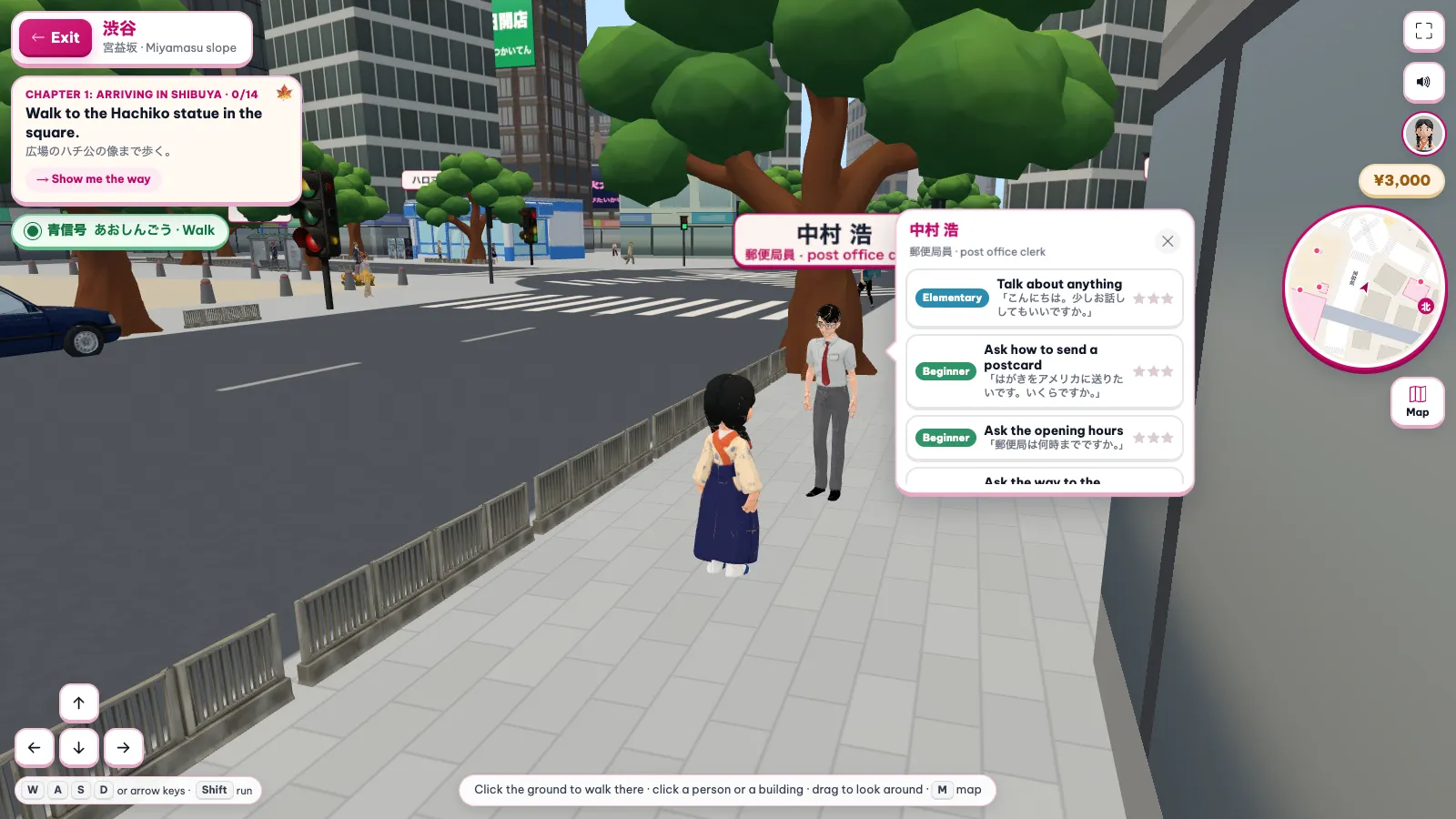
Not every conversation is a task. More than a hundred people walk the streets: an office worker on a break, a student, a retiree with his dog. Stop any of them and talk about the weather, food, work or your plans for the weekend.
- Easy topics suggested for every person
- Or choose Talk about anything and lead the conversation yourself
- Polite and friendly for learners of every age
Tokyo, Kyoto and Osaka, a train ride apart
Each district has its own streets, people and story chapter. Travel between them by train, bus or taxi (to Kyoto and Osaka by Shinkansen or night bus), and pay the fare with the yen you earn by talking.
 Daily life
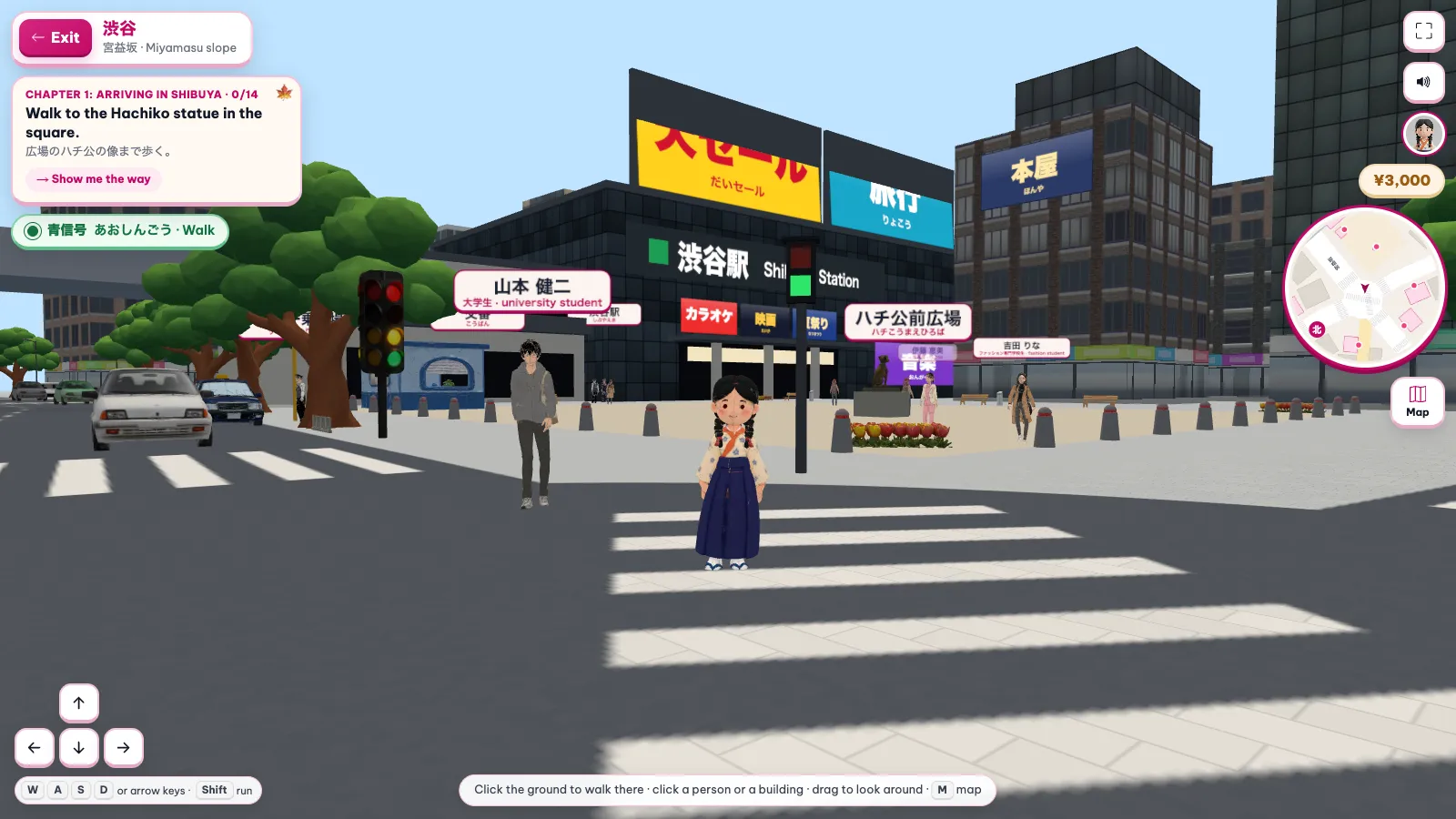
Shibuya
The famous crossing, the Hachiko statue and the streets around them: a café, a ramen shop, a convenience store, a pharmacy, a bookshop, the post office and the police box.
12 places56 conversations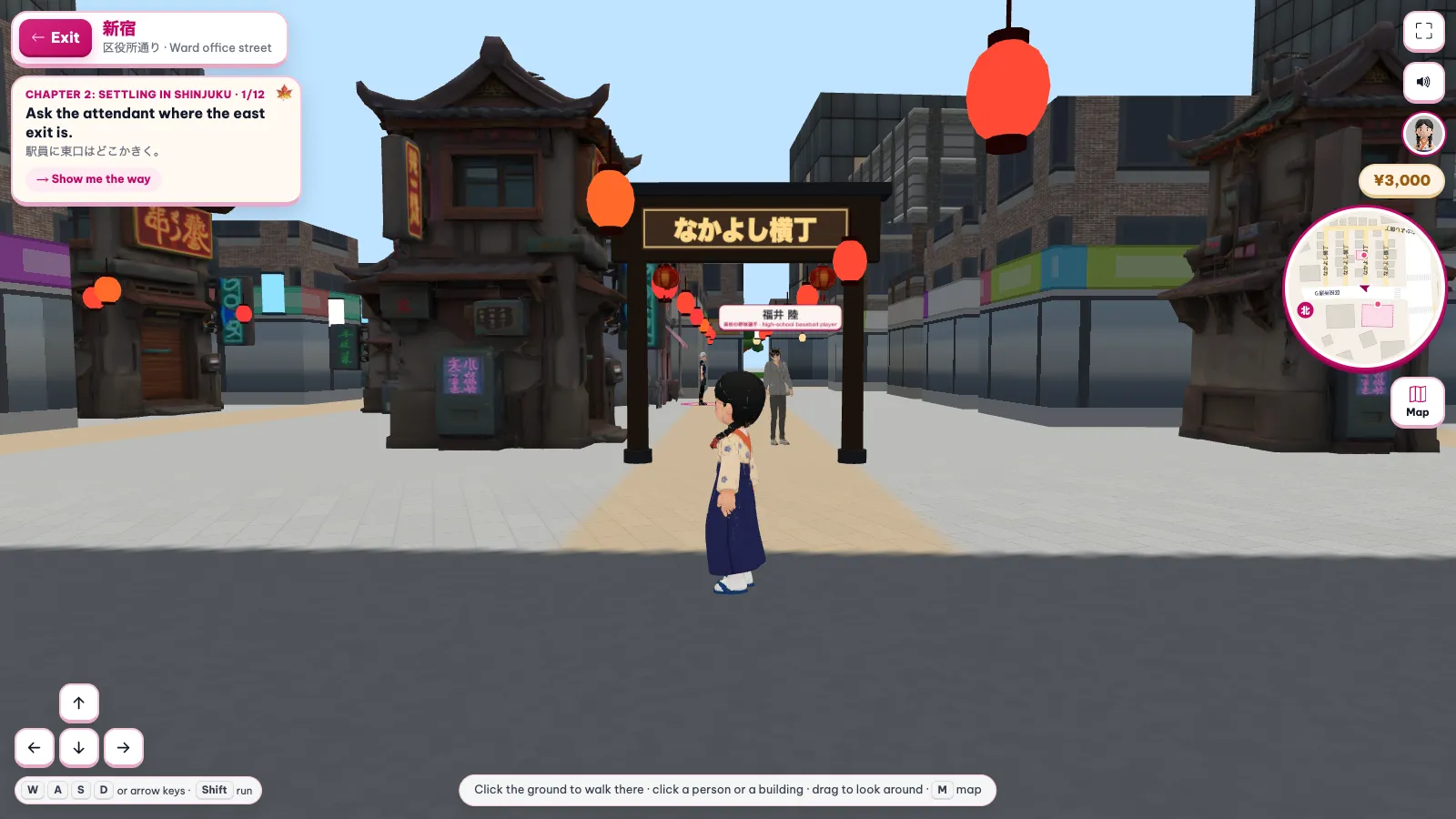 Living in Japan
Shinjuku
Everything you need when you move to Japan: the ward office, a bank, a clinic, a dentist, an estate agent, a hair salon, a gym, an office and an izakaya for the evening.
14 places68 conversations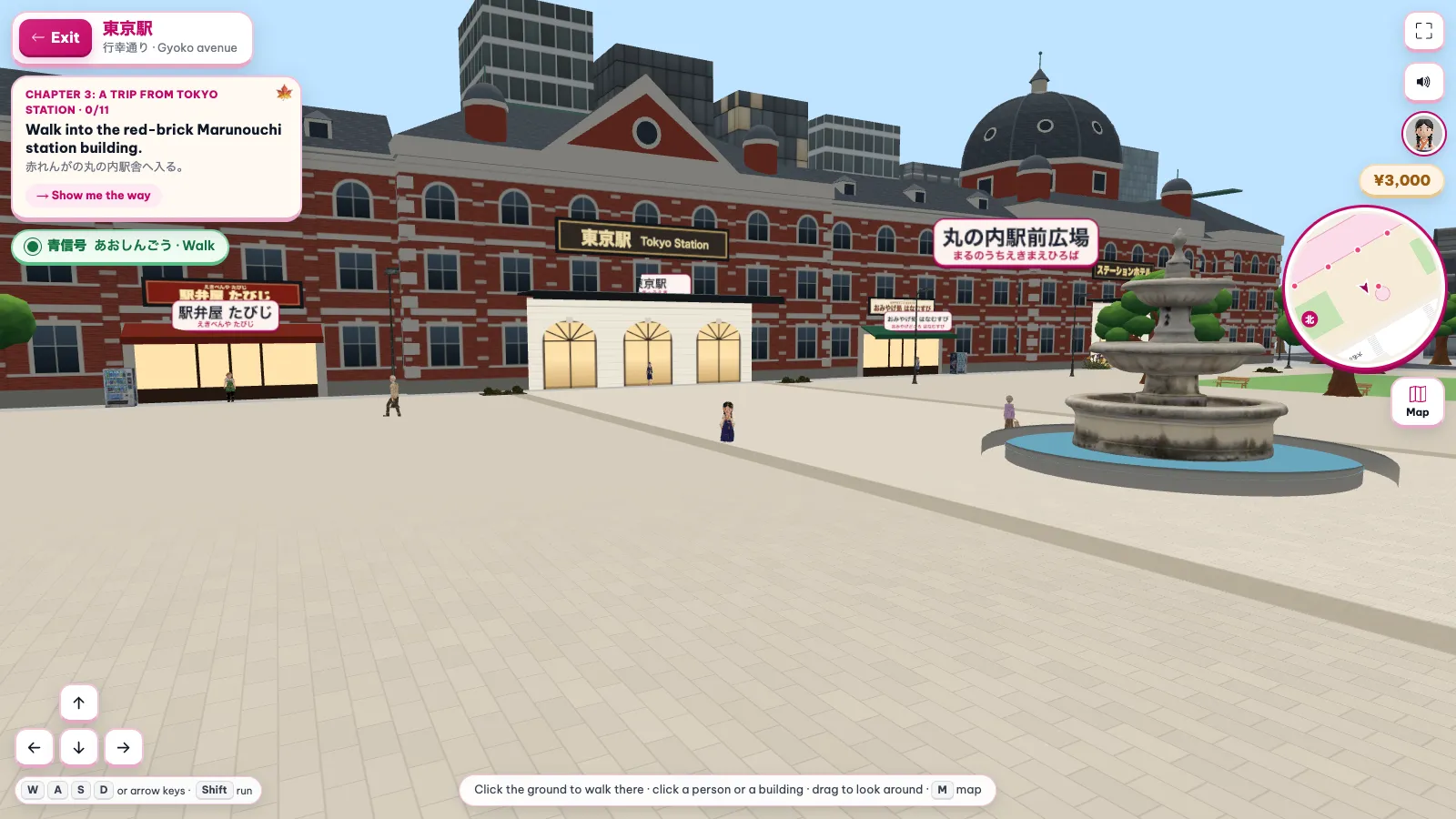 Travel and business
Tokyo Station
The red-brick station building and the business district in front of it: the Shinkansen ticket office, boxed lunches for the train, a hotel, a travel agent, an office tower and dinner on a terrace.
13 places71 conversations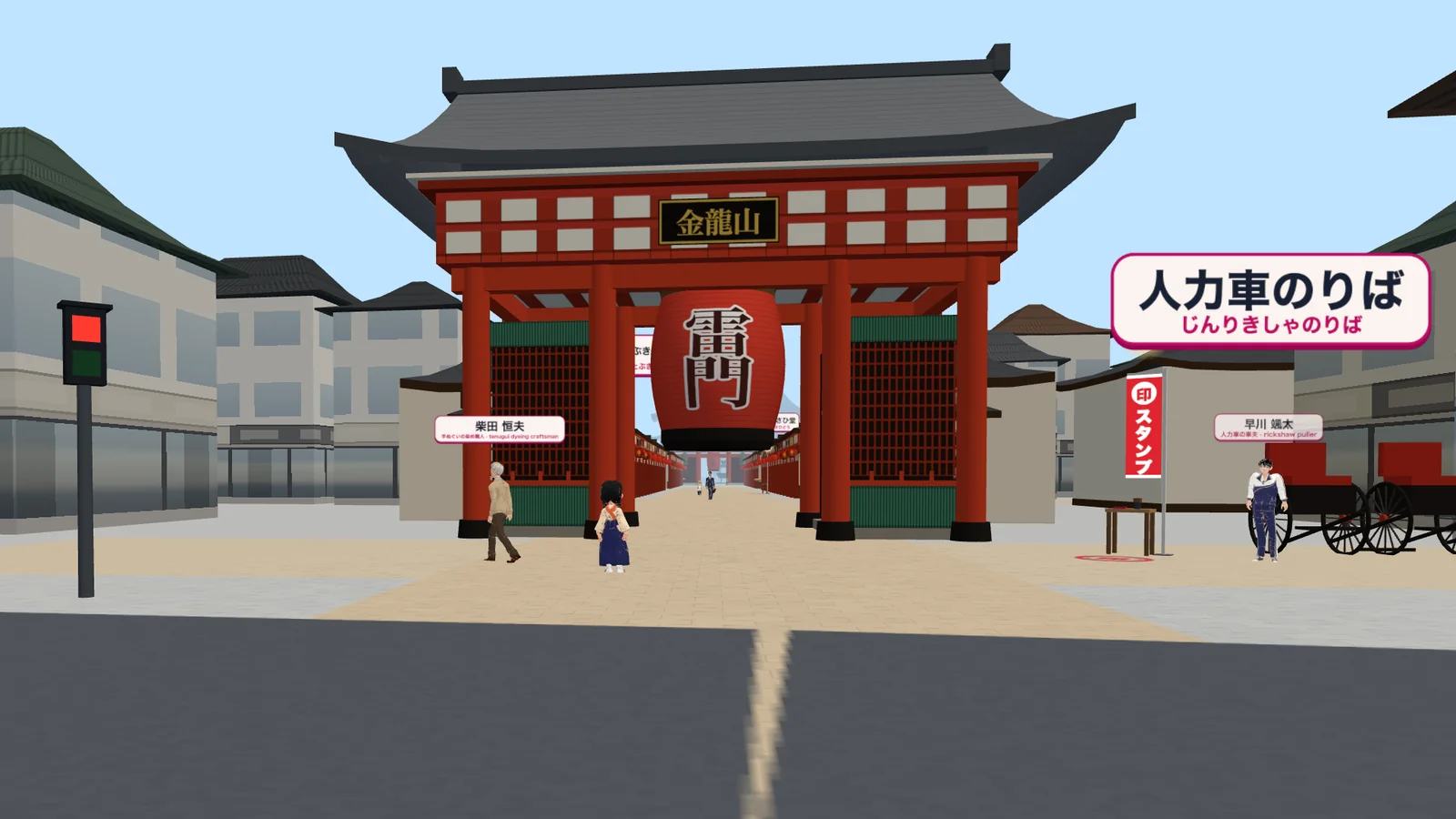 Old Tokyo
Asakusa
Kaminarimon with its giant red lantern, the stalls of Nakamise and the Sensō-ji temple: a fortune counter, rice crackers, kimono rental, tempura, monja, a ryokan, the rickshaws and the water bus.
14 places68 conversations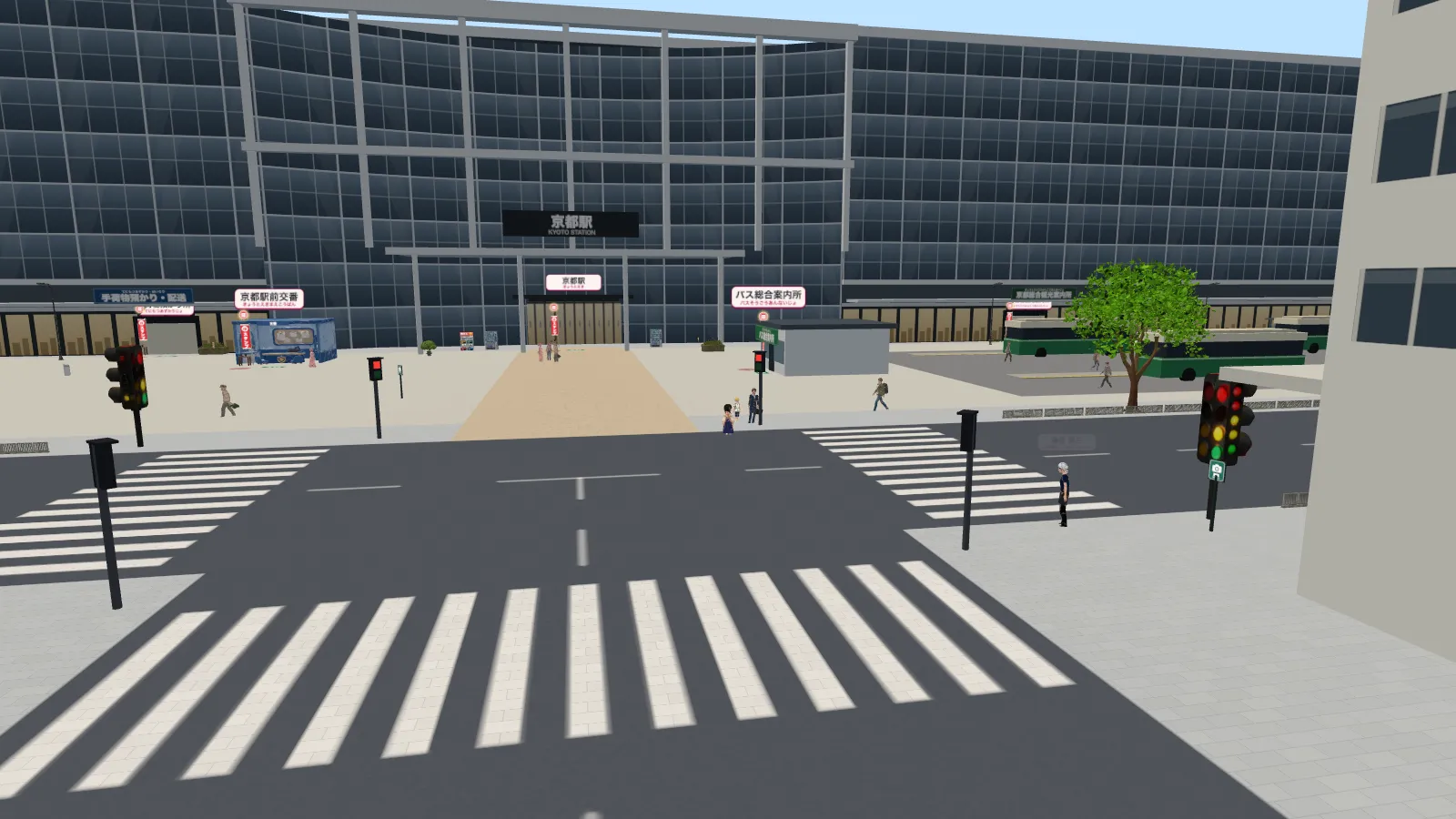 Kyoto Station
Kyoto
The glass station, Kyoto Tower and the great gate of Higashi Honganji: the bus office and its day pass, a luggage counter, matcha sweets, Uji tea, yatsuhashi, Kyoto pickles, nishin soba, kimono rental and a ryokan.
17 places77 conversations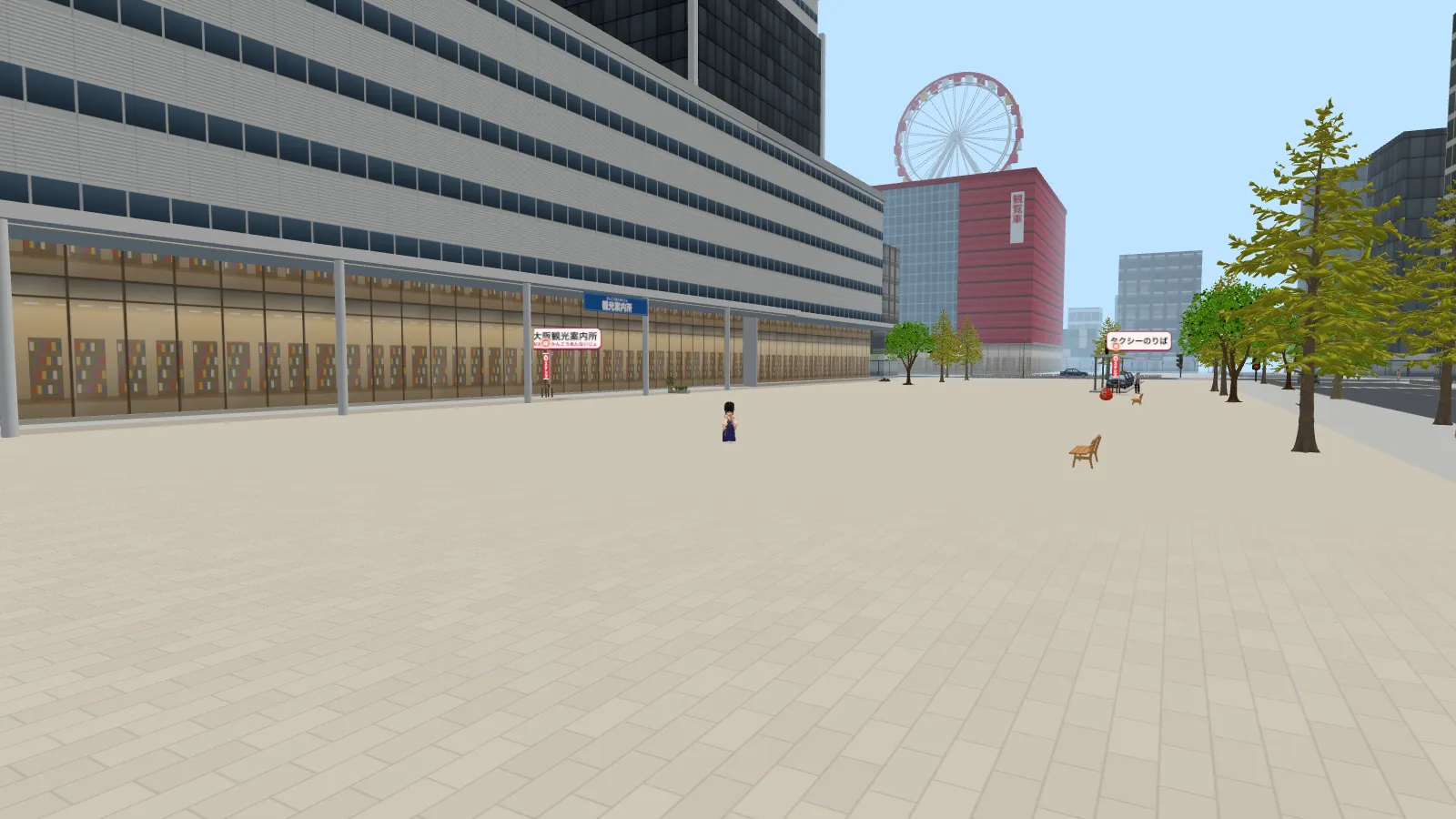 Umeda
Osaka
Osaka Station, the red Ferris wheel and the twin towers of the Floating Garden: takoyaki, okonomiyaki, kushikatsu and the no-double-dipping rule, an old coffee house, the department-store food hall, a shrine with an old love story, and Osaka dialect.
16 places73 conversations
You remember what you said, not what you read
A phrase from a list is easy to forget. A phrase you used to get your coffee, find your platform or get your wallet back stays with you, because you needed it. 3D City gives you that feeling every day, without a plane ticket.
- Speak without fear: nobody is watching, and you can try again
- Practise the exact situation before you meet it in real life
- Ten minutes is enough: one walk, one conversation, one new phrase
すみません、駅はどこですか。
Sumimasen, eki wa doko desu ka.
Excuse me, where is the station?
Walk for free. Talk as much as you want with Pro.
Free
Everything you need to explore.
- Walk every district
- Tap signs and objects to learn words, with sound
- Save words to your flashcards
- One short speaking try with a person in the city
Pro
For real speaking practice every day.
- Talk with everyone in the city
- All 413 conversations, at every level
- Stars, corrections and your phrasebook
- Uses the same speaking time as AI Sensei
3D City needs a laptop or a desktop computer. On your phone, practise speaking with AI Sensei.
Questions about 3D City
What is 3D City?
3D City is a part of Unihongo where you practise Japanese conversation inside 3D models of Tokyo, Kyoto and Osaka. You walk through districts such as Shibuya, Asakusa, the Kyoto Station area and Umeda in Osaka, go into 86 places such as a café, a bank or a ticket office, and talk in Japanese with the people who work there. They are AI characters who listen to you and answer out loud.
Is 3D City free?
Walking around every district, reading the signs, learning words from the street and saving them to your flashcards are free with a Unihongo account. Talking with the people uses AI Sensei speaking time: a Free account has one short try, and a paid plan lets you keep talking every day.
Do I need to install anything?
No. 3D City opens in your web browser on a laptop or a desktop computer. It is not available on phones yet, because the city needs a larger screen and more graphics power.
Which browser should I use?
To speak with your microphone, use Chrome, Edge or Safari. In other browsers you can still walk, read, listen and type your answers in Japanese.
What level of Japanese do I need?
Any level. There are conversations at five levels, from beginner to advanced. At the beginner level people speak slowly in short sentences, every reply has a translation under it, and Ask Sensei suggests what you can say next.
Are the people in the city real?
No. Every person is an AI character with a name, a job, a personality and a voice. They stay in their role, they keep the conversation polite and suitable for all ages, and they never get tired of repeating something for you.
Is this the real Tokyo?
The streets are based on the real map of each area, and you will recognise the Shibuya crossing, the Hachiko statue, the red-brick Tokyo Station building, the giant red lantern of Kaminarimon, Kyoto Tower and the red Ferris wheel of Umeda. The shops, companies and people are invented for practice.
Tokyo is open. Come in and say hello.
Your first conversation is one short walk away.
3D City is a model of Tokyo, Kyoto and Osaka made for language practice. Its shops, companies and people are fictional.