
Learn kanji one stroke at a time.
All 2,136 Jōyō kanji, sorted by JLPT level from N5 to N1. Watch each one being written, remember it with a memory trick, then write it yourself with your mouse or finger.
Free with a Unihongo account. Works on your phone and computer.
- 2,136Jōyō kanji
- N5–N1every JLPT level
- 32languages for meanings
Four steps from new kanji to known kanji
Pick your level
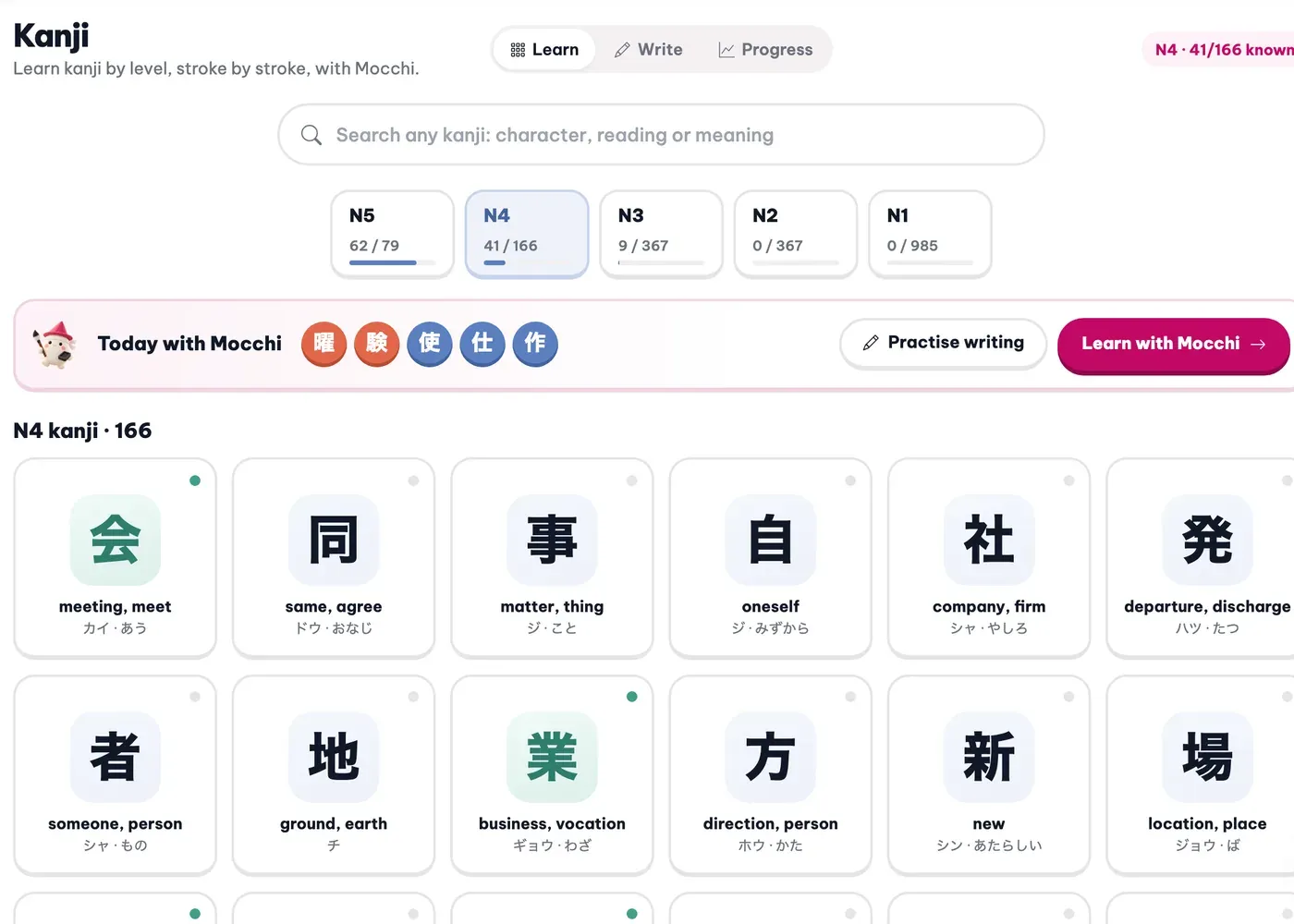
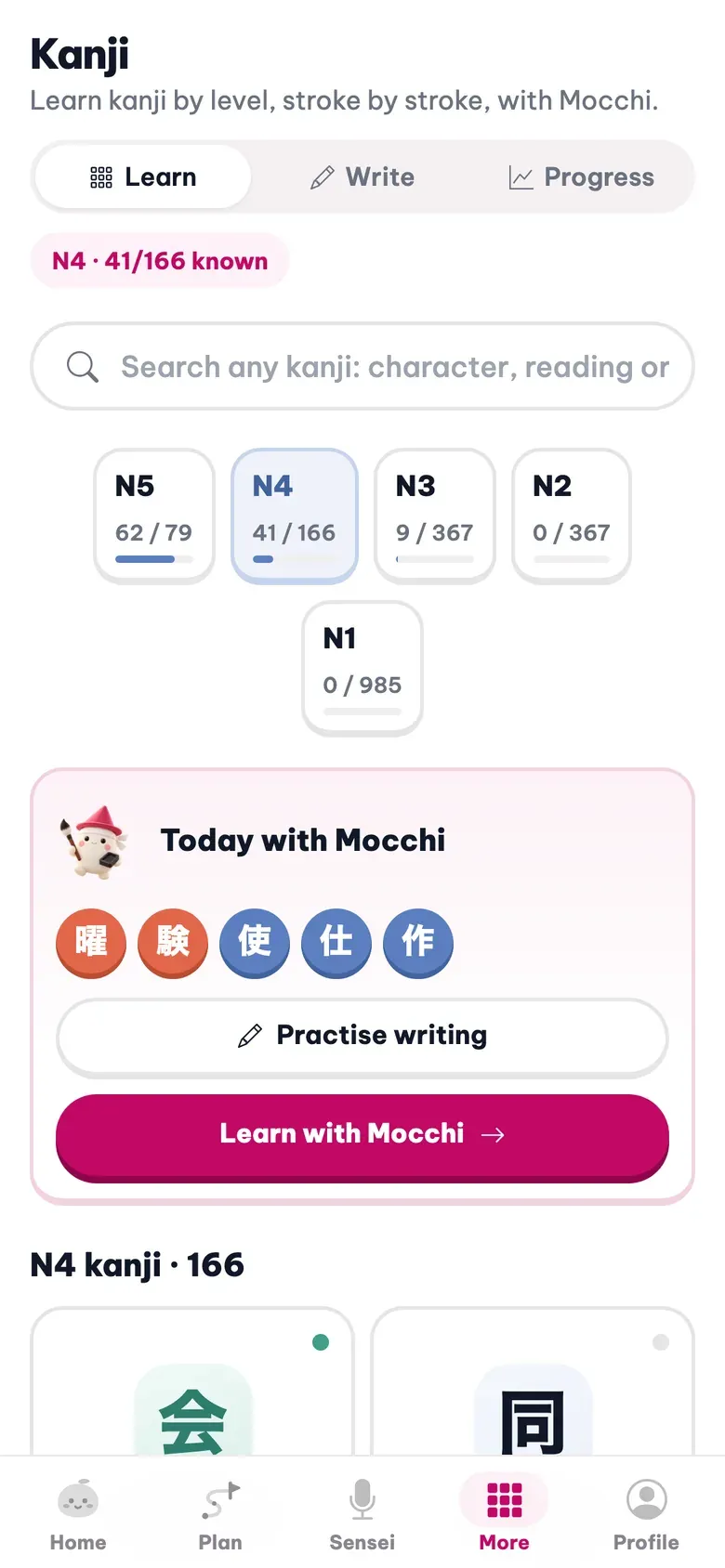
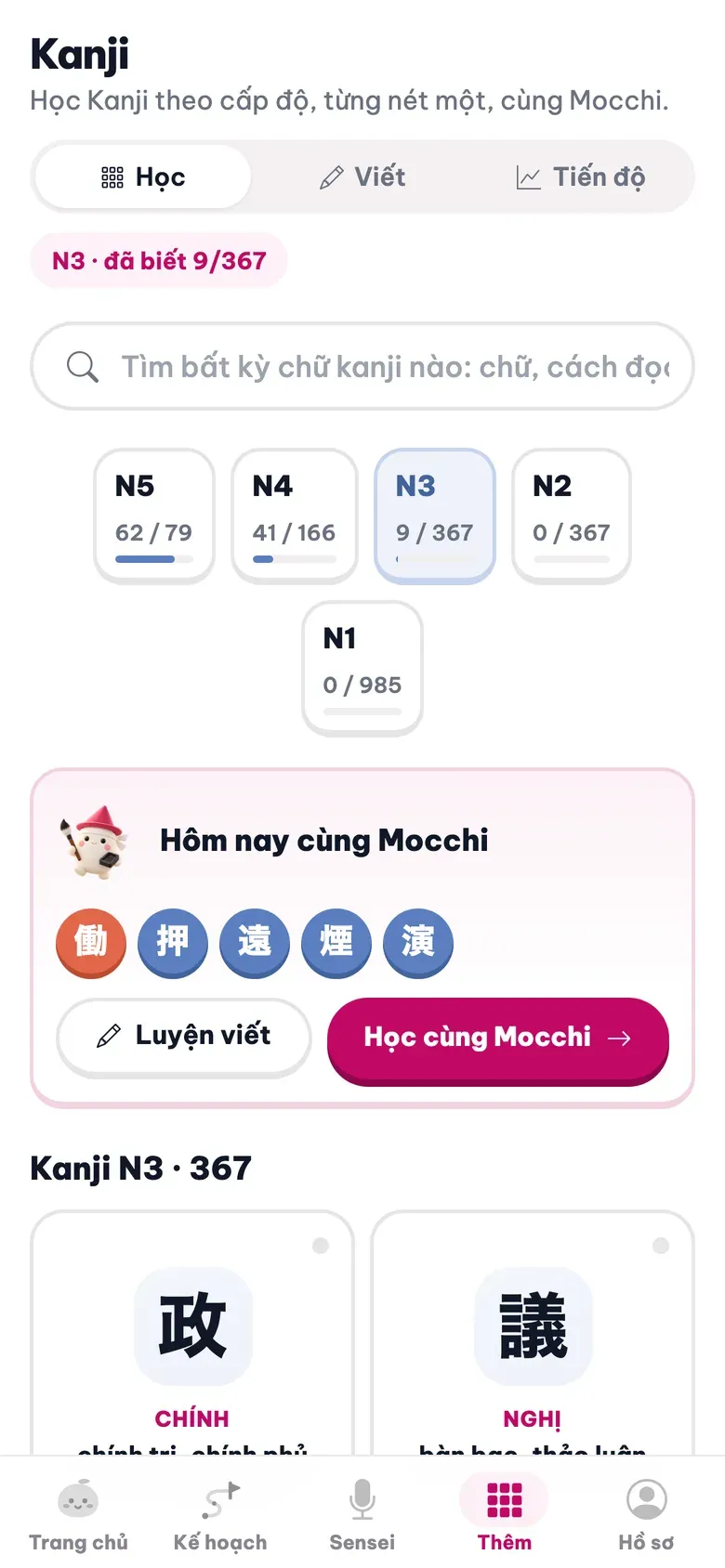
Start at N5 or jump to the level you are studying. Each level shows how many kanji you know.
Learn it
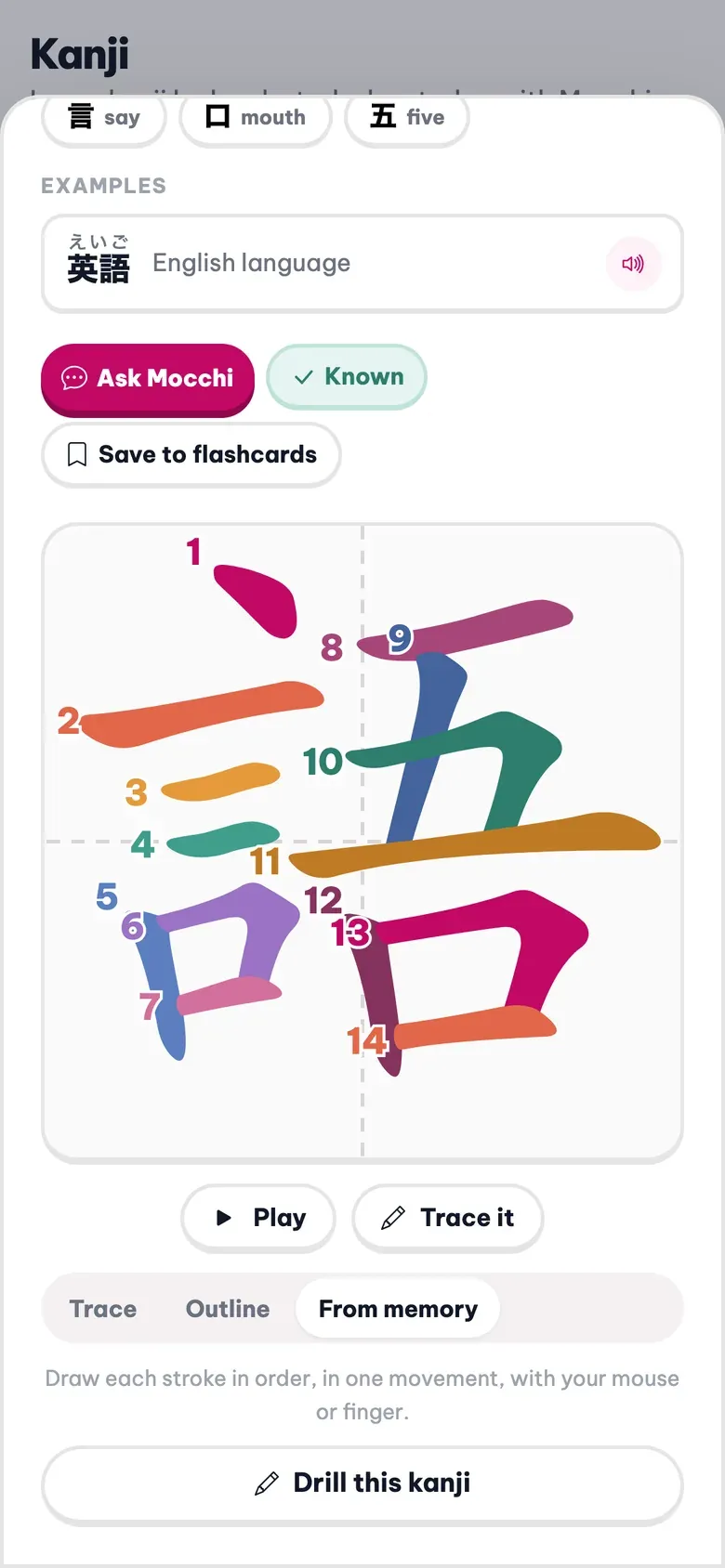
Open a kanji to see its readings, parts and example words, and watch the stroke order play.
Trace it
Write it with your mouse or finger. Every stroke is checked as you draw.
Review with Mocchi
Each day Mocchi picks five kanji for you, starting with the ones you found hard.
All the kanji you need, sorted by JLPT level
The Kanji page holds all 2,136 Jōyō kanji, the set taught in Japanese schools and used in everyday writing. Pick a JLPT level from N5 to N1 and the cards show each kanji with its meaning, readings and stroke count.
- Level cards show how many kanji you know at each level
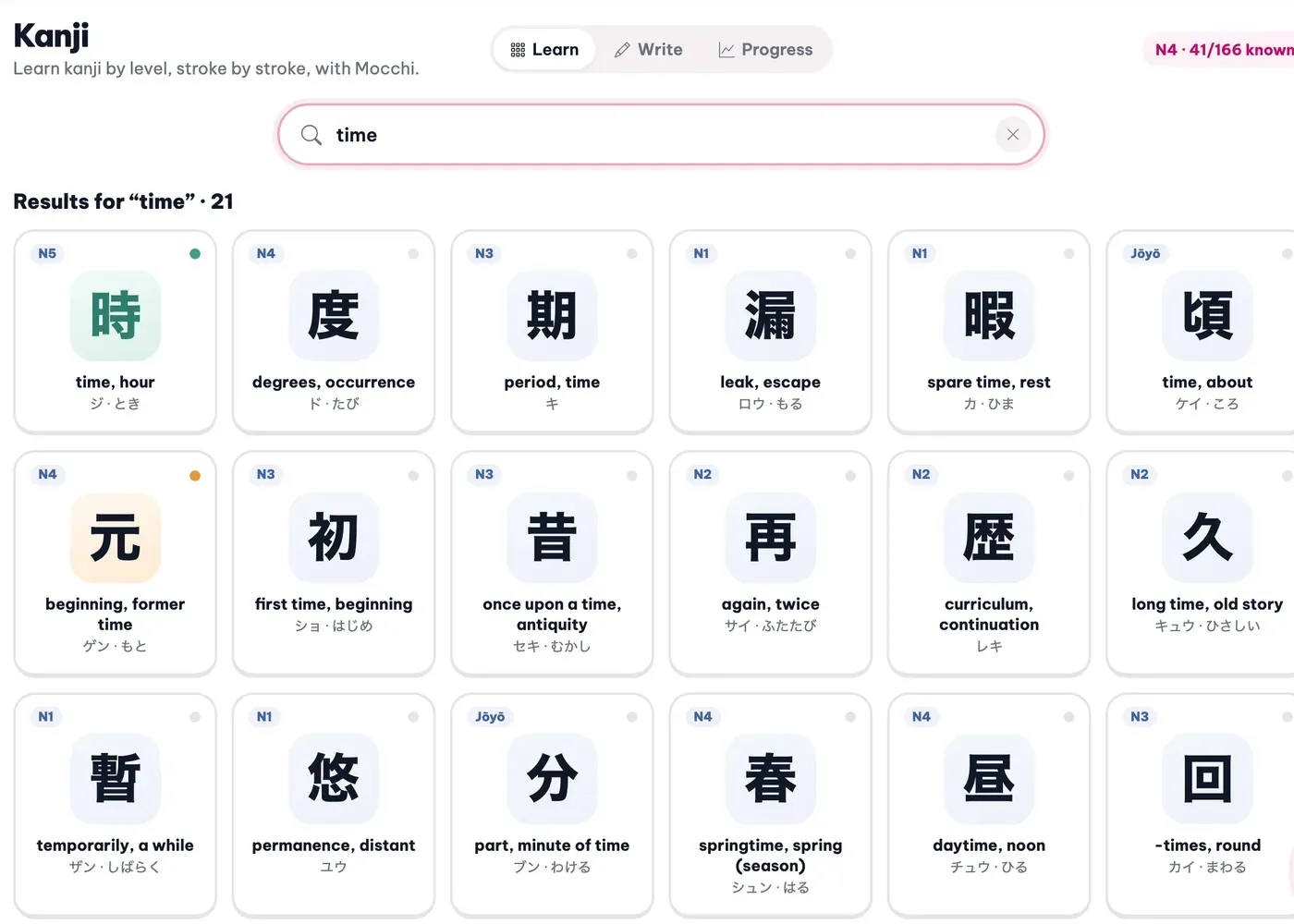
- Search across every level by kanji, reading or meaning
- Mark a kanji as known, or keep it in your learning set
Watch the stroke order, then read the whole story
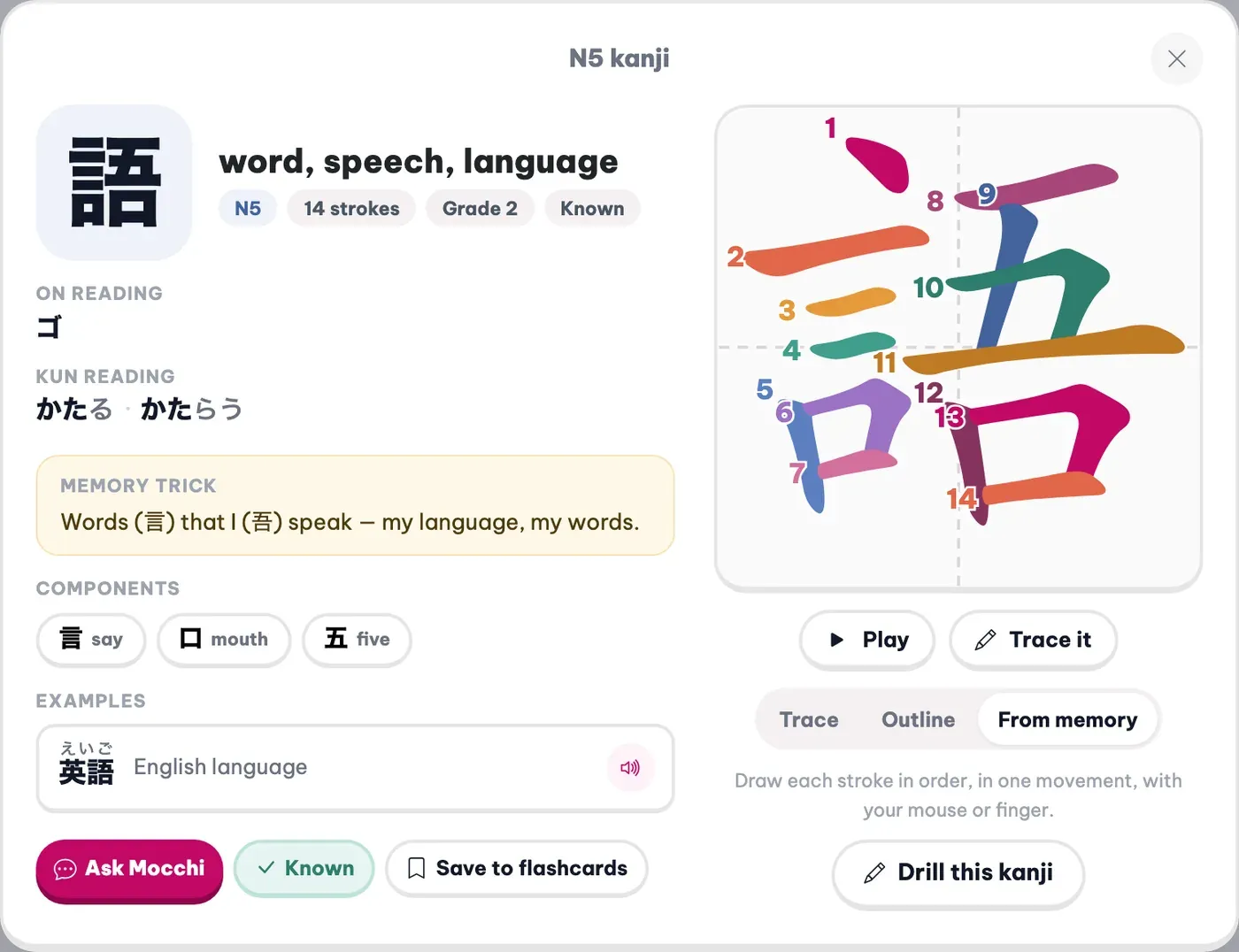
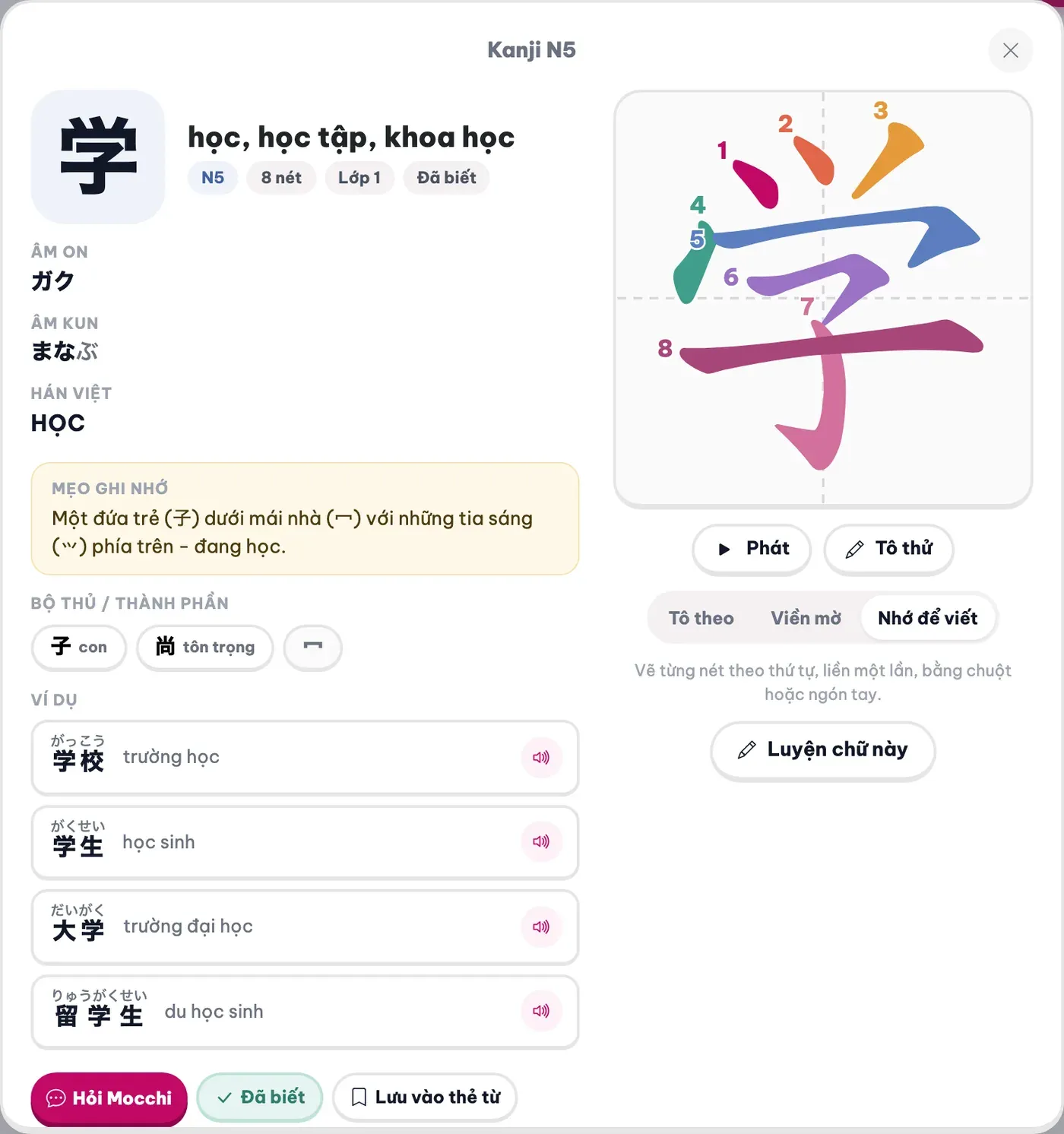
Tap a kanji and its sheet opens. The stroke order plays on its own, then settles on a numbered, colour-coded guide you can study at your own pace.
- On and kun readings, and the parts the kanji is built from
- Example words from the JLPT word lists, with audio
- A memory trick for every kanji
Write it yourself, graded stroke by stroke
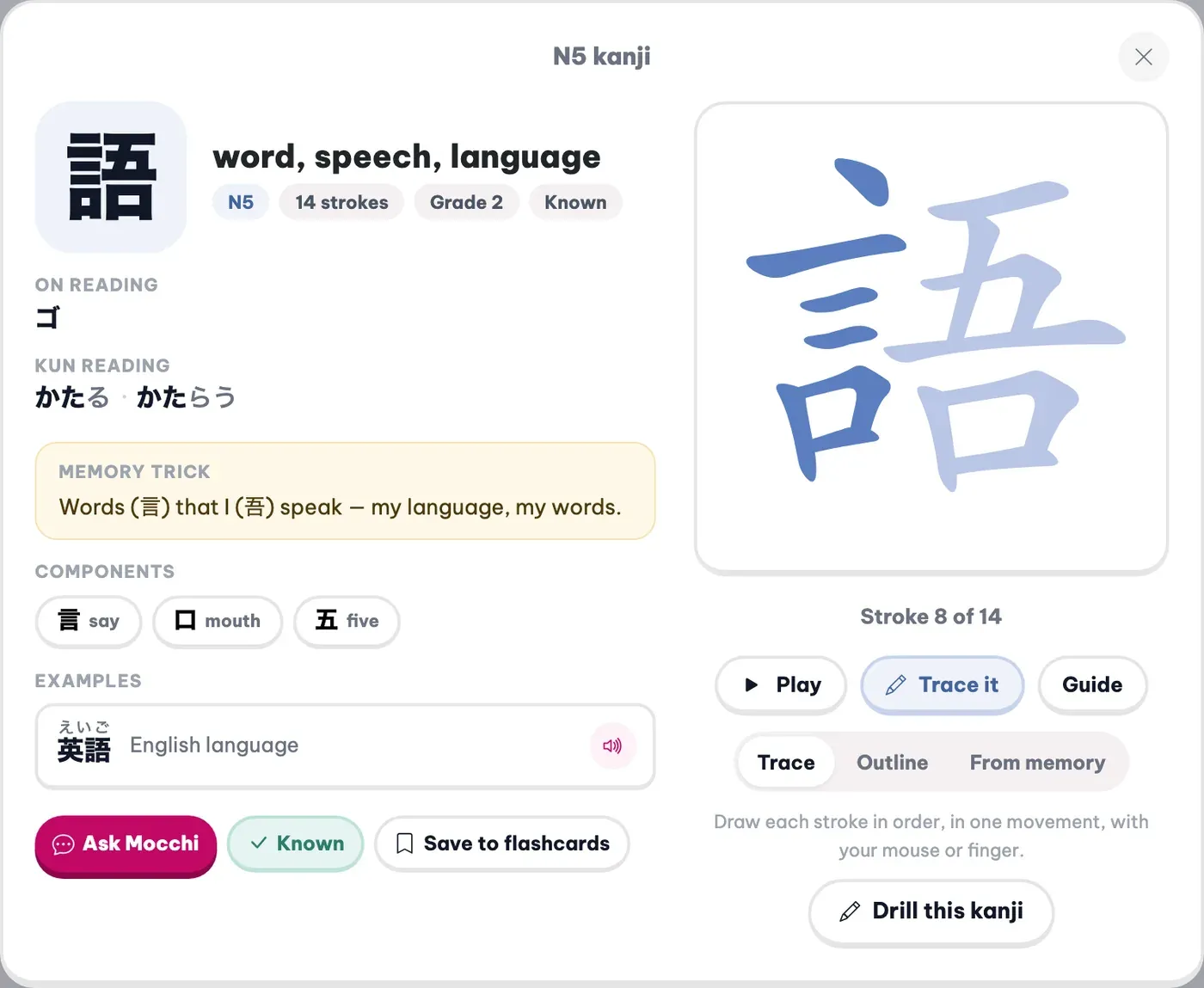
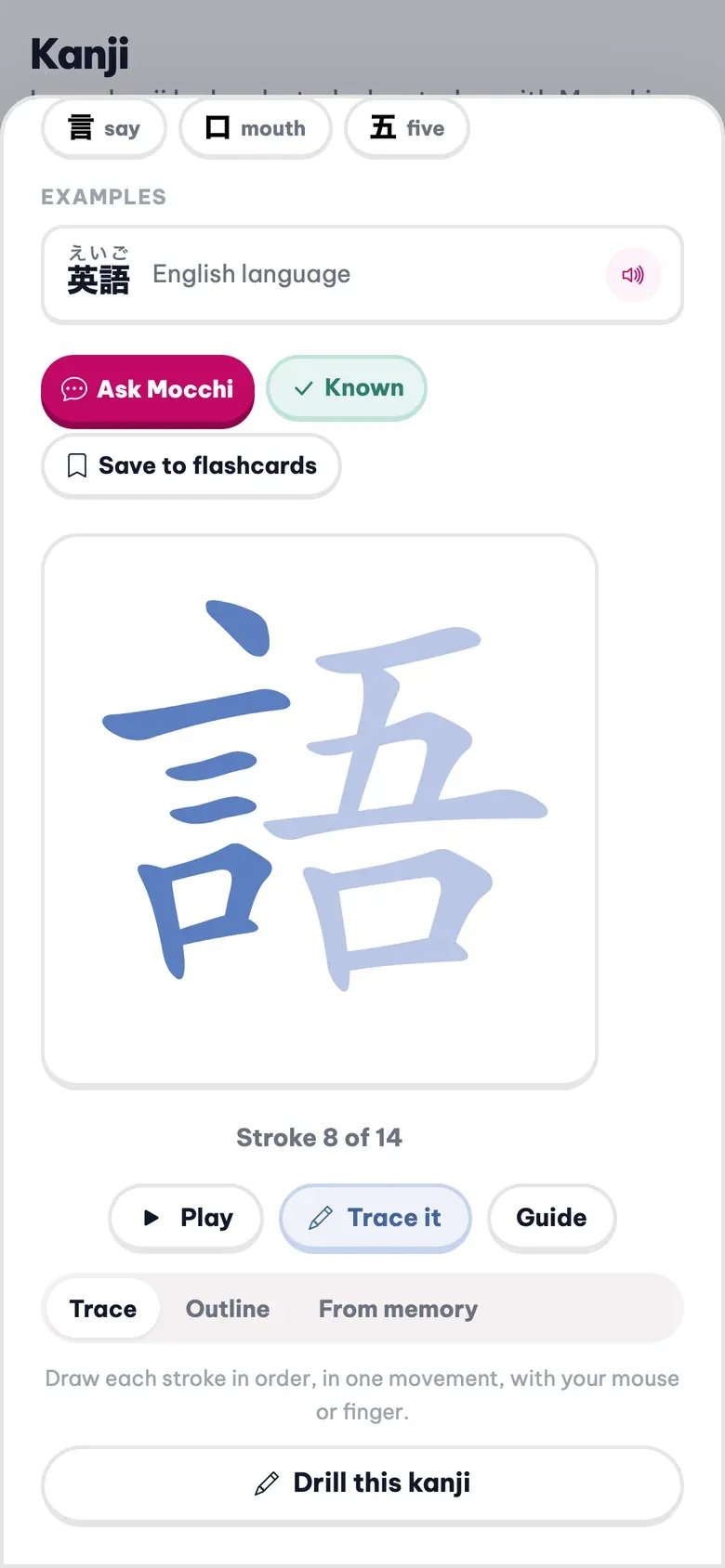
Press “Trace it” and write the kanji with your mouse, or with your finger on a phone. Each stroke is checked as you draw it, so you find out at once if the direction or order is wrong.
- Trace over the full kanji first
- Then over a faint outline
- Then from memory, on a blank square
A short writing drill whenever you have five minutes
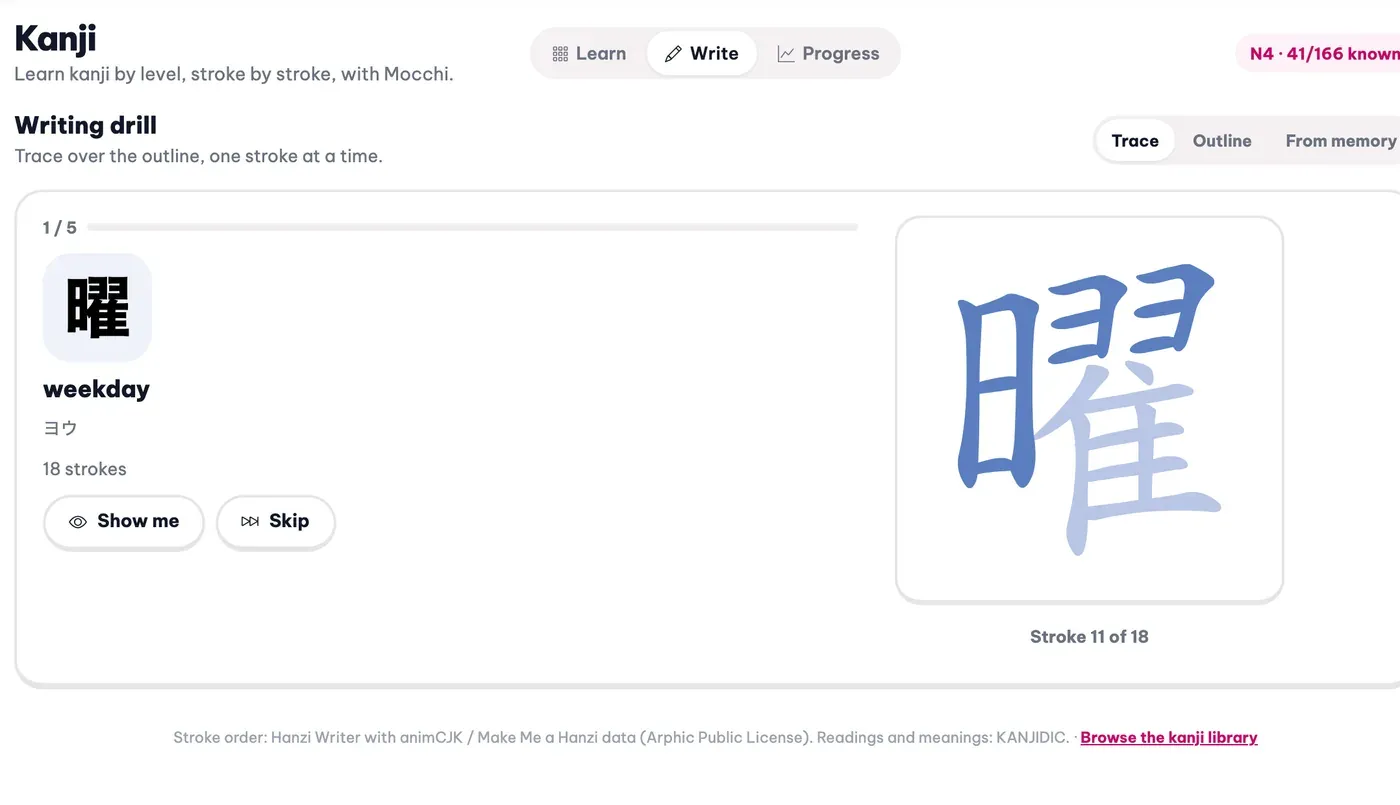
The Write tab turns a set of kanji into a writing drill: today’s five, or the kanji you are learning. Choose trace, outline or from memory, and ask for a hint when you get stuck.
- Drill today’s five kanji or your whole learning set
- “Show me” replays a kanji you can’t remember
- Your results show which kanji need another round
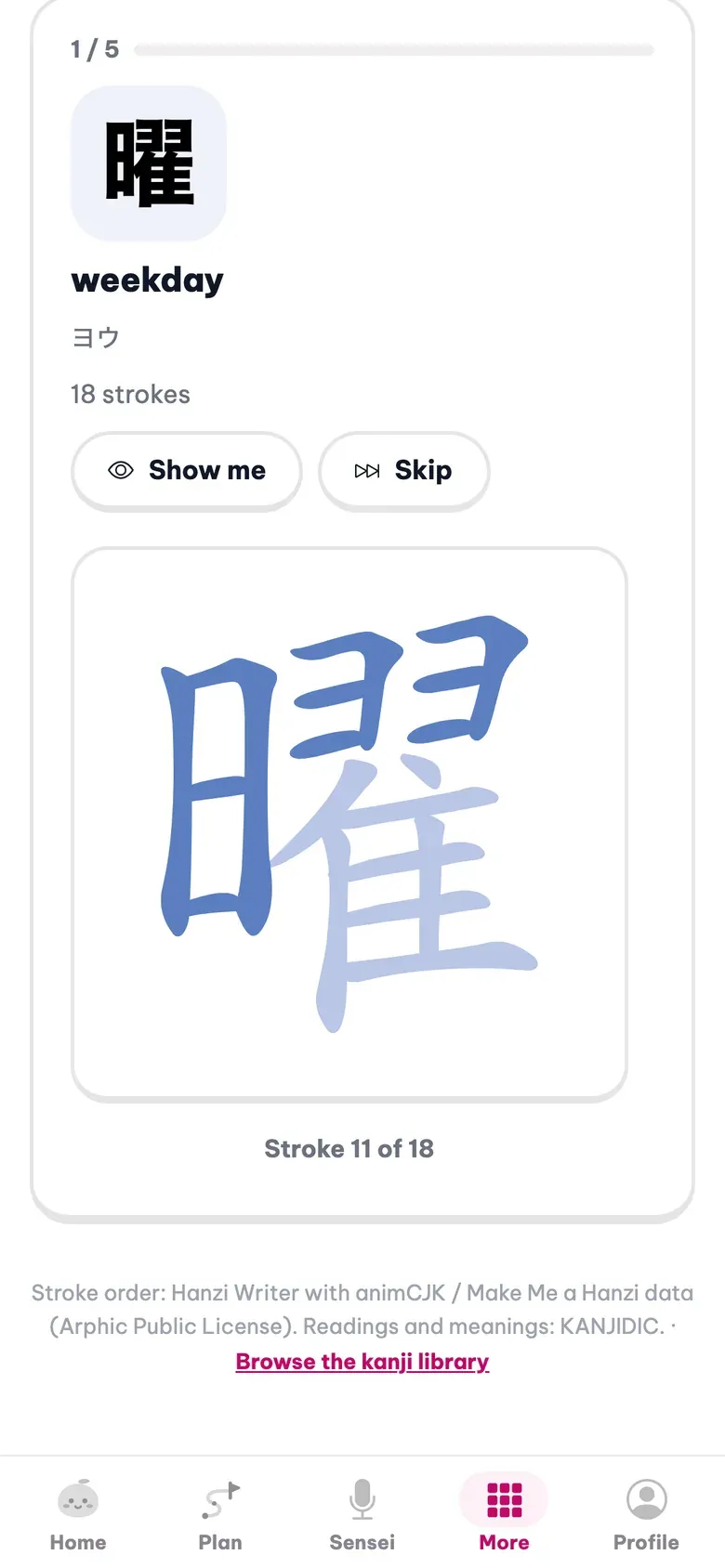
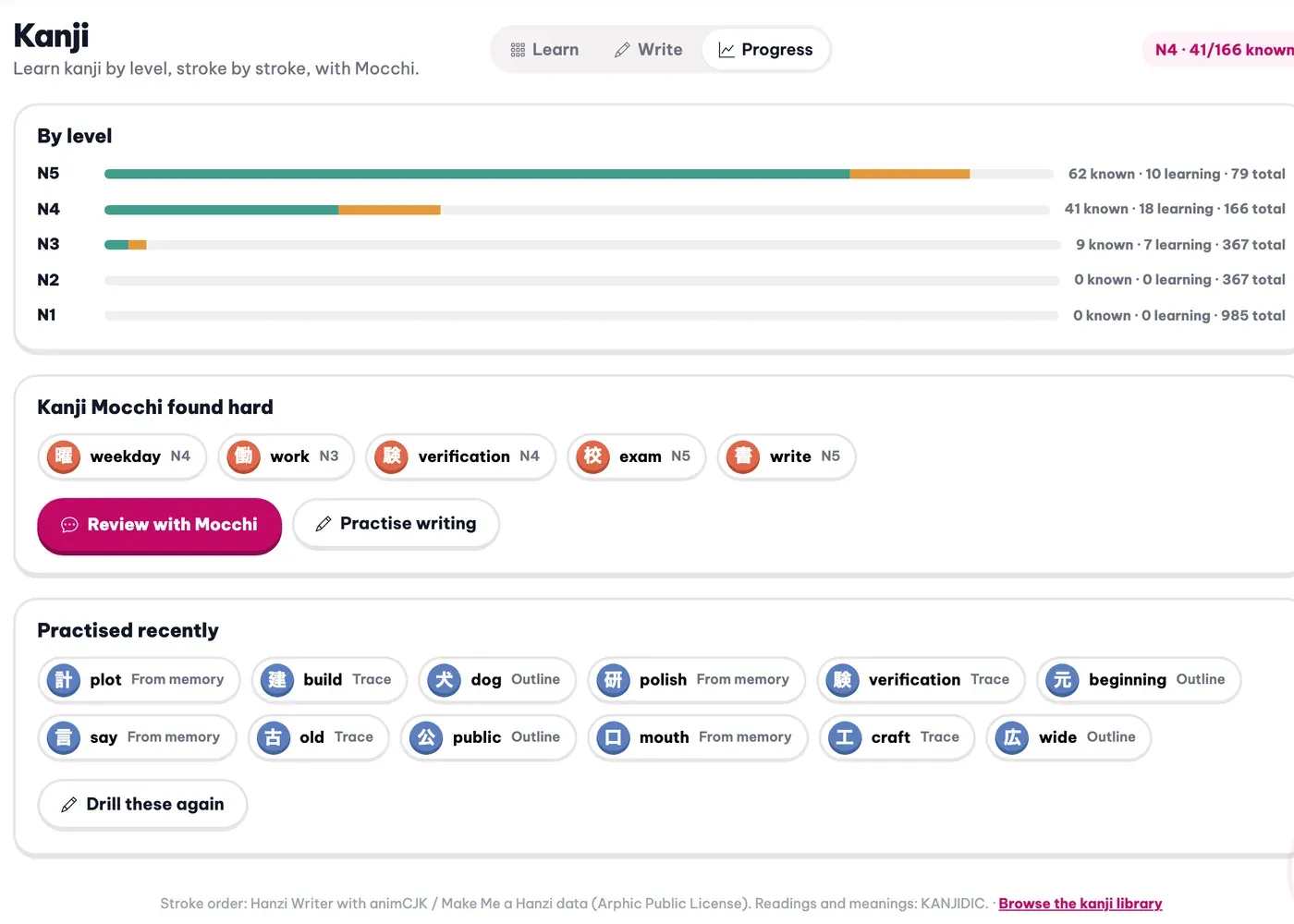
Mocchi picks today’s kanji. The Progress tab shows how far you’ve come
Every day, “Today with Mocchi” picks five kanji for you: first the ones Mocchi found hard, then the ones you are learning. Learn them with Mocchi, the AI tutor, or practise writing them straight away.
- Known and learning kanji at every JLPT level
- The kanji Mocchi found hard, ready to review
- The kanji you practised recently, ready to drill again
A story for every kanji, in your own language
Kanji are easier to remember when the parts tell a story. Every kanji comes with a memory trick built from the parts you can see, and its meanings appear in your own language, with 32 languages to choose from.
Words (言) that I (吾) speak: my language, my words.
Hán Việt readings for Vietnamese learners
Learning in Vietnamese? Each kanji also shows its Hán Việt reading, such as HỌC for 学, so you can lean on the Sino-Vietnamese words you already know.
Just looking something up?
The kanji library lists all 2,136 Jōyō kanji with readings, meanings and school grades. No account needed.
Questions about learning kanji on Unihongo
Is the Kanji page free?
Yes. Everything on the Kanji page is free with a Unihongo account: the JLPT levels, every kanji sheet, stroke order, tracing, and the Write and Progress tabs. Search is unlimited on paid plans, with a few searches a day on Free. Learning kanji with Mocchi uses Mocchi’s own allowance.
Which kanji can I learn?
All 2,136 Jōyō kanji, the official list of kanji for everyday use in Japan. They are grouped by JLPT level from N5 to N1, and the search box looks across every level at once.
How does the stroke-order practice work?
Each kanji’s stroke order plays as an animation, then stays on screen as a numbered guide. Press “Trace it” to write the kanji yourself: every stroke is checked as you draw. When tracing gets easy, move to a faint outline, then to writing from memory.
Can I practise writing on my phone?
Yes. Tracing works with your finger on a phone or tablet, and with your mouse on a computer. Your progress is saved to your account, so you can switch between devices.
Are meanings shown in my language?
Meanings are shown in your language, and the page is available in 32 languages. Vietnamese learners also see the Hán Việt reading of every kanji.
How does Mocchi help me learn kanji?
Every day, “Today with Mocchi” picks five kanji for you, starting with the ones Mocchi noticed you found hard. You can learn them with Mocchi, Unihongo’s AI tutor, or open a writing drill. Mocchi’s kanji lessons are limited to a few a day on Free.
How is this different from the kanji library?
The kanji library is a free public reference you can browse without an account. The Kanji page is where you study: it remembers which kanji you know, gives you stroke-by-stroke writing practice, and works with Mocchi.
Your first kanji is one tap away.
Pick a level, watch the strokes, and write it yourself. It’s free.