
The four words for travelling with a baby
Japanese uses an English-based word for stroller, bebīkā (ベビーカー), from baby car. The baby carrier worn on the body is a dakkohimo, literally a hugging strap. These two, plus the priority seat and the elevator, are the words you will read and hear on every journey.
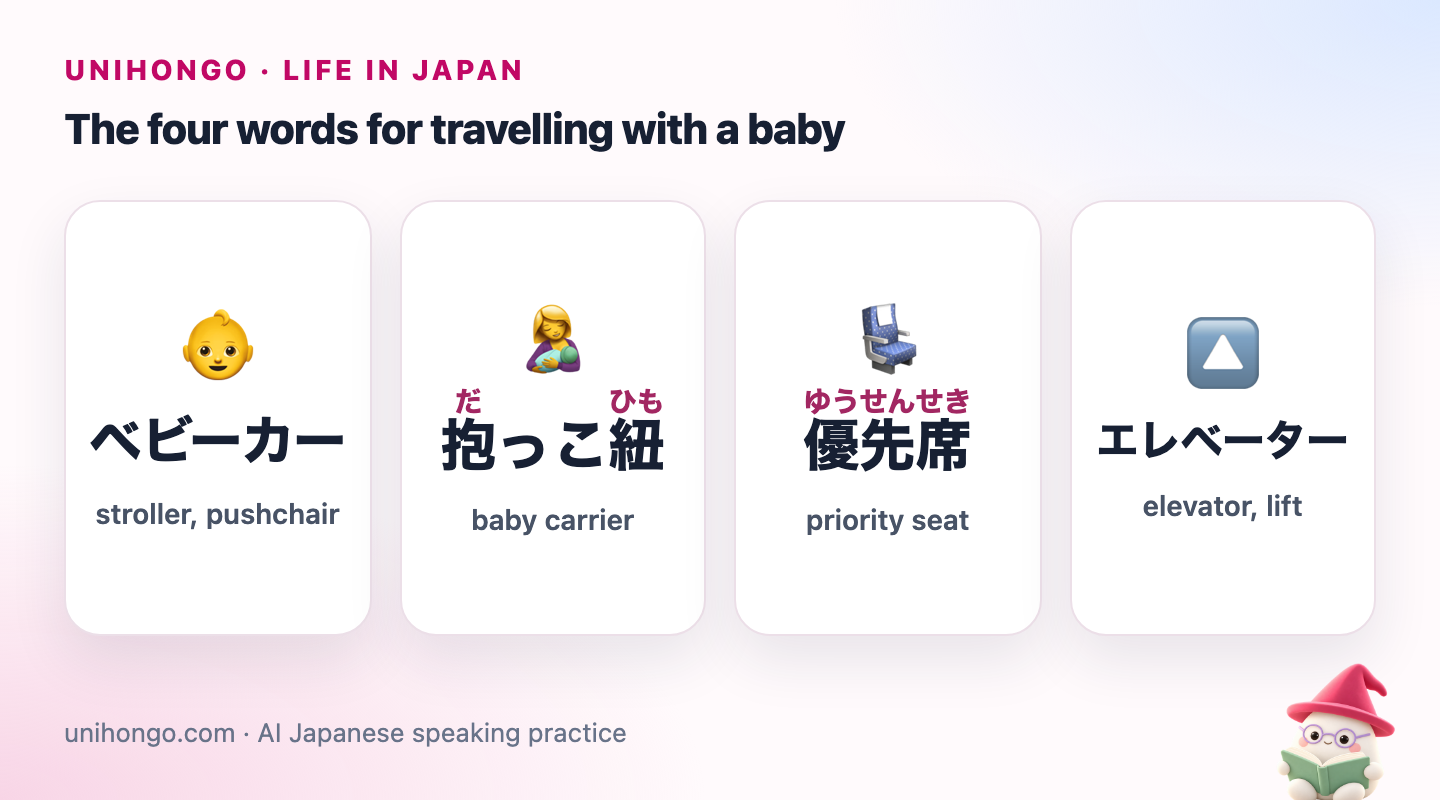
| Japanese | Romaji | Meaning |
|---|---|---|
| ベビーカー | bebīkā | stroller, pushchair |
| 抱っこ紐 | dakkohimo | baby carrier |
| 優先席 | yūsenseki | priority seat |
| エレベーター | erebētā | elevator, lift |
The rules and the signs
Since 2014, national guidance agreed with rail and bus operators says strollers may be used on trains and buses without folding. A stroller mark, a simple pictogram of a stroller, shows the areas and elevators meant for them. On trains, the space is often shared with wheelchairs and labelled as a wheelchair space or a free space, near the doors at the end of a car.
The same guidance asks stroller users to keep the brakes on, hold on to the handle, and be careful in crowded places. Nobody can make you fold a stroller, but on a packed train some parents choose to fold it or wait. On buses, drivers may ask you to secure the stroller with a belt, and some buses have limited space, so practice differs by company.
| Japanese | Romaji | Meaning |
|---|---|---|
| ベビーカーマーク | bebīkā māku | stroller symbol |
| 車いすスペース | kurumaisu supēsu | wheelchair (and stroller) space |
| フリースペース | furī supēsu | open space on a train car |
| ストッパーをかけてください。 | Sutoppā o kakete kudasai. | Please put the brake on. |
| 混雑時はご配慮をお願いします。 | Konzatsuji wa gohairyo o onegai shimasu. | Sign: Please be considerate when it's crowded. |
Getting through the station
Plan the route, not just the train. Most large stations have elevators, but they can be at one end of the platform or on the far side of the concourse, and older or smaller stations may have an elevator on only one exit. Railway websites have station maps that show elevators, accessible toilets and wide gates, which are worth checking before a new trip.
At the ticket gate, use the wide gate, often marked with a wheelchair symbol. If there are only stairs, station staff can sometimes help or suggest another route; ask at the manned gate. Escalators are not meant for strollers, and signs often say so.
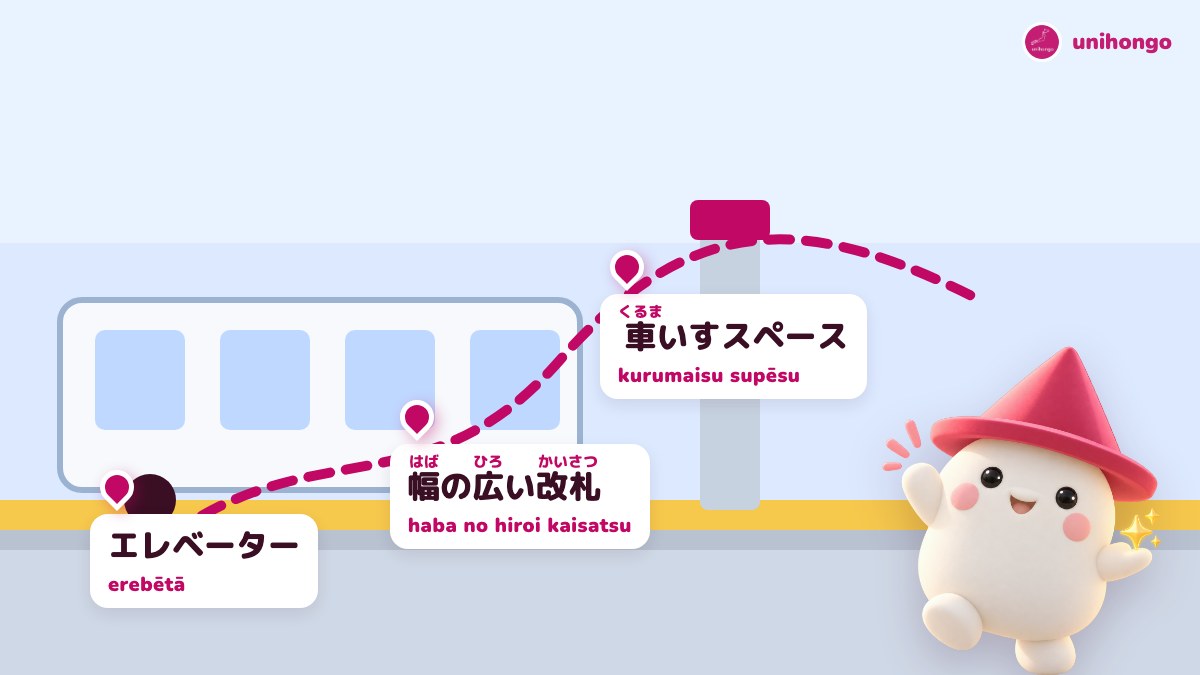
| Japanese | Romaji | Meaning |
|---|---|---|
| エレベーターはどこですか。 | Erebētā wa doko desu ka. | Where is the elevator? |
| 幅の広い改札 | haba no hiroi kaisatsu | wide ticket gate |
| ホームの端にあります。 | Hōmu no hashi ni arimasu. | Staff: It's at the end of the platform. |
| ベビーカーでエスカレーターを使わないでください。 | Bebīkā de esukarētā o tsukawanaide kudasai. | Sign: Do not use the escalator with a stroller. |
| エレベーターがない出口はありますか。 | Erebētā ga nai deguchi wa arimasu ka. | Are there exits without an elevator? |
On the train: where to stand and sit
Board through the door nearest the stroller or wheelchair space, which is often in particular cars; many platforms mark where those doors stop. Mind the gap between the train and the platform, which can be wide at curved stations, and back the stroller in if the front wheels are small.
Once inside, face the stroller sideways or against the wall, brakes on, and keep a hand on it, because trains can lurch. If you are carrying the baby, you may use a priority seat, and people often offer their seat. Accept with thanks or decline with a smile; both are fine.
| Japanese | Romaji | Meaning |
|---|---|---|
| よかったら、どうぞ。 | Yokattara, dōzo. | Passenger: Please, take this seat. |
| ありがとうございます。助かります。 | Arigatō gozaimasu. Tasukarimasu. | Thank you, that really helps. |
| 大丈夫です。すぐ降りますので。 | Daijōbu desu. Sugu orimasu node. | I'm fine, thanks. I'm getting off soon. |
| お子さん、何か月ですか。 | Okosan, nankagetsu desu ka. | Passenger: How many months old is your baby? |
| 六か月です。 | Rokkagetsu desu. | She's six months old. |
Crowded hours and getting off
Weekday mornings from about 7:30 to 9:30 and evenings around 6 p.m. are the hardest times on city lines, though the exact peak depends on the line. If you can, travel outside these hours. If you must ride a crowded train, a baby carrier with a folded stroller, or no stroller at all, is often easier for everyone, including you.
When your stop comes and people are standing in front of the door, say you are getting off clearly and start moving. People will make space. A short apology for bumping someone is natural.
Buses and taxis are the other options for short trips. On city buses, board with the stroller through the door the driver indicates, and follow any instruction to fold it or secure it with the belt; when a bus is full, waiting for the next one is common. Taxis are useful on rainy days or with a sleeping baby. Rules on child seats in taxis differ from private cars, and some taxi companies can arrange a child seat if you book ahead, so ask when you call.
| Japanese | Romaji | Meaning |
|---|---|---|
| すみません、降ります。 | Sumimasen, orimasu. | Excuse me, I'm getting off. |
| 通してください。 | Tōshite kudasai. | Please let me through. |
| ご迷惑をおかけしました。 | Gomeiwaku o okake shimashita. | Sorry for the trouble. |
| 次の電車にします。 | Tsugi no densha ni shimasu. | I'll take the next train. |
Mini dialogue: asking for help at the gate
Station staff at the manned gate are used to helping with strollers, luggage and wheelchairs. Polite but simple Japanese is enough.
| Japanese | Romaji | Meaning |
|---|---|---|
| すみません、ベビーカーで三番線に行きたいんですが。 | Sumimasen, bebīkā de sanbansen ni ikitai n desu ga. | You: Excuse me, I'd like to get to platform 3 with a stroller. |
| エレベーターは右奥にございます。 | Erebētā wa migi oku ni gozaimasu. | Staff: The elevator is at the back on the right. |
| 乗り換えの駅にもエレベーターはありますか。 | Norikae no eki ni mo erebētā wa arimasu ka. | You: Is there an elevator at the transfer station too? |
| はい、ございます。お気をつけて。 | Hai, gozaimasu. Oki o tsukete. | Staff: Yes, there is. Take care. |
| ありがとうございました。 | Arigatō gozaimashita. | You: Thank you very much. |
Mistakes and surprises
- Taking a stroller on an escalator. Many stations prohibit it, and it is dangerous if the stroller tips.
- Parking in the middle of the doorway. Stand to the side or in the marked space so people can get on and off.
- Assuming every exit has an elevator. Check the map; the exit you know may only have stairs.
- Forgetting the brakes. Trains brake suddenly, and a rolling stroller is a real hazard.
- Feeling you must apologise all the time. A short sumimasen when you need space is enough; travelling with a baby is normal.
Learn the station signs before your next trip
Station signs are short, and they repeat. Give Mocchi the words from this guide with /create-flashcards, pick a photo for each, and run /review-flashcards for a few days; after that, the elevator and stroller-space signs jump out at you on the platform. If you want, ask Mocchi to quiz you on the polite replies too, so that accepting a seat comes out without thinking.
Platform announcements are the other half. Listen & Pick, one of the quick games, trains you to recognise words by ear, which helps when an announcement tells you which side the doors will open.