
The subsidy in four words
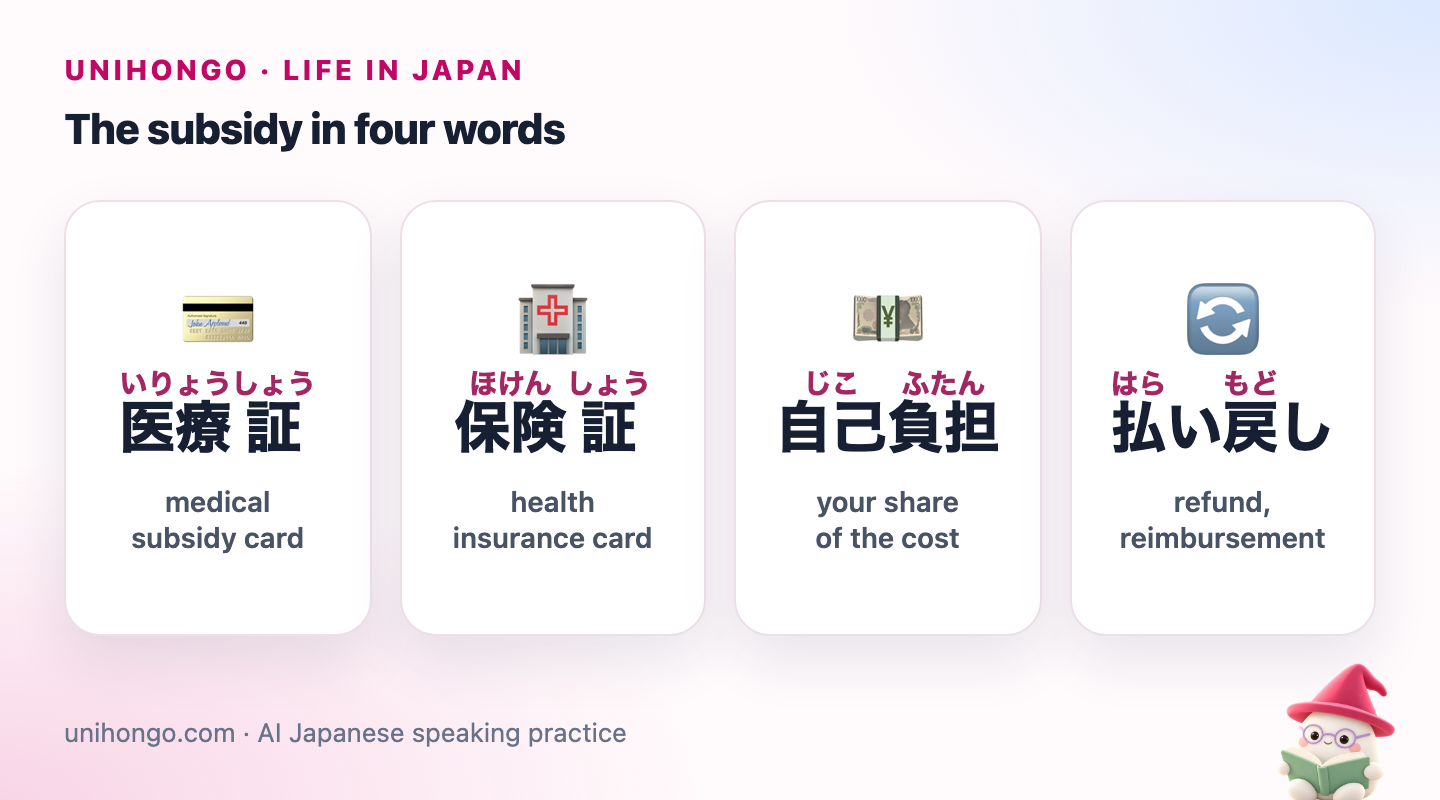
Four words cover almost every conversation about the child medical subsidy, at the city office and at the clinic counter. The first is the card itself; the others are what it works with and what it changes.
| Japanese | Romaji | Meaning |
|---|---|---|
| 医療証 | iryōshō | medical subsidy card |
| 保険証 | hokenshō | health insurance card |
| 自己負担 | jiko futan | your share of the cost |
| 払い戻し | haraimodoshi | refund, reimbursement |
How the subsidy fits with health insurance
Everyone living in Japan for the longer term joins public health insurance, either through a job or through the city. Insurance pays most of the cost of treatment, and the patient pays a share at the counter: for children before elementary school this is usually 20 percent, and from elementary school 30 percent. The child medical subsidy is a second layer on top: the local government pays all or part of that remaining share.
So the subsidy only works if the child is insured first. A newborn needs to be added to a parent's insurance, or enrolled in the city's national health insurance, before you apply. Since late 2024, new paper insurance cards are no longer issued and the My Number card is used as the insurance card, with a separate document, a shikaku kakuninsho, for those who need one; many cities still issue a paper iryōshō alongside, and some now let the subsidy be read from the My Number card as well.
| Japanese | Romaji | Meaning |
|---|---|---|
| 子ども医療費助成 | kodomo iryōhi josei | child medical subsidy |
| 乳幼児医療証 | nyūyōji iryōshō | subsidy card for babies and preschoolers |
| 資格確認書 | shikaku kakuninsho | health insurance eligibility document |
| Point | What you may find | Where to check |
|---|---|---|
| Age limit | Often to the end of junior high or to the March after age 18 | City website, children's section |
| Charge per visit | Nothing in many cities; a small set amount in others | The card or the city's guide |
| Income limit | None in many cities; some still have one | Application guide |
| Card name | Iryōshō, or a local nickname | The card itself |
| Outside the prefecture | Often pay first, then claim a refund | The city's refund page |
Applying at the city office
Apply at the children's or family section of your city office, often at the same time as the birth registration or moving-in notice, or soon after, once the child's insurance is sorted. Many cities let you apply online or by post too. The timing matters: in many cities, the subsidy starts from the date of application, or from the birth or moving-in date only if you apply within a set period.
| Japanese | Romaji | Meaning |
|---|---|---|
| 子ども医療費助成の申請をしたいです。 | Kodomo iryōhi josei no shinsei o shitai desu. | I'd like to apply for the child medical subsidy. |
| 何が必要ですか。 | Nani ga hitsuyō desu ka. | What do I need to bring? |
| 子どもの保険はまだ手続き中です。 | Kodomo no hoken wa mada tetsuzuki-chū desu. | My child's insurance is still being processed. |
| 医療証はいつ届きますか。 | Iryōshō wa itsu todokimasu ka. | When will the card arrive? |
- Your child's health insurance information: the insurance card, eligibility document or the details shown on the parent's My Number insurance.
- The parent's ID, and often the parent's My Number for the income check where one applies.
- Sometimes an income certificate from your previous city if you moved in during the year.
- A bank account in the parent's name, for refunds.
- The city's application form, filled in at the window if needed.
Using the card at the clinic and pharmacy
At reception, hand over or scan the child's insurance and show the iryōshō, every time, or at least at the first visit each month if the clinic says so. The pharmacy needs it too, because medicine is part of the cost. If your city uses the My Number card for the subsidy, the reception staff will tell you whether they can read it there.
Many parents find that the bill becomes zero or a small fixed amount. Keep the receipt anyway: it is the proof you need if you ever claim a refund or a tax deduction for medical costs.
| Japanese | Romaji | Meaning |
|---|---|---|
| 保険証と医療証です。 | Hokenshō to iryōshō desu. | Here's the insurance card and the subsidy card. |
| こちらで医療証は使えますか。 | Kochira de iryōshō wa tsukaemasu ka. | Can I use the subsidy card here? |
| 今月初めての受診です。 | Kongetsu hajimete no jushin desu. | This is our first visit this month. |
| 領収書をください。 | Ryōshūsho o kudasai. | May I have a receipt? |
When you still pay, and how refunds work
The subsidy covers medical care that health insurance covers. Things outside insurance are usually not included: voluntary vaccinations, medical certificates and other documents, the extra charge for a private hospital room, and the special fee at large hospitals when you come without a referral letter. Meals during a hospital stay are handled differently from city to city.
You also pay first when the card cannot be used: at a clinic outside your prefecture, on a day you forgot the card, or before the card arrived. In these cases pay the normal insurance share, keep the receipt, and apply to the city for a refund. Cities set a time limit and list the documents, usually the receipt, the card and bank details.
| Japanese | Romaji | Meaning |
|---|---|---|
| 医療証を忘れました。 | Iryōshō o wasuremashita. | I forgot the subsidy card. |
| 県外で受診しました。 | Kengai de jushin shimashita. | We saw a doctor outside the prefecture. |
| 払い戻しの申請をしたいです。 | Haraimodoshi no shinsei o shitai desu. | I'd like to apply for a refund. |
| 申請の期限はありますか。 | Shinsei no kigen wa arimasu ka. | Is there a deadline for applying? |
When something changes
The card is tied to your address, the child's insurance and sometimes your income, so tell the city when any of these change. Moving to another city means returning the card and applying again in the new city, where the rules may be different. A change of job usually changes the insurance, so the city needs the new details. Some cities renew cards each year, others when the child reaches a new age band; check the expiry date printed on the card.
| Japanese | Romaji | Meaning |
|---|---|---|
| 保険が変わりました。 | Hoken ga kawarimashita. | Our insurance has changed. |
| 引っ越すので、医療証を返したいです。 | Hikkosu node, iryōshō o kaeshitai desu. | We're moving, so I'd like to return the card. |
| 有効期限 | yūkō kigen | expiry date |
| 更新の手続き | kōshin no tetsuzuki | renewal procedure |
Mini dialogue: at the children's section window
| Japanese | Romaji | Meaning |
|---|---|---|
| 先月子どもが生まれたので、医療証の申請に来ました。 | Sengetsu kodomo ga umareta node, iryōshō no shinsei ni kimashita. | You: My child was born last month, so I've come to apply for the subsidy card. |
| おめでとうございます。お子さんの保険の情報はお持ちですか。 | Omedetō gozaimasu. Okosan no hoken no jōhō wa omochi desu ka. | Clerk: Congratulations. Do you have your child's insurance details? |
| はい、会社の保険に入りました。 | Hai, kaisha no hoken ni hairimashita. | You: Yes, she's on my company insurance. |
| では、こちらの申請書にご記入ください。 | Dewa, kochira no shinseisho ni gokinyū kudasai. | Clerk: Then please fill in this application form. |
| 医療証は郵送ですか。 | Iryōshō wa yūsō desu ka. | You: Will the card be posted to me? |
| はい、一、二週間でお届けします。 | Hai, ichi, nishūkan de otodoke shimasu. | Clerk: Yes, it will arrive in a week or two. |
Mistakes that cost parents money
- Applying late. In many cities, the subsidy only covers visits from the application date, so apply soon after the birth or move.
- Not keeping receipts. Without them, you cannot claim a refund for a visit when you paid in full.
- Assuming the rules from your last city. A move can change the age limit, the charge and the card.
- Forgetting the pharmacy. The card works there too; show it with the prescription.
- Ignoring the expiry date. An expired card means paying at the counter until the new one arrives.
Rehearse the city office visit
Window Japanese is fast and full of set phrases, so it pays to hear it before the real visit. In AI Sensei, pick Yamada-sensei and ask for the role of a clerk in the children's section of a city office: apply for the subsidy for a newborn, say your insurance is still being processed, and ask when the card arrives. Ask the Sensei to use the polite office style, then read the session report for the words you missed.
Before you go, paste the city's application form headings into Mocchi with /explain, so that terms like shinseisha and hihokensha are clear when you are standing at the counter.