
Punctuality in four words
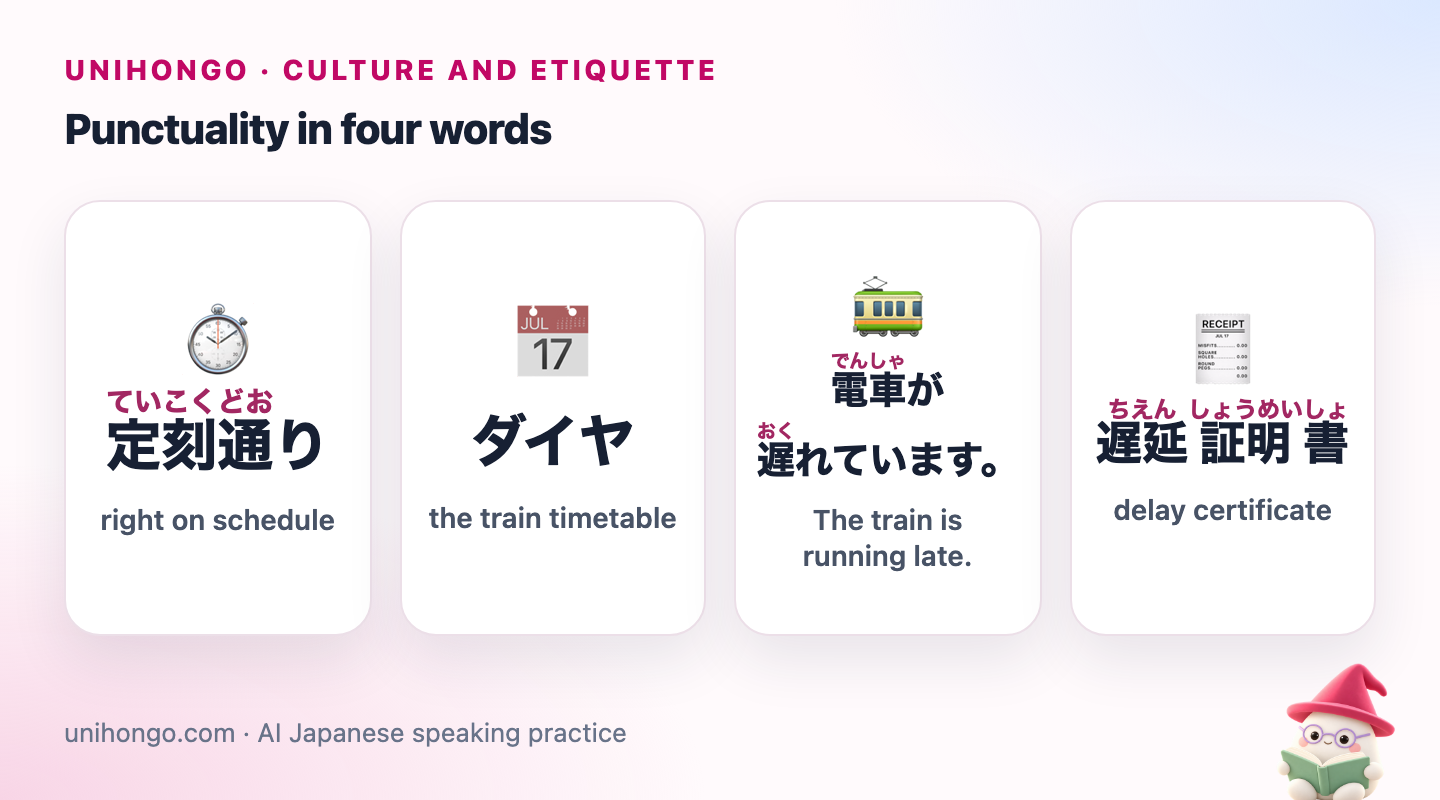
Railway staff and passengers share a small vocabulary for time. The timetable is the daiya, the scheduled time is teikoku, and a train that runs exactly as planned is teikoku dōri. When things go wrong, the word is chien, delay. You will hear all four in announcements and in the news.
| Japanese | Romaji | Meaning |
|---|---|---|
| 定刻通り | teikoku dōri | right on schedule |
| ダイヤ | daiya | the train timetable |
| 電車が遅れています。 | Densha ga okurete imasu. | The train is running late. |
| 遅延証明書 | chien shōmeisho | delay certificate |
Daiya comes from the English word diagram, because railway timetables are planned on a chart that shows every train as a line across time and distance. Railway fans use the word, and so do ordinary commuters when they say the timetable is in chaos: daiya ga midarete iru.
Why they run on time: the usual explanations
Railway experts tend to point to a mix of design, practice and people rather than one secret. These are the reasons most often given, and each one explains part of the picture.
- Dedicated tracks. The shinkansen runs on its own lines with no level crossings, and many commuter lines carry mainly their own trains, so there are fewer conflicts to sort out.
- Timetables planned in detail. Stops are planned to the second, including how long the doors stay open, and there is a small margin built in so that a train can recover a few seconds.
- Maintenance at night. Track and equipment work is mostly done after the last train, so it does not disturb the timetable.
- Staff routines. Drivers and conductors point at signals and say what they see aloud, a method called shisa kanko, pointing and calling, which is widely credited with reducing mistakes.
- Fast boarding. Marks on the platform show exactly where the doors will stop, passengers queue there, let people off first and board quickly.
- A service culture. A delay is treated as an inconvenience to customers, so it is announced, explained and apologised for, and staff work hard to avoid it.
There is a famous example of how seriously this is taken: in 2017, a railway company near Tokyo made international news after apologising because a train had left about twenty seconds early. Most Japanese passengers found the story a little funny too, but it shows the standard that railway staff set themselves.
When trains are late: what the announcements say
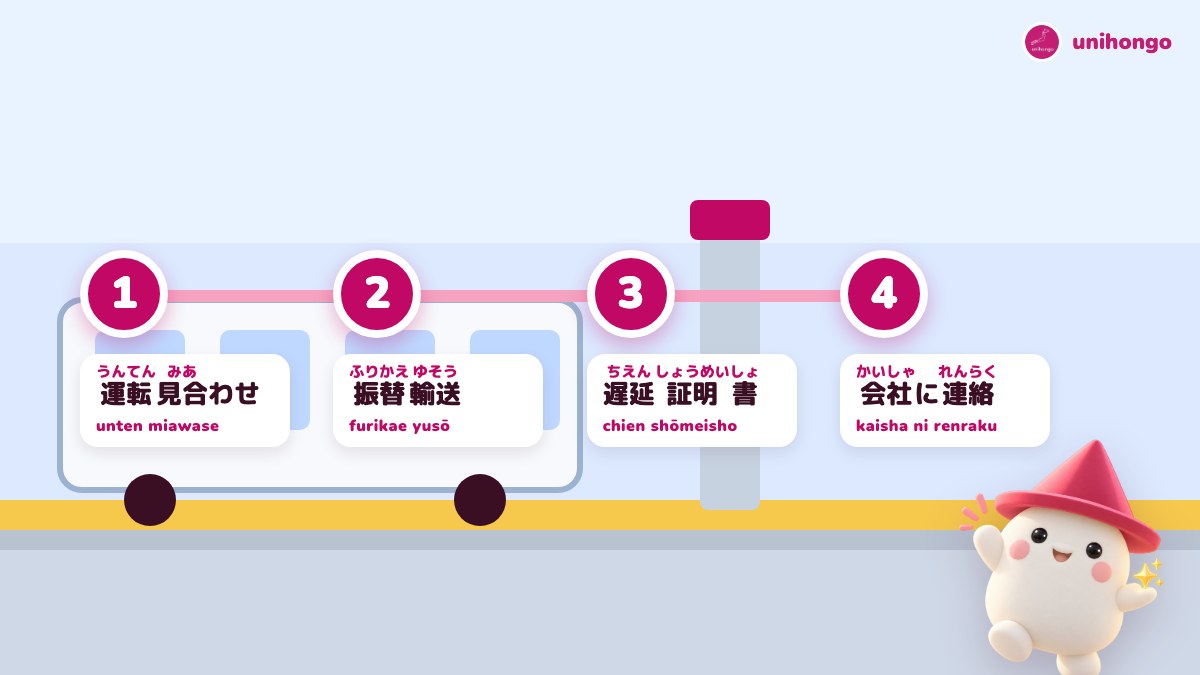
Delays do happen, and the announcements follow a pattern: the reason, the section affected, the current situation and an apology. You do not need to catch every word. Listen for the reason, for the word miawase, suspended, and for furikae yusō, which means your ticket can be used on another line to get around the problem.
| Japanese | Romaji | Meaning |
|---|---|---|
| 人身事故の影響で | jinshin jiko no eikyō de | due to an accident involving a person |
| 運転を見合わせています。 | Unten o miawasete imasu. | Service is suspended for now. |
| 振替輸送を行っています。 | Furikae yusō o okonatte imasu. | Other lines are accepting your ticket. |
| お急ぎのところ申し訳ございません。 | Oisogi no tokoro mōshiwake gozaimasen. | Announcer: We apologise for the delay. |
| 運転を再開しました。 | Unten o saikai shimashita. | Service has resumed. |
| 車両点検のため | sharyō tenken no tame | because of a train inspection |
Asking station staff what to do
If service is suspended, the staff at the ticket gate are your best source of information. Ask simply and politely, and show your ticket or IC card if you are not sure it is valid on another line. Station staff are often very busy during a big delay, so have your question ready.
| Japanese | Romaji | Meaning |
|---|---|---|
| すみません、いつごろ動きますか。 | Sumimasen, itsu goro ugokimasu ka. | Excuse me, when will it start running? |
| 何分ぐらい遅れますか。 | Nanpun gurai okuremasu ka. | About how many minutes late will it be? |
| 渋谷へはどう行けばいいですか。 | Shibuya e wa dō ikeba ii desu ka. | How should I get to Shibuya? |
| 振替輸送は使えますか。 | Furikae yusō wa tsukaemasu ka. | Can I use the alternative transport? |
| 遅延証明書をください。 | Chien shōmeisho o kudasai. | Could I have a delay certificate? |
The delay checklist: from platform to office
Most commuters handle a delay in the same order: understand what has happened, decide on another route if needed, get proof of the delay and tell their workplace or school. Doing the last step early matters more than the exact wording. Many managers mind a late call more than a late arrival.
| Japanese | Romaji | Meaning |
|---|---|---|
| 電車が遅れていて、十分ほど遅れます。 | Densha ga okurete ite, juppun hodo okuremasu. | The train's late; I'll be about ten minutes late. |
| 申し訳ありません。 | Mōshiwake arimasen. | I'm very sorry. (polite, to a manager) |
| 着いたらすぐに連絡します。 | Tsuitara sugu ni renraku shimasu. | I'll let you know as soon as I arrive. |
| 遅延証明書をもらっておきます。 | Chien shōmeisho o moratte okimasu. | I'll get a delay certificate. |
| 了解。気をつけて来てね。 | Ryōkai. Ki o tsukete kite ne. | Manager: Got it. Get here safely. (casual) |
With friends, the same message is much shorter: densha okurete, chotto okureru. Gomen! means the train's late, I'll be a bit late, sorry. Juppun and jippun are both used for ten minutes; juppun is the more common pronunciation today.
Small habits that keep trains on time
You help keep the timetable when you board quickly. That does not mean rushing or pushing; it means being ready. Queue at the marks, step aside to let people off, move into the carriage instead of stopping at the door, and do not run for a train whose doors are closing. Station staff often call out kakekomi jōsha wa kiken desu, running onto trains is dangerous, because a door that is forced open delays everyone.
| Japanese | Romaji | Meaning |
|---|---|---|
| 駆け込み乗車はおやめください。 | Kakekomi jōsha wa oyame kudasai. | Announcer: Please don't rush onto the train. |
| 奥へお詰めください。 | Oku e otsume kudasai. | Announcer: Please move further inside. |
| すみません、降ります。 | Sumimasen, orimasu. | Excuse me, I'm getting off. |
Common learner mistakes
- Saying okuremashita, I was late, when you are still on the train. Use okuremasu or okuresō desu, I'll be late or I'm likely to be late.
- Calling a manager with a casual gomen. At work, mōshiwake arimasen or sumimasen is the expected register.
- Giving no time estimate. Say roughly how late you will be, even with hodo or gurai, about.
- Assuming every railway gives paper slips at every station. Many large companies now publish delay certificates online, so check the company's website if the gate staff direct you there.
- Waiting on the platform without asking. If service is suspended, the gate staff can tell you about other lines and furikae yusō.
Rehearse the late-train call before you need it
A real delay is stressful, which is exactly why it is worth rehearsing in advance. Paste one of the announcement lines from this post into Mocchi with /explain, and Mocchi will break it down word by word, show which parts carry the key information and keep a note of the delay words you still mix up.
Then open the roleplay mission Call Work About a Train Delay and ask Ibuki-sensei to play your manager. Explain the delay, give your arrival time and apologise in polite Japanese; the session report afterwards lists your corrections and the useful phrases you could add next time.