
Mama-tomo in four words
Most parent friendships in Japan run through the same few steps and the same few words. Here is the vocabulary that you will hear from the first day at the kindergarten gate to the end-of-year party.
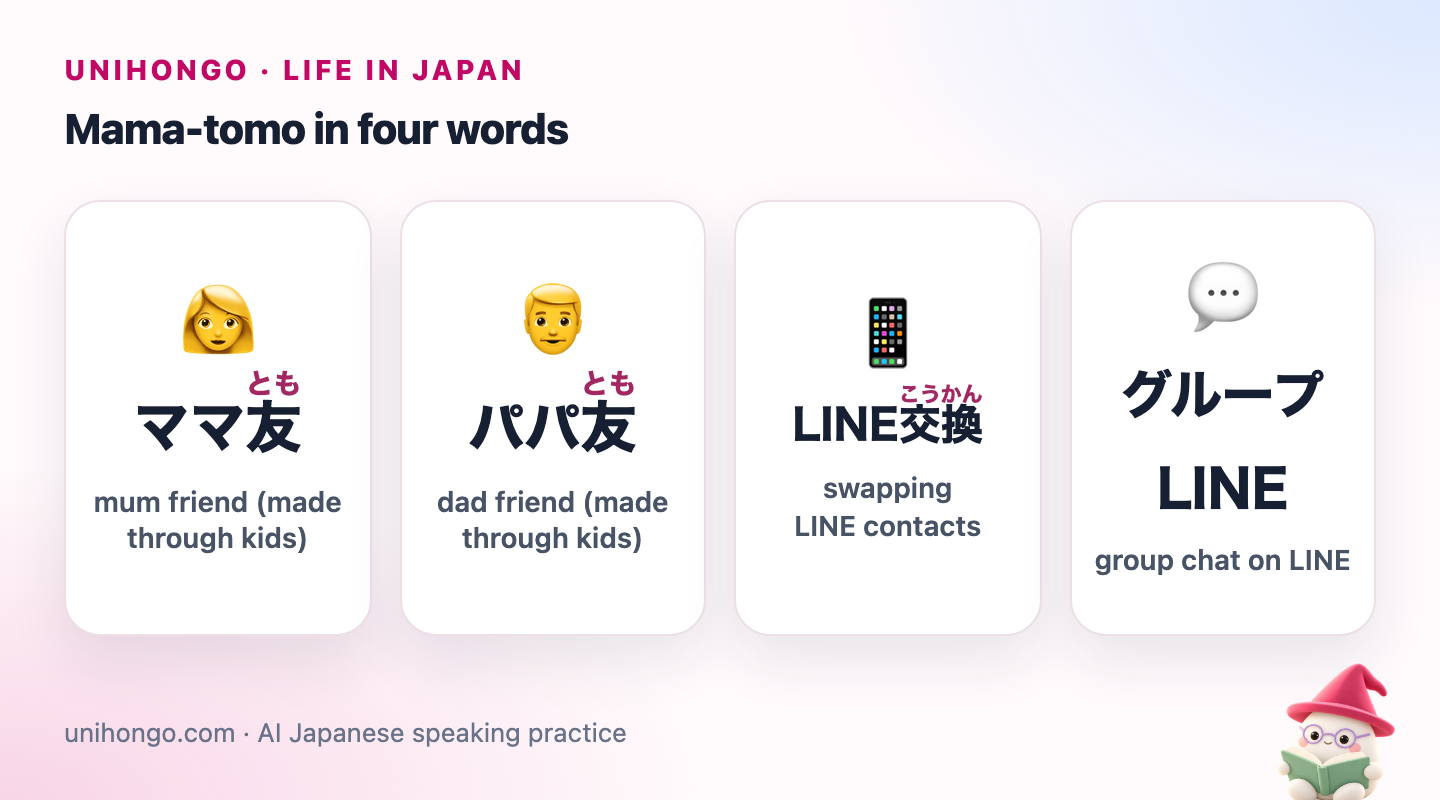
| Japanese | Romaji | Meaning |
|---|---|---|
| ママ友 | mama tomo | mum friend (made through kids) |
| パパ友 | papa tomo | dad friend (made through kids) |
| LINE交換 | rain kōkan | swapping LINE contacts |
| グループ LINE | gurūpu rain | group chat on LINE |
Where parent friendships start
The places are predictable: the daycare entrance in the morning, the kindergarten bus stop, the school gate, the local park, the city's children's centre, called jidōkan (児童館) or kosodate shien sentā, and later sports clubs and lessons. Seeing the same faces every day is how it starts, long before anyone suggests a coffee.
Friendships tend to grow in stages. Rushing a stage, such as inviting someone home the first week, can feel a bit much to some people, while waiting too long is rarely a problem.
| Japanese | Romaji | Meaning |
|---|---|---|
| ゆいちゃんのママですよね。 | Yui-chan no mama desu yo ne. | You're Yui's mum, aren't you? |
| いつもお世話になっています。 | Itsumo osewa ni natte imasu. | Thanks for always being so kind to us. (set phrase) |
| タメ口でいい? | Tameguchi de ii? | Is it OK if we talk casually? |
| Stage | What usually happens | Speech style |
|---|---|---|
| Faces you know | A greeting and a comment about the weather or the children | Polite |
| Small talk | Ages, which class, where you live nearby | Polite, a little relaxed |
| Contact swap | Swapping LINE to share information or arrange play | Polite, friendly |
| Play dates | Meeting at a park, then sometimes at home or for lunch | Mixed, becoming casual |
| Friends | Helping each other out, talking about more than the children | Casual, if both are comfortable |
In many groups, parents keep speaking politely to each other for a long time, even when they are friendly. That is not coldness. Switch to casual speech when the other person does, or ask, as some people do: tameguchi de ii? Is it fine to talk casually?
Suggesting a contact swap
LINE is the usual way parents keep in touch in Japan. The natural moment to suggest a swap is when there is a practical reason: arranging to meet at the park, sending photos from an event, or sharing information about school. A practical reason makes the request feel light.
In person, people swap by showing a QR code in the app. If you are not ready to swap, it is fine to say you rarely use LINE, but most parents will expect it sooner or later.
| Japanese | Romaji | Meaning |
|---|---|---|
| よかったら、LINE交換しませんか。 | Yokattara, rain kōkan shimasen ka. | If you like, shall we swap LINE? |
| ぜひぜひ!QRコード出しますね。 | Zehi zehi! Kyūāru kōdo dashimasu ne. | Parent: Sure! I'll bring up my QR code. |
| 写真、送りますね。 | Shashin, okurimasu ne. | I'll send you the photos. |
| また公園で遊ばせましょう。 | Mata kōen de asobasemashō. | Let's let the kids play at the park again. |
Class LINE groups: the unwritten rules
Many classes, teams and kindergartens have a parents' group chat, usually started by a class representative. It is used for reminders, lost items, changes to events and thank-yous. Some groups are lively, others are almost silent apart from notices.
Patterns differ, but these habits keep most groups comfortable: reply only when the message is for you or asks for an answer, keep replies short and polite, use a sticker if others do, and send personal conversations as a private message instead of to the whole group. Read status, kidoku (既読), shows when you have opened a message; leaving it without reply, kidoku surū, is fine in a big group but can feel cold in a one-to-one chat.
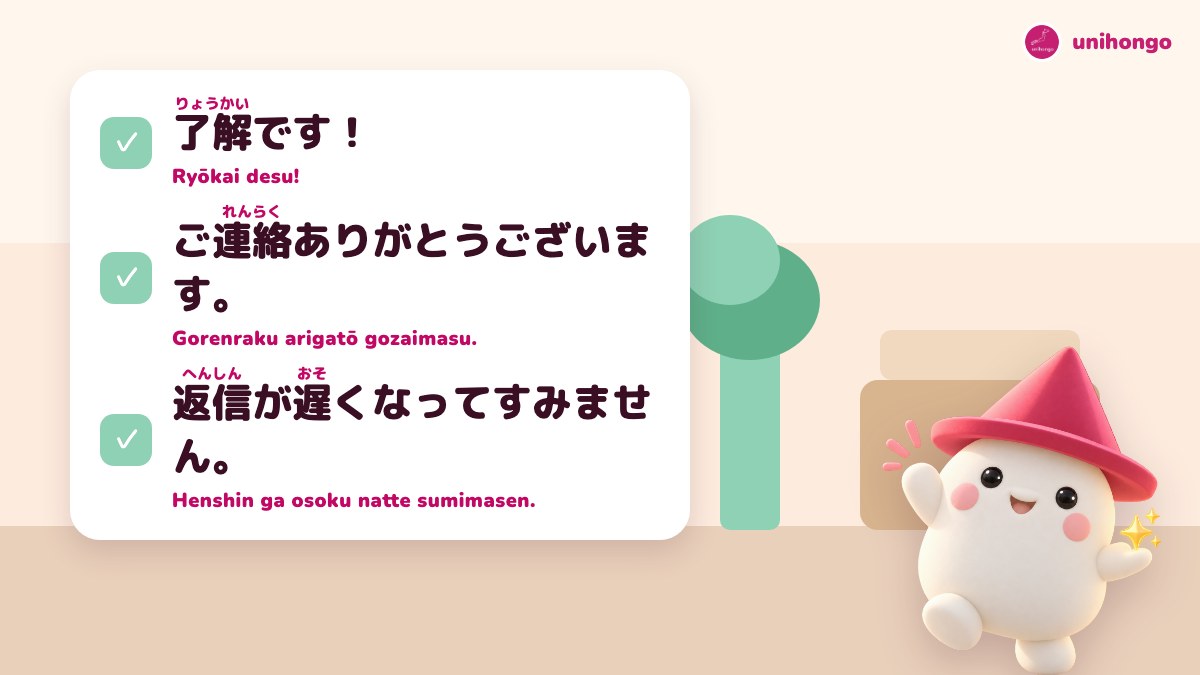
| Japanese | Romaji | Meaning |
|---|---|---|
| 了解です! | Ryōkai desu! | Got it! (friendly, polite) |
| ご連絡ありがとうございます。 | Gorenraku arigatō gozaimasu. | Thank you for letting us know. |
| 返信が遅くなってすみません。 | Henshin ga osoku natte sumimasen. | Sorry for the late reply. |
| うちの子の帽子、どなたか見ませんでしたか。 | Uchi no ko no bōshi, donata ka mimasen deshita ka. | Has anyone seen my child's hat? |
Invitations, visits and small thank-yous
After a few meetings at the park, someone may suggest lunch, a coffee after drop-off, or a play date at home. When you visit a home, people often bring a small snack to share, and say ojama shimasu as they come in. If someone takes your child home for an afternoon or gives you something, a small gift or treat in return, an okaeshi (お返し), is common, but keep it small so it does not create pressure.
Invitations are often vague at first, such as kondo ocha demo, let's have tea sometime. A vague invitation is friendly, not a plan. If you want to make it real, suggest a day.
| Japanese | Romaji | Meaning |
|---|---|---|
| 今度、お茶でもどうですか。 | Kondo, ocha demo dō desu ka. | How about a coffee sometime? |
| 来週の水曜日はどうですか。 | Raishū no suiyōbi wa dō desu ka. | How about next Wednesday? |
| お邪魔します。 | Ojama shimasu. | Said when entering someone's home. |
| みんなで食べてください。 | Minna de tabete kudasai. | Here's something for everyone to eat. |
| この前はありがとうございました。 | Kono mae wa arigatō gozaimashita. | Thank you for the other day. |
Keeping a comfortable distance
Many Japanese parents value a friendly but not too close relationship with other parents, sometimes described as an ii kyori kan (いい距離感), a good sense of distance. Questions about a partner's job, income, the size of your home or which school you are aiming for can feel intrusive, so avoid asking them early, and feel free to answer them vaguely yourself.
If a conversation turns to gossip about another family, you do not have to join in. A neutral reply and a change of topic is the usual move. And it is fine to say no to some events: most people understand that families have jobs, other children and limited energy.
| Japanese | Romaji | Meaning |
|---|---|---|
| 残念ですが、その日は予定があって。 | Zannen desu ga, sono hi wa yotei ga atte. | Sadly, I have plans that day. |
| また誘ってください。 | Mata sasotte kudasai. | Please ask me again. |
| そうなんですね。 | Sō nan desu ne. | Is that so. (neutral, non-committal) |
| うちはまだ何も決めていないんです。 | Uchi wa mada nani mo kimete inai n desu. | We haven't decided anything yet. |
Mini dialogue: from park chat to a plan
| Japanese | Romaji | Meaning |
|---|---|---|
| ゆいちゃん、いつも楽しそうですね。 | Yui-chan, itsumo tanoshisō desu ne. | You: Yui always looks like she's having fun. |
| ありがとうございます。そうくんと遊ぶのが大好きみたいで。 | Arigatō gozaimasu. Sō-kun to asobu no ga daisuki mitai de. | Parent: Thank you. She seems to love playing with Sō. |
| よかったら、今度一緒に児童館に行きませんか。 | Yokattara, kondo issho ni jidōkan ni ikimasen ka. | You: If you like, shall we go to the children's centre together sometime? |
| いいですね!じゃあ、LINE交換しましょうか。 | Ii desu ne! Jā, rain kōkan shimashō ka. | Parent: Sounds good! Shall we swap LINE, then? |
| はい。また連絡しますね。 | Hai. Mata renraku shimasu ne. | You: Sure. I'll be in touch. |
What surprises newcomers
- Being called by your child's name. Sō-kun no mama can feel odd at first, but it is friendly and practical.
- How long polite speech lasts. Friendly parents may stay with desu and masu for months.
- Group chats with dozens of members. You can read without replying unless the message is for you.
- Small gifts going back and forth. Keep them modest; a packet of sweets is plenty.
- Fathers being treated as a novelty at some playgrounds. This is changing, and a simple greeting usually breaks the ice.
Rehearse the second conversation
The first hello is easy; the second and third conversations are where parent friendships grow. Open AI Sensei, choose Sakura-sensei and ask the Sensei to play another parent you keep meeting at the park. Practise the stages in order: a compliment about their child, a question about the children's centre, and a suggestion to swap LINE. Then ask the Sensei to invite you to something you cannot make, and decline kindly.
Before you send a message in the class group, type it to Mocchi with /correct. Mocchi points out anything that sounds too blunt or too formal and offers a friendlier version.