
The four words on every smoking sign
Smoking signs in Japan are short and use a handful of kanji. 禁 means forbidden, 喫 means to take in, as in smoke or drink, and 煙 means smoke. Once you know those three, most signs become easy.
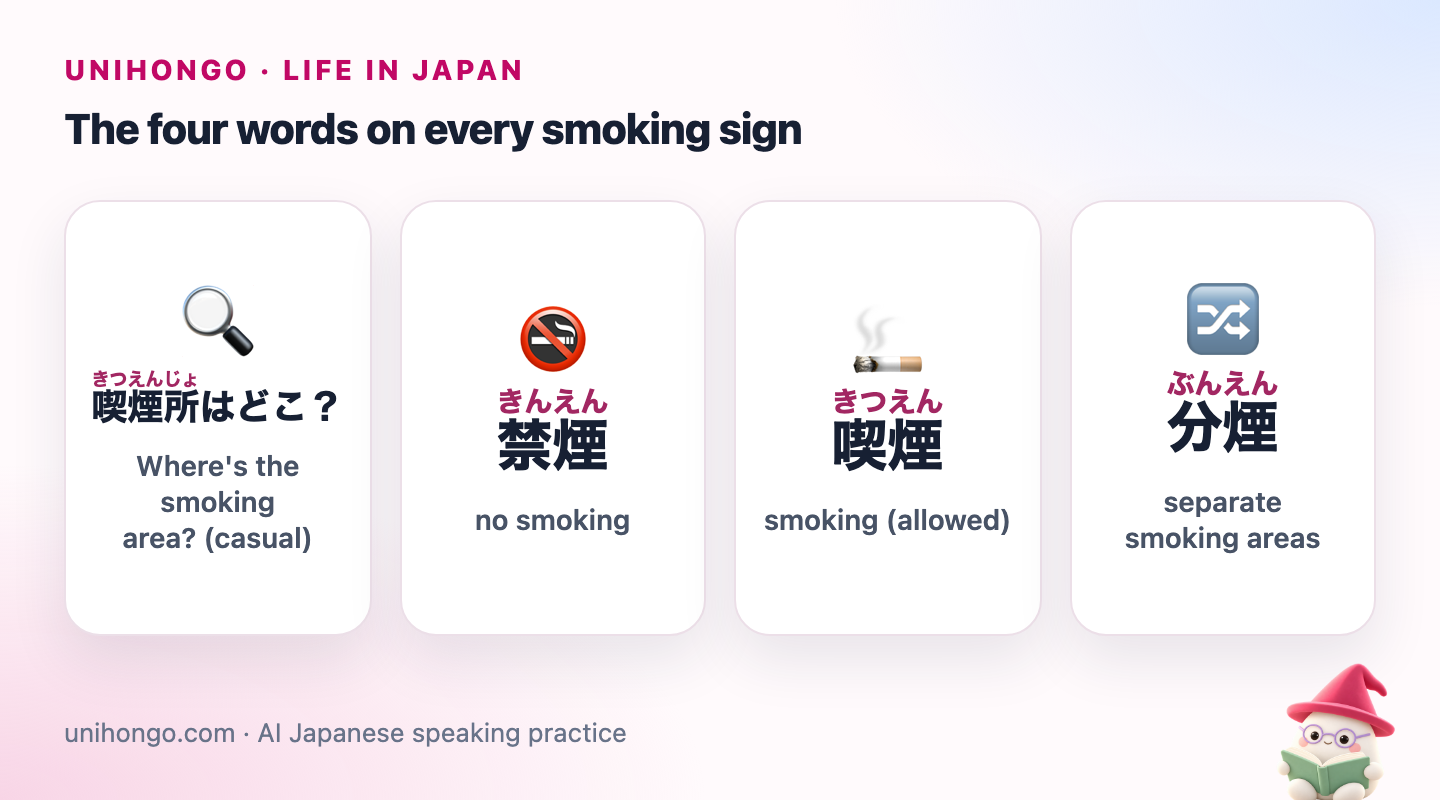
| Japanese | Romaji | Meaning |
|---|---|---|
| 喫煙所はどこ? | Kitsuenjo wa doko? | Where's the smoking area? (casual) |
| 禁煙 | kin'en | no smoking |
| 喫煙 | kitsuen | smoking (allowed) |
| 分煙 | bun'en | separate smoking areas |
| 喫煙所 | kitsuenjo | designated smoking area |
Two layers of rules: national and local
The national Health Promotion Act was revised to protect people from second-hand smoke, and it has applied in full since April 2020. Schools, hospitals, clinics and government offices are smoke-free on their premises, except for a designated outdoor area in some cases. Offices, restaurants, hotels' shared areas, stations and most other buildings are smoke-free indoors in principle, but may set up a separate smoking room.
Local governments add their own rules. Many cities and wards ban smoking on the street in designated areas, rojō kitsuen kinshi chiku, and some charge a fine to people caught smoking there. Tokyo also has its own ordinance that is stricter than national law for restaurants with employees. Because the local layer varies, the same act can be fine in one town and banned a few stations away.
| Japanese | Romaji | Meaning |
|---|---|---|
| 路上喫煙禁止地区 | rojō kitsuen kinshi chiku | no-street-smoking zone |
| 歩きたばこ禁止 | aruki tabako kinshi | no smoking while walking |
| 過料 | karyō | a non-criminal fine |
| Place | General rule | Notes |
|---|---|---|
| Schools, hospitals, government offices | No smoking on the premises | Some allow a designated outdoor area |
| Offices, shops, stations, hotels' shared areas | No smoking indoors in principle | Designated smoking rooms allowed |
| Restaurants and bars | No smoking indoors in principle | Smoking rooms, or a sign for certain small existing bars |
| Streets | Set by each city or ward | Bans in designated areas, sometimes with fines |
| Your own home | Your choice | Rental contracts and neighbours may limit balcony smoking |
Smoking rooms and the signs at the door
Under the national rules, a building that allows any smoking must show a sign at the entrance and on the smoking room. The sign tells you what kind of room it is, and that matters, because the rules inside differ.
| Japanese | Romaji | Meaning |
|---|---|---|
| 喫煙専用室 | kitsuen senyō shitsu | smoking-only room |
| 加熱式たばこ専用 | kanetsushiki tabako senyō | heated tobacco only |
| 二十歳未満立入禁止 | hatachi miman tachiiri kinshi | no entry for under-20s |
| 全席禁煙 | zenseki kin'en | all seats non-smoking |
- Kitsuen senyō shitsu: a room only for smoking. You cannot eat or drink inside.
- Kanetsushiki tabako senyō kitsuen shitsu: a room only for heated tobacco, where eating and drinking can be allowed.
- Kitsuen kanō shitsu or kitsuen kanō ten: certain small, older bars and restaurants that meet set conditions may allow smoking, with a sign at the door.
- Kitsuen mokuteki shitsu: places whose main purpose is smoking, such as cigar or shisha bars.
People under 20 may not enter any of these smoking areas, even as staff or with their parents. That is why some family restaurants have no smoking room at all.
Hotels are a special case: guest rooms count as private space, so some hotels still offer smoking rooms, kitsuen rūmu, while shared areas such as the lobby follow the indoor rules. Many hotels have gone fully non-smoking, so if it matters to you either way, ask when you book rather than at check-in.
Asking about smoking: what you say and hear
Whether you smoke or want to avoid smoke, the same few questions work in restaurants, hotels and offices. Staff answer quickly, often with a gesture towards the room or the door.
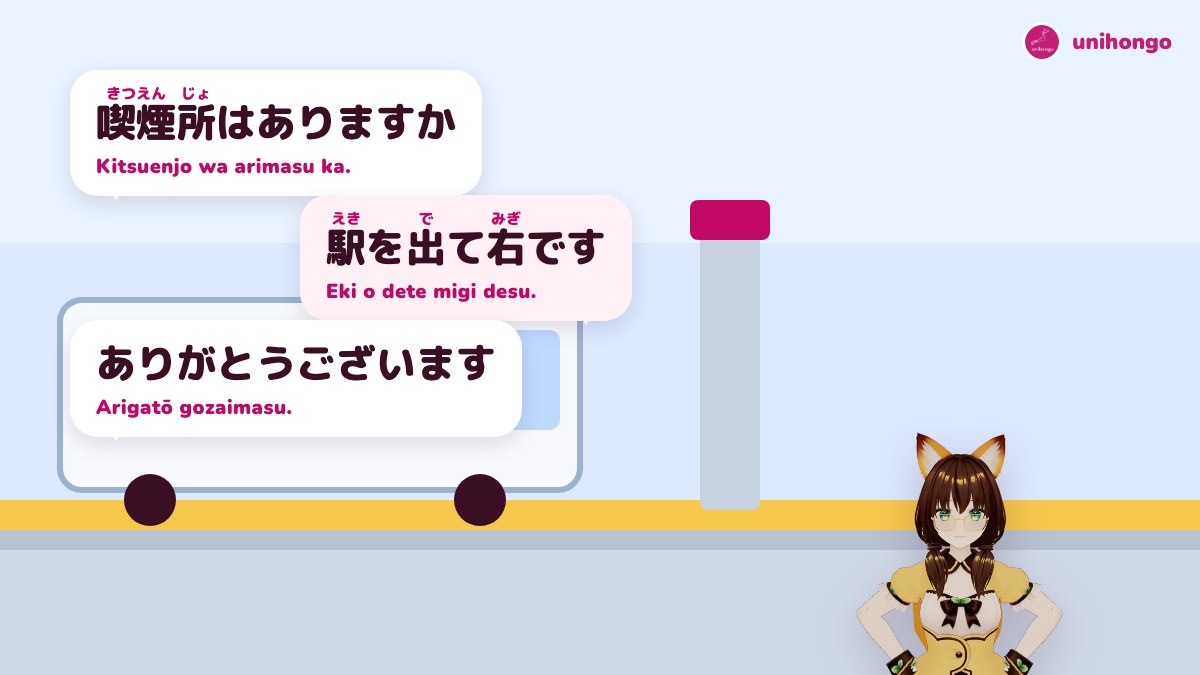
| Japanese | Romaji | Meaning |
|---|---|---|
| 喫煙所はありますか。 | Kitsuenjo wa arimasu ka. | Is there a smoking area? |
| 駅を出て右にございます。 | Eki o dete migi ni gozaimasu. | Staff: It's to the right as you leave the station. |
| たばこを吸ってもいいですか。 | Tabako o sutte mo ii desu ka. | May I smoke? |
| 申し訳ありません、店内は全面禁煙です。 | Mōshiwake arimasen, tennai wa zenmen kin'en desu. | Staff: Sorry, the whole restaurant is non-smoking. |
| 禁煙の部屋をお願いします。 | Kin'en no heya o onegai shimasu. | A non-smoking room, please. |
| 灰皿をもらえますか。 | Haizara o moraemasu ka. | Could I have an ashtray? |
Heated tobacco and e-cigarettes
Heated tobacco, kanetsushiki tabako, is widely used in Japan, and you will see the term on signs and in smoking rooms. Legally it is still tobacco: the age limit of 20 applies, and where smoking is banned, heated tobacco is generally banned too, unless a room is marked for heated tobacco only.
E-cigarettes, denshi tabako, are a separate category. Liquids containing nicotine are regulated in Japan, so the e-cigarettes sold in ordinary shops are usually nicotine-free. If you are bringing devices or liquids from abroad, check the current rules before you travel. Whatever you use, follow the same signs as for cigarettes unless the place says otherwise.
| Japanese | Romaji | Meaning |
|---|---|---|
| 加熱式たばこ | kanetsushiki tabako | heated tobacco |
| 電子たばこ | denshi tabako | e-cigarette |
| 紙巻きたばこ | kamimaki tabako | ordinary cigarettes |
| 加熱式なら大丈夫ですか。 | Kanetsushiki nara daijōbu desu ka. | Is heated tobacco OK here? |
Smoking at home and at work
At home, smoking inside your own apartment is your choice, but rental contracts sometimes forbid it or charge for cleaning when you move out, and smoke from balconies is a common source of complaints between neighbours. If you smoke, read your contract and be considerate about where smoke drifts. If a neighbour's smoke bothers you, the management company is usually the first place to ask.
At work, smoking breaks happen in designated rooms or outside areas, and some companies limit smoking during working hours or ban it on the premises entirely. Check the work rules; new employees are usually told during orientation.
| Japanese | Romaji | Meaning |
|---|---|---|
| ベランダでの喫煙はご遠慮ください。 | Beranda de no kitsuen wa goenryo kudasai. | Please refrain from smoking on balconies. |
| 隣のたばこの煙が気になるんですが。 | Tonari no tabako no kemuri ga ki ni naru n desu ga. | The smoke from next door bothers me. |
| 社内に喫煙所はありますか。 | Shanai ni kitsuenjo wa arimasu ka. | Is there a smoking area in the office? |
Common mistakes
- Assuming the rules in one city apply everywhere. Street bans and fines differ by ward and town.
- Smoking while walking. Even where it is not fined, it is widely disliked because of burns and ash in crowds.
- Dropping cigarette ends. Littering is banned, and street smokers are expected to use a smoking area or a portable ashtray, keitai haizara.
- Bringing a child into a smoking room or a smoking bar. People under 20 are not allowed in.
- Reading kitsuen as no smoking because it looks similar to kin'en. Kitsuen with 喫 means smoking is allowed.
Make the sign words automatic
Signs are read in a second as you walk past, so recognition has to be instant. Ask Mocchi to /create-flashcards for the smoking sign words in this guide; you pick a photo for each card, and /review-flashcards brings back the ones you hesitate on.
To make the kanji stick, play Flashcard Flip with that same deck: matching 禁煙 and 喫煙 under time pressure is exactly the skill you need on the street.