
Four things you will see every week
Religion in Japan is very visible, even for people who never think of themselves as religious. Shrines and temples are part of every neighbourhood, and objects from both traditions appear in homes, cars, offices and school bags.
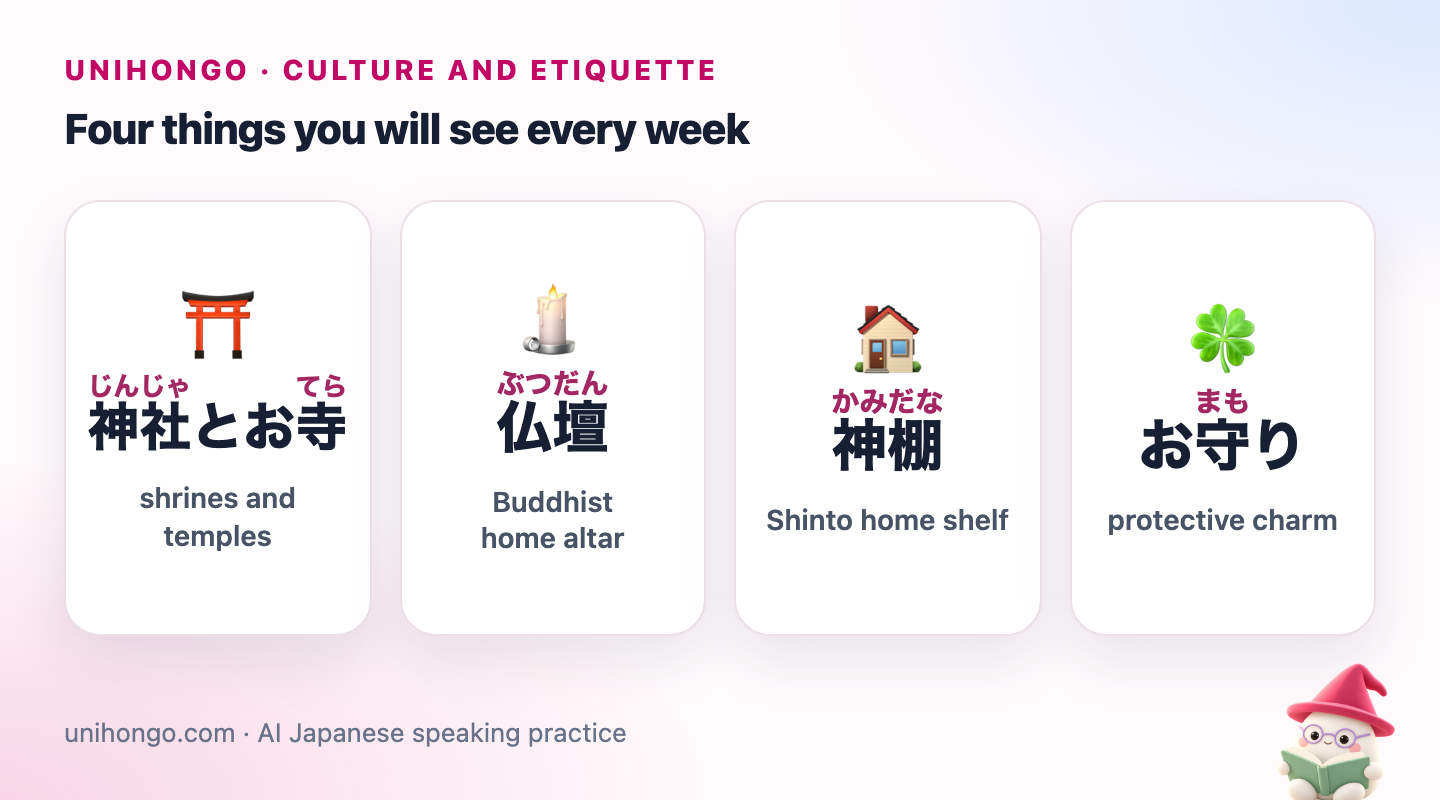
| Japanese | Romaji | Meaning |
|---|---|---|
| 神社とお寺 | jinja to otera | shrines and temples |
| 仏壇 | butsudan | Buddhist home altar |
| 神棚 | kamidana | Shinto home shelf |
| お守り | omamori | protective charm |
Two traditions, side by side
Shinto is the native tradition of kami, gods or spirits found in nature, places and ancestors, worshipped at shrines. Buddhism came from the Asian mainland around the sixth century and is practised at temples. For most of Japanese history the two were closely mixed, and they were formally separated only in the late nineteenth century. In daily life many people still move between them without a sense of contradiction.
The common pattern below is a generalisation; families and regions differ, and some people are devoted members of one tradition or another faith.
| Japanese | Romaji | Meaning |
|---|---|---|
| 神様 | kamisama | the gods, a god (Shinto) |
| 仏様 | hotokesama | the Buddha; also the departed |
| ご先祖様 | gosenzosama | ancestors (respectful) |
| Point | Shinto | Buddhism |
|---|---|---|
| Place | Shrine, with a torii gate | Temple, often with a main hall and a cemetery |
| Clergy | Shrine priests and shrine maidens | Monks and priests of many schools |
| Often linked with | Birth, growth, festivals, protection, the new year | Death, memorials, ancestors |
| At home | A small shelf with a talisman, the kamidana | An altar cabinet for ancestors, the butsudan |
| Typical visits | New Year visit, a baby's first shrine visit, Shichi-Go-San | Funerals, memorial services, grave visits at Obon and the equinoxes |
Religion at home: the altar and the shelf
A butsudan is a wooden cabinet, sometimes large and lacquered, sometimes a small modern box on a shelf. Inside are memorial tablets, ihai (位牌), bearing the names of the departed, often photos, a small bell, an incense holder and offerings such as rice, tea, fruit or sweets. Family members put their hands together in front of it, light incense, ring the bell and sometimes report news to their grandparents. Gifts of food are often placed there first, before the family eats them.
A kamidana is a small shelf, usually high on a wall, holding a paper or wooden talisman, ofuda (お札), from a shrine, with a sakaki branch and offerings of rice, salt and water. Kamidana are now less common in city homes, but you will see them in many shops, restaurants, offices and dojos.
If you visit a family with a butsudan, especially after a death in the family, you may be invited to offer incense. It is a gesture of respect, and the family will show you what to do.
| Japanese | Romaji | Meaning |
|---|---|---|
| お線香をあげてもいいですか。 | Osenkō o agete mo ii desu ka. | May I offer incense? |
| どうぞ、おばあちゃんも喜びます。 | Dōzo, obāchan mo yorokobimasu. | Host: Please do, Grandma would be happy. |
| 手を合わせる | te o awaseru | to put your hands together (in prayer) |
| お供え | osonae | an offering |
Through the year and through a life
Most contact with religion follows the calendar. At New Year, many people make hatsumōde, the first shrine or temple visit of the year, and on New Year's Eve temple bells ring 108 times, joya no kane. In spring and autumn, around the equinoxes, families visit graves for ohigan, and in summer they welcome ancestors home during Obon. Christmas is celebrated widely too, mostly as a cheerful seasonal event rather than a religious one.
Life events are often divided between traditions. Babies make a first shrine visit, omiya mairi, and children celebrate Shichi-Go-San at shrines. Weddings may be held at a shrine, in a chapel-style ceremony or without any religious element. Funerals and memorial services are usually Buddhist. Before building a house, some families hold a Shinto groundbreaking ceremony, jichinsai, and people in an unlucky year of age, yakudoshi, may go to a shrine or temple for a protective prayer.
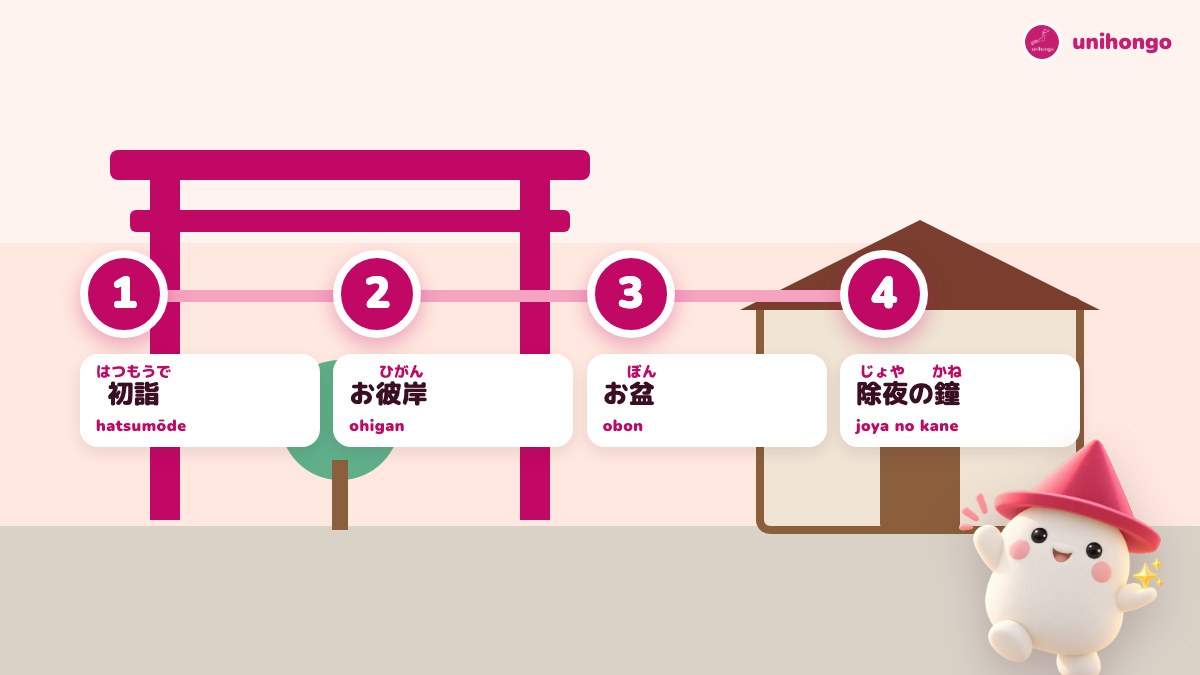
| Japanese | Romaji | Meaning |
|---|---|---|
| 初詣 | hatsumōde | first shrine or temple visit of the year |
| お彼岸 | ohigan | equinox week (grave visits) |
| お盆 | obon | summer festival of the ancestors |
| 除夜の鐘 | joya no kane | New Year's Eve temple bells |
| お宮参り | omiya mairi | a baby's first shrine visit |
| 厄年 | yakudoshi | an unlucky year of age |
When people say they are not religious
Ask someone in Japan about their religion and a common answer is mushūkyō desu, I have no religion. For many, this means they do not belong to an organisation or hold a fixed creed, not that they never pray, visit shrines or honour ancestors. The word shūkyō itself can suggest an organised group, and some people associate it with pressure to join or donate, so it may feel heavier than religion does in English.
If you hear a family belongs to a particular temple, they may say uchi wa ___ shū desu, our family is of the ___ school, which often means the temple that handles the family's funerals and graves. Do not assume either answer tells you how someone feels personally; ask about customs, listen, and let the other person decide how deep to go.
| Japanese | Romaji | Meaning |
|---|---|---|
| 特に宗教はありません。 | Toku ni shūkyō wa arimasen. | I don't have any particular religion. |
| 無宗教です。 | Mushūkyō desu. | I'm not religious. |
| うちは浄土真宗です。 | Uchi wa jōdo shinshū desu. | Our family is Jōdo Shinshū (a Buddhist school). |
| お正月は初詣に行きますか。 | Oshōgatsu wa hatsumōde ni ikimasu ka. | Do you go to a shrine at New Year? |
Talking about your own religion politely
Whatever your background, a short, factual sentence works best. Use shinkō shite imasu, I follow, I believe in, for a faith you practise, and add something practical only if it matters, such as food, prayer times or a holiday. People will usually respond with interest and a question or two. If you are asked to join a ritual you would rather not, a thank-you and a simple explanation is enough; standing quietly and bowing slightly shows respect without taking part.
| Japanese | Romaji | Meaning |
|---|---|---|
| 私はキリスト教徒です。 | Watashi wa kirisutokyōto desu. | I'm a Christian. |
| イスラム教を信仰しています。 | Isuramukyō o shinkō shite imasu. | I practise Islam. |
| 仏教ですが、宗派が違います。 | Bukkyō desu ga, shūha ga chigaimasu. | I'm Buddhist, but of a different school. |
| 宗教上の理由で、お酒は飲みません。 | Shūkyōjō no riyū de, osake wa nomimasen. | For religious reasons, I don't drink alcohol. |
| お祈りできる場所はありますか。 | Oinori dekiru basho wa arimasu ka. | Is there a place where I can pray? |
| 私は見ているだけでもいいですか。 | Watashi wa mite iru dake demo ii desu ka. | Is it all right if I just watch? |
Mini dialogue: New Year talk with a coworker
| Japanese | Romaji | Meaning |
|---|---|---|
| お正月は初詣に行きましたか。 | Oshōgatsu wa hatsumōde ni ikimashita ka. | Coworker: Did you go to a shrine at New Year? |
| はい、近所の神社に行きました。おみくじは吉でした。 | Hai, kinjo no jinja ni ikimashita. Omikuji wa kichi deshita. | You: Yes, to the local shrine. My fortune was good luck. |
| いいですね。国ではお正月に何かしますか。 | Ii desu ne. Kuni de wa oshōgatsu ni nanika shimasu ka. | Coworker: Nice. Do you do anything at New Year back home? |
| 家族で教会に行くことが多いです。 | Kazoku de kyōkai ni iku koto ga ōi desu. | You: We often go to church as a family. |
| へえ、そうなんですね。日本と違いますね。 | Hē, sō nan desu ne. Nihon to chigaimasu ne. | Coworker: Oh, I see. That's different from Japan. |
Small mistakes to avoid
- Treating a butsudan as furniture. Do not put bags or drinks on it, and ask before photographing it.
- Throwing old charms in the rubbish. People usually return them to a shrine or temple, often at New Year, where they are burned.
- Assuming mushūkyō means hostile to religion. It usually means no membership, not no customs.
- Bringing up new religious movements or controversial groups in casual talk. It can make people uncomfortable.
- Wearing celebration colours or bringing a gift for a funeral without checking. Funerals have their own rules; ask someone close to the family.
Turn these customs into conversation
Start with the reading side. Ask Mocchi /kanji 仏 and /kanji 神 to see how the two characters run through words like butsudan, hotokesama, jinja and kamisama, then ask for a /quiz on the year's customs, from hatsumōde to joya no kane, so the vocabulary is ready when someone mentions them.
Then try the conversation in real time. In AI Sensei, ask Yamada-sensei to play a colleague asking about your New Year, and answer about your own customs and beliefs in a calm, simple way.