
Summer homework in four words
The homework sheet, often titled natsuyasumi no kurashi or simply a list of tasks, names each piece of work. These four words cover most of it, especially in the lower and middle grades.
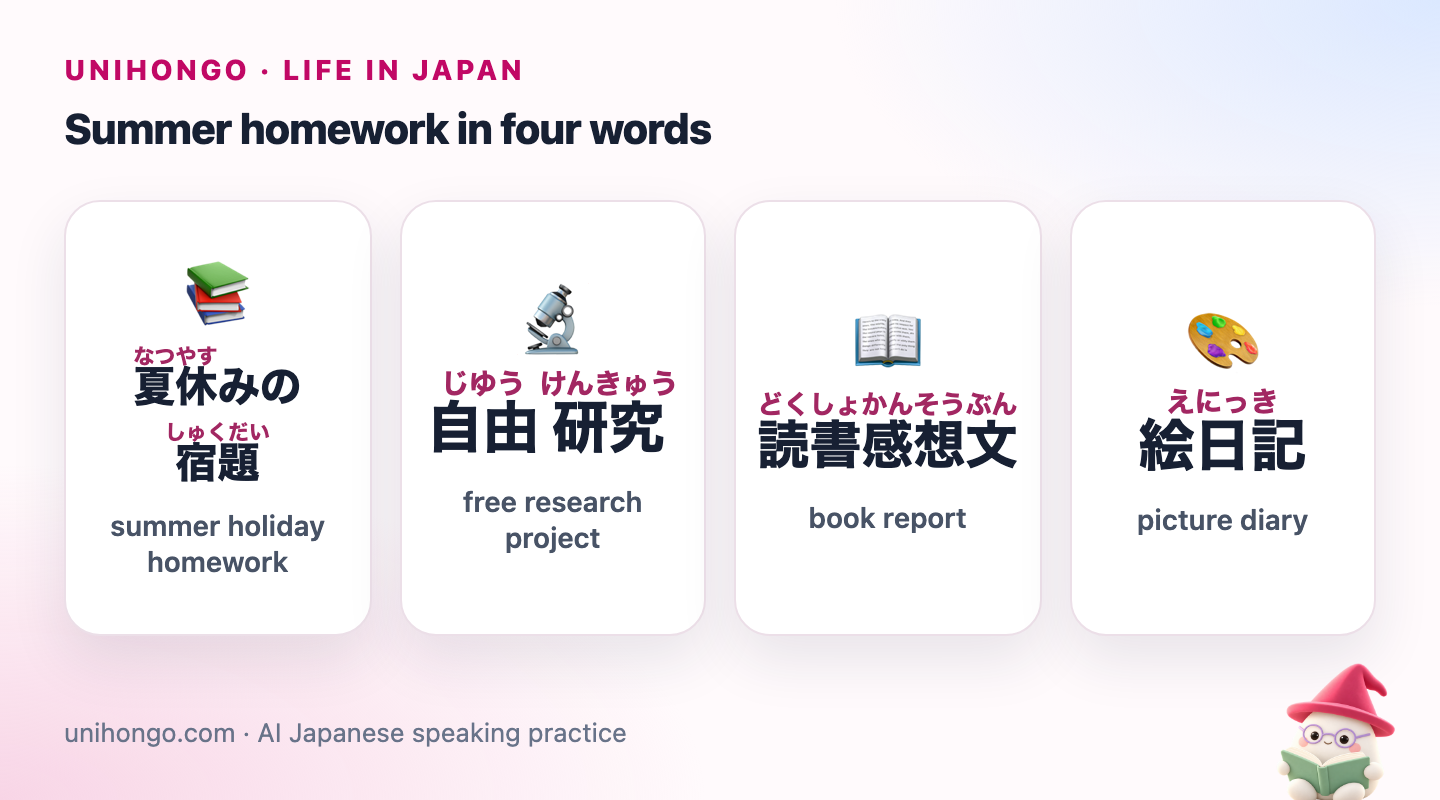
| Japanese | Romaji | Meaning |
|---|---|---|
| 夏休みの宿題 | natsuyasumi no shukudai | summer holiday homework |
| 自由研究 | jiyū kenkyū | free research project |
| 読書感想文 | dokusho kansōbun | book report |
| 絵日記 | enikki | picture diary |
What a typical homework sheet includes
The table shows common tasks. A school might set four of these or all of them, and the amount grows with each grade. Some schools have reduced summer homework in recent years, so do not be surprised if your child's list is short.
| Japanese | Romaji | Meaning |
|---|---|---|
| ドリル | doriru | drill book |
| 音読カード | ondoku kādo | reading-aloud card (parent signs) |
| 原稿用紙 | genkō yōshi | Japanese manuscript paper |
| 工作 | kōsaku | craft project |
| 朝顔の観察 | asagao no kansatsu | observing the morning glory |
| Task | What it is | Tips for parents |
|---|---|---|
| Drill book | Daily pages of kanji, arithmetic and reading | A few pages each morning keeps it from piling up |
| Picture diary | A drawing and a few lines about a day, for younger children | Choose days with an outing or something new |
| Free research | A project the child chooses, shown on paper or in a notebook | Pick a small question that can be answered at home |
| Book report | An essay about a book, often for a set number of manuscript pages | Read early and note favourite scenes |
| Craft or poster | A made object or a poster on a theme such as safety | Check the size and theme on the sheet |
| Reading aloud | Reading a text aloud to a parent, who signs a card | Short daily sessions work best |
| Observation diary | First graders often bring home a morning glory to observe | Water it daily and take photos for the record |
Radio exercises and summer mornings
Rajio taisō (ラジオ体操), radio exercises, is a set of simple exercises done to piano music and a voice counting along, broadcast on national radio early every morning. Many people learned it at school, and in summer some neighbourhoods gather children in a park to do it together.
These sessions are usually run by the kodomokai (子ども会), the local children's association, or by parent volunteers, often for only part of the holiday. Children bring a stamp card on a string, the shusseki kādo, and get a stamp each day; some areas give a small prize for a full card. Joining is voluntary, and it is a gentle way for a new family to meet neighbours.
| Japanese | Romaji | Meaning |
|---|---|---|
| ラジオ体操に行こう! | Rajio taisō ni ikō! | Let's go to radio exercises! (casual) |
| スタンプを押してもらった? | Sutanpu o oshite moratta? | Did you get your stamp? (casual) |
| 何時からですか。 | Nanji kara desu ka. | What time does it start? |
| 子ども会に入っていなくても参加できますか。 | Kodomokai ni haitte inakute mo sanka dekimasu ka. | Can we join even if we aren't in the children's association? |
Planning the six weeks
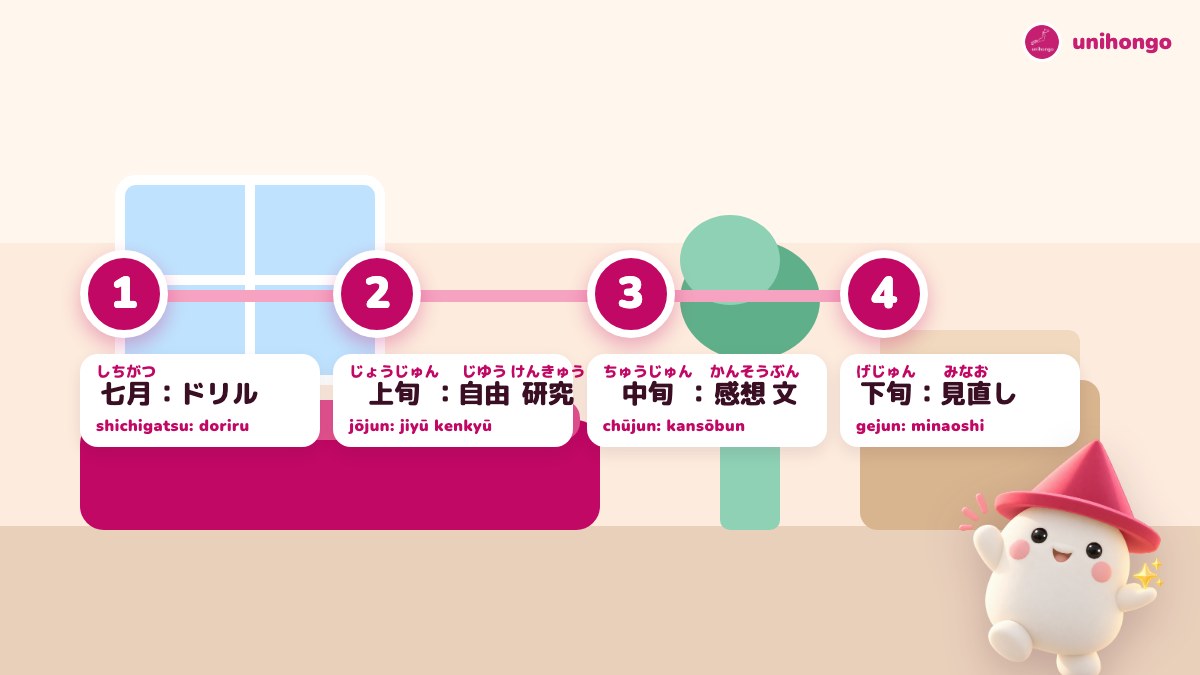
The classic summer story in Japan is the child who leaves everything until the last days of August while the whole family helps finish the diary from memory. A simple plan avoids it. Many schools give children a planning sheet, a keikakuhyō, to fill in on the first day.
| Japanese | Romaji | Meaning |
|---|---|---|
| 毎朝ドリルを二ページやろうね。 | Maiasa doriru o ni pēji yarō ne. | Parent: Let's do two drill pages every morning. (casual) |
| 自由研究は何にする? | Jiyū kenkyū wa nani ni suru? | Parent: What will you do for your research? (casual) |
| もう終わった? | Mō owatta? | Parent: Have you finished yet? (casual) |
| あとは読書感想文だけ! | Ato wa dokusho kansōbun dake! | Child: Only the book report left! |
- First week: read the sheet together, put the due date on the calendar, and split the drill book into daily pages.
- Late July: choose the research topic and the book for the report while there is plenty of time.
- Early August: do the research and any outings it needs before the Obon holiday, when many families travel.
- Mid-August: write the book report and finish the craft or poster.
- Last week: check every task against the sheet, sign the cards that need a parent's seal or signature, and pack the bag.
The free research project, step by step
Jiyū kenkyū follows a simple pattern that schools teach: a question, a prediction, what you did, what happened, and what you learned. A good topic is small and close to home. Which ice melts fastest, how many kinds of insects live in the park, how the family's favourite dish is made, or where the tap water comes from are all typical.
The result is usually written on a large sheet of paper, mozōshi (模造紙), or in a notebook with photos and drawings. For younger children, a craft with a short explanation is often accepted instead. Read the sheet: some schools ask for a fixed format.
| Japanese | Romaji | Meaning |
|---|---|---|
| きっかけ | kikkake | why I chose this topic |
| 予想 | yosō | prediction |
| 方法 | hōhō | method |
| 結果 | kekka | results |
| わかったこと | wakatta koto | what I found out |
Helping without doing it for them
Teachers know parents help, especially with the research project and the craft. What they want to see is the child's own thinking and handwriting. Good help means taking the child to the library, buying materials, asking questions such as why do you think that happened, and checking for missing pages. Writing the report for them, or correcting every sentence until it sounds like an adult, usually shows.
For the book report, the hardest part is often starting. Ask your child which scene they liked best, how they felt and why, and what they would do in the main character's place, then let them write those answers in their own words.
| Japanese | Romaji | Meaning |
|---|---|---|
| どの場面が一番好きだった? | Dono bamen ga ichiban suki datta? | Parent: Which scene did you like best? |
| どうしてそう思ったの? | Dōshite sō omotta no? | Parent: Why did you think that? |
| 自分の言葉で書いてみて。 | Jibun no kotoba de kaite mite. | Parent: Try writing it in your own words. |
Asking the teacher about a task
If a task is unclear, ask before the holiday starts or at the start of it. A short note in the contact notebook or a call to the school office is normal. Teachers may be at school for part of the holiday, but schools often have closed days around Obon.
| Japanese | Romaji | Meaning |
|---|---|---|
| 夏休みの宿題について質問があります。 | Natsuyasumi no shukudai ni tsuite shitsumon ga arimasu. | You: I have a question about the summer homework. |
| はい、何でしょう。 | Hai, nan deshō. | Teacher: Yes, what is it? |
| 自由研究は工作でもいいですか。 | Jiyū kenkyū wa kōsaku demo ii desu ka. | You: Is a craft acceptable for the research project? |
| はい、説明を一枚つけてください。 | Hai, setsumei o ichimai tsukete kudasai. | Teacher: Yes, please attach one page of explanation. |
| 提出はいつですか。 | Teishutsu wa itsu desu ka. | You: When is it due? |
| 始業式の日に持ってきてください。 | Shigyōshiki no hi ni motte kite kudasai. | Teacher: Please bring it on the opening ceremony day. |
A summer routine for the parent too
While your child does the morning drill, do ten minutes of your own. Photograph the homework sheet and ask Mocchi to /explain any line you cannot read, then ask it for a /quiz on the words, such as kansōbun, kansatsu and teishutsu, so you can follow what your child is doing. If you would like a plan of your own for the holiday, Mocchi's /plan gives you small daily tasks that fit next to the children's routine.
For a family game in the evening, Vocabulary Dash in Unihongo's games works with your own flashcards, so the summer words can become a race between parent and child.