
Four phrases that get you through rush hour
In a packed train almost nobody speaks, so the few words people do say carry a lot of meaning. These four cover most of what you need: a polite excuse me, the classic I'm getting off, a request for a little room, and the call for help you hope you never use.
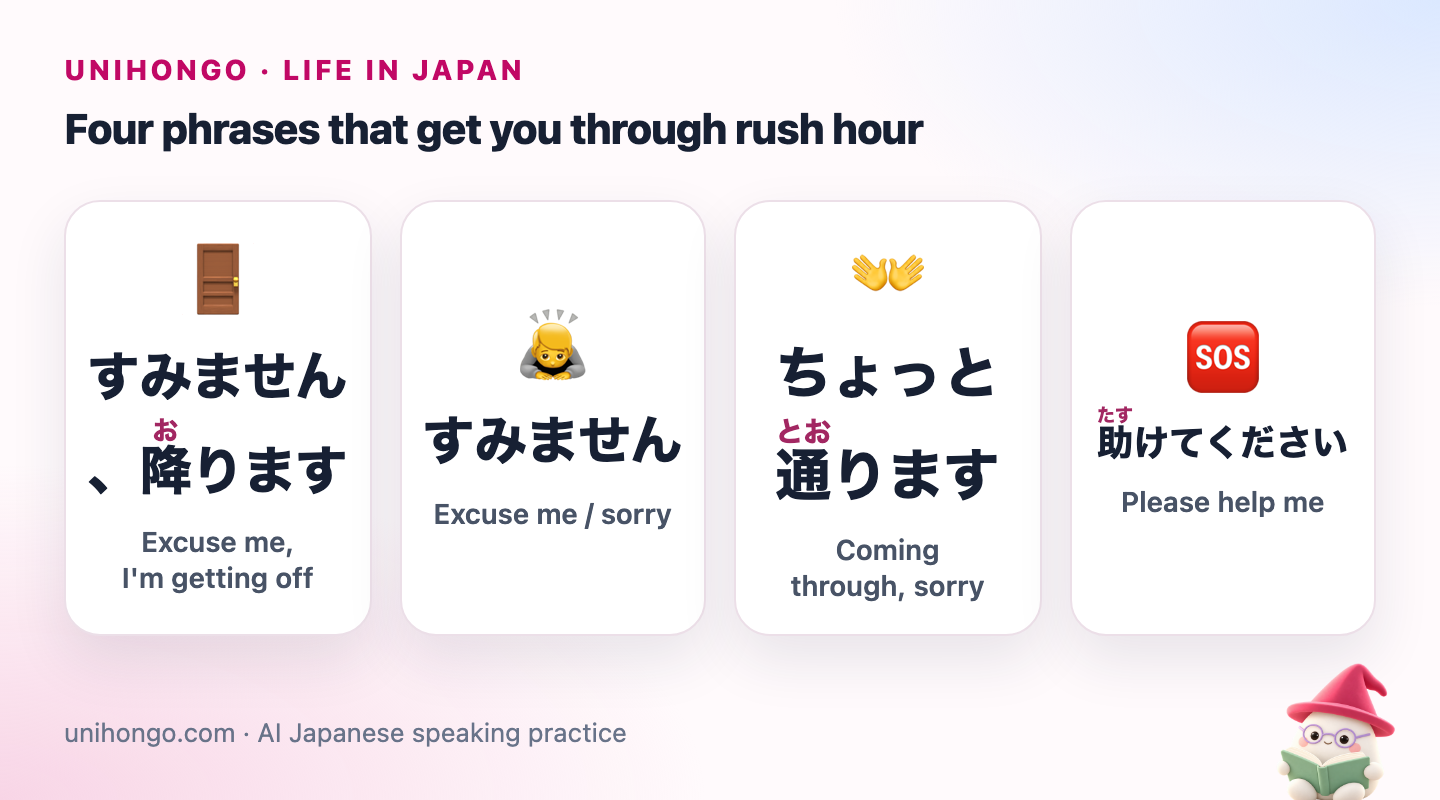
| Japanese | Romaji | Meaning |
|---|---|---|
| すみません、降ります | Sumimasen, orimasu | Excuse me, I'm getting off |
| すみません | Sumimasen | Excuse me / sorry |
| ちょっと通ります | Chotto tōrimasu | Coming through, sorry |
| 助けてください | Tasukete kudasai | Please help me |
Sumimasen does most of the work. Said with a small bow of the head, it apologises for bumping someone, asks for space and thanks a person for moving, all at once. You do not need anything longer.
When the peaks are, and how to avoid the worst
Every big city has its own pattern, but the shape is similar. The morning rush is short and intense, because most offices and schools start at a similar time. The evening rush is longer and lighter, because people leave at different times. Trains heading into the centre are full in the morning and trains heading out are full in the evening.
| Japanese | Romaji | Meaning |
|---|---|---|
| 時差出勤 | jisa shukkin | staggered start time |
| 各駅停車 | kakueki teisha | local train (stops at every station) |
| 快速 | kaisoku | rapid train |
| 混雑 | konzatsu | crowding |
| Time | What it is like | What helps |
|---|---|---|
| About 7:30 to 9:30, weekdays | Most crowded; some lines are packed to the doors | Leave 30 minutes earlier or later if your work allows |
| About 17:30 to 20:00, weekdays | Busy but more spread out | Take a slower local train, or wait for the next one |
| Late evening | Quieter, but the last trains can fill up again | Check the time of the last train |
| Weekends and holidays | Much lighter on commuter lines | Crowds move to shopping and tourist areas |
Many companies now allow staggered hours, called jisa shukkin, or flexitime. If your contract allows it, ask your manager; starting at 10 instead of 9 can change your commute completely. A local train, kakueki teisha, that stops at every station is often less crowded than the rapid or express on the same line, and sometimes you can sit down.
Picking your car and your spot
Regular commuters know which car stops nearest the stairs at their destination, and those cars fill first. Cars at the ends of the train are often a little emptier. On the platform, line up at the marked boarding position, jōsha ichi, in the queue lines on the floor, and let everyone off before you board.
Inside, where you stand decides how hard your trip will be. If you are riding a long way, move into the aisle between the seats; you can hold a strap and you will not be pushed out at every stop. If you are getting off soon, stay near the door. The worst spot is right by the door when you are going ten stops.
| Japanese | Romaji | Meaning |
|---|---|---|
| 乗車位置 | jōsha ichi | boarding position |
| リュックは前に抱えてください。 | Ryukku wa mae ni kakaete kudasai. | Please carry backpacks in front. |
| 女性専用車 | josei senyō sha | women-only car |
| 奥へお詰めください。 | Oku e otsume kudasai. | Please move further inside. |
- Wear your backpack on your front or put it on the overhead rack. A backpack on your back pushes into the person behind you; many railways ask you to carry it in front, mae ni kakaeru, during busy times.
- Keep your phone close to your chest and your elbows in. Large bags go between your feet.
- Hold a strap or pole. Sudden braking happens, and in a crowd one person falling pushes many others.
- Women-only cars, josei senyō sharyō, run on many lines during the morning rush. The platform shows a pink sign and the hours. Check the sign before you board.
Getting off from the middle of the crowd
This is the moment most newcomers dread. The secret is to start early. A stop or two before yours, begin moving gently towards the door when the train stops and people shift. At your station, say sumimasen, orimasu clearly as soon as the doors open, and keep moving steadily. Nobody minds a clear signal; what bothers people is someone suddenly pushing from deep inside after the doors start to close.
If you are standing by the door and others need to get off, step out onto the platform, stand to one side and get back in after them. This is normal and expected, and you will not lose your place on the train.
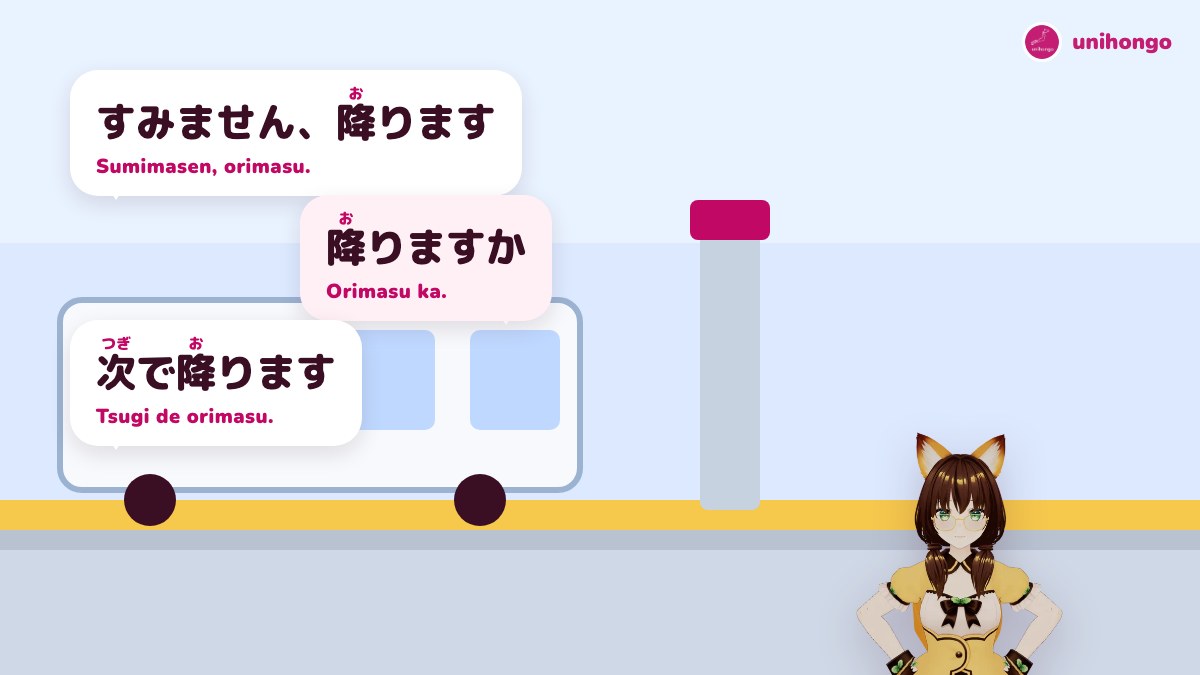
| Japanese | Romaji | Meaning |
|---|---|---|
| 次で降ります。 | Tsugi de orimasu. | I'm getting off at the next stop. |
| 降りますか。 | Orimasu ka. | Are you getting off? |
| いえ、まだです。 | Ie, mada desu. | No, not yet. |
| あ、すみません。どうぞ。 | A, sumimasen. Dōzo. | Oh, sorry. Go ahead. |
Delay and suspension announcements
Rush hour delays are common, and the announcements follow fixed patterns. Chien means delay, and unten miawase means the service is suspended for now. The announcement usually gives the reason, the section affected and sometimes the expected restart time, saikai mikomi. When a line stops, other railways often accept your ticket or pass on an alternative route; this is furikae yusō, and staff hand out or announce the details.
If you are late for work because of a delay, many railways issue a delay certificate, chien shōmeisho, at the gate or on their website. Your company may ask for it.
| Japanese | Romaji | Meaning |
|---|---|---|
| 遅延 | chien | delay |
| 運転見合わせ | unten miawase | service suspended |
| 人身事故のため | jinshin jiko no tame | due to an accident involving a person |
| 振替輸送を行っています。 | Furikae yusō o okonatte imasu. | Alternative transport is available. |
| 運転再開の見込みは未定です。 | Unten saikai no mikomi wa mitei desu. | The restart time is not yet known. |
| お急ぎのところ申し訳ございません。 | Oisogi no tokoro mōshiwake gozaimasen. | We apologise for the delay. (announcement) |
Feeling unwell, being groped, or seeing trouble
Heat, crowding and skipped breakfast make people faint on morning trains every day, and staff are used to it. If you feel dizzy, get off at the next station, sit down and tell a staff member. Do not try to hold on for many more stops. Most carriages also have an emergency call button, hijō tsūhō botan, for when someone collapses or a fight starts.
Groping, chikan, is a crime in Japan. If it happens to you or you see it, saying yamete kudasai loudly often stops it at once, and people nearby will usually help. Tell staff at the next station, or call 110 for the police. Many railways run women-only cars and put up posters encouraging people to report it. Remembering the time, the car number and the person's clothes helps the police.
| Japanese | Romaji | Meaning |
|---|---|---|
| 気分が悪いです。 | Kibun ga warui desu. | I feel unwell. |
| やめてください! | Yamete kudasai! | Stop it! |
| 痴漢です! | Chikan desu! | This person is a groper! |
| 駅員さんを呼んでください。 | Ekiin san o yonde kudasai. | Please call a station staff member. |
| 人が倒れました。 | Hito ga taoremashita. | Someone has collapsed. |
Things that surprise newcomers
- Staff pushing passengers in. At a few very busy stations, staff help the last people fit in so the doors can close. It is rarer than it used to be, and it is not a sign that anything is wrong.
- The silence. Phone calls are avoided on trains, and most people do not talk in the crowd. Keep your voice low and switch your phone to silent mode, manā mōdo.
- Seats in the rush. You might get a seat if you board at the start of a line, but priority seats, yūsenseki, are for older people, pregnant women, people with disabilities or injuries and people with small children.
- Running for the door. Rushing aboard as the doors close, kakekomi jōsha, causes delays and injuries. Announcements ask you not to, and the next train is usually only minutes away.
- Dropping something on the tracks. Do not climb down. Tell a staff member, who will pick it up with a special tool when it is safe.
Learn the announcements before the next delay
Most rush hour stress comes from not knowing what is happening. Try asking Mocchi: give me the ten most common Japanese train delay words and quiz me on them. Mocchi explains each word, quizzes you, and remembers which ones you missed, so your next review starts there.
For listening, add the words to your own flashcards and play Listen & Pick in Unihongo's games section, a quick way to train your ear between stops.