
Yōchien, hoikuen and kodomoen in one minute
Japan has three main kinds of preschool. A yōchien is a school for early education, run under the education ministry's rules, so it has a curriculum, terms and long holidays. A hoikuen is a childcare centre for families who need someone to look after their child during the working day, and you apply through the city office. A nintei kodomoen, a certified centre for children, does both under one roof and takes children on either basis.
Many neighbourhoods have all three, and the colourful bus that collects children every morning is the most visible sign of a yōchien. Children wear a uniform or a smock, a round hat and a shoulder bag, and every item carries their name.
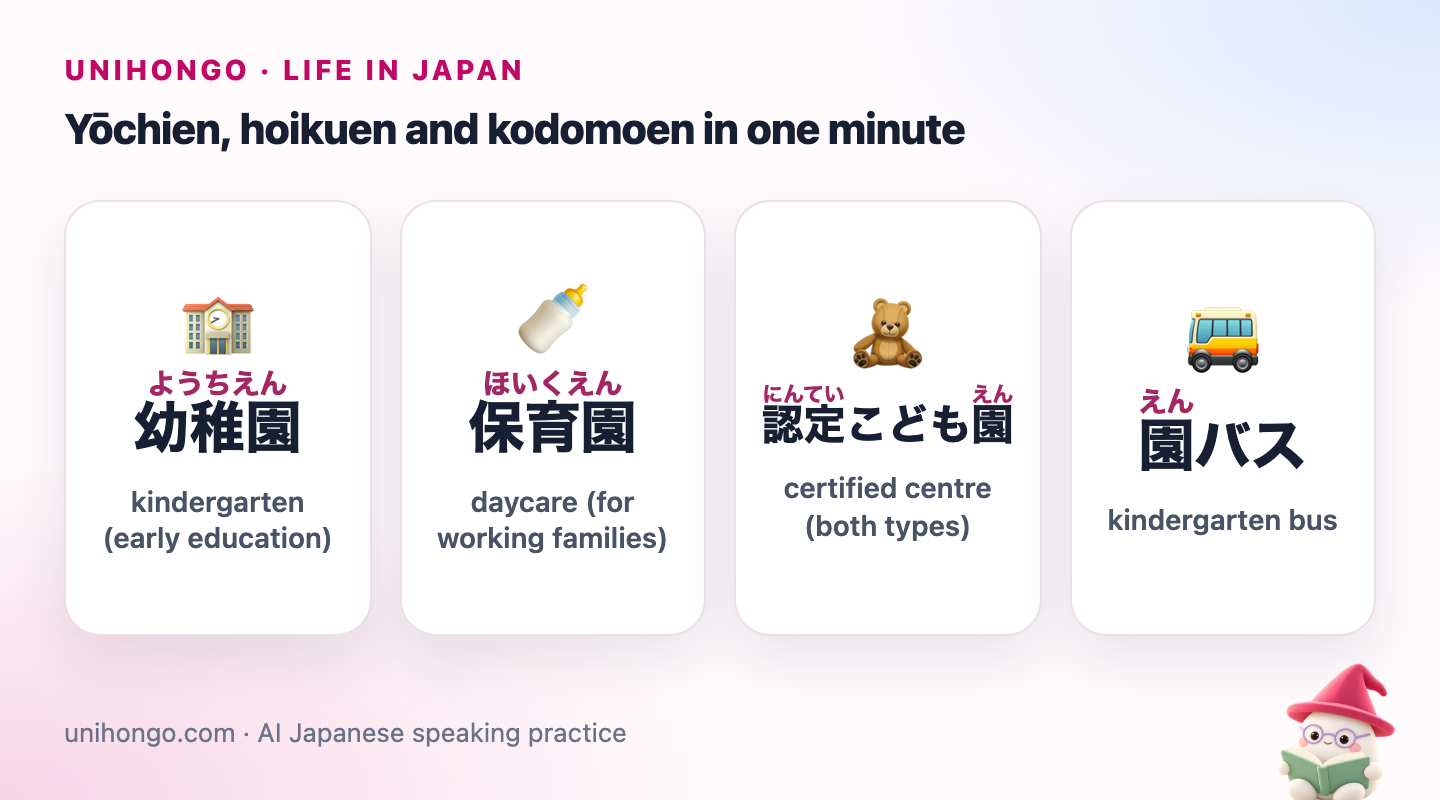
| Japanese | Romaji | Meaning |
|---|---|---|
| 幼稚園 | yōchien | kindergarten (early education) |
| 保育園 | hoikuen | daycare (for working families) |
| 認定こども園 | nintei kodomoen | certified centre (both types) |
| 園バス | en basu | kindergarten bus |
The three types side by side
The table shows the usual pattern. Each facility sets its own hours and rules, and some private kindergartens offer long extended care that makes them work almost like a daycare, so always ask.
| Japanese | Romaji | Meaning |
|---|---|---|
| 預かり保育はありますか。 | Azukari hoiku wa arimasu ka. | Do you offer extended care? |
| 何時までお願いできますか。 | Nanji made onegai dekimasu ka. | Until what time can you look after them? |
| 夏休み中も利用できますか。 | Natsuyasumi-chū mo riyō dekimasu ka. | Can we use it during the summer holiday too? |
| Point | Yōchien | Hoikuen | Nintei kodomoen |
|---|---|---|---|
| Main purpose | Early education | Daytime care while parents work | Education and care |
| Usual ages | About 3 to 5 | Babies to 5 | Babies to 5 |
| Who can join | Any family | Families the city certifies as needing care | Both, on different terms |
| Usual day | Around 4 hours, plus optional extended care | Long days, often until early evening | Depends on the child's enrolment type |
| How to apply | Usually directly to the kindergarten | Through the city office | Depends on the type of place |
| Holidays | School-style breaks | Open most of the year | Depends on the child's enrolment type |
Extended care at a yōchien is called azukari hoiku (預かり保育). It keeps children after the normal day or during holidays, usually for an extra fee. If both parents work, this is the first question to ask.
Applying: open days, forms and the April start
The Japanese school year starts in April, and so does kindergarten. For private kindergartens, the process often starts a year earlier. The timing below is common in many areas, but kindergartens and cities set their own dates, so check each one's website or call the office.
| Japanese | Romaji | Meaning |
|---|---|---|
| 見学はできますか。 | Kengaku wa dekimasu ka. | Can we visit and look around? |
| 願書はいつから配られますか。 | Gansho wa itsu kara kubararemasu ka. | From when are application forms handed out? |
| 面接では何をしますか。 | Mensetsu de wa nani o shimasu ka. | What happens at the interview? |
| 子どもは日本語がまだ少ししかできません。 | Kodomo wa nihongo ga mada sukoshi shika dekimasen. | My child only speaks a little Japanese so far. |
| 大丈夫ですよ。すぐ慣れますよ。 | Daijōbu desu yo. Sugu naremasu yo. | Teacher: That's fine. They get used to it quickly. |
- Spring to summer: open days and information sessions (kengakukai, setsumeikai). Many kindergartens also run a play class for two-year-olds, called pre-hoiku, which is a gentle way to meet the staff.
- Early autumn: application packs, the gansho (願書), are handed out. Popular kindergartens can have queues on the day.
- Autumn: applications are submitted, often with a short interview or play session with your child.
- Winter: you pay the enrolment fee, buy the uniform and supplies, and attend an orientation day.
- April: the entrance ceremony, nyūenshiki (入園式), and the first days, which are often short.
Daily life: the bus, bentō and name labels
Most children are either dropped off and picked up by a parent, called sōgei (送迎), or ride the en basu from a stop near home. The bus has a set time, and a parent waits at the stop to hand the child over to the teacher in the morning and receive them again in the afternoon.
Lunch is a big topic. Some kindergartens have a catered lunch every day, some ask for a home-made bentō every day, and many mix the two, for example bentō on certain days of the week. The bentō box, chopsticks, cup and lunch cloth all need the child's name. Expect to label everything: clothes, shoes, crayons, even each individual crayon at some kindergartens.
Children wear indoor shoes, uwabaki (上履き), inside the building, and the shoes go home on Fridays to be washed at some kindergartens. Short days, when children come home before lunch, appear on the calendar as gozen hoiku (午前保育).
| Japanese | Romaji | Meaning |
|---|---|---|
| お弁当の日 | obentō no hi | bentō day (bring a packed lunch) |
| 給食の日 | kyūshoku no hi | catered lunch day |
| 上履き | uwabaki | indoor shoes |
| お名前を書いてください。 | Onamae o kaite kudasai. | Please write your child's name on it. |
| 降園は二時です。 | Kōen wa niji desu. | Going-home time is two o'clock. |
Reading the notices that come home
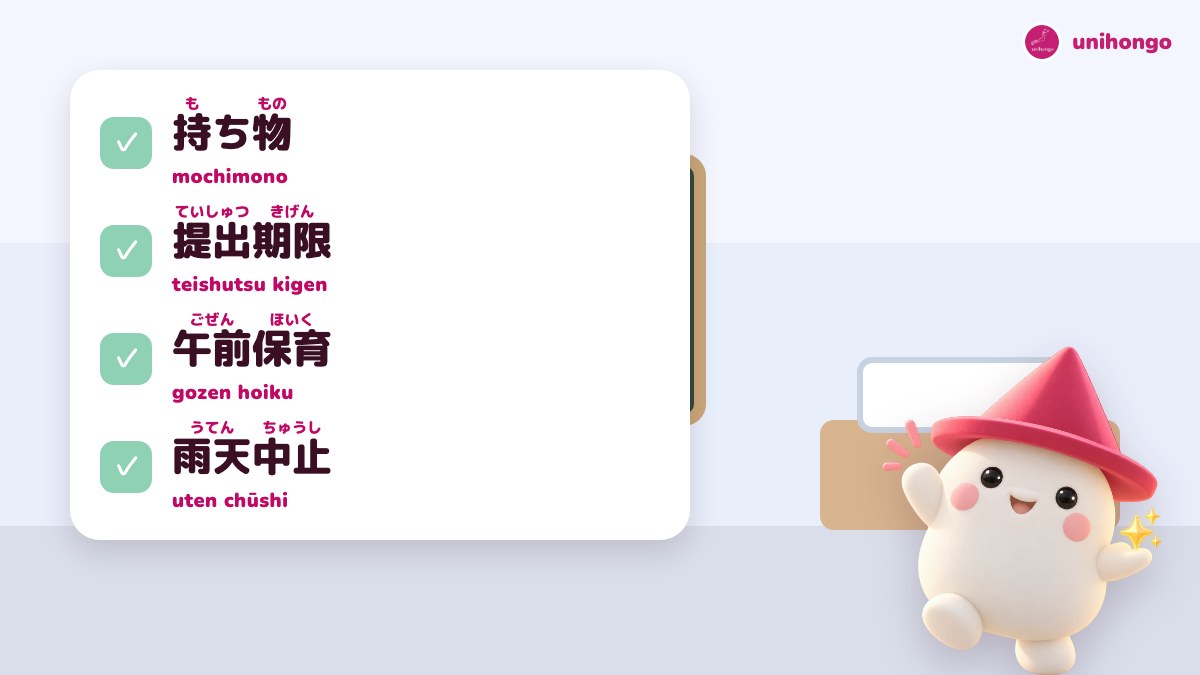
Your child will bring home printed notices, often called otayori (お便り), and many kindergartens also send messages through an app. The same few words appear again and again. Learn them once and most notices become readable: what to bring, by when, which day is short and what happens if it rains.
| Japanese | Romaji | Meaning |
|---|---|---|
| 持ち物 | mochimono | things to bring |
| 提出期限 | teishutsu kigen | deadline for handing it in |
| 午前保育 | gozen hoiku | morning-only day |
| 雨天中止 | uten chūshi | cancelled if it rains |
| 参観日 | sankanbi | parents' observation day |
| 運動会 | undōkai | sports day |
| 発表会 | happyōkai | performance day (songs, plays) |
| 遠足 | ensoku | school outing |
If a deadline is close and you are unsure what a notice asks for, write a short question in the contact notebook or ask at the bus stop. Teachers would much rather answer than find a missing form.
Parents' duties: the association and the roles
Most kindergartens have a parents' association, a hogoshakai (保護者会) or PTA. Each year some parents take on roles, called yakuin (役員) or kakari (係), such as class representative, event helper or newsletter editor. At some kindergartens roles are chosen by volunteers, at others by drawing lots, kujibiki. Yōchien tend to expect more parent involvement than daycare, because they assume parents have more time, but this is changing as more families work.
If your Japanese is still basic or you work full time, it is fine to say so early, and to offer something you can do instead, such as helping on one event day.
| Japanese | Romaji | Meaning |
|---|---|---|
| 今年は仕事で役員が難しいです。 | Kotoshi wa shigoto de yakuin ga muzukashii desu. | This year a committee role is difficult because of work. |
| 行事のお手伝いならできます。 | Gyōji no otetsudai nara dekimasu. | I can help on event days, though. |
| 日本語の書類はまだ苦手です。 | Nihongo no shorui wa mada nigate desu. | I still struggle with documents in Japanese. |
| 何をすればいいか教えていただけますか。 | Nani o sureba ii ka oshiete itadakemasu ka. | Could you tell me what I should do? |
Mini dialogue: at the bus stop
The handover at the bus stop takes less than a minute, but it is where small news is passed on. Teachers speak politely and briskly; you can answer in simple polite Japanese.
| Japanese | Romaji | Meaning |
|---|---|---|
| おはようございます。今日もよろしくお願いします。 | Ohayō gozaimasu. Kyō mo yoroshiku onegai shimasu. | You: Good morning. Thank you for today. |
| おはようございます。ゆうちゃん、元気? | Ohayō gozaimasu. Yū-chan, genki? | Teacher: Good morning. Yū, how are you? |
| 昨日少し咳が出ていました。 | Kinō sukoshi seki ga dete imashita. | You: She had a bit of a cough yesterday. |
| わかりました。様子を見ますね。 | Wakarimashita. Yōsu o mimasu ne. | Teacher: I see. We'll keep an eye on her. |
| 今日はお迎えに祖母が来ます。 | Kyō wa omukae ni sobo ga kimasu. | You: Her grandmother will collect her today. |
| はい、承知しました。 | Hai, shōchi shimashita. | Teacher: Yes, understood. |
Things that surprise new families
- How much has to be made by hand. Some kindergartens ask for home-sewn bags of a fixed size; shops near the kindergarten often sell ready-made sets, and buying them is common.
- The bentō culture. A simple, balanced bentō is enough. Elaborate character bentō are a hobby for some parents, not a requirement.
- Short first weeks. Children may come home before lunch for a while so they can get used to being away from home.
- Events on weekdays. Observation days and parents' meetings can be in working hours, so check the year calendar early and plan time off.
- Mixing up hoikuen words. In a hoikuen the contact book and the day's flow are different, and terms such as hokatsu belong to the daycare search, not to kindergarten.
Practise the kindergarten year before it starts
Start with the paper. Photograph a real notice or the kindergarten's year calendar, type the words you do not know into Mocchi with /create-flashcards, and pick a picture for each card so that mochimono or uten chūshi has an image in your head. A /quiz on those cards before the next notice arrives makes the following one much faster to read.
Then rehearse the talking part out loud. In AI Sensei, choose Hana-sensei and ask the Sensei to play your child's kindergarten teacher at the bus stop: pass on that your child has a cough, say who will pick them up, and ask about the next event. Ask the Sensei to speak at natural speed the second time, because real handovers are quick.