
Four lines for any outing with a baby
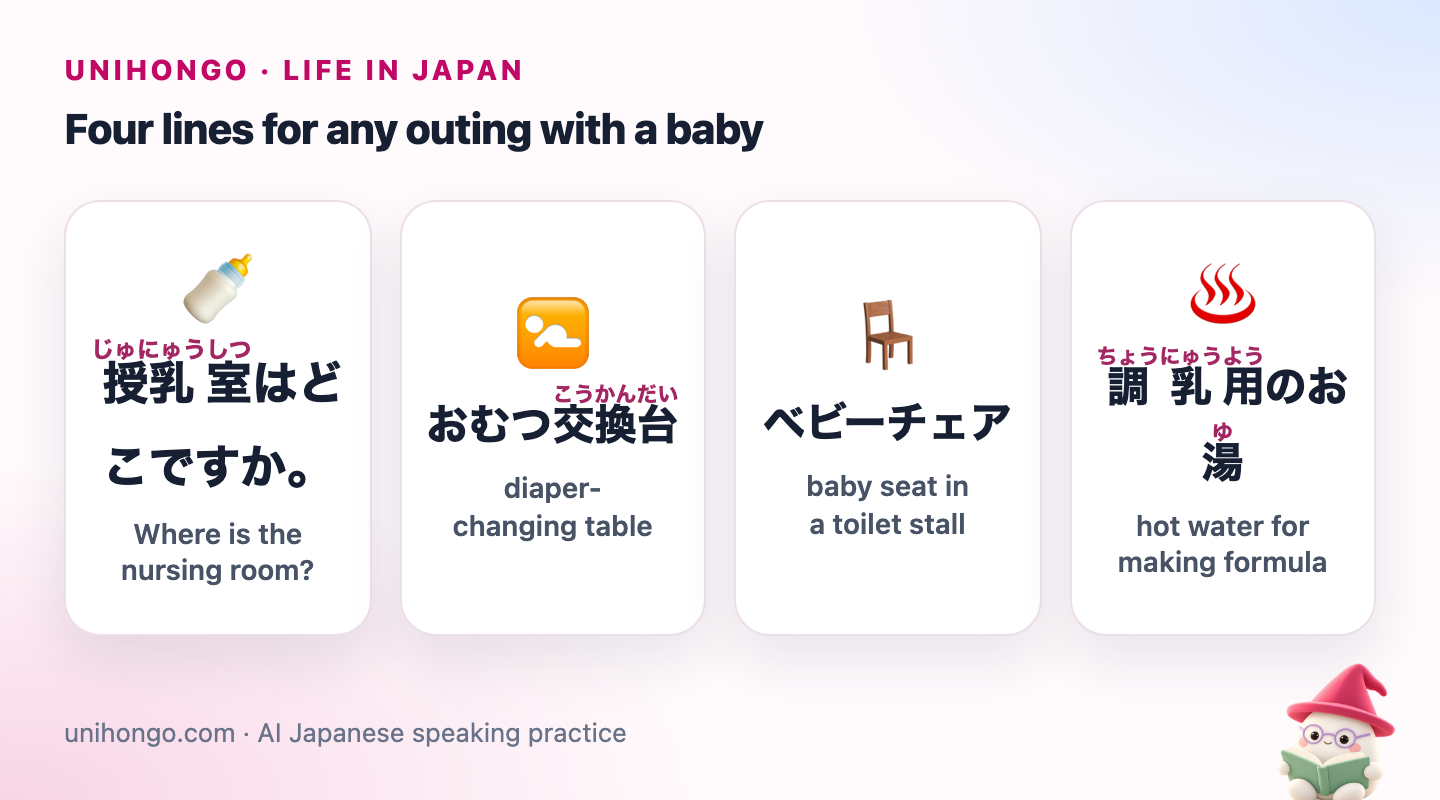
If you remember only four things, make them these: the question that finds the nursing room, and the three facilities you will look for once you are there. The baby seat in a toilet stall is easy to miss: it is a small fold-down seat on the wall that holds a baby safely while you use the toilet.
| Japanese | Romaji | Meaning |
|---|---|---|
| 授乳室はどこですか。 | Junyūshitsu wa doko desu ka. | Where is the nursing room? |
| おむつ交換台 | omutsu kōkandai | diaper-changing table |
| ベビーチェア | bebī chea | baby seat in a toilet stall |
| 調乳用のお湯 | chōnyūyō no oyu | hot water for making formula |
Types of baby facilities
Names on signs vary from building to building, but the facilities fall into a few types.
| Japanese | Romaji | Meaning |
|---|---|---|
| ベビールーム | bebī rūmu | baby room |
| 多目的トイレ | tamokuteki toire | multipurpose toilet |
| 赤ちゃんの駅 | akachan no eki | baby stop (local scheme name) |
| Facility | What is usually inside | Where to look |
|---|---|---|
| Baby room | Nursing booths, changing tables, sink, often hot water | Department stores and malls, usually on the children's floor |
| Nursing room | Private booths or a small room with a chair | Malls, airports, large stations, city facilities |
| Changing table | A fold-down table on the wall | Most large toilets, including men's and multipurpose ones |
| Multipurpose toilet | Large space, changing table, sometimes an adult bed | Stations, parks, public buildings |
| Baby-stop places | A place to feed or change, shown by a sticker | Shops and facilities in cities that run such a scheme |
Multipurpose toilets go by several names, such as tamokuteki toire, takinō toire or minna no toire. They are designed for wheelchair users, people with ostomies, and parents with babies, among others. Use them when you need the space, and do not linger.
Many local governments run a scheme that marks shops and public buildings where parents can feed or change a baby, with a sticker at the entrance. The name differs by area, for example akachan no eki, baby stop, or other local names, so look on your city's website.
Words on the door and inside the room
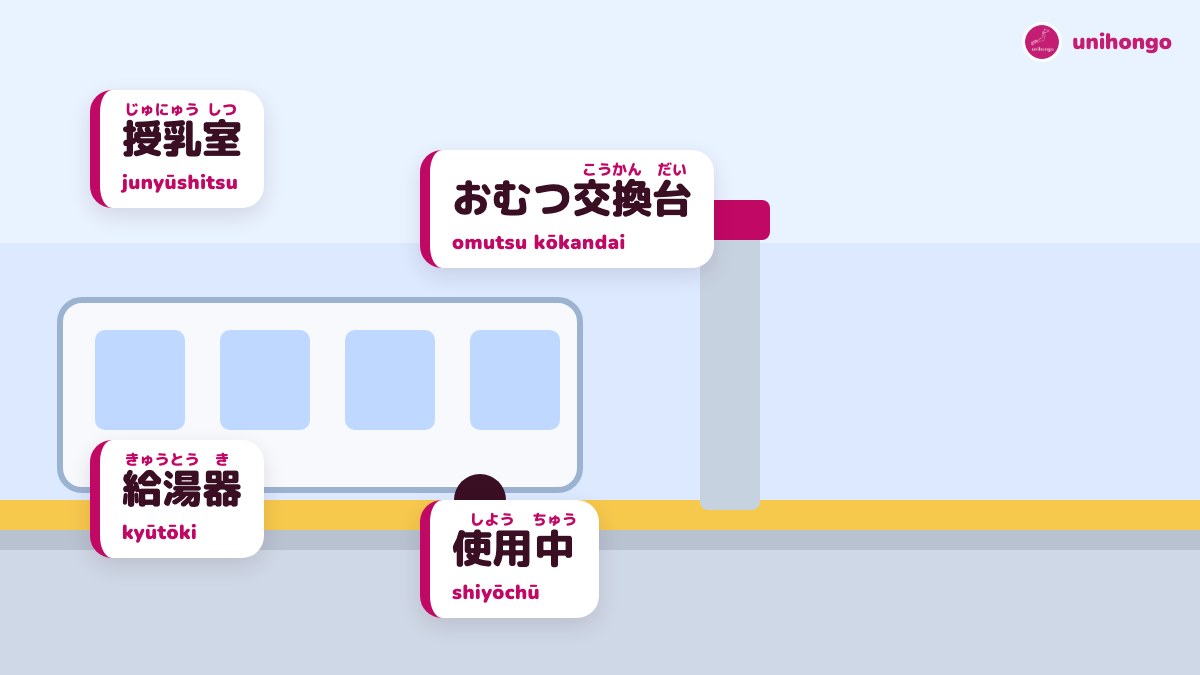
A good baby room in a Japanese department store can feel like a small station of its own. The words below appear on doors, booth curtains, buttons and notices. Hot water dispensers often have a child lock, a button you hold or press first, and the water is very hot.
| Japanese | Romaji | Meaning |
|---|---|---|
| 使用中 | shiyōchū | in use, occupied |
| 空き | aki | vacant |
| 給湯器 | kyūtōki | hot water dispenser |
| 体重計 | taijūkei | baby scale |
| 電子レンジ | denshi renji | microwave |
| 男性の入室はご遠慮ください。 | Dansei no nyūshitsu wa goenryo kudasai. | Sign: Men are asked not to enter. |
| 男性もご利用いただけます。 | Dansei mo goriyō itadakemasu. | Sign: Men may also use this room. |
| おむつはお持ち帰りください。 | Omutsu wa omochikaeri kudasai. | Sign: Please take used diapers home. |
Finding baby facilities in a mall or station
In department stores, the baby room is usually on the floor with children's clothes and toys. Malls often have one near the toilets on each floor, or one larger room near the centre; the floor guide, furoa gaido, marks it with a baby-bottle or baby icon. Many shops also publish their facilities on their website.
Large stations usually have changing tables in the toilets and sometimes a nursing room inside or near the ticket gates; railway websites list them on station pages. Airports have nursing rooms in both the public areas and the departure areas. Children's centres, public libraries and city offices often have one too. When in doubt, ask at the information counter.
Outside the city centre, look at large supermarkets, home centres, family restaurants and motorway service areas, many of which have a changing table or a small baby room. Parks and convenience stores vary much more: some toilets have a changing table and a baby seat, others have nothing, so on a long outing with a small baby it helps to know where the next big shop is.
| Japanese | Romaji | Meaning |
|---|---|---|
| フロアガイド | furoa gaido | floor guide |
| インフォメーション | infomēshon | information counter |
| 何階ですか。 | Nangai desu ka. | Which floor is it on? |
| 改札の中ですか、外ですか。 | Kaisatsu no naka desu ka, soto desu ka. | Is it inside or outside the ticket gates? |
Asking staff, and what you will hear
Staff in shops and stations are used to these questions, and answers are usually very polite. Listen for the floor number, the direction, and the name the building uses for the room.
| Japanese | Romaji | Meaning |
|---|---|---|
| すみません、おむつを替えられる場所はありますか。 | Sumimasen, omutsu o kaerareru basho wa arimasu ka. | Excuse me, is there somewhere I can change a diaper? |
| ミルク用のお湯はいただけますか。 | Miruku-yō no oyu wa itadakemasu ka. | Could I have some hot water for formula? |
| 四階の赤ちゃん休憩室にございます。 | Yonkai no akachan kyūkeishitsu ni gozaimasu. | Staff: It's in the baby rest room on the 4th floor. |
| エスカレーターを上がって右手です。 | Esukarētā o agatte migite desu. | Staff: Go up the escalator, it's on your right. |
Fathers and shared rooms
More fathers in Japan now take babies out alone, and facilities are catching up. In many newer malls, the changing and formula area of a baby room is open to everyone, while the breastfeeding booths are behind a curtain or a separate door. Older rooms may be for women only. Read the sign on the door, or ask; staff can direct you to another changing table, such as the one in a men's or multipurpose toilet.
If you are a mother in a shared space, it is fine to ask someone politely to wait or to step out of the booth area, and staff can help if needed.
| Japanese | Romaji | Meaning |
|---|---|---|
| 男性も入れますか。 | Dansei mo hairemasu ka. | Can men go in? |
| おむつ替えだけしたいんですが。 | Omutsugae dake shitai n desu ga. | I only need to change a diaper. |
| すぐ終わりますので。 | Sugu owarimasu node. | I'll be done soon. |
Mini dialogue: at the information counter
| Japanese | Romaji | Meaning |
|---|---|---|
| すみません、授乳室はありますか。 | Sumimasen, junyūshitsu wa arimasu ka. | You: Excuse me, is there a nursing room? |
| はい、三階の子ども服売り場の奥にございます。 | Hai, sangai no kodomofuku uriba no oku ni gozaimasu. | Staff: Yes, at the back of the children's clothing section on the 3rd floor. |
| お湯もありますか。 | Oyu mo arimasu ka. | You: Is there hot water too? |
| はい、給湯器がございます。 | Hai, kyūtōki ga gozaimasu. | Staff: Yes, there's a hot water dispenser. |
| ありがとうございます。 | Arigatō gozaimasu. | You: Thank you. |
Small manners in a shared baby room
- Close the curtain or lock the booth while feeding, and leave it open when you are done so others can see it is free.
- Wipe the changing table if there are wipes or a spray, and never leave a baby alone on it, even for a second.
- Take used diapers home when the sign asks; some rooms have a bin, many do not.
- Keep feeding times reasonable when people are waiting, and say sumimasen, omatase shimashita if someone waited for you.
- Use the multipurpose toilet when you need it, and leave it promptly for people who have no other option.
Say it before you need it
When the baby is crying, it is hard to remember any Japanese. Practise in a calm moment: open AI Sensei, pick Ibuki-sensei and ask for the role of a staff member at a department store information counter. Ask for the nursing room, hot water and a changing table, and ask the Sensei to give directions with floor numbers so you practise listening for them.
For reading, ask Mocchi /kanji 授 and it will explain the kanji in 授乳室 and show other words that use it, which makes the sign stick.