
The numbers on a viewing day
An agent showing you a flat will tell you its size, its floor and how it compares with the other places you saw. These four lines are the core. Each uses a different counter, and each can change your decision.
| Japanese | Romaji | Meaning |
|---|---|---|
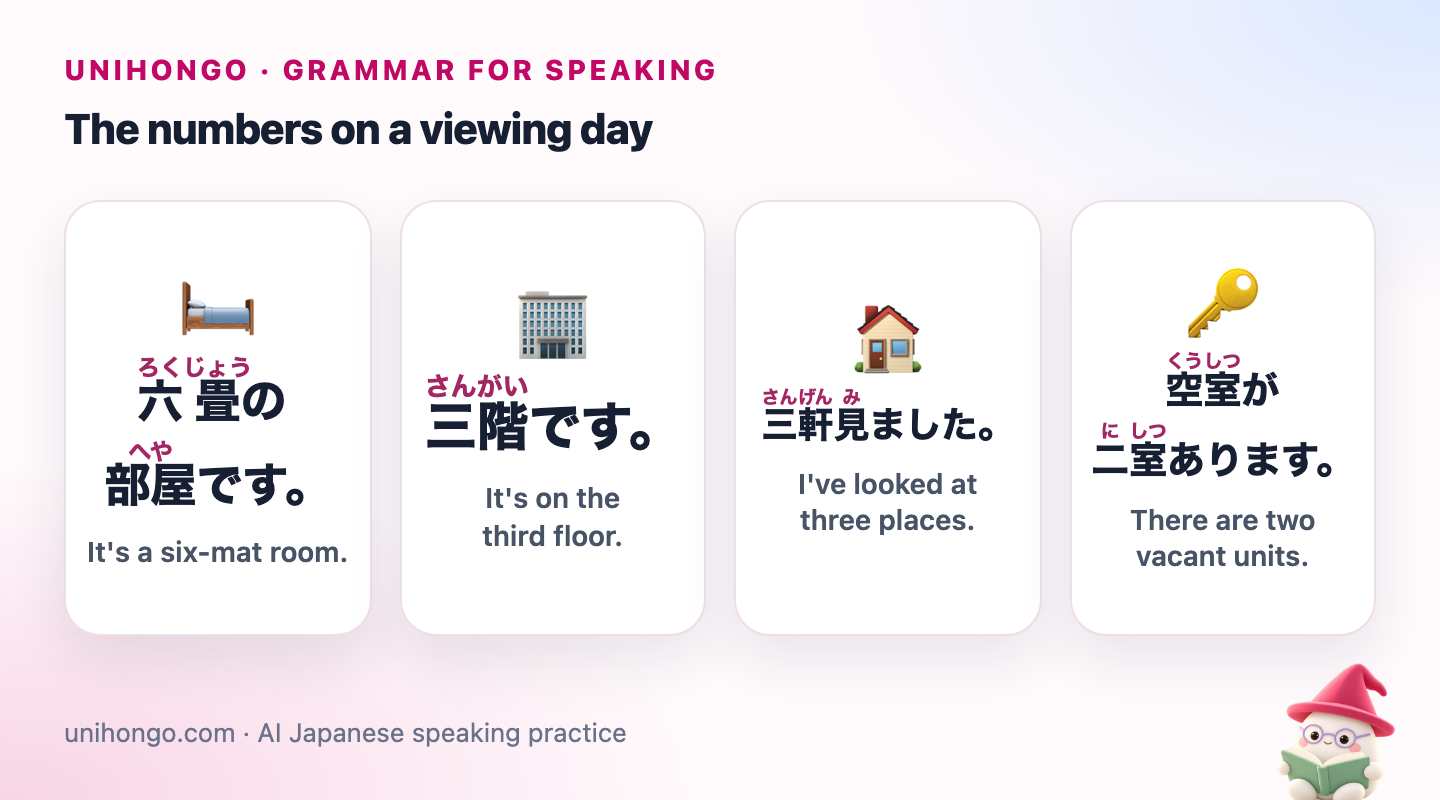
| 六畳の部屋です。 | Rokujō no heya desu. | It's a six-mat room. |
| 三階です。 | Sangai desu. | It's on the third floor. |
| 三軒見ました。 | Sangen mimashita. | I've looked at three places. |
| 空室が二室あります。 | Kūshitsu ga nishitsu arimasu. | There are two vacant units. |
軒: houses, buildings and the shops nearby
軒 (ken) counts houses, buildings and shops: ikken, niken, sangen, yonken, goken, rokken, nanaken, hakken or hachiken, kyūken, jukken. The question is nangen. It appears when you talk about how many places you have viewed and about the neighbourhood: how many convenience stores or supermarkets are nearby.
Ikken is also part of the word ikkendate, a detached house, and ikken ikken means one by one, door to door.
| Japanese | Romaji | Meaning |
|---|---|---|
| 今日は何軒見られますか。 | Kyō wa nangen miraremasu ka. | How many places can we see today? |
| 近くにコンビニが二軒あります。 | Chikaku ni konbini ga niken arimasu. | There are two convenience stores nearby. |
| 一軒家に住みたいです。 | Ikkenya ni sumitai desu. | I'd like to live in a house. |
| もう一軒見てもいいですか。 | Mō ikken mite mo ii desu ka. | Could we see one more place? |
階: floors, from the ground up
階 (kai) counts floors and has two sound changes to remember: three is sangai and the question is nangai. One, six, eight and ten take a small tsu: ikkai, rokkai, hakkai or hachikai, jukkai. In Japan, ikkai is the floor at street level, so nikai is one floor up. Basement floors use chika, underground: chika ikkai.
Many people have preferences about floors. Ground-floor flats can feel less private and less secure, so some tenants, especially people living alone, ask for nikai ijō, the second floor or above. Upper floors may cost more. Ask about an elevator, erebētā, if the building is tall.
| Japanese | Romaji | Meaning |
|---|---|---|
| お部屋は何階ですか。 | Oheya wa nangai desu ka. | Which floor is the flat on? |
| 二階以上がいいです。 | Nikai ijō ga ii desu. | I'd prefer the second floor or above. |
| 五階建ての三階です。 | Gokaidate no sangai desu. | It's on the third floor of a five-storey building. |
| エレベーターはありますか。 | Erebētā wa arimasu ka. | Is there an elevator? |
| ゴミ置き場は一階です。 | Gomi okiba wa ikkai desu. | The rubbish area is on the ground floor. |
畳 and LDK: size and layout
畳 (jō) measures a room in tatami mats, even when the floor is wood. Common sizes are yojōhan, four and a half mats, rokujō, six mats, and hachijō, eight mats. Mat sizes traditionally differ by region, and real estate listings generally use a standard size of at least about 1.6 square metres per mat, so a rokujō room is roughly ten square metres. Check the total area in square metres, heibei, written ㎡ on the listing.
The layout code tells you how many rooms there are besides the shared spaces. The number counts bedrooms or other rooms, and the letters show the shared areas. Read the number in Japanese except for two, which is often nī, and the letters with English letter names.
| Japanese | Romaji | Meaning |
|---|---|---|
| リビングは何畳ですか。 | Ribingu wa nanjō desu ka. | How many mats is the living room? |
| 八畳の洋室と六畳の和室です。 | Hachijō no yōshitsu to rokujō no washitsu desu. | An eight-mat Western room and a six-mat tatami room. |
| 四畳半はちょっと狭いですね。 | Yojōhan wa chotto semai desu ne. | Four and a half mats is a bit small. |
| 2LDKを探しています。 | Nī eru dī kē o sagashite imasu. | I'm looking for a 2LDK. |
| Code | Reading | Meaning |
|---|---|---|
| 1R | wan rūmu | one room with the kitchen inside it |
| 1K | wan kē | one room plus a separate kitchen |
| 1DK | wan dī kē | one room plus a dining-kitchen |
| 1LDK | wan eru dī kē | one room plus a living-dining-kitchen |
| 2LDK | nī eru dī kē | two rooms plus a living-dining-kitchen |
室 and 号室: rooms and room numbers
室 (shitsu) counts rooms in a more formal way, and it is the counter for units in a building and rooms at a hotel: isshitsu, nishitsu, sanshitsu. You meet it in words like kūshitsu, vacant room, and manshitsu, fully booked. In daily speech about your own flat, people usually say heya ga futatsu, two rooms, instead.
号室 (gōshitsu) is a room number, the number you write on forms and deliveries: nihyaku san gōshitsu, room 203. The first digit usually tells you the floor.
| Japanese | Romaji | Meaning |
|---|---|---|
| このマンションは全部で二十室です。 | Kono manshon wa zenbu de nijusshitsu desu. | This building has twenty units in total. |
| お部屋は二つあります。 | Oheya wa futatsu arimasu. | There are two rooms. |
| 何号室ですか。 | Nangōshitsu desu ka. | What's the room number? |
| ホテルを二室予約しました。 | Hoteru o nishitsu yoyaku shimashita. | I booked two hotel rooms. |
Mini dialogue: viewing a flat
You are viewing your third flat of the day with an agent. The agent uses polite service Japanese; you use ordinary polite speech.
| Japanese | Romaji | Meaning |
|---|---|---|
| こちらが三軒目のお部屋です。 | Kochira ga sangenme no oheya desu. | Agent: This is the third place today. |
| 何階ですか。 | Nangai desu ka. | You: Which floor is it? |
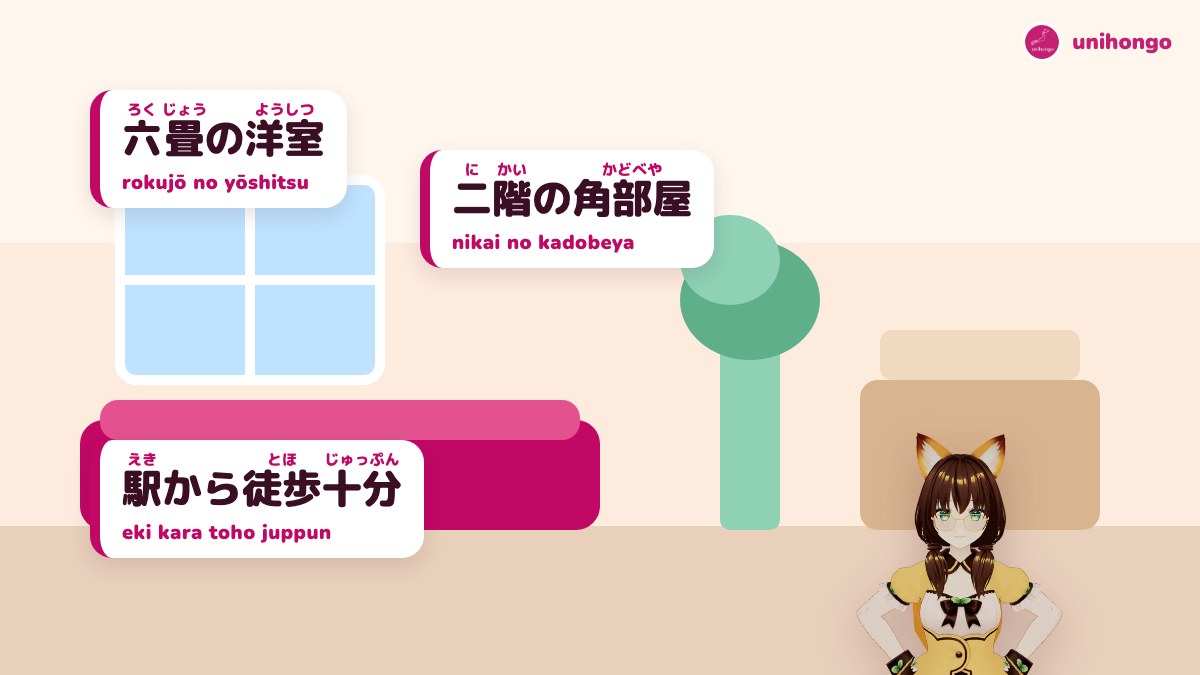
| 二階の角部屋です。 | Nikai no kadobeya desu. | Agent: A corner unit on the second floor. |
| 寝室は何畳ですか。 | Shinshitsu wa nanjō desu ka. | You: How many mats is the bedroom? |
| 六畳です。リビングは十畳あります。 | Rokujō desu. Ribingu wa jūjō arimasu. | Agent: Six mats. The living room is ten. |
| 駅から何分ですか。 | Eki kara nanpun desu ka. | You: How many minutes from the station? |
| 徒歩十分です。 | Toho juppun desu. | Agent: A ten-minute walk. |
| いいですね。もう一軒と比べてから決めます。 | Ii desu ne. Mō ikken to kurabete kara kimemasu. | You: Nice. I'll decide after comparing it with one more. |
The suffix me turns a count into an order: sangenme, the third place; nikaime, the second time. It is handy at viewings, where you will often compare places by number.
Rent, deposits and keys
Money at the rental agency is often counted in months of rent. A listing might say shikikin ikkagetsu, a deposit of one month's rent, and reikin nashi, no key money. The suffix bun, worth of, turns a length into an amount: yachin no nikagetsu bun, two months' rent. Which payments apply and how much they are vary by area, landlord and contract, so ask the agent to go through each one.
Contracts are counted in years with 年 (nen): ninen keiyaku, a two-year contract. Keys are long and thin, so they take 本, and the agent will often tell you how many keys you receive when you sign.
| Japanese | Romaji | Meaning |
|---|---|---|
| 敷金一か月、礼金なしです。 | Shikikin ikkagetsu, reikin nashi desu. | Deposit of one month's rent, no key money. |
| 初期費用は家賃の何か月分ですか。 | Shoki hiyō wa yachin no nankagetsu bun desu ka. | How many months' rent are the move-in costs? |
| 二年契約です。 | Ninen keiyaku desu. | It's a two-year contract. |
| 鍵は二本お渡しします。 | Kagi wa nihon owatashi shimasu. | Agent: We'll give you two keys. |
Mistakes that surprise you on moving day
- Reading nikai as the British second floor. In Japan, nikai is one floor above the street.
- Saying sankai or sanken. They are sangai and sangen, and the questions are nangai and nangen.
- Comparing rooms only by 畳. Mat sizes vary, so check the square metres as well.
- Saying ni eru dī kē with a short ni. Many people stretch it to nī so it is not lost before the letters.
- Using 室 for your own rooms in casual talk. Heya ga mittsu sounds more natural than sanshitsu.
Rehearse the viewing before you go
Paste a real listing into Mocchi and type /explain, or ask: read this listing with me and quiz me on the counters. Mocchi breaks down the floor, size and layout codes, and remembers the words you had to ask about so they come back in a later review.
Then practise the conversation in the View an Apartment mission in AI Sensei, where Hana-sensei plays the estate agent. Ask about the floor, the room sizes and the walk to the station, and ask Hana-sensei to slow down when the numbers come too fast.