
The birth registration in four words
The process is simple once you know its four parts: the registration form, the medical certificate printed on the same sheet, the 14-day deadline, and the handbook you already received during pregnancy, which the office may want to see.
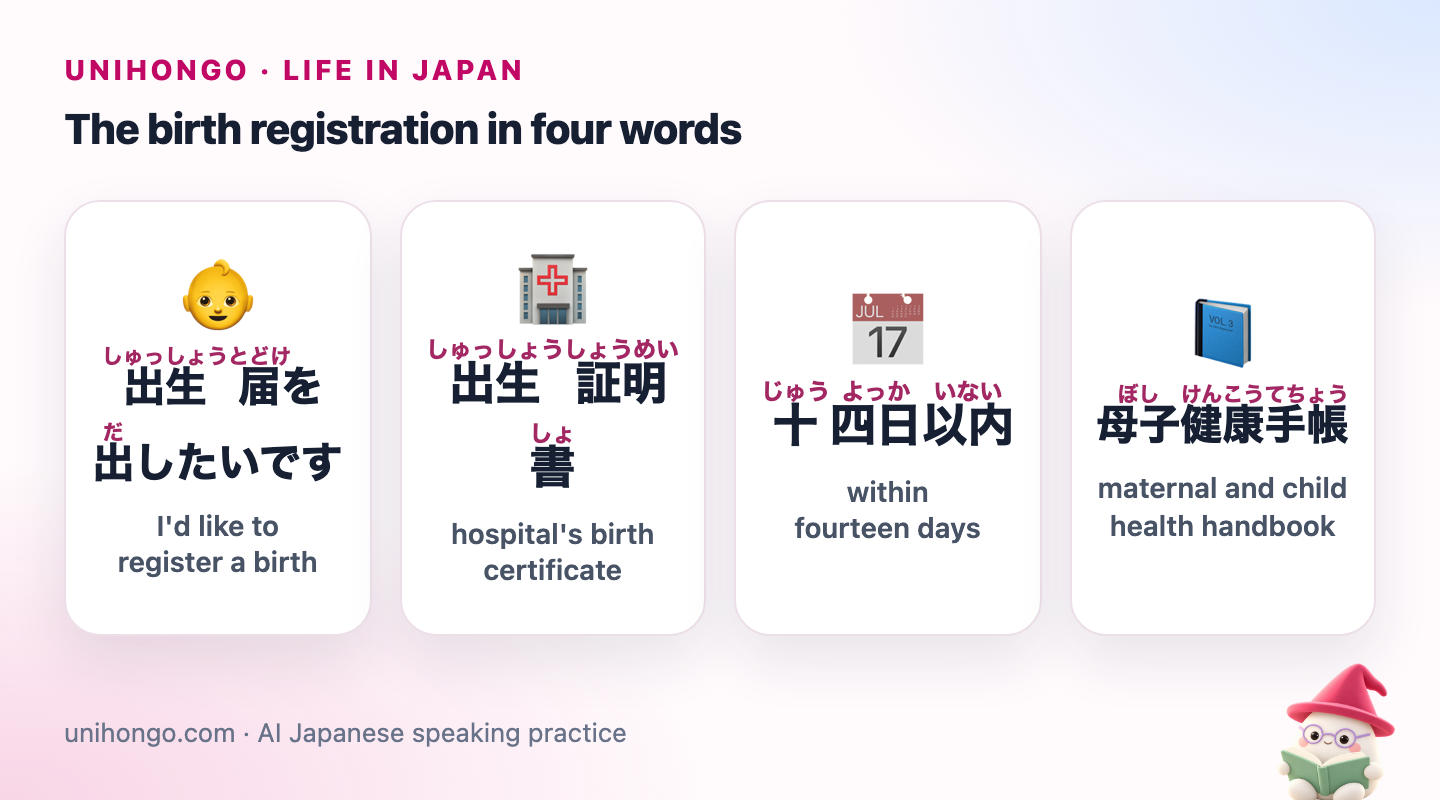
| Japanese | Romaji | Meaning |
|---|---|---|
| 出生届を出したいです | Shusshō todoke o dashitai desu | I'd like to register a birth |
| 出生証明書 | shusshō shōmeisho | hospital's birth certificate |
| 十四日以内 | jūyokka inai | within fourteen days |
| 母子健康手帳 | boshi kenkō techō | maternal and child health handbook |
How the form works
Most hospitals hand you the form, often with the right half already completed and signed by the doctor or midwife. If you give birth at home or the form is not provided, the municipal office has blank forms, and the birth attendant fills in the certificate.
The left half is yours. Write clearly in black ink, and do not cut the sheet in half. If you plan to submit it at a different office from your home city, check whether they need anything extra.
| Japanese | Romaji | Meaning |
|---|---|---|
| 子の氏名 | ko no shimei | the child's name |
| よみかた | yomikata | reading of the name in kana |
| 父母との続き柄 | fubo to no tsuzukigara | relationship to the parents |
| 生まれたところ | umareta tokoro | place of birth |
| 住所・世帯主の氏名 | jūsho, setainushi no shimei | address and name of the head of household |
| 届出人 | todokedenin | the person filing (usually a parent) |
A Japanese baby's name must use characters from the approved lists, and the reading in kana is recorded. For a baby with no Japanese nationality, ask the office how to write the name; many offices ask for katakana with the Latin spelling alongside, matching what you will use on the passport.
Before the birth: decide these in advance
| Japanese | Romaji | Meaning |
|---|---|---|
| 名前の漢字は使えますか。 | Namae no kanji wa tsukaemasu ka. | Can this kanji be used in a name? |
| 外国籍の子の名前はどう書けばいいですか。 | Gaikokuseki no ko no namae wa dō kakeba ii desu ka. | How should we write a foreign child's name? |
- The name and its spelling or reading, including how it will appear on a passport if your baby will have one from another country.
- Which office you will file at, and whether your partner, a relative or you will go.
- Your health insurance: through an employer, or national health insurance at the city office. Ask HR what they need after the birth.
- For foreign parents: which documents your embassy needs to register the birth and issue a passport, and the address of the immigration office for the residence status application.
At the window: the registration and what comes next
Bring the form, the handbook, your ID and, for foreign parents, passports and residence cards. After checking the form, the clerk usually tells you which other windows to visit. Many offices let you do several procedures the same day.
| Japanese | Romaji | Meaning |
|---|---|---|
| 出生届をお願いします。 | Shusshō todoke o onegai shimasu. | You: A birth registration, please. |
| 母子手帳はお持ちですか。 | Boshi techō wa omochi desu ka. | Clerk: Do you have the health handbook? |
| はい、こちらです。 | Hai, kochira desu. | You: Yes, here it is. |
| 次は児童手当の窓口へどうぞ。 | Tsugi wa jidō teate no madoguchi e dōzo. | Clerk: Next, please go to the child allowance window. |
| 受理証明書も必要です。 | Juri shōmeisho mo hitsuyō desu. | You: I also need an acceptance certificate. |
| 住民票も一通ください。 | Jūminhyō mo ittsū kudasai. | You: And one copy of the jūminhyō, please. |
Foreign parents usually need an acceptance certificate, juri shōmeisho, or a certificate of the entries, for the embassy and immigration. A jūminhyō showing the baby is also often requested; for a foreign baby, the record is completed once the residence status is granted, so ask the office what it can issue in the meantime.
The first month, step by step
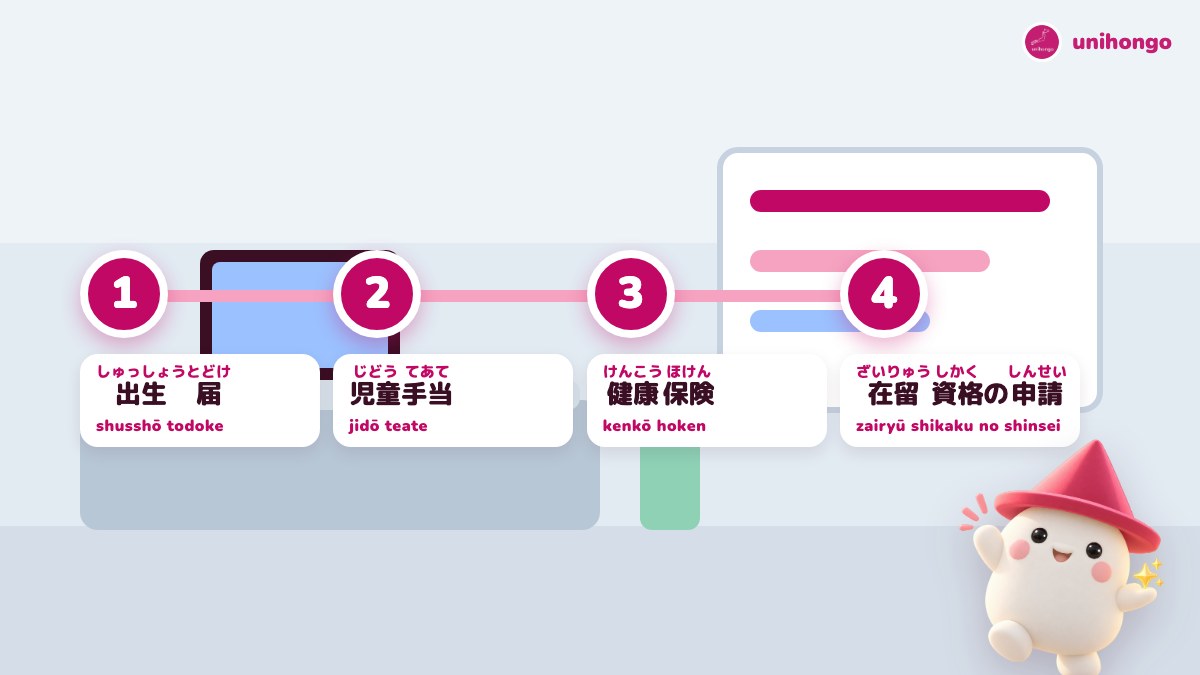
The procedures below are the usual set. Several have short deadlines, so do them together where you can.
| Japanese | Romaji | Meaning |
|---|---|---|
| 児童手当の申請をしたいです。 | Jidō teate no shinsei o shitai desu. | I'd like to apply for child allowance. |
| 子どもを扶養に入れたいです。 | Kodomo o fuyō ni iretai desu. | I'd like to add my child as a dependant. |
| 子どもの在留資格の申請に来ました。 | Kodomo no zairyū shikaku no shinsei ni kimashita. | I'm here to apply for my child's residence status. |
- Birth registration: within 14 days, at the municipal office.
- Child allowance, jidō teate: apply at your city office promptly. Payments generally start from the month after you apply, and offices give a short grace period after the birth, so apply in the same visit.
- Health insurance: add the baby through your employer, or at the city office for national health insurance. The baby's card then lets you use the child medical subsidy many cities offer.
- Child medical subsidy: apply for the recipient card at the city office once the insurance card is ready. Ages covered and rules differ by city.
- Foreign baby: apply for a status of residence at the immigration office within 30 days of the birth if the baby will stay more than 60 days, and contact your embassy for the passport and their own birth registration.
Mini dialogue: calling HR about the insurance
| Japanese | Romaji | Meaning |
|---|---|---|
| 先週、子どもが生まれました。 | Senshū, kodomo ga umaremashita. | You: My child was born last week. |
| おめでとうございます! | Omedetō gozaimasu! | HR: Congratulations! |
| 健康保険の手続きは何が必要ですか。 | Kenkō hoken no tetsuzuki wa nani ga hitsuyō desu ka. | You: What do you need for the health insurance? |
| 扶養の届と、住民票などをお願いします。 | Fuyō no todoke to, jūminhyō nado o onegai shimasu. | HR: A dependant form and a jūminhyō or similar. |
| わかりました。今週中に出します。 | Wakarimashita. Konshūchū ni dashimasu. | You: Understood. I'll submit them this week. |
Mini dialogue: at immigration for a newborn
Foreign parents take the baby's residence status application to the regional immigration office. Requirements depend on the parents' own status, so check the immigration website and bring what it lists, usually the application form, the birth registration acceptance certificate or similar, a jūminhyō for the household, the parents' residence cards and passports, and the baby's passport if it is ready. Ask whether the baby needs to come with you.
| Japanese | Romaji | Meaning |
|---|---|---|
| 子どもの在留資格取得の申請です。 | Kodomo no zairyū shikaku shutoku no shinsei desu. | You: An application for my child's residence status. |
| お子さんのパスポートはありますか。 | Okosan no pasupōto wa arimasu ka. | Officer: Does your child have a passport? |
| まだ申請中です。 | Mada shinseichū desu. | You: It's still being processed. |
| では、出生届の受理証明書を見せてください。 | Dewa, shusshō todoke no juri shōmeisho o misete kudasai. | Officer: Then please show the birth acceptance certificate. |
Mistakes that mean a second trip
- Missing the 14-day deadline because of a hospital stay. If you cannot go, someone else can usually carry the form; a late filing needs an explanation.
- Choosing a kanji that is not on the approved lists, or writing a reading the office queries. Check in advance.
- Forgetting the child allowance application, which can delay the first payment.
- Waiting for the passport before applying for residence status. The 30-day deadline runs regardless; ask immigration what to bring if the passport is not ready.
- Writing a foreign name one way on the form and another on the passport. Consistent spelling saves trouble for years.
A calm checklist before the due date
Ask Mocchi: My baby is due in March. Make me a checklist in English and Japanese for the birth registration, child allowance, health insurance and residence status, with one sentence to say at each window. Mocchi builds the list, explains any word you ask about, and picks up where you left off when you come back after the birth.
If you want to say the lines before you need them, AI Sensei's city hall topic works well: ask Hana-sensei to play the clerk and to speak slowly.