
Key money and deposit in one minute
Both words are built on the kanji 金 (money). Shikikin (敷金) begins with 敷, to lay down: money laid down as security. Reikin (礼金) begins with 礼, thanks or courtesy: it is usually explained as a thank-you payment to the landlord for letting the room. The practical difference is simple. The deposit is yours and comes back, minus what you owe. The key money is gone the moment you pay it.
Both are normally counted in months of rent. An agent will say shikikin ikkagetsu, reikin ikkagetsu, one month each, or reikin nashi, no key money. In many cities the most common range is zero to two months for each, but it depends on the area, the building and the season.
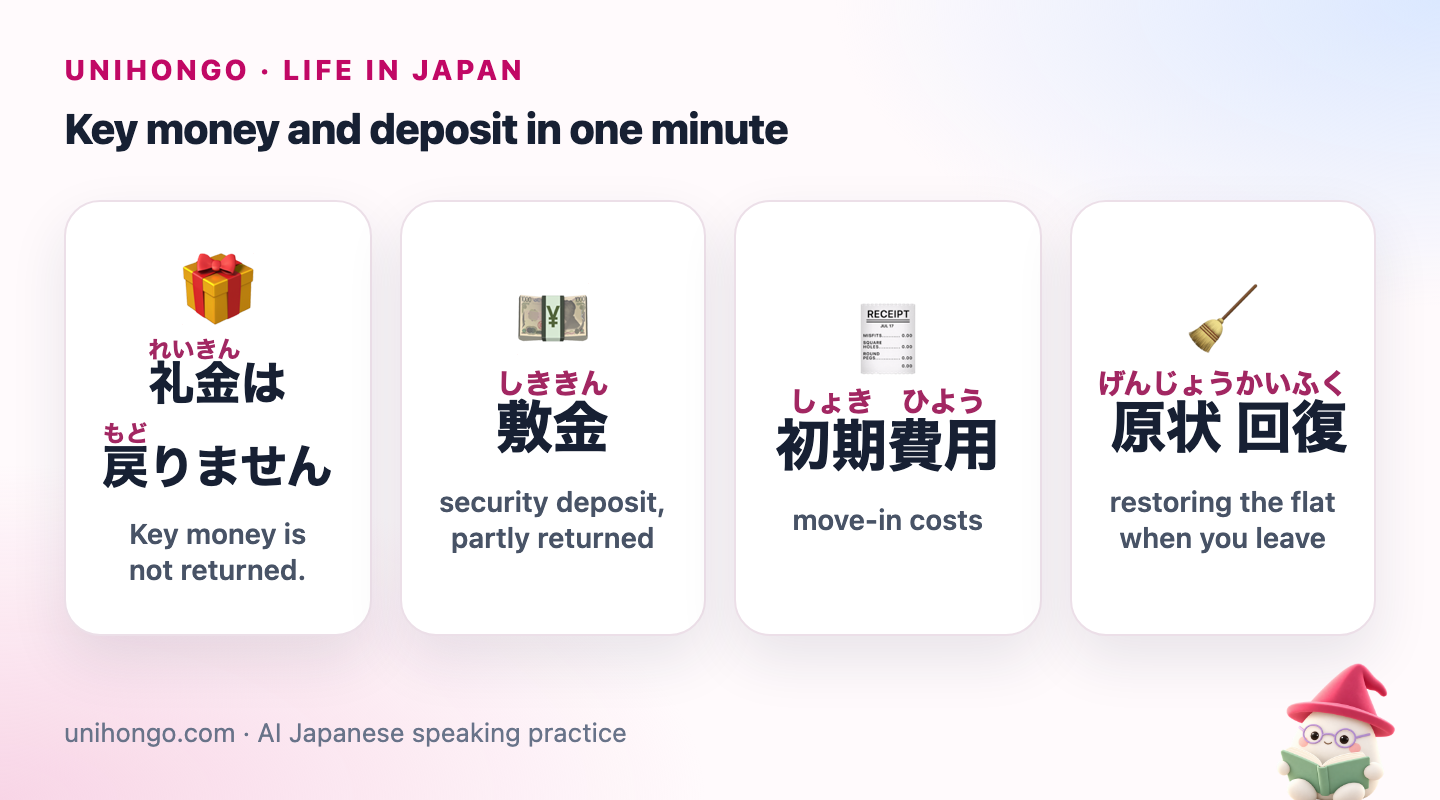
| Japanese | Romaji | Meaning |
|---|---|---|
| 礼金は戻りません | Reikin wa modorimasen. | Key money is not returned. |
| 敷金 | shikikin | security deposit, partly returned |
| 初期費用 | shoki hiyō | move-in costs |
| 原状回復 | genjō kaifuku | restoring the flat when you leave |
| 敷金一か月、礼金なしです。 | Shikikin ikkagetsu, reikin nashi desu. | Agent: One month's deposit, no key money. |
The move-in estimate, line by line
Ask for the estimate in writing, mitsumorisho (見積書), before you apply. The table shows the lines you are most likely to see. Not every flat has every line, and the names vary slightly between agencies.
| Japanese | Romaji | Meaning |
|---|---|---|
| 見積書をいただけますか。 | Mitsumorisho o itadakemasu ka. | Could I have a written estimate? |
| これは必須ですか、任意ですか。 | Kore wa hissu desu ka, nin'i desu ka. | Is this required or optional? |
| 日割り家賃はいつから計算されますか。 | Hiwari yachin wa itsu kara keisan saremasu ka. | From which day is the pro-rated rent counted? |
| Line on the estimate | What it is | Do you get it back? |
|---|---|---|
| 敷金 shikikin | Security deposit held by the landlord | Yes, minus rent owed and repairs |
| 礼金 reikin | Key money, a payment to the landlord | No |
| 仲介手数料 chūkai tesūryō | The letting agency's fee | No |
| 前家賃 mae yachin | Next month's rent paid in advance | No, it is your rent |
| 日割り家賃 hiwari yachin | Rent for the rest of the move-in month | No, it is your rent |
| 火災保険料 kasai hokenryō | Tenant's fire and contents insurance | No |
| 保証料 hoshōryō | First fee to the guarantor company | No |
| 鍵交換費用 kagi kōkan hiyō | Changing the lock for a new tenant | No |
The agency fee has a legal ceiling: the agency's total fee for arranging a rental is limited to one month's rent plus consumption tax, and the tenant's share is in principle half of that unless the tenant agrees in advance to pay more. In practice many agencies ask the tenant for the full month, and the agreement is part of the paperwork, so read what you sign.
You may also see optional extras such as room disinfection (shitsunai shōdoku), a 24-hour support service or a cleaning kit. Some are genuinely optional and some are a condition of the flat. It is fine to ask which is which.
What happens to the deposit when you leave
When you move out, the landlord or management company inspects the flat, works out what has to be repaired and deducts that cost, plus any unpaid rent, from the deposit. The rest is returned, often a month or two after you hand back the keys; the contract may state a time limit.
The key idea is the line between normal wear and damage. Japan's Civil Code, revised in 2020, says the tenant does not have to restore ordinary wear and tear or ageing, and the Ministry of Land, Infrastructure, Transport and Tourism publishes guidelines on restoration that agencies widely refer to. Sun-faded wallpaper, dents from furniture and the natural ageing of tatami are generally the landlord's cost. Cigarette stains, holes you made, mould you let spread and pet damage are generally yours.
Contracts can add a special clause, tokuyaku (特約), such as a fixed professional cleaning fee on leaving. Clear, reasonable clauses that you agreed to are generally treated as valid, so read them before you sign rather than after you leave.
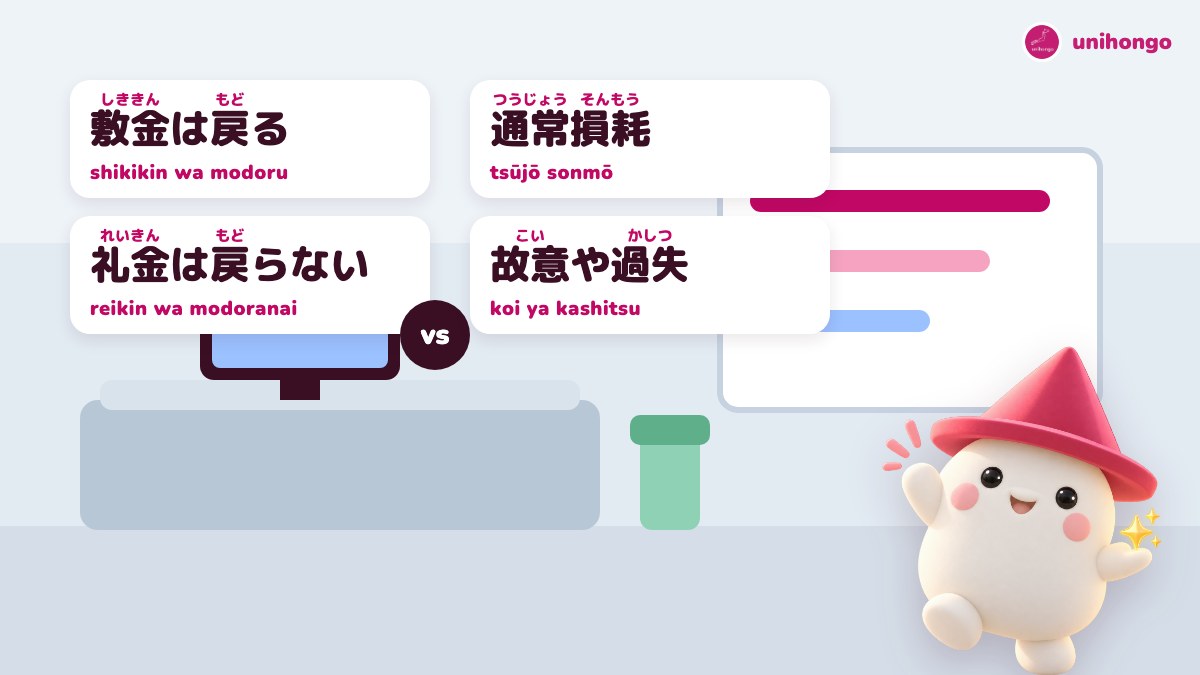
| Japanese | Romaji | Meaning |
|---|---|---|
| 通常損耗 | tsūjō sonmō | normal wear and tear |
| 経年劣化 | keinen rekka | deterioration from age |
| 退去立ち会い | taikyo tachiai | move-out inspection with you present |
| 敷金精算書 | shikikin seisansho | deposit settlement statement |
| この傷は入居した時からありました。 | Kono kizu wa nyūkyo shita toki kara arimashita. | This mark was already here when I moved in. |
| 差し引きの内訳を教えていただけますか。 | Sashihiki no uchiwake o oshiete itadakemasu ka. | Could you tell me the breakdown of the deductions? |
Regional and building differences
Customs differ around the country. In parts of the Kansai region you may see hoshōkin (保証金), a larger deposit, combined with shikibiki (敷引き), a fixed part of it that is kept by the landlord whatever the condition of the flat. Some regions rarely use key money at all. Always read the words on the listing rather than assuming they work the way they did in your last city.
Flats advertised as zero-zero, with no deposit and no key money, are easier to move into but often have other conditions: a cleaning fee charged on leaving, a penalty for cancelling within the first year or two (tanki kaiyaku iyakukin, 短期解約違約金), or a higher rent. Public UR rental housing is known for having no key money, no agency fee and no renewal fee, though it does take a deposit.
| Japanese | Romaji | Meaning |
|---|---|---|
| 敷金礼金ゼロ | shikikin reikin zero | no deposit, no key money |
| 保証金 | hoshōkin | deposit (common in parts of Kansai) |
| 敷引き | shikibiki | fixed amount kept from the deposit |
| 短期解約違約金はありますか。 | Tanki kaiyaku iyakukin wa arimasu ka. | Is there a penalty for leaving early? |
Negotiating politely: what to ask and when
Negotiation in Japanese rentals happens before you apply, through the agent, who passes the request to the landlord or management company. Once you have submitted an application, and certainly once you have signed, the terms are fixed. Ask one or two things, not everything, and frame them as a question about flexibility rather than a demand.
Your chances are better when the room has been on the market for a while, outside the busy season from about January to March, or when you can move in soon. Common requests are a lower key money, a rent-free first month called free rent (furī rento), or skipping an optional add-on. Rent itself is harder to move because it affects the building's other tenants.
| Japanese | Romaji | Meaning |
|---|---|---|
| 礼金は相談できますか。 | Reikin wa sōdan dekimasu ka. | Is the key money negotiable? |
| 礼金を半月分にしていただくことは可能でしょうか。 | Reikin o hantsukibun ni shite itadaku koto wa kanō deshō ka. | Would it be possible to make the key money half a month? |
| フリーレントは付けられますか。 | Furī rento wa tsukeraremasu ka. | Could a rent-free period be added? |
| 条件が合えば、すぐに申し込みたいです。 | Jōken ga aeba, sugu ni mōshikomitai desu. | If the terms work out, I'd like to apply right away. |
Mini dialogue at the agency counter
| Japanese | Romaji | Meaning |
|---|---|---|
| 初期費用の内訳を確認したいのですが。 | Shoki hiyō no uchiwake o kakunin shitai no desu ga. | You: I'd like to go through the breakdown of the move-in costs. |
| はい。敷金と礼金がそれぞれ一か月分です。 | Hai. Shikikin to reikin ga sorezore ikkagetsubun desu. | Agent: Certainly. Deposit and key money are one month each. |
| 礼金を少し下げていただくことはできますか。 | Reikin o sukoshi sagete itadaku koto wa dekimasu ka. | You: Could the key money be lowered a little? |
| 大家さんに確認してみますね。 | Ōya san ni kakunin shite mimasu ne. | Agent: I'll check with the landlord. |
| お願いします。室内消毒は任意ですか。 | Onegai shimasu. Shitsunai shōdoku wa nin'i desu ka. | You: Thank you. Is the room disinfection optional? |
| はい、外すこともできます。 | Hai, hazusu koto mo dekimasu. | Agent: Yes, we can take it off. |
Notice the softeners: no desu ga at the end of the first line, itadaku koto wa dekimasu ka for the request. They keep the tone cooperative. A flat chotto takai desu ne, that's a bit expensive, is fine as a remark but is not a request; follow it with a concrete question.
Mistakes that cost newcomers money
- Comparing flats by monthly rent only. Add up the full move-in estimate and the cost of leaving, including any cleaning clause.
- Thinking key money is a deposit. Reikin is never returned, even if you leave after a month.
- Skipping the move-in photos. Without them, it is hard to show that a mark was there before you.
- Accepting a deduction for normal wear without asking. Ask for the breakdown and, if needed, mention the restoration guidelines politely.
- Trying to renegotiate after signing. Ask before you apply, through the agent, and get the result in writing.
If a deposit dispute does not settle, your local consumer affairs centre (shōhi seikatsu sentā) can advise; the national consumer hotline is 188. This guide is general information, not legal advice.
Read your own estimate with Mocchi
Type the lines of your real estimate into Mocchi and ask: explain each line and tell me which ones I get back. Mocchi explains the words, notes the ones you were unsure about and can quiz you on them later with /quiz, so that by the time you sit down with the agent the vocabulary is familiar.
Then rehearse the request out loud. In AI Sensei, ask Hana-sensei to play a letting agent and try asking for lower key money in polite Japanese; the session report afterwards points out any phrase that came out too blunt.