
Why the konbini is a payment counter
Companies and public offices in Japan send many bills as paper slips with a barcode. Convenience stores have agreements to collect those payments on the company's behalf, a service called shūnō daikō (収納代行). For you, it means you can pay at night or at the weekend, near home, without a bank account.
The slip itself goes by several names: a payment slip, haraikomihyō, a tax payment form, nōfusho, or simply a seikyūsho, bill. What matters is the barcode and the statement on the slip that it can be used at convenience stores, often a row of chain logos.
| Japanese | Romaji | Meaning |
|---|---|---|
| コンビニで払えます。 | Konbini de haraemasu. | You can pay it at a convenience store. |
| 支払いをお願いします。 | Shiharai o onegai shimasu. | I'd like to pay this, please. |
| 夜でも払えるので便利です。 | Yoru demo haraeru node benri desu. | It's handy because you can pay at night. |
The words printed on the slip
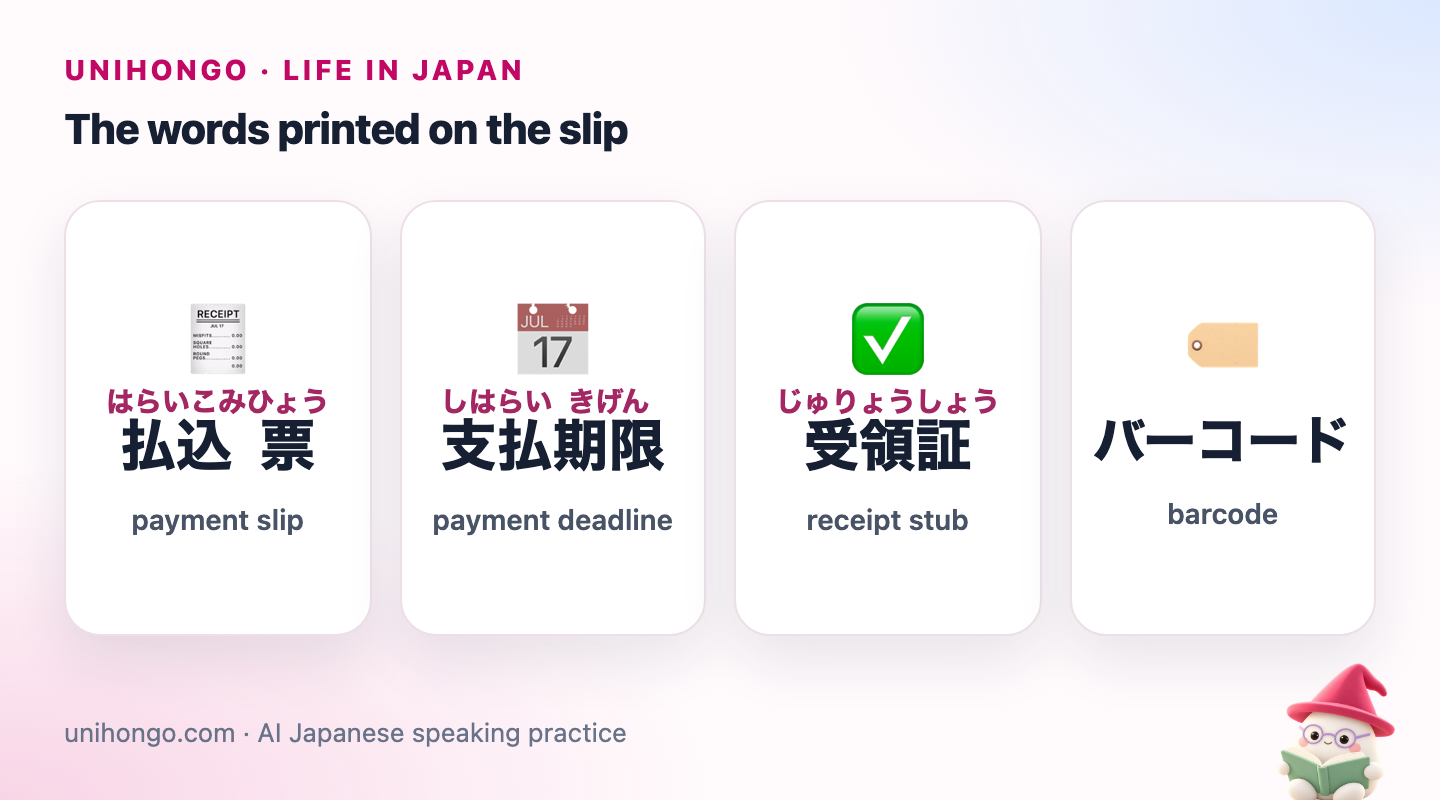
| Japanese | Romaji | Meaning |
|---|---|---|
| 払込票 | haraikomihyō | payment slip |
| 支払期限 | shiharai kigen | payment deadline |
| 受領証 | juryōshō | receipt stub |
| バーコード | bākōdo | barcode |
| 取扱期限 | toriatsukai kigen | last date it can be handled |
| コンビニ収納 | konbini shūnō | payable at convenience stores |
| お客様番号 | okyakusama bangō | customer number |
| ご請求金額 | goseikyū kingaku | amount billed |
| コンビニではお支払いできません | konbini de wa oshiharai dekimasen | cannot be paid at convenience stores |
Read the dates carefully. The payment deadline is when the bill is due; a separate usable date, sometimes labelled toriatsukai kigen or shiyō kigen, is the last day the barcode works at the register. They can be the same or different.
The counter, step by step
| Japanese | Romaji | Meaning |
|---|---|---|
| お支払いですね。 | Oshiharai desu ne. | Clerk: You're paying this, right? |
| 合計で八千二百円になります。 | Gōkei de hassen nihyaku en ni narimasu. | Clerk: That comes to 8,200 yen in total. |
| 画面の確認ボタンを押してください。 | Gamen no kakunin botan o oshite kudasai. | Clerk: Please press the confirm button on the screen. |
| こちら控えになります。 | Kochira hikae ni narimasu. | Clerk: This is your copy. |
| 現金のみになります。 | Genkin nomi ni narimasu. | Clerk: It's cash only, I'm afraid. |
- Bring the whole slip, not a torn-off part, and queue at the register as usual.
- Hand it over and say you want to pay it. The clerk scans the barcode and tells you the amount.
- At some chains you press a confirmation button on the customer screen.
- Pay, usually in cash.
- The clerk stamps the slip, keeps the store's parts and gives you the receipt stub and a register receipt.
Paying for online orders with a number
Many online shops, ticket sites and travel sites offer konbini payment. Instead of a slip, you get a payment number, sometimes with a confirmation number, and a deadline. Each chain handles it a little differently: at some you enter the number on the in-store multimedia terminal, which prints a slip to take to the register within a short time; at others you show the number or a barcode on your phone to the clerk. The shop's confirmation email explains which steps to follow for each chain.
| Japanese | Romaji | Meaning |
|---|---|---|
| お支払い番号 | oshiharai bangō | payment number |
| 確認番号 | kakunin bangō | confirmation number |
| この番号で支払いたいんですが。 | Kono bangō de haraitai n desu ga. | I'd like to pay using this number. |
| 発券された用紙をレジにお持ちください。 | Hakken sareta yōshi o reji ni omochi kudasai. | Take the printed slip to the register. (screen) |
Payment numbers have a deadline, often only a few days after the order. If you miss it, the order is usually cancelled automatically and you have to order again. Payment at the register is final: if you then cancel the order, the refund comes from the shop, not from the konbini.
A full exchange at the register
Here is a typical exchange for a utility bill. The clerk's lines are fast and formulaic, so it helps to know them in advance.
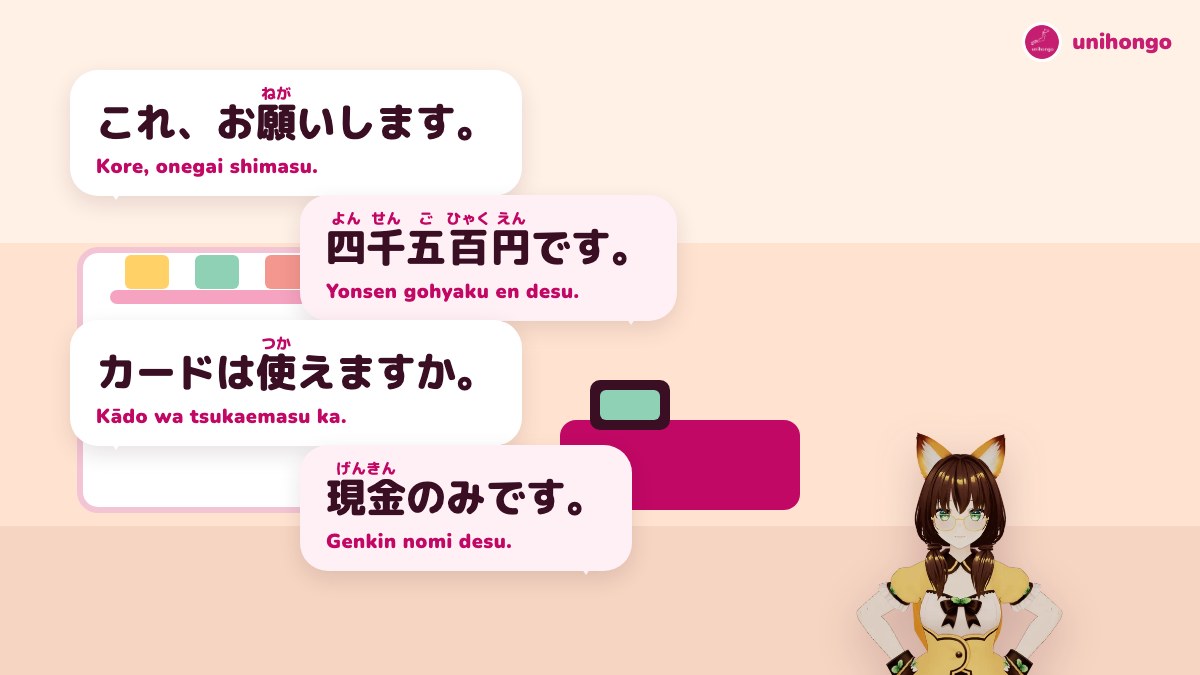
| Japanese | Romaji | Meaning |
|---|---|---|
| これ、お願いします。 | Kore, onegai shimasu. | You: This, please. |
| はい、お支払いですね。四千五百円です。 | Hai, oshiharai desu ne. Yonsen gohyaku en desu. | Clerk: Sure, a payment. That's 4,500 yen. |
| カードは使えますか。 | Kādo wa tsukaemasu ka. | You: Can I use a card? |
| 申し訳ございません、現金のみです。 | Mōshiwake gozaimasen, genkin nomi desu. | Clerk: I'm sorry, cash only. |
| わかりました。現金で。 | Wakarimashita. Genkin de. | You: All right. Cash, then. |
| こちら、受領証です。大切に保管してください。 | Kochira, juryōshō desu. Taisetsu ni hokan shite kudasai. | Clerk: Here's the receipt stub. Please keep it safe. |
What you cannot pay there
The register refuses some slips, and the clerk cannot override it. Common reasons:
| Japanese | Romaji | Meaning |
|---|---|---|
| こちらは期限が過ぎているので、お取り扱いできません。 | Kochira wa kigen ga sugite iru node, otoriatsukai dekimasen. | Clerk: This is past its date, so we can't accept it. |
| どこで払えばいいですか。 | Doko de haraeba ii desu ka. | You: Where should I pay it, then? |
| 発行元にお問い合わせください。 | Hakkōmoto ni otoiawase kudasai. | Clerk: Please contact the issuer. |
- The slip has no barcode or does not list convenience stores as a payment place, as with some postal transfer slips and some tax forms.
- The usable date has passed. Pay at a bank, a post office if listed, or the issuing office, or ask for a new slip.
- The amount is above the limit for barcode payments; large tax bills usually go to a bank or tax office.
- The slip is damaged and the barcode will not scan.
- You want a refund or a correction. The konbini only collects money; contact the company that issued the bill.
Habits that save trouble
- Pay a few days before the deadline; a refused slip on the last day leaves no time.
- Keep receipt stubs for at least a year, longer for tax and pension slips.
- If you pay the same bill every month, consider automatic debit or card payment with the company.
- Do not pay a slip twice: if you lost the stub, ask the company whether the payment was recorded before paying again.
- Be wary of slips or payment numbers from people you do not know; some scams ask victims to pay at a konbini.
- Bring enough cash: konbini ATMs work, but a withdrawal fee may apply outside your bank's free hours.
- Check the name and amount on the slip before paying; a slip sent to the previous resident of your flat is not yours to pay.
Which bills arrive as slips, and a lost slip
You will meet payment slips most often in your first months, before automatic debit is set up. The first electricity, gas or water bill after moving in, the first months of a mobile contract, national health insurance, the national pension and resident tax for people who are not paid through an employer usually come as slips. Online shops, ticket sites and some schools also send them.
If you lose a slip, do not wait for a reminder. Call the company or office that issued it, give your customer number or name and address, and ask for a new one. For public bills, the city office or pension office can reissue it. Once you have paid by a new slip, the old one must not be used.
| Japanese | Romaji | Meaning |
|---|---|---|
| 払込票を再発行していただけますか。 | Haraikomihyō o saihakkō shite itadakemasu ka. | Could you reissue the payment slip? |
| お客様番号をお願いします。 | Okyakusama bangō o onegai shimasu. | Company: Your customer number, please. |
| 口座振替の申込書を送ってください。 | Kōza furikae no mōshikomisho o okutte kudasai. | Please send me the automatic debit form. |
| もう支払いましたが、確認できますか。 | Mō shiharaimashita ga, kakunin dekimasu ka. | I've already paid. Can you check? |
Rehearse the register in five minutes
- Ask Mocchi: "Quiz me on what a konbini clerk says when I pay a bill". Mocchi uses /quiz to test whether you catch each line, and explains the polite forms you miss.
- Ask Mocchi to explain the back of one of your real slips with /explain, so you know where it can and cannot be paid.
- Then open AI Sensei, ask Haru-sensei to play a busy konbini clerk, and pay a bill, ask about card payment and handle a refused slip.