
Eight money proverbs to know
These eight cover the most common money situations: bargains, generosity, free offers, small change, easy money and the link between money and friendship.
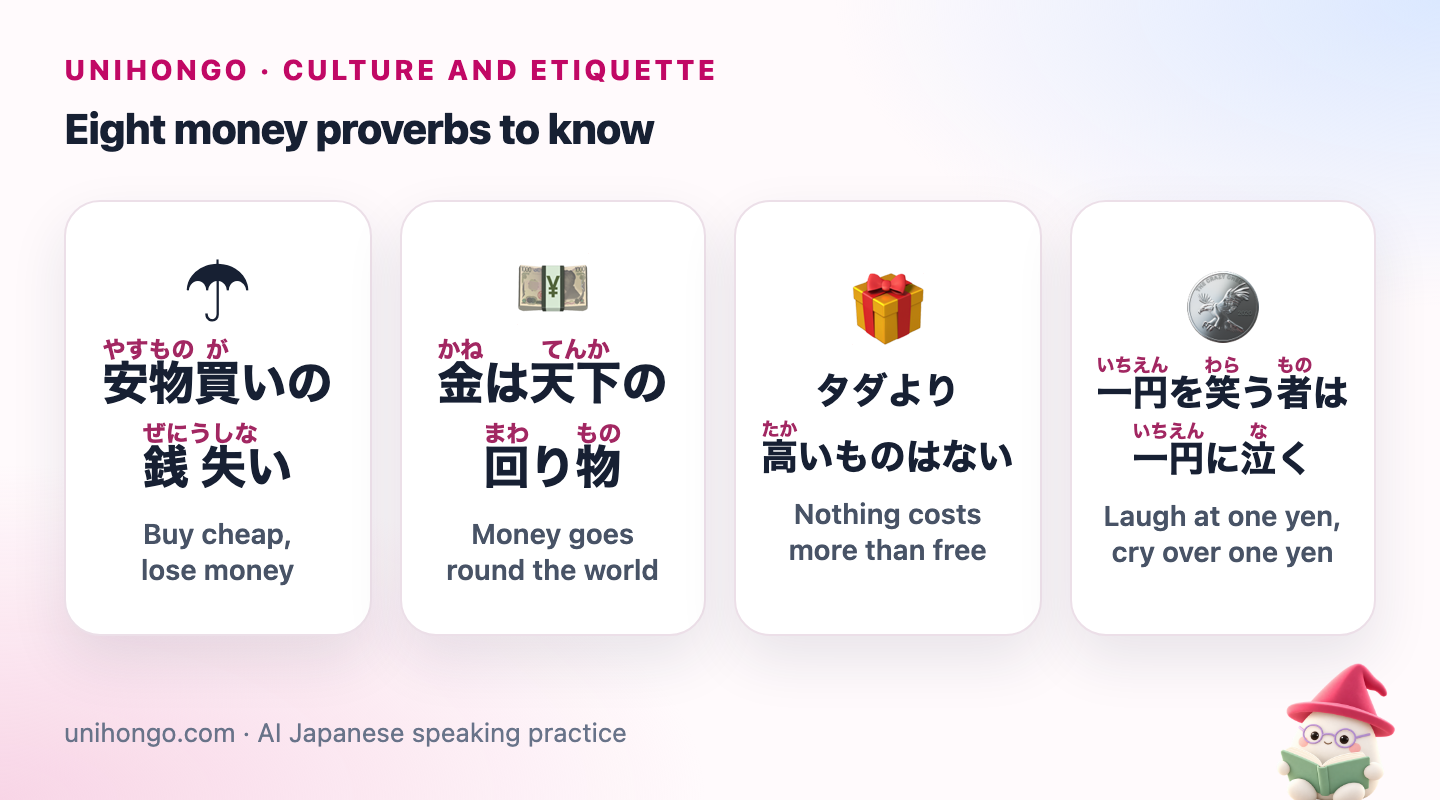
| Japanese | Romaji | Meaning |
|---|---|---|
| 安物買いの銭失い | Yasumonogai no zeniushinai | Buy cheap, lose money |
| 金は天下の回り物 | Kane wa tenka no mawarimono | Money goes round the world |
| タダより高いものはない | Tada yori takai mono wa nai | Nothing costs more than free |
| 一円を笑う者は一円に泣く | Ichien o warau mono wa ichien ni naku | Laugh at one yen, cry over one yen |
| 悪銭身につかず | Akusen mi ni tsukazu | Ill-gotten money never stays |
| 金の切れ目が縁の切れ目 | Kane no kireme ga en no kireme | When money ends, the bond ends |
| 地獄の沙汰も金次第 | Jigoku no sata mo kane shidai | Even hell's verdicts depend on money |
| 宵越しの銭は持たない | Yoigoshi no zeni wa motanai | No money kept overnight: spend it |
安物買いの銭失い: the false bargain
This is probably the money proverb you will hear most. Someone buys a cheap umbrella, it breaks in the first strong wind, they buy another, and in the end they have spent more than a good umbrella would have cost. That is 安物買いの銭失い. It is used about clothes, shoes, electronics, furniture and even cheap language courses.
The tone is usually self-mocking. People say it with a sigh about their own purchases: やっぱり安物買いの銭失いだった, I should have known. Saying it about a friend's purchase can sound like criticism, so add a smile or keep it general. The proverb is also a favourite in advertising for quality goods, so you may see it in shop slogans.
| Japanese | Romaji | Meaning |
|---|---|---|
| やっぱり安物買いの銭失いだった。 | Yappari yasumonogai no zeniushinai datta. | I knew it: a cheap buy that cost me more. |
| 安物買いの銭失いにならないように。 | Yasumonogai no zeniushinai ni naranai yō ni. | So I don't end up wasting money on cheap stuff. |
| このかさ、もう壊れた! | Kono kasa, mō kowareta! | This umbrella's already broken! |
金は天下の回り物 and 宵越しの銭は持たない
金は天下の回り物 says money goes round the whole world. It never stays in one place, so if you have none today you may have some tomorrow, and if you have some now you should not hoard it. It is a classic line for comforting a friend who is broke, for telling someone not to worry about paying you back, or for cheerfully justifying a treat.
宵越しの銭は持たない, I don't keep money overnight, is linked to the image of the Edo townsman, the Edokko, proud of spending the day's earnings the same night. The full traditional phrase starts with 江戸っ子は. Today people use it jokingly about someone who spends everything as soon as it arrives, sometimes as a gentle tease, sometimes with admiration.
| Japanese | Romaji | Meaning |
|---|---|---|
| 金は天下の回り物だから、気にしないで。 | Kane wa tenka no mawarimono da kara, ki ni shinaide. | Money comes and goes, so don't worry about it. |
| 給料日だし、金は天下の回り物! | Kyūryōbi da shi, kane wa tenka no mawarimono! | It's payday, and money's meant to circulate! |
| 彼は宵越しの銭は持たないタイプだね。 | Kare wa yoigoshi no zeni wa motanai taipu da ne. | He's the type who spends it all the same day. |
Free gifts and small change
タダより高いものはない, nothing is more expensive than free, warns that a free offer often comes with a hidden cost: an obligation, a sales pitch or a favour you will be expected to return. You can say it about free offers that are hard to cancel, a free lunch that turns into a sales seminar, or a gift from someone who will later ask for something. It is often written with katakana タダ.
一円を笑う者は一円に泣く, whoever laughs at one yen will cry over one yen, means respect small amounts. It is a modern version of an older saying with 一銭, and it is often said to have been spread by a postal savings slogan. People say it when someone leaves small change behind or ignores small savings.
| Japanese | Romaji | Meaning |
|---|---|---|
| タダより高いものはないよ。 | Tada yori takai mono wa nai yo. | Nothing costs more than free, you know. |
| 一円を笑う者は一円に泣くよ。 | Ichien o warau mono wa ichien ni naku yo. | Don't laugh at small change. |
The darker money proverbs
悪銭身につかず means money gained dishonestly does not stay with you. It is also used, more lightly, about gambling wins or unexpected windfalls that disappear quickly. 金の切れ目が縁の切れ目, when the money runs out, so does the relationship, is a cynical comment on friendships or romances that only lasted while one person was paying. 地獄の沙汰も金次第, even the judgements of hell depend on money, says that money can solve almost anything, and it is used with bitterness or irony.
These three are strong. They make good reading practice and you will meet them in dramas, comics and news commentary, but in conversation they can sound harsh. Use them about stories and characters rather than about people present.
| Proverb | Tone | Safe use |
|---|---|---|
| 悪銭身につかず | Moralising or wry | About a lottery or gambling win that vanished |
| 金の切れ目が縁の切れ目 | Cynical | About a drama plot or a news story |
| 地獄の沙汰も金次第 | Bitter, ironic | About corruption or unfair systems in general |
Mini dialogue: shopping for a suitcase
Two friends are comparing suitcases in a shop. One is tempted by the cheapest model; the other has learnt the hard way.
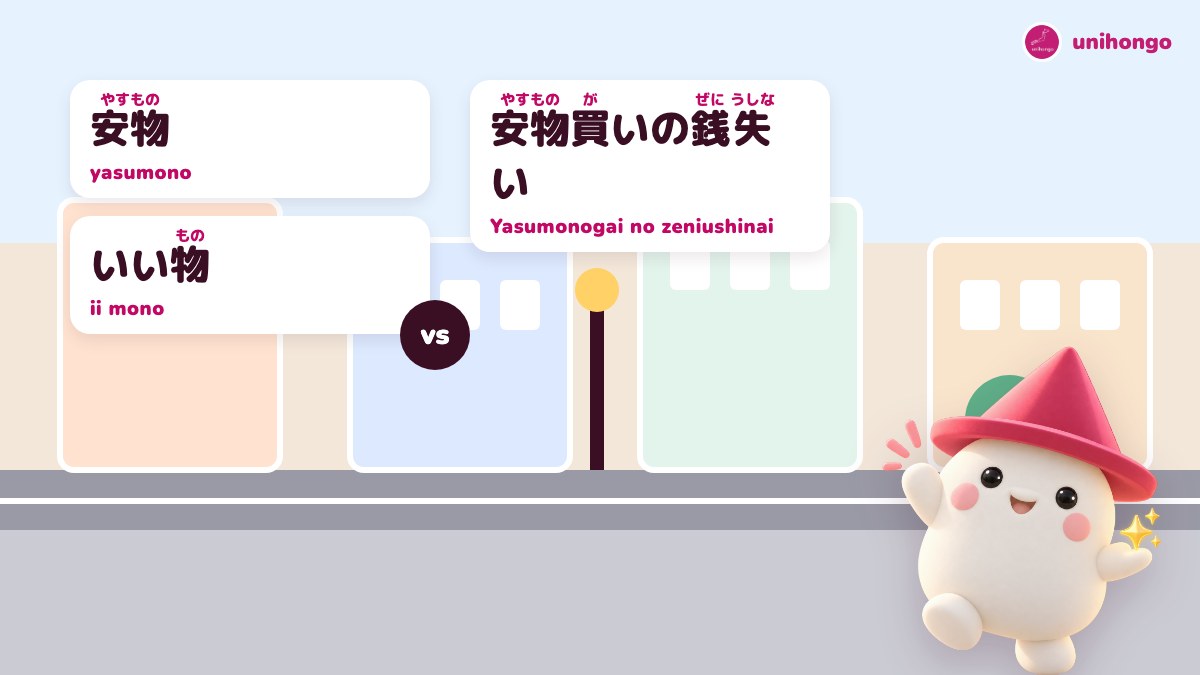
| Japanese | Romaji | Meaning |
|---|---|---|
| このスーツケース、安い!これにしようかな。 | Kono sūtsukēsu, yasui! Kore ni shiyō ka na. | You: This suitcase is cheap! Maybe I'll get it. |
| うーん、車輪が弱そうだよ。 | Ūn, sharin ga yowasō da yo. | Friend: Hmm, the wheels look weak. |
| そう?でも半額だよ。 | Sō? Demo hangaku da yo. | You: Really? But it's half price. |
| 私も前に安いのを買って、一回で壊れたんだ。 | Watashi mo mae ni yasui no o katte, ikkai de kowareta n da. | Friend: I bought a cheap one before and it broke after one trip. |
| 安物買いの銭失いか。じゃあ、こっちにする。 | Yasumonogai no zeniushinai ka. Jā, kotchi ni suru. | You: Buy cheap, pay twice, huh. Then I'll take this one. |
When to keep money proverbs to yourself
- Do not use 金の切れ目が縁の切れ目 about a real couple or friendship you know; it implies someone was only there for the money.
- Avoid commenting on a colleague's purchase with 安物買いの銭失い unless you are close; it can sound like a judgement on their taste or budget.
- Never use money proverbs to comment on someone's salary, rent or debts. Money is a private topic for many people in Japan.
- Do not overdo the classical forms. In daily speech, people say お金 rather than 銭, except inside the proverbs themselves.
Everyday money words that sit beside the proverbs
In daily conversation, money proverbs usually come after plainer money words. Learn these first, because they are what people actually say at the shop, the office and the dinner table, and the proverb is often just the punchline.
節約 means saving or cutting back, and 節約中, I'm on a budget, is a perfectly normal reason to skip a night out. 無駄遣い is wasteful spending, and 衝動買い is impulse buying, the usual cause of 安物買いの銭失い. コスパ, short for cost performance, is the modern word for value for money; something with good コスパ is cheap for what you get, which is the reverse of the false bargain. 割り勘 means splitting the bill equally, which is common among friends, while おごる means to treat someone. If a friend treats you, a natural follow-up is 今度は私がおごるね, next time it's on me, which keeps the friendship balanced in the spirit of 親しき仲にも礼儀あり.
These words are also gentler than proverbs for commenting on spending. 衝動買いしちゃった, I bought it on impulse, is a light confession; 安物買いの銭失いだ is the sigh that follows when it breaks.
| Japanese | Romaji | Meaning |
|---|---|---|
| 今月は節約中なんだ。 | Kongetsu wa setsuyaku chū nan da. | I'm on a budget this month. |
| また衝動買いしちゃった。 | Mata shōdōgai shichatta. | I bought something on impulse again. |
| このお店はコスパがいいね。 | Kono omise wa kosupa ga ii ne. | This place is good value for money. |
| 今日は割り勘にしよう。 | Kyō wa warikan ni shiyō. | Let's split the bill today. |
| 今度は私がおごるね。 | Kondo wa watashi ga ogoru ne. | Next time it's my treat. |
Practise money talk without the awkwardness
A good drill is to explain a purchase decision in Japanese, using one proverb and a reason. Type something like this to Mocchi on Unihongo: /correct 安いイヤホンを買ったけど、すぐ壊れました。安物買いの銭失いでした。 Mocchi corrects the sentence, suggests a more natural phrasing and keeps a note of the proverb for a later review.
Then take the conversation into AI Sensei. Choose Sakura-sensei and ask Sakura-sensei to play a friend helping you choose between two products in a shop. Weigh price against quality out loud, try one proverb at the right moment, and see how the Sensei reacts.