
Five insurances, one word
Shakai hoken literally means social insurance. People use it in two ways. In the narrow sense it means the insurance run by the health insurer and the pension service: health insurance and the employees' pension, with nursing care insurance added from age 40. In everyday talk, as in a job advert that says shaho kanbi (社保完備), fully covered by social insurance, it usually includes the two labour insurances as well.
| Japanese | Romaji | Meaning |
|---|---|---|
| 社会保険に入ります。 | Shakai hoken ni hairimasu. | I'll be enrolled in social insurance. |
| 社保完備 | shaho kanbi | full social insurance (job ads) |
| 保険料は給料から引かれます。 | Hokenryō wa kyūryō kara hikaremasu. | The premiums are taken from your salary. |
What each insurance covers
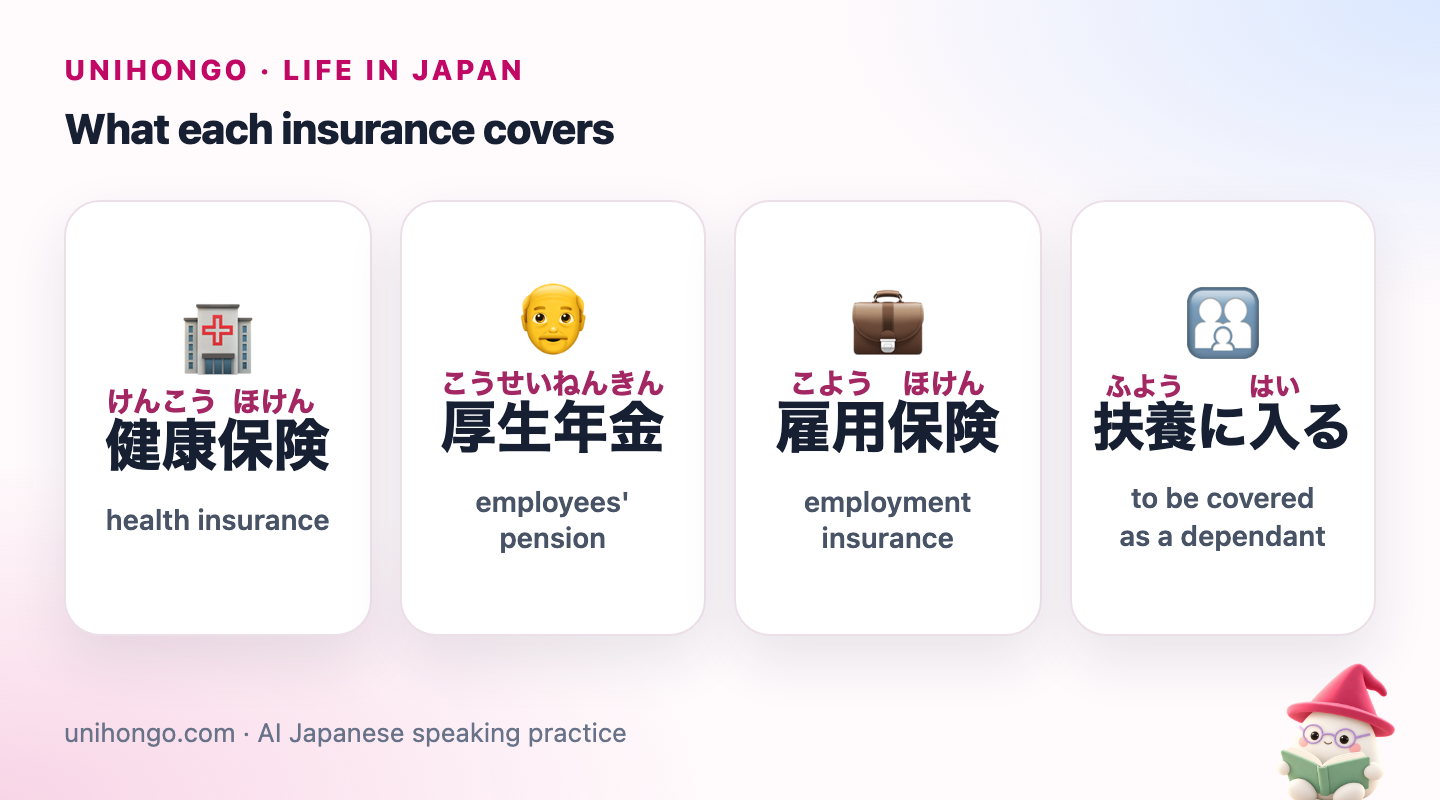
| Japanese | Romaji | Meaning |
|---|---|---|
| 健康保険 | kenkō hoken | health insurance |
| 厚生年金 | kōsei nenkin | employees' pension |
| 雇用保険 | koyō hoken | employment insurance |
| 扶養に入る | fuyō ni hairu | to be covered as a dependant |
| Insurance | What it does | Who pays |
|---|---|---|
| Health insurance (kenkō hoken) | Covers most of the cost of treatment, plus sick pay and childbirth benefits | You and the employer |
| Employees' pension (kōsei nenkin) | Old-age, disability and survivors' pensions | You and the employer, half each |
| Nursing care (kaigo hoken) | Long-term care later in life; paid with health insurance from 40 to 64 | You and the employer |
| Employment (koyō hoken) | Unemployment benefit, training support, childcare leave benefit | You and the employer, employer more |
| Workers' accident (rōsai hoken) | Injury or illness at work or on the commute | Employer only |
Shakai hoken or the city's national health insurance
Everyone living in Japan for more than three months must have public health insurance. If you are not in an employer's scheme, you join kokumin kenkō hoken, often shortened to kokuho, at the city office. The treatment is the same at the clinic: the share you pay at the counter is the same. The differences are in who runs it, how premiums are calculated and how families are covered.
| Point | Employer insurance | National health insurance |
|---|---|---|
| Run by | Kyōkai kenpo or a company insurance society | Your city or ward |
| Premium | Percentage of pay, shared with the employer | Based on household income and members, paid by you |
| Family | Dependants covered without extra premium | Each member is counted in the premium |
| Sick pay | Yes, if you cannot work due to illness | Generally no |
Your insurer is printed on your insurance documents. Kyōkai kenpo (協会けんぽ) covers many small and medium companies; large companies often have their own society, a kenkō hoken kumiai (健康保険組合).
How premiums are set
Premiums are not calculated on each month's exact pay. They are based on a standard monthly remuneration, hyōjun hōshū getsugaku, a pay band set from your average pay, usually reviewed each year using April to June pay and revised when your pay changes a lot. That is why overtime in spring can raise your deductions for months afterwards, and why your first payslips may show a figure based on your contract rather than actual pay.
Rates for health insurance differ by insurer and prefecture and are revised regularly; the pension rate is set nationally. Bonus payments also carry premiums.
| Japanese | Romaji | Meaning |
|---|---|---|
| 標準報酬月額 | hyōjun hōshū getsugaku | standard monthly remuneration |
| 保険料率 | hokenryō ritsu | premium rate |
| 被保険者 | hihokensha | insured person |
| 被扶養者 | hifuyōsha | dependant |
| 事業主負担 | jigyōnushi futan | employer's share |
| 定時決定 | teiji kettei | yearly revision of the pay band |
| 保険料が上がったのはなぜですか。 | Hokenryō ga agatta no wa naze desu ka. | Why did my premiums go up? |
Look for a notice from HR, often in September, that your standard monthly remuneration has been revised. It explains why your deductions change even when your salary did not. If a large drop in pay lasts several months, the band can also be revised mid-year; ask HR.
Joining, leaving, and the deadlines
When you join a company, HR handles enrolment, shikaku shutoku (資格取得). You receive proof of insurance: since the end of new paper cards, that is usually your My Number card registered as an insurance card, or an eligibility certificate (資格確認書) if you do not use one.
When you leave, your enrolment ends, shikaku sōshitsu (資格喪失), on the day after your last day. From that day, the employer insurance cannot be used. Plan the switch before you leave.
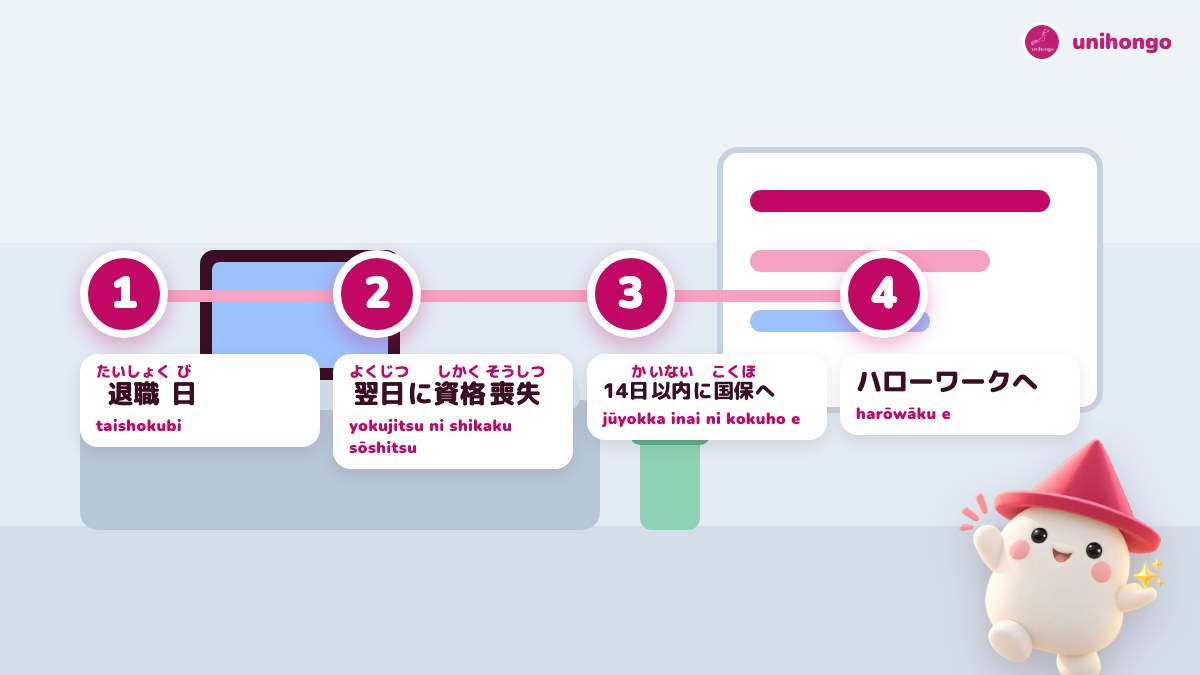
- Health insurance: join kokuho at the city office within 14 days, or apply to continue the employer insurance voluntarily (nin'i keizoku) within 20 days, or join a family member's insurance as a dependant.
- Pension: switch to kokumin nenkin at the city office, unless you start a new job straight away.
- Employment insurance: HR sends a separation notice, the rishokuhyō (離職票), which you take to Hello Work to apply for unemployment benefit if you are eligible.
- Ask HR for the loss-of-eligibility certificate, shikaku sōshitsu shōmeisho, which the city office may ask to see.
Asking HR
HR questions about insurance are routine. Use polite Japanese, keep each question to one point, and ask for the answer in writing if it involves dates.
| Japanese | Romaji | Meaning |
|---|---|---|
| 社会保険の加入はいつからですか。 | Shakai hoken no kanyū wa itsu kara desu ka. | You: From when am I enrolled in social insurance? |
| 妻を扶養に入れたいのですが。 | Tsuma o fuyō ni iretai no desu ga. | You: I'd like to add my wife as a dependant. |
| では、収入がわかる書類を出してください。 | Dewa, shūnyū ga wakaru shorui o dashite kudasai. | HR: Then please submit a document showing her income. |
| 資格喪失証明書をいただけますか。 | Shikaku sōshitsu shōmeisho o itadakemasu ka. | You: Could I have the loss-of-eligibility certificate? |
| 離職票はいつ届きますか。 | Rishokuhyō wa itsu todokimasu ka. | You: When will the separation notice arrive? |
| マイナ保険証の登録はしていますか。 | Maina hokenshō no tōroku wa shite imasu ka. | HR: Have you registered your My Number card as an insurance card? |
| まだです。どうすればいいですか。 | Mada desu. Dō sureba ii desu ka. | You: Not yet. What should I do? |
Points that confuse newcomers
- Using the health insurance card for an injury at work or on the way to work. That is workers' accident insurance; tell the clinic and HR.
- Assuming coverage continues for a few days after leaving. It ends the day after your last day.
- Thinking that kokuho is worse care. The clinic treats both the same; the differences are premiums and benefits like sick pay.
- Forgetting that resident tax is not part of shakai hoken, even though it sits next to it on the payslip.
- Not telling HR about a new dependant, a marriage or a birth, which can change your cover and your family's.
- Expecting the first payslip to show no insurance. Premiums are usually deducted from the following month's pay, so the first and last payslips can look unusual.
- Starting a new job a week after leaving the old one and forgetting the gap: for those days you still need cover, through kokuho or a family member's insurance.
Benefits people forget they have
Health insurance through an employer pays more than doctors' bills. If you cannot work because of an illness or injury that is not work-related, and you are not paid during that time, you can claim sickness allowance, shōbyō teatekin (傷病手当金), after a short waiting period. It replaces part of your pay for a limited time, and you apply through your insurer with forms from HR and a doctor's statement. The national health insurance run by cities generally does not offer this.
For childbirth, public health insurance pays a lump-sum birth allowance, shussan ikuji ichijikin, usually paid straight to the hospital. Employees who take maternity leave can also receive a maternity allowance, shussan teatekin, from employer insurance, and employment insurance supports childcare leave. The amounts and conditions are revised, so ask HR when the time comes.
| Japanese | Romaji | Meaning |
|---|---|---|
| 傷病手当金 | shōbyō teatekin | sickness allowance |
| 出産育児一時金 | shussan ikuji ichijikin | lump-sum birth allowance |
| 出産手当金 | shussan teatekin | maternity allowance |
| 病気で休んでいる間、手当はもらえますか。 | Byōki de yasunde iru aida, teate wa moraemasu ka. | Can I get an allowance while I'm off sick? |
| 申請書はどこでもらえますか。 | Shinseisho wa doko de moraemasu ka. | Where can I get the application form? |
A study plan for insurance words
These words come back every month on your payslip, so they are worth learning properly. Tell Mocchi your situation, for example that you are changing jobs next month, and ask it to add the insurance words to your study plan with /adjust-plan; it builds a few small daily tasks and ticks them off as you go. Use /kanji 険 to see how the same character runs through 保険, 保険料 and 保険証.
For fast recognition, play Vocabulary Dash with a flashcard set of the ten words in this guide until you can read them on a payslip without slowing down.