
Locked out: four lines to know
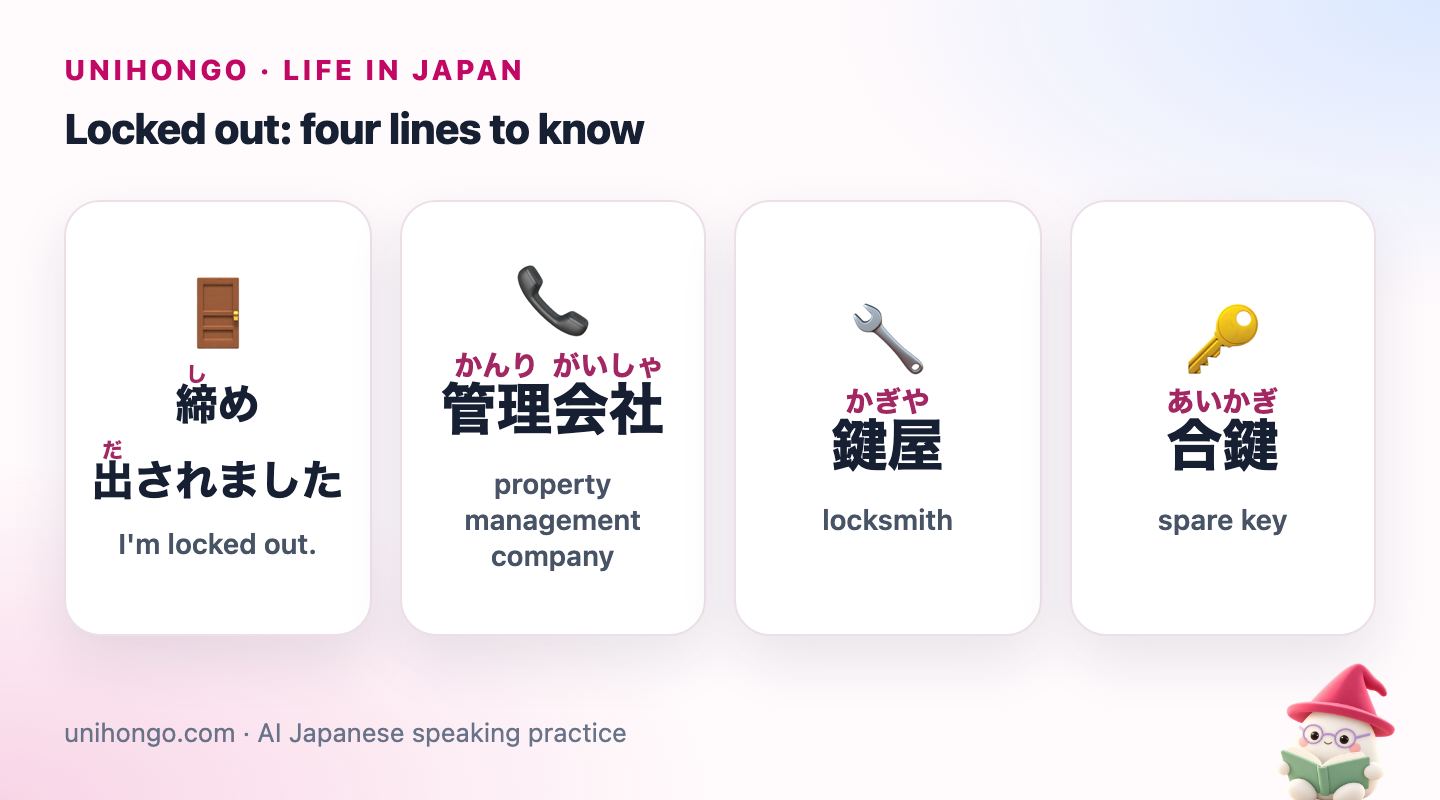
Shimedasareta (締め出された) literally means I was shut out, and it is the natural way to say you are locked out. The other three words name the people and the thing you need.
| Japanese | Romaji | Meaning |
|---|---|---|
| 締め出されました | Shimedasaremashita. | I'm locked out. |
| 管理会社 | kanri gaisha | property management company |
| 鍵屋 | kagiya | locksmith |
| 合鍵 | aikagi | spare key |
Who to call, in order
| Japanese | Romaji | Meaning |
|---|---|---|
| 二十四時間対応ですか。 | Nijūyo jikan taiō desu ka. | Are you available 24 hours? |
| 緊急の場合は | kinkyū no baai wa | in an emergency (on a recording) |
| 鍵を開けに来ていただけますか。 | Kagi o ake ni kite itadakemasu ka. | Could you come and open the lock? |
- Anyone else with a key: a partner, housemate or family member who lives with you.
- The management company or landlord. Look for the number in your contract, phone contacts, the mailbox area or the notice board at the entrance.
- A 24-hour support service. Many contracts include one, sometimes listed on the move-in estimate as 24-hour support (24時間サポート). It can send someone to open the door, sometimes for a fee.
- A locksmith. Search for one nearby, ask for the total price before agreeing, and prepare proof of address.
- The police, only if you suspect a break-in or your key was stolen. For a simple lockout, they will usually direct you to the management company or a locksmith.
Outside office hours the management company's normal number may play a recording with an emergency number; listen for kinkyū no baai wa, in an emergency, followed by the number.
Calling the management company
Give the building name and room number first, then the situation in one sentence. They may ask you to confirm your identity, check that you are the registered tenant, and tell you whether they can send someone or whether you should call their contracted locksmith.
| Japanese | Romaji | Meaning |
|---|---|---|
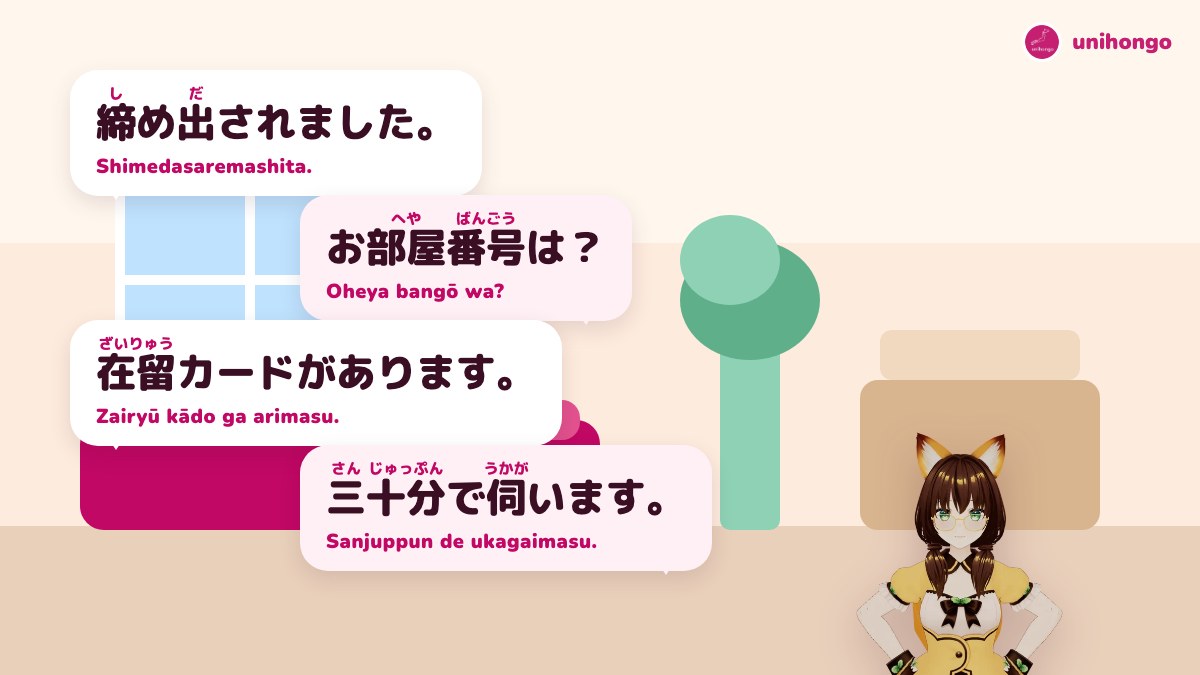
| さくらハイツの二〇三号室の者です。 | Sakura Haitsu no nimarusan gōshitsu no mono desu. | You: I'm the tenant of room 203 in Sakura Heights. |
| 鍵を部屋の中に忘れて、締め出されてしまいました。 | Kagi o heya no naka ni wasurete, shimedasarete shimaimashita. | You: I left my key inside and I'm locked out. |
| ご本人確認ができるものはお持ちですか。 | Gohonnin kakunin ga dekiru mono wa omochi desu ka. | Staff: Do you have something to confirm your identity? |
| 在留カードを持っています。 | Zairyū kādo o motte imasu. | You: I have my residence card. |
| 三十分ほどで担当者が伺います。 | Sanjuppun hodo de tantōsha ga ukagaimasu. | Staff: Someone will be there in about thirty minutes. |
| 費用はかかりますか。 | Hiyō wa kakarimasu ka. | You: Will there be a charge? |
Calling a locksmith
Locksmiths in Japan work around the clock in most cities, but prices vary widely and late-night work costs more. Before agreeing, ask for the total including the call-out fee, shutchōryō (出張料). A reputable locksmith will ask for proof that you live there, usually a residence card or a document with your name and address, and may decline to open a door if you cannot show it. That is a protection for you too.
| Japanese | Romaji | Meaning |
|---|---|---|
| 家の鍵を開けてほしいのですが。 | Ie no kagi o akete hoshii no desu ga. | I'd like you to open my door. |
| 出張料を含めて、全部でいくらですか。 | Shutchōryō o fukumete, zenbu de ikura desu ka. | How much in total, including the call-out fee? |
| 鍵の種類はディンプルキーです。 | Kagi no shurui wa dinpuru kī desu. | The key is a dimple key. |
| 作業の前に金額を確認させてください。 | Sagyō no mae ni kingaku o kakunin sasete kudasai. | Please let me confirm the price before you start. |
Auto-lock entrances and modern locks
Many buildings have an auto-lock entrance, ōto rokku (オートロック): the outer door opens only with your key, a code or a card, or when someone buzzes you in from inside. If you are locked out of the whole building, the locksmith or management company has to get through that door too, so mention it on the phone. Some buildings ask residents not to let strangers follow them in; follow your building's rules.
Newer flats may use card keys or smart locks that open with a phone or a code. If a smart lock's battery runs out, many models still have a physical key or an emergency power point; keep the backup key somewhere other than inside the flat.
| Lock word | What it is | What to tell the caller |
|---|---|---|
| オートロック ōto rokku | Locked building entrance | That the entrance is locked too |
| ディンプルキー dinpuru kī | Key with dimples, hard to copy | The key type, if you know it |
| カードキー kādo kī | Card that opens the door | That it is a card system |
| スマートロック sumāto rokku | Lock opened by phone or code | The model, and that the battery died |
| ダブルロック daburu rokku | Two locks on one door | That there are two locks |
If your key is lost, not just left inside
A lost key is a security question as well as an inconvenience. Report it at a kōban (police box) or police station as a lost item, ishitsu todoke (遺失届). Tell the management company, and ask whether the lock cylinder should be changed, shirindā kōkan (シリンダー交換). Because the building's lock belongs to the landlord, arrange the change through them or with their permission. When the tenant loses a key, the cost of the new cylinder is usually the tenant's.
If you lose a card key or a key for a building with auto-lock, the replacement may need to be registered with the building's system; this takes time, so ask early.
| Japanese | Romaji | Meaning |
|---|---|---|
| 家の鍵をなくしました。 | Ie no kagi o nakushimashita. | I've lost my house key. |
| 遺失届を出したいです。 | Ishitsu todoke o dashitai desu. | I'd like to report a lost item. |
| シリンダー交換は必要ですか。 | Shirindā kōkan wa hitsuyō desu ka. | Does the lock cylinder need changing? |
| 費用はどちらの負担になりますか。 | Hiyō wa dochira no futan ni narimasu ka. | Who pays for it? |
Before it happens: a five-minute setup
A lockout is much easier when the information is ready. Take five minutes this week to prepare, ideally with your contract in front of you, and you will spend the stressful night making one call instead of searching for numbers.
| Japanese | Romaji | Meaning |
|---|---|---|
| 夜間の緊急連絡先を教えてください。 | Yakan no kinkyū renrakusaki o oshiete kudasai. | Please tell me the night emergency number. |
| 鍵のトラブルもサポートの対象ですか。 | Kagi no toraburu mo sapōto no taishō desu ka. | Does the support service cover key problems? |
| スペアキーを作ってもいいですか。 | Supea kī o tsukutte mo ii desu ka. | May I make a spare key? |
- Save the management company's daytime and emergency numbers in your phone, with the building name and room number in the contact.
- Check your contract or move-in estimate for a 24-hour support service, and note what it covers.
- Take a photo of your residence card and keep the card itself in your wallet, not on the shelf by the door.
- Ask whether a trusted friend nearby could hold a spare key, if your contract allows a spare.
- Write down the key's number or the maker's name stamped on it; locksmiths and makers can use it.
Mistakes to avoid
- Climbing in from a neighbour's balcony or your own. It is dangerous and looks like a break-in to anyone watching.
- Calling the first locksmith ad without asking the total price. Confirm the amount before work starts.
- Changing the lock yourself without telling the management company. The lock is part of the landlord's property.
- Saying wasuremashita when the key is lost. Wasureta means you left it somewhere known; nakushita means it is gone.
- Hiding a spare key under the doormat or in the meter box. These are the first places a burglar looks.
Rehearse the late-night call
Ask Mocchi for a short script for your own building: type your building name and room number and ask for the lockout call in polite Japanese, with two likely questions from the staff. Mocchi remembers your building details for the next time you practise.
Then say it under pressure. In AI Sensei, ask Sakura-sensei to be a tired management company operator at night who speaks quickly, and get through the call: situation, identity, price and arrival time.