
Four housing words on every listing site
Japanese property sites sort homes by a handful of type words. Learn these four first; the rest of this guide fills in the details and the less common types.
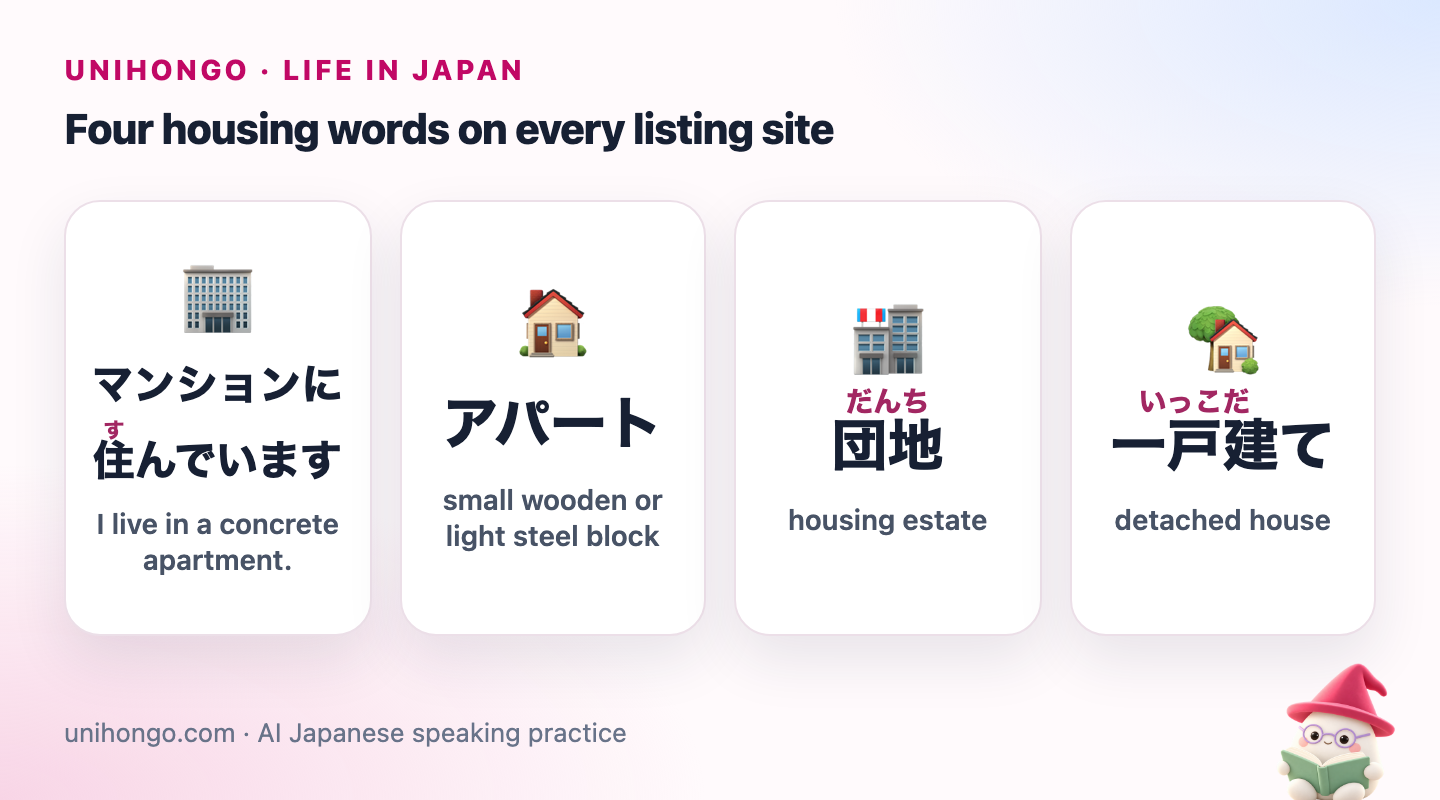
| Japanese | Romaji | Meaning |
|---|---|---|
| マンションに住んでいます | Manshon ni sunde imasu. | I live in a concrete apartment. |
| アパート | apāto | small wooden or light steel block |
| 団地 | danchi | housing estate |
| 一戸建て | ikkodate | detached house |
Mansion and apāto: what the words really mean
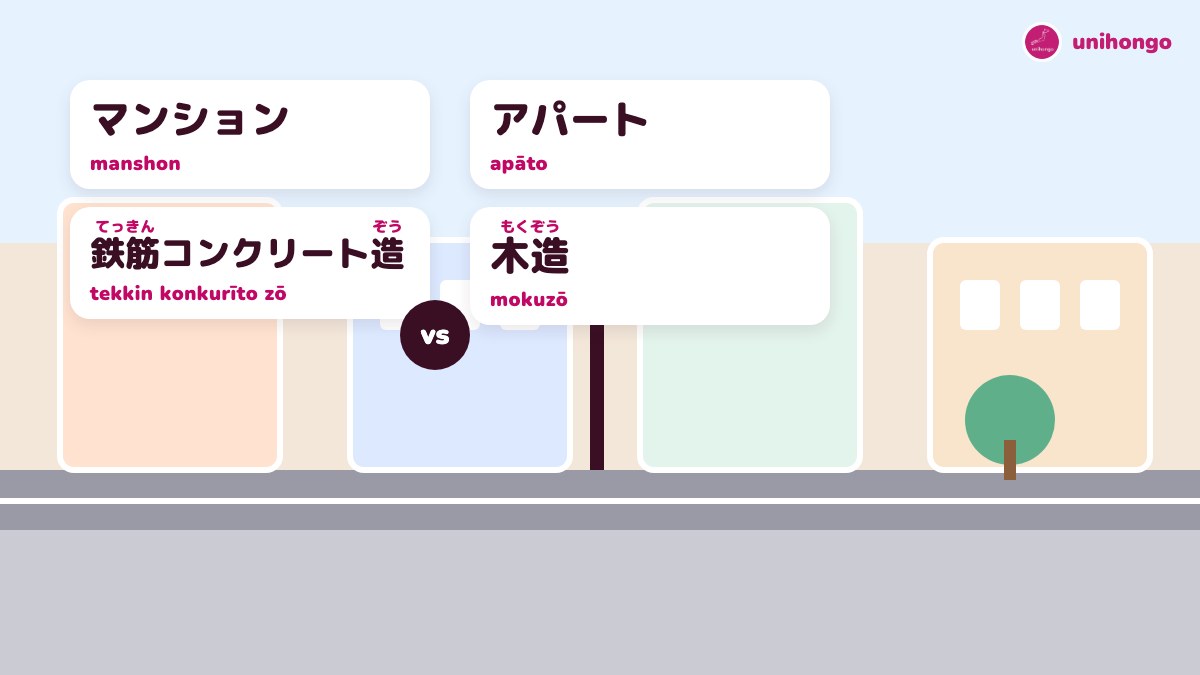
A manshon (マンション) is usually a building of reinforced concrete (RC) or steel-reinforced concrete (SRC), commonly three floors or more, often with an elevator, an auto-lock entrance and a management office or caretaker. Many are built for sale, and individual owners rent out their units; these are listed as bunjō chintai (分譲賃貸), condominiums for rent, and can be better finished than buildings built purely for renting.
An apāto (アパート) is usually a building of wood or light steel frame, often two floors with outdoor stairs and corridors. Rents tend to be lower, and the buildings can be pleasant, but sound and cold often pass through more easily. Building names give hints but are not rules: names with Haitsu (ハイツ) or Kōpo (コーポ) are often apāto, and an old name ending in Sō (荘) suggests an older wooden building.
| Japanese | Romaji | Meaning |
|---|---|---|
| 分譲賃貸 | bunjō chintai | a condo unit rented out by its owner |
| オートロック付き | ōto rokku tsuki | with an auto-lock entrance |
| 管理人は常駐ですか。 | Kanrinin wa jōchū desu ka. | Is there a caretaker on site full-time? |
| マンションというより、アパートですね。 | Manshon to iu yori, apāto desu ne. | It's more of an apāto than a mansion, isn't it? |
Structure codes and building age
Listings have a structure line, kōzō (構造), that tells you how the building was made. It matters for noise, heat and fire resistance, so read it before the photos.
| Japanese | Romaji | Meaning |
|---|---|---|
| 構造は何ですか。 | Kōzō wa nan desu ka. | What's the building's structure? |
| 築何年ですか。 | Chiku nannen desu ka. | How old is the building? |
| 新耐震基準を満たしていますか。 | Shin taishin kijun o mitashite imasu ka. | Does it meet the new earthquake standard? |
| On the listing | Meaning | What it usually means for you |
|---|---|---|
| 木造 mokuzō (W) | Wooden frame | Lower rent; more sound and cold through walls and floors |
| 軽量鉄骨造 keiryō tekkotsu zō | Light steel frame | Common for apāto; similar to wood for noise |
| 鉄骨造 tekkotsu zō (S) | Steel frame | Stronger; noise depends on walls and floors |
| 鉄筋コンクリート造 (RC) | Reinforced concrete | Typical mansion; usually quieter and more solid |
| 鉄骨鉄筋コンクリート造 (SRC) | Steel-reinforced concrete | Often taller blocks; solid and quiet |
Next to the structure you will see the building's age. Chikunensū (築年数) is years since completion, written as 築10年 for ten years old. Shinchiku (新築) means newly built and never lived in. A building completed after about 1982 is likely, but not certain, to meet the stricter seismic standard introduced in June 1981; ask the agent if it matters to you.
Danchi, UR and public housing
Danchi (団地) are large estates of similar apartment blocks, many built in the decades after the war to house growing cities. Some have been renovated and are popular again for their space, greenery and lower rents. Older blocks may have no elevator and steep stairs.
Many danchi are run by UR, the Urban Renaissance Agency (UR都市機構). UR rental housing is known for not requiring key money, an agency fee, a renewal fee or a guarantor, though it does take a deposit and has its own income or savings conditions. Public housing, kōei jūtaku (公営住宅), run by prefectures and cities, is a different system for households under income limits, usually with application periods and a lottery; ask your city office about it.
| Japanese | Romaji | Meaning |
|---|---|---|
| UR賃貸 | yū āru chintai | UR rental housing |
| 公営住宅 | kōei jūtaku | public housing run by a city or prefecture |
| 申し込みの条件を教えてください。 | Mōshikomi no jōken o oshiete kudasai. | Please tell me the conditions for applying. |
| エレベーターはありますか。 | Erebētā wa arimasu ka. | Is there an elevator? |
Houses, share houses and other types
| Japanese | Romaji | Meaning |
|---|---|---|
| 家具付きですか。 | Kagu tsuki desu ka. | Is it furnished? |
| 共用部分は何がありますか。 | Kyōyō bubun wa nani ga arimasu ka. | What are the shared areas? |
- Ikkodate (一戸建て): a detached house. Rentals exist, especially outside big city centres. Expect to handle more yourself, from garden care to rubbish.
- Terasu hausu (テラスハウス): terraced houses joined side by side, each with its own entrance.
- Mezonetto (メゾネット): a flat on two floors with its own internal stairs, inside a larger building.
- Shea hausu (シェアハウス): a shared house with a private bedroom and shared kitchen and bathroom. Often simpler contracts and furnished rooms.
- Shataku (社宅) and ryō (寮): company housing and dormitories, arranged through an employer or school, with their own rules.
Heat, cold and noise: what the type means day to day
Many Japanese homes, especially older wooden ones, have little insulation and single-glazed windows, so they are cold in winter and hot in summer. Concrete buildings hold heat and cold longer, which helps in winter but can make a top-floor flat warm on summer nights. A ground-floor room in any building can feel damp; ask about condensation and mould, ketsuro (結露) and kabi (カビ), at the viewing.
Noise depends on structure, the floor above you and your neighbours' habits. In a wooden apāto you may hear footsteps, doors and voices; in a concrete mansion you are more likely to hear plumbing or a washing machine through the walls. Upper floors and corner rooms are usually quieter. If you play an instrument, work night shifts or have small children, ask about the building's rules and the people around you before you sign rather than after a complaint.
| Japanese | Romaji | Meaning |
|---|---|---|
| 結露はしますか。 | Ketsuro wa shimasu ka. | Do the windows get condensation? |
| 防音はどうですか。 | Bōon wa dō desu ka. | How is the soundproofing? |
| 楽器は使えますか。 | Gakki wa tsukaemasu ka. | Are musical instruments allowed? |
Mansion or apāto? Comparing at a glance
When two flats have similar rent and size, the type and structure often decide how it feels to live there. Use these questions at a viewing rather than trusting the label.
| Japanese | Romaji | Meaning |
|---|---|---|
| 隣の音は聞こえますか。 | Tonari no oto wa kikoemasu ka. | Can you hear the neighbours? |
| 冬は寒いですか。 | Fuyu wa samui desu ka. | Is it cold in winter? |
| 角部屋ですか。 | Kadobeya desu ka. | Is it a corner room? |
| 上の階はどんな方が住んでいますか。 | Ue no kai wa donna kata ga sunde imasu ka. | What kind of people live upstairs? |
The last question is something agents can answer only in general terms, such as a single person or a family, but it helps you judge noise. Kadobeya, a corner room, has a neighbour on one side only and is often in demand.
Mistakes when reading housing words
- Expecting luxury from the word mansion. It describes construction, not size or quality.
- Ignoring the structure line. A concrete building and a wooden one at the same rent are very different to live in.
- Assuming every danchi is public housing. Many are UR rentals open to a wider range of people, and some units are privately owned.
- Judging age by the photos. Renovated rooms can hide an old structure; check the completion year.
- Treating building names as categories. Haitsu, kōpo and residence are marketing names, not legal types.
From listing words to a real viewing
Paste a listing into Mocchi and ask: read this listing with me and explain the type, structure and age. Mocchi explains each word, and you can add them to flashcards with /create-flashcards so the structure terms stick before your next search.
Then walk through a viewing in AI Sensei. Choose Haru-sensei, ask for an estate agent showing you a flat, and ask about noise, heating and the earthquake standard in your own words; the session report lists the questions that came out unclear.