
The renewal in four words
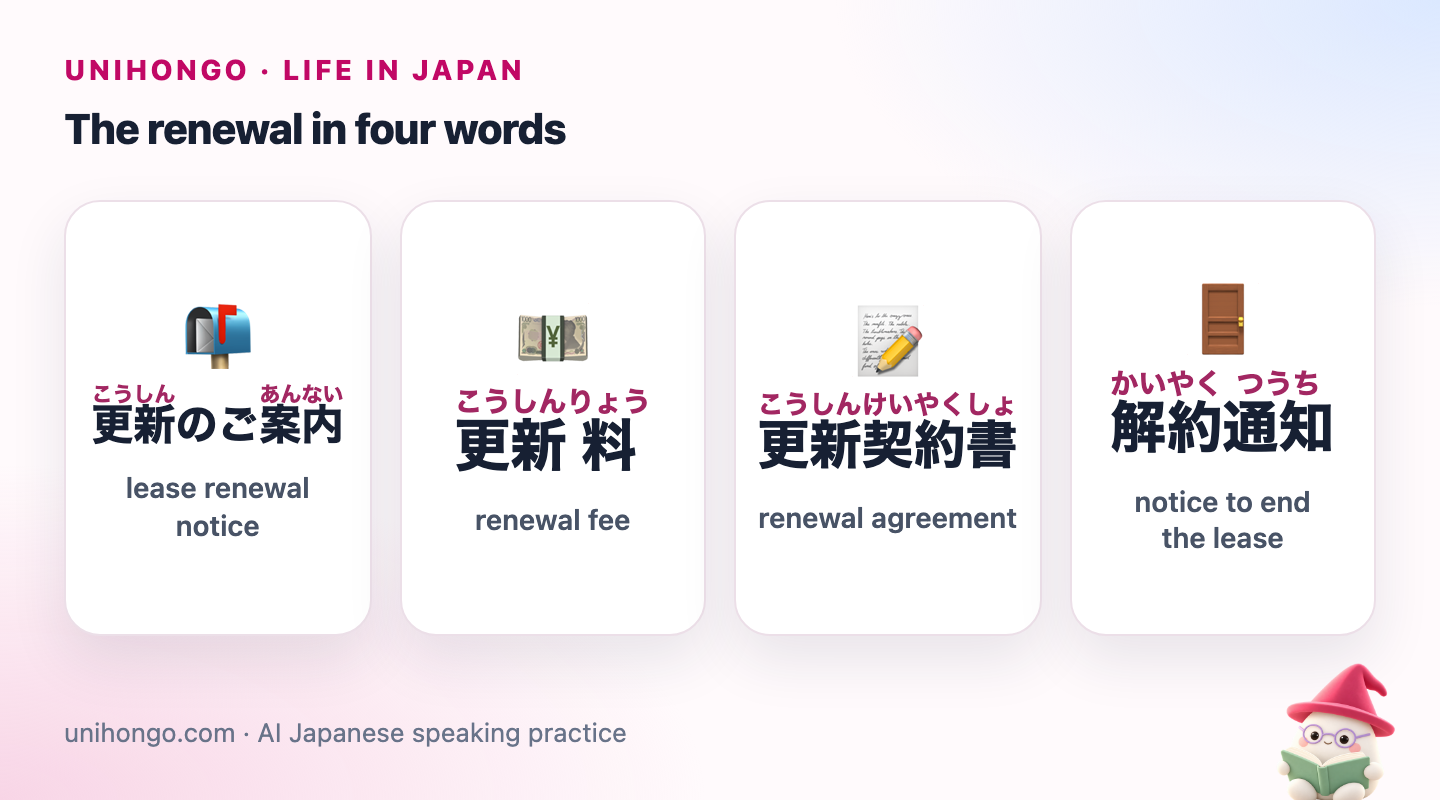
Kōshin (更新) means renewal, and it is the word printed on the envelope. Kaiyaku (解約) is ending the contract, the word you need if you decide to leave. These four expressions are enough to follow most of the letter.
| Japanese | Romaji | Meaning |
|---|---|---|
| 更新のご案内 | kōshin no goannai | lease renewal notice |
| 更新料 | kōshinryō | renewal fee |
| 更新契約書 | kōshin keiyakusho | renewal agreement |
| 解約通知 | kaiyaku tsūchi | notice to end the lease |
How renewal works under a Japanese lease
Most Japanese rentals use an ordinary lease, futsū shakuya keiyaku (普通借家契約), usually for two years. At the end of the term the contract is renewed if you want to stay; the landlord can refuse only for a justifiable reason, which in practice is uncommon. The management company handles the paperwork, often starting two to three months before the end date.
A fixed-term lease, teiki shakuya keiyaku (定期借家契約), works differently. It ends on the stated date with no automatic renewal. If both sides want, you sign a new contract, saikeiyaku (再契約), which can have new conditions or may not be offered at all. These leases are common for flats whose owners plan to return or rebuild. Check the first page of your contract: the type is written there.
| Japanese | Romaji | Meaning |
|---|---|---|
| 私の契約は普通借家ですか、定期借家ですか。 | Watashi no keiyaku wa futsū shakuya desu ka, teiki shakuya desu ka. | Is my contract an ordinary or a fixed-term lease? |
| 契約期間はいつまでですか。 | Keiyaku kikan wa itsu made desu ka. | Until when does my contract run? |
| Point | Ordinary lease | Fixed-term lease |
|---|---|---|
| Japanese | 普通借家 futsū shakuya | 定期借家 teiki shakuya |
| At the end of the term | Renewed if you want to stay | Ends; a new contract is needed |
| Landlord can refuse | Only for a justifiable reason | Yes, no new contract is required |
| Typical paperwork | Renewal agreement, possibly a fee | Re-contract, possibly new conditions |
What the renewal envelope contains
A typical envelope holds a cover letter, two copies of a renewal agreement to sign and stamp or sign, a payment slip or bank details, and forms for renewing the fire insurance. You may be asked for an updated copy of your residence card, especially if your period of stay has changed, and sometimes for proof of income.
The costs you are most likely to see are listed below. Not every contract has all of them, and the names vary.
| Japanese | Romaji | Meaning |
|---|---|---|
| 更新料は契約書に書いてありますか。 | Kōshinryō wa keiyakusho ni kaite arimasu ka. | Is the renewal fee written in the contract? |
| 火災保険は自分で選べますか。 | Kasai hoken wa jibun de erabemasu ka. | Can I choose the fire insurance myself? |
| 在留カードのコピーも必要ですか。 | Zairyū kādo no kopī mo hitsuyō desu ka. | Do you also need a copy of my residence card? |
| Item | What it is | Who it goes to |
|---|---|---|
| 更新料 kōshinryō | Renewal fee, often counted in months of rent | Landlord |
| 更新事務手数料 kōshin jimu tesūryō | Admin fee for the renewal paperwork | Management company or agency |
| 火災保険料 kasai hokenryō | Renewing the tenant's fire insurance | Insurance company |
| 更新保証料 kōshin hoshōryō | Renewing the guarantor company contract | Guarantor company |
The fire insurance matters even if you plan to argue about the fee. Many leases require it, and if it lapses you are uninsured for fire and water damage to neighbours. If you would rather choose your own insurer, ask whether that is allowed; some management companies accept a policy you arrange yourself if it meets their conditions.
Rent changes at renewal
Renewal is when rent changes are most often proposed. A landlord may ask for an increase, chinryō zōgaku (賃料増額), for example after a rise in local rents or taxes. You are not obliged to accept on the spot: you can ask for the reason, ask whether the increase can be smaller, or point out problems with the flat. If no agreement is reached, the lease generally continues and the dispute is handled separately, but this is a point where advice from a consumer affairs centre or a lawyer is worth having.
The reverse also happens. If similar flats in your building are now advertised for less, you can politely ask whether the rent could be reviewed. Many landlords say no, but some agree to a small reduction to keep a reliable tenant.
| Japanese | Romaji | Meaning |
|---|---|---|
| 家賃の値上げの理由を教えていただけますか。 | Yachin no neage no riyū o oshiete itadakemasu ka. | Could you tell me the reason for the rent increase? |
| 今の家賃のままで更新することは可能でしょうか。 | Ima no yachin no mama de kōshin suru koto wa kanō deshō ka. | Would it be possible to renew at the current rent? |
| 同じ建物の部屋が安く募集されているようです。 | Onaji tatemono no heya ga yasuku boshū sarete iru yō desu. | It seems rooms in the same building are listed for less. |
Your renewal timeline
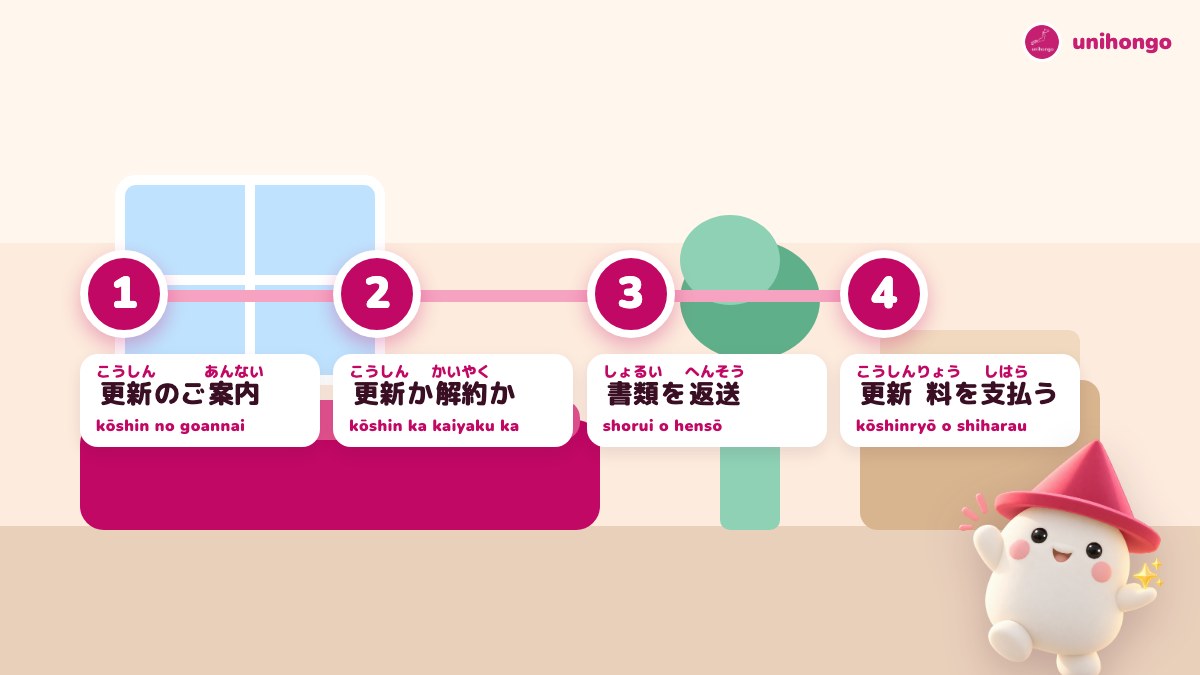
The exact months vary by company, but the order is usually the same. Mark the dates as soon as the envelope arrives.
| Japanese | Romaji | Meaning |
|---|---|---|
| 更新の書類はいつまでに返送すればいいですか。 | Kōshin no shorui wa itsu made ni hensō sureba ii desu ka. | By when should I send back the renewal papers? |
| 解約の予告期間は何か月ですか。 | Kaiyaku no yokoku kikan wa nankagetsu desu ka. | How many months' notice do I need to give to leave? |
- Two to three months before the end date: the renewal notice arrives. Check the contract type and the notice period for leaving.
- Decide whether to stay. If you might move, look at the notice period first: often one month, sometimes two.
- If you stay: return the signed agreement and pay the fees by the date on the letter. Renew the fire insurance and guarantor if required.
- If you leave: send the cancellation notice in the form the contract requires, often a written form or an online form, before the deadline.
- Keep copies of everything you send and the receipt for any payment.
Moving out instead of renewing
Sometimes the renewal fee is the push you needed to move. If so, compare honestly: the renewal costs against the move-in costs of a new flat, the cost of movers and the deposit settlement on your current place. Leaving just before the end date avoids the renewal fee, but the notice deadline counts, not the day you decide.
Ask how rent is calculated in your last month. Some contracts charge by the day, hiwari (日割り), and some charge the whole month, tsukiwari (月割り), whatever day you leave. That one detail can change your best moving date.
| Japanese | Romaji | Meaning |
|---|---|---|
| 更新せずに退去したいと考えています。 | Kōshin sezu ni taikyo shitai to kangaete imasu. | I'm thinking of moving out rather than renewing. |
| 解約通知書を送っていただけますか。 | Kaiyaku tsūchisho o okutte itadakemasu ka. | Could you send me the cancellation form? |
| 最後の月の家賃は日割りですか。 | Saigo no tsuki no yachin wa hiwari desu ka. | Is the last month's rent pro-rated by the day? |
Mini dialogue: calling the management company
| Japanese | Romaji | Meaning |
|---|---|---|
| 更新の件でお電話しました。 | Kōshin no ken de odenwa shimashita. | You: I'm calling about my lease renewal. |
| お部屋番号とお名前をお願いします。 | Oheya bangō to onamae o onegai shimasu. | Staff: Your room number and name, please. |
| 更新料はいくらになりますか。 | Kōshinryō wa ikura ni narimasu ka. | You: How much will the renewal fee be? |
| 家賃の一か月分です。書類に記載しております。 | Yachin no ikkagetsubun desu. Shorui ni kisai shite orimasu. | Staff: One month's rent. It's stated in the documents. |
| 分かりました。今月中に返送します。 | Wakarimashita. Kongetsu chū ni hensō shimasu. | You: I see. I'll send it back this month. |
Ken (件) means matter or case, and ~ no ken de is the standard way to open a call or email about a topic. Kisai shite orimasu is humble business Japanese for it is written; you only need to recognise it.
Common mistakes at renewal time
- Ignoring the envelope until after the deadline. Late forms rarely cancel the renewal, but they cause reminders, late fees on insurance and awkward calls.
- Letting the fire insurance lapse. It often renews separately from the lease and needs its own payment.
- Giving notice by phone only when the contract requires writing. Use the form the contract names and keep a copy.
- Assuming a fixed-term lease will be renewed. It ends unless you sign a new contract.
- Forgetting the guarantor renewal fee when budgeting. It can arrive as a separate bill.
Say it before you dial
Renewal calls are short but full of dates and numbers, which is exactly what is hard to catch on the phone. Ask Mocchi to explain the difference between kōshin, kaiyaku and saikeiyaku with one example sentence each, then ask for a quiz on the dates and fees in this guide.
When the words feel easy, open AI Sensei and ask Yamada-sensei to play a management company employee. Call to ask about the renewal fee, then call again to give notice that you are moving out, and compare the two session reports.