
Furikomi and its look-alikes
Furikomi is the standard way to pay a person or company by sending money into their account. Two similar words cause confusion. Furikae (振替) is a transfer between accounts, often your own, and kōza furikae is automatic debit for bills. Sōkin (送金) is the general word for sending money, used for overseas remittances and apps.
| Japanese | Romaji | Meaning |
|---|---|---|
| 振込をお願いします。 | Furikomi o onegai shimasu. | I'd like to make a transfer, please. |
| 家賃は振込で払っています。 | Yachin wa furikomi de haratte imasu. | I pay my rent by bank transfer. |
| 自動引き落としにしました。 | Jidō hikiotoshi ni shimashita. | I switched it to automatic debit. |
The details you need
An invoice or a rental contract usually shows the transfer details in one box. Read them in this order, which is also the order the ATM asks for them.
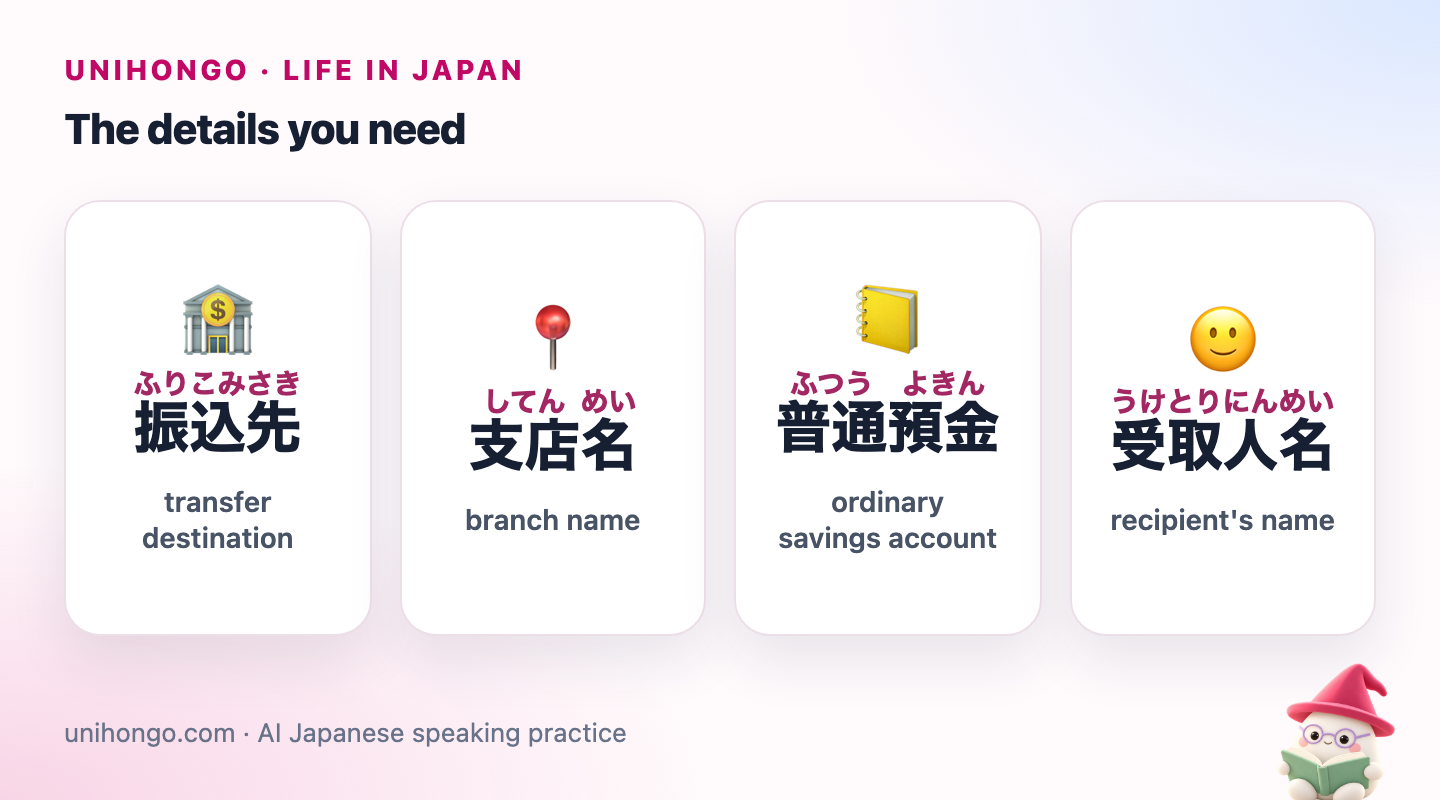
| Japanese | Romaji | Meaning |
|---|---|---|
| 振込先 | furikomisaki | transfer destination |
| 支店名 | shitenmei | branch name |
| 普通預金 | futsū yokin | ordinary savings account |
| 受取人名 | uketorininmei | recipient's name |
| 口座番号 | kōza bangō | account number |
| 振込依頼人 | furikomi irainin | sender |
| 店番 | tenban | branch number |
| 当座預金 | tōza yokin | current account (mostly businesses) |
The recipient name is held in katakana, often half-width, and company names use abbreviations: カ) stands for kabushiki gaisha at the start of a name, and (カ at the end. Some branches have names that are not places, such as numbers or words, and the ATM may let you search by the branch number instead. Account numbers at most banks are seven digits.
Schools and event organisers sometimes ask you to put a student number or a reference before your name in the sender field, so that they can match the payment. Do exactly what they ask.
ATM, online or counter
| Japanese | Romaji | Meaning |
|---|---|---|
| 振込手数料 | furikomi tesūryō | transfer fee |
| 他行宛 | takō ate | to another bank |
| 当日扱い | tōjitsu atsukai | processed the same day |
| 翌営業日 | yokueigyōbi | next business day |
| Method | Good for | Watch out for |
|---|---|---|
| ATM with your cash card | Everyday transfers, saving recipients for next time | Large cash transfers are restricted; fees outside hours |
| Online or app banking | Lowest fees, transfers any time | Set-up and security codes; daily limits |
| Bank counter | Large amounts, unusual cases, help in person | Highest fees, ID checks, opening hours |
When the money arrives depends on the banks and the time. Many transfers between Japanese banks now arrive within minutes at any hour, but some banks or times still mean the next business day. If a deadline matters, such as rent due on the 27th, send it a few days early.
To prevent fraud and money laundering, ATMs do not accept cash transfers above a set amount; for those, use your account balance or go to the counter with ID.
The ATM, screen by screen
| Japanese | Romaji | Meaning |
|---|---|---|
| 受取人名をご確認ください。 | Uketorininmei o gokakunin kudasai. | Please check the recipient's name. |
| お振込み金額 | ofurikomi kingaku | transfer amount |
| 暗証番号 | anshō bangō | PIN |
| ご利用明細 | goriyō meisai | transaction statement |
- Choose お振込み (transfer) on the main menu and insert your cash card, or choose cash payment.
- Choose the bank, then the branch, by name or number.
- Choose the account type, usually 普通, and enter the account number.
- The screen shows the recipient name retrieved from the bank: 受取人名をご確認ください. Check it matches.
- Enter the amount, check the fee shown, and enter your PIN.
- Take the statement, ご利用明細, and keep it until the recipient confirms payment.
At the counter
Counter transfers usually start with a transfer request form, furikomi iraisho, filled in at the desk area, and a numbered ticket. Staff may ask the purpose of a large transfer, the relationship to the recipient and your ID; these questions are a legal requirement, not suspicion of you.
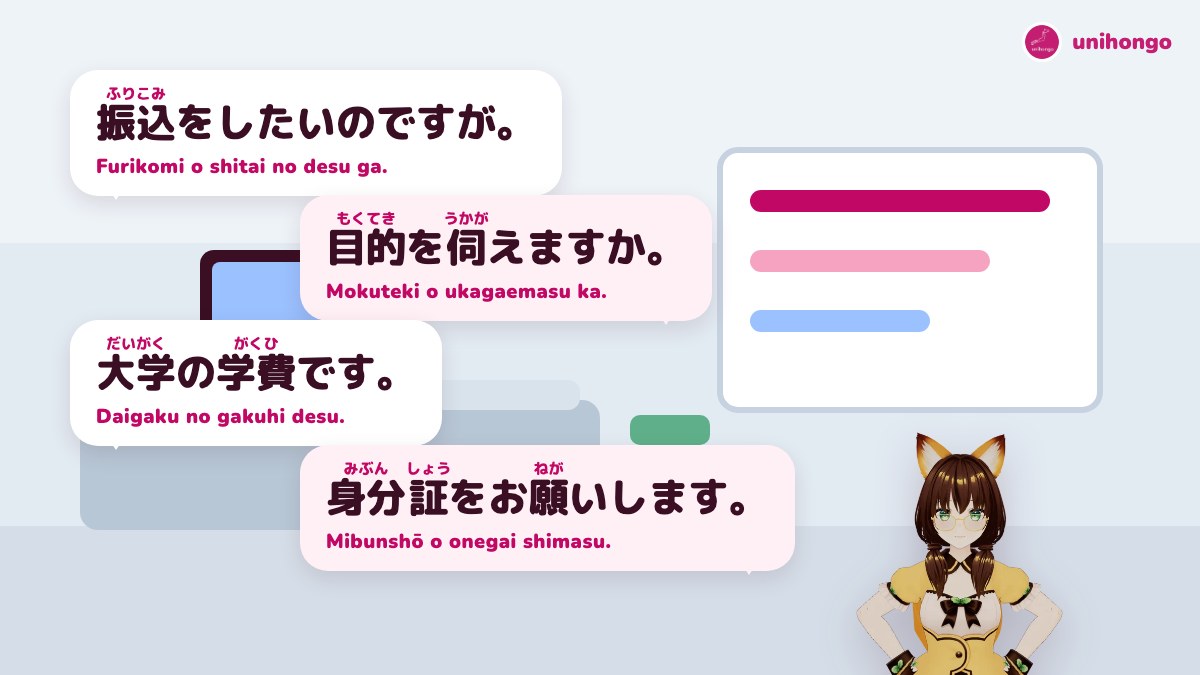
| Japanese | Romaji | Meaning |
|---|---|---|
| 振込をしたいのですが、ATMでできませんでした。 | Furikomi o shitai no desu ga, ētīemu de dekimasen deshita. | You: I want to make a transfer, but the ATM wouldn't do it. |
| こちらの振込依頼書にご記入ください。 | Kochira no furikomi iraisho ni gokinyū kudasai. | Clerk: Please fill in this transfer request form. |
| お振込みの目的を伺ってもよろしいですか。 | Ofurikomi no mokuteki o ukagatte mo yoroshii desu ka. | Clerk: May I ask the purpose of the transfer? |
| 大学の学費です。 | Daigaku no gakuhi desu. | You: It's my university tuition. |
| 本人確認書類をお願いします。 | Honnin kakunin shorui o onegai shimasu. | Clerk: Your ID, please. |
| 在留カードでいいですか。 | Zairyū kādo de ii desu ka. | You: Is my residence card all right? |
Mistakes, returns and scams
If the account details were invalid, the transfer fails and the money normally comes back to you. If it reached the wrong real account, ask your bank for kumimodoshi (組戻し), a return request. The bank asks the recipient's bank to contact the account holder, who must agree; there is usually a fee and no guarantee.
Transfer scams, furikome sagi (振り込め詐欺), are part of what the police call special fraud. Typical patterns include a caller pretending to be a relative in trouble, someone claiming to be from a city office or a bank offering a refund that you must collect at an ATM, and messages saying an account will be frozen. ATMs often display a warning against operating them while on the phone.
| Japanese | Romaji | Meaning |
|---|---|---|
| 組戻しをお願いしたいです。 | Kumimodoshi o onegai shitai desu. | I'd like to request a transfer return. |
| 振込先を間違えてしまいました。 | Furikomisaki o machigaete shimaimashita. | I sent it to the wrong account. |
| 携帯電話で話しながらATMを操作しないでください。 | Keitai denwa de hanashi nagara ētīemu o sōsa shinaide kudasai. | Do not use the ATM while on the phone. (warning sign) |
- No genuine refund requires you to operate an ATM. Hang up.
- Call the organisation back on a number you find yourself.
- If you think you have been tricked, contact your bank immediately and the police; in an emergency, call 110.
Common mistakes
- Typing the name in full-width katakana or with the wrong small kana; let the bank retrieve the name and compare.
- Paying rent on the due date and missing it because the transfer is processed the next business day.
- Forgetting to add the reference number the school asked for in the sender name.
- Assuming the counter will be quick at lunchtime or near month-end, the busiest times.
- Trusting a caller because they know your name or bank.
- Throwing away the ATM statement before the recipient confirms the payment; it is your proof if they say nothing arrived.
- Choosing cash payment at the ATM for a large amount, which is refused, instead of paying from your account balance.
Online banking: registered payees and limits
Once you use online or app banking, transfers become quicker and usually cheaper. The first transfer to a new recipient takes the longest, because you enter all the details and confirm with a one-time password sent to your phone or generated by an app. After that you can save the recipient, tōroku furikomisaki, and pay rent each month in a few taps, or book a future-dated transfer, furikomi yoyaku.
Banks set a daily transfer limit, which you can lower for safety or raise for a large payment, sometimes only after a waiting period. If a transfer is refused online, check the limit before calling the bank. Never give a one-time password to anyone who calls you; banks do not ask for it.
| Japanese | Romaji | Meaning |
|---|---|---|
| 登録振込先 | tōroku furikomisaki | saved recipient |
| ワンタイムパスワード | wan taimu pasuwādo | one-time password |
| 振込予約 | furikomi yoyaku | scheduled transfer |
| 振込限度額を上げたいです。 | Furikomi gendogaku o agetai desu. | I'd like to raise my transfer limit. |
Practise the counter before payday
Ask Mocchi to explain any line from your bank's app with /explain, and to quiz you on the transfer screen words until you can read the confirmation screen at a glance. Mocchi keeps track of the ones you hesitate on.
Then practise the counter conversation with your voice: in AI Sensei, ask Sakura-sensei to play a bank clerk who asks about the purpose of a transfer and your ID, and ask Sakura-sensei to speak quickly the second time.