
What a card issuer looks at
A credit card in Japan is a promise to pay later, so the issuer wants to know that you can and will. The application asks who you are, where you live, how you earn your money and where the repayments will come from. Most cards are applied for online, with identity checked by photographing your residence card and your face on a smartphone, or by mail.
Your monthly bill is taken automatically from a Japanese bank account on a fixed day, so the account is part of the application. Many people find it easiest to apply for the card linked to the bank where they already have an account.
| Japanese | Romaji | Meaning |
|---|---|---|
| カードを作りたい。 | Kādo o tsukuritai. | I want to get a credit card. (casual) |
| ネットで申し込みました。 | Netto de mōshikomimashita. | I applied online. |
| 審査に時間がかかるそうです。 | Shinsa ni jikan ga kakaru sō desu. | Apparently the screening takes a while. |
The words on the application
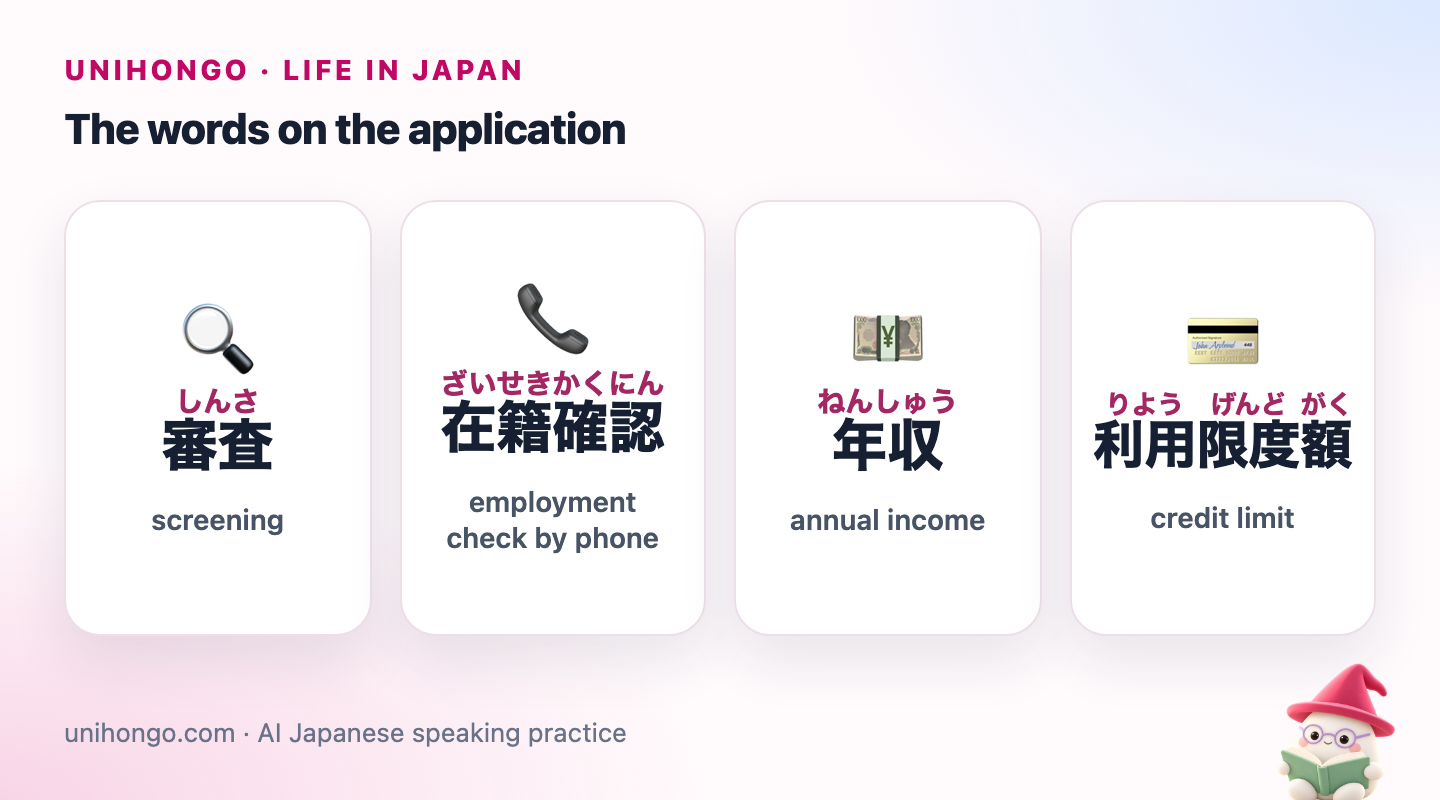
| Japanese | Romaji | Meaning |
|---|---|---|
| 審査 | shinsa | screening |
| 在籍確認 | zaiseki kakunin | employment check by phone |
| 年収 | nenshū | annual income |
| 利用限度額 | riyō gendogaku | credit limit |
| 勤続年数 | kinzoku nensū | years with your employer |
| 引き落とし口座 | hikiotoshi kōza | account for repayments |
| 本人確認書類 | honnin kakunin shorui | ID documents |
| 持ち家 | mochiie | own home |
| 賃貸 | chintai | rented home |
| 正社員 | seishain | regular full-time employee |
| 契約社員 | keiyaku shain | contract employee |
Forms also ask about your housing (owned, rented, company housing, living with family), your employment type (regular employee, contract, part-time, self-employed, student) and sometimes your period of stay. Answer accurately: details are checked, and a mismatch can lead to refusal.
From application to card
| Japanese | Romaji | Meaning |
|---|---|---|
| 審査結果のお知らせ | shinsa kekka no oshirase | notice of the screening result |
| 本人限定受取郵便 | honnin gentei uketori yūbin | mail handed only to the addressee |
| 暗証番号を設定してください。 | Anshō bangō o settei shite kudasai. | Please set your PIN. |
- Apply online or on paper, choosing the card and the repayment account.
- Verify your identity, often with a residence card photo and a selfie, or by showing ID to the delivery person.
- Screening: the issuer checks your details and the credit bureau records.
- Possible employment check by phone to your workplace.
- Result by email or app, then the card arrives by registered mail that must be handed to you in person.
- Set up the app or website account, and set or receive the PIN.
The phone call to your workplace
The employment check, zaiseki kakunin, surprises people. Someone from the issuer calls your company's main number, usually using a personal name rather than the card company's, and asks for you. If a colleague says you are out of the office, or confirms you work there, that is usually enough. They do not ask about your salary.
Prepare by telling a colleague or reception that you are expecting a personal call to confirm your employment. If your company never puts calls through or you work remotely, check whether the issuer accepts documents instead.
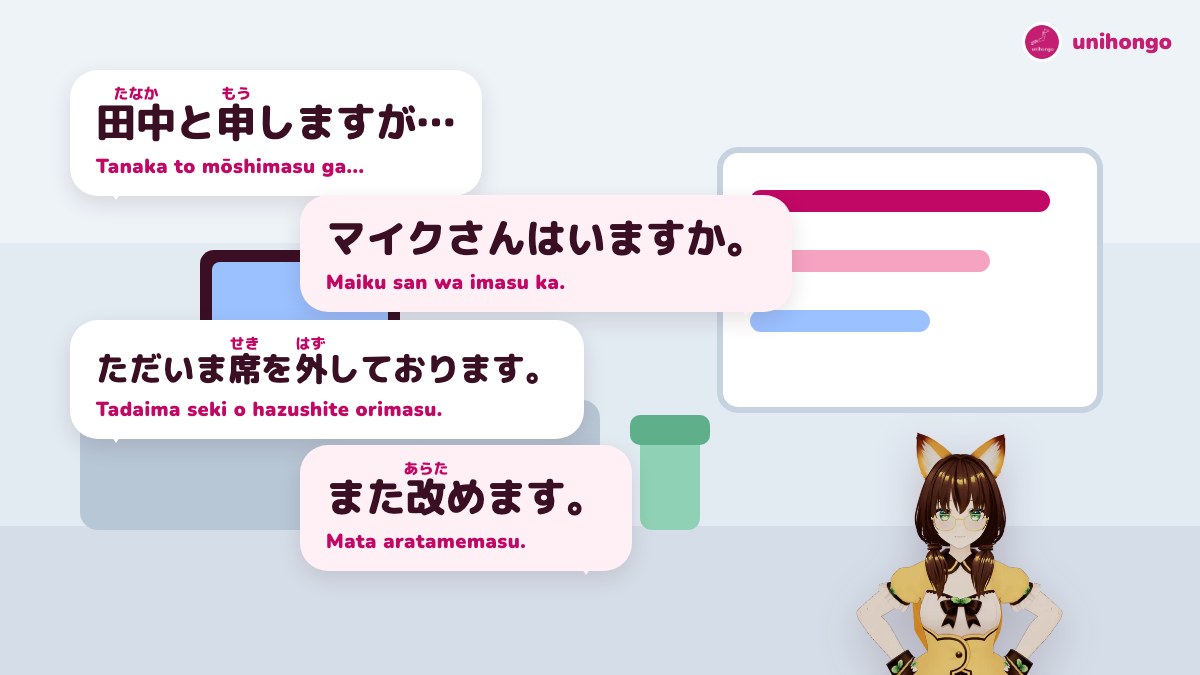
| Japanese | Romaji | Meaning |
|---|---|---|
| 田中と申しますが、マイクさんはいらっしゃいますか。 | Tanaka to mōshimasu ga, Maiku san wa irasshaimasu ka. | Caller: My name is Tanaka. Is Mike there? |
| ただいま席を外しております。 | Tadaima seki o hazushite orimasu. | Colleague: He's away from his desk at the moment. |
| 承知しました。また改めます。 | Shōchi shimashita. Mata aratamemasu. | Caller: Understood. I'll try another time. |
| カードの在籍確認の電話が来るかもしれません。 | Kādo no zaiseki kakunin no denwa ga kuru ka mo shiremasen. | You: A call may come to check my employment for a card. |
Why first applications can fail
Issuers do not explain refusals, and there is no single cause. These patterns come up again and again:
| Possible factor | What helps |
|---|---|
| Short time in Japan or no credit history here | Start with one card from your bank; use and repay it on time |
| Short remaining period of stay | Apply after renewing your residence status |
| Several applications close together | Apply for one card and wait months before the next |
| Unstable or very new income | Apply after a few months in the job |
| Late phone or loan payments, including phone handset instalments | Pay everything on time; history is shared via credit bureaus |
Credit history in Japan is recorded by credit bureaus such as CIC and JICC. You can request your own record if you want to check it. Handset instalments on a mobile contract count as credit, so a missed phone bill can matter.
Using the card at a shop
At the register, cards are inserted or tapped, and you sometimes enter a PIN or sign. For larger purchases the clerk may ask how many payments you want. One payment, ikkatsu, is standard and usually has no interest. Instalments and revolving payment, ribo-barai, add interest; revolving keeps the monthly amount fixed while the balance and interest build up, and some cards are set to revolving by default, so check your settings.
| Japanese | Romaji | Meaning |
|---|---|---|
| お支払い回数は? | Oshiharai kaisū wa? | Clerk: How many payments? |
| 一括でお願いします。 | Ikkatsu de onegai shimasu. | You: In one payment, please. |
| 暗証番号の入力をお願いします。 | Anshō bangō no nyūryoku o onegai shimasu. | Clerk: Please enter your PIN. |
| リボ払い | ribo barai | revolving payment |
| 分割払い | bunkatsu barai | instalment payment |
| タッチ決済でお願いします。 | Tacchi kessai de onegai shimasu. | Contactless, please. |
| カードをお預かりします。 | Kādo o oazukari shimasu. | Clerk: I'll take your card for a moment. |
Many terminals now accept contactless payment, touch kessai: you hold the card over the reader instead of inserting it. For larger amounts or some terminals, you insert the card and enter your PIN. At restaurants, staff may take the card to a terminal at the register, which is normal.
Mistakes to avoid
- Applying for several cards in one week after a refusal.
- Writing an income or employer that does not match your documents.
- Not warning your workplace about the phone check.
- Leaving the card on a default revolving setting.
- Forgetting that the card must be cancelled, and the bill paid, before you leave Japan.
- Ignoring the issuer's calls or letters after a missed payment; contacting them early usually makes arranging payment easier.
- Lending your card to a friend. Only the cardholder may use it, and it can lead to the card being cancelled.
- Clicking links in emails or texts that claim to be from your card company; open the app or type the address yourself.
Reading the monthly statement
Each card has a closing date, shimebi, and a payment date, shiharaibi. Everything you spend up to the closing date is billed together and taken from your account on the payment date the following month, for example closing on the 15th and paying on the 10th of the next month. Make sure the money is in the account a day before; a failed debit is recorded and can affect later applications.
Statements are mostly online now. Check them each month for charges you do not recognise and for subscriptions you forgot. If you see a charge you did not make, call the number on the back of the card straight away. Some cards have an annual fee, nenkaihi, that is waived if you use the card once a year; read the conditions when it arrives.
Before leaving Japan for good, pay the final bill, cancel the card, and change any services billed to it. Cancelling is done by phone or online, and the remaining balance is still taken from your account, so do not close the bank account first.
| Japanese | Romaji | Meaning |
|---|---|---|
| 締め日 | shimebi | closing date |
| お支払い日 | oshiharaibi | payment date |
| ご利用明細 | goriyō meisai | statement of use |
| 年会費 | nenkaihi | annual fee |
| 身に覚えのない請求があります。 | Mi ni oboe no nai seikyū ga arimasu. | There's a charge I don't recognise. |
| カードを解約したいです。 | Kādo o kaiyaku shitai desu. | I'd like to cancel my card. |
Fill in the form with confidence
Tell Mocchi you are about to apply for your first Japanese card and ask it to explain the field labels you are unsure about, and to write a short quiz with /quiz on the words in this guide. If you write a sentence for the phone check, ask Mocchi to check it with /correct; it will point out anything that sounds unnatural.
To see how fast these words appear in real speech, play Listen & Pick with your card flashcards, so that 審査 and 在籍確認 sound familiar before a call comes.