
The guarantor system in four words
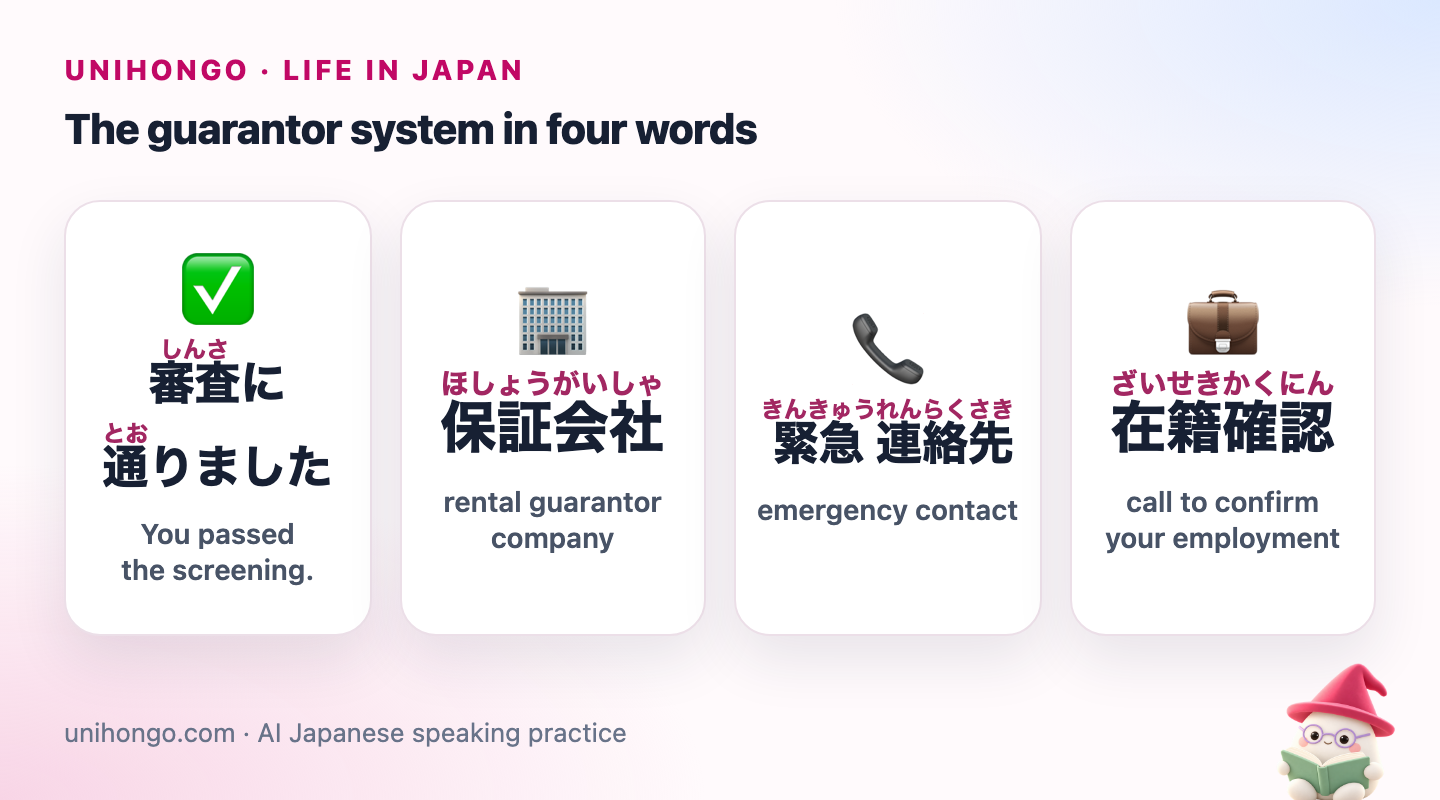
These four expressions cover almost every conversation about guarantors. Shinsa (審査) is screening: the landlord's and the guarantor company's decision about your application. Zaiseki kakunin (在籍確認) is a call to your workplace to confirm that you are employed there.
| Japanese | Romaji | Meaning |
|---|---|---|
| 審査に通りました | Shinsa ni tōrimashita. | You passed the screening. |
| 保証会社 | hoshō gaisha | rental guarantor company |
| 緊急連絡先 | kinkyū renrakusaki | emergency contact |
| 在籍確認 | zaiseki kakunin | call to confirm your employment |
Why landlords want a guarantor company
Japanese tenancy law protects tenants strongly: a landlord cannot simply evict someone the day rent is late. A guarantor company reduces the landlord's risk, because unpaid rent is covered quickly and the company deals with collecting it. For the landlord, it also means one standard process for every applicant.
Personal guarantors still exist. Since the Civil Code revision of 2020, a contract with an individual guarantor for an ongoing debt such as rent must state a maximum amount, kyokudogaku (極度額). This is one reason many landlords now prefer companies, even for Japanese tenants with family nearby.
There are several kinds of company: some are linked to credit card or consumer credit firms, some are independent, and some specialise in foreign residents, with staff who speak other languages. You usually cannot choose freely: the landlord or management company names the company they work with, though some agents offer two or three options.
| Japanese | Romaji | Meaning |
|---|---|---|
| 保証会社の利用は必須ですか。 | Hoshō gaisha no riyō wa hissu desu ka. | Is using a guarantor company required? |
| 連帯保証人 | rentai hoshōnin | joint personal guarantor |
| どの保証会社になりますか。 | Dono hoshō gaisha ni narimasu ka. | Which guarantor company will it be? |
| 外国語の対応はありますか。 | Gaikokugo no taiō wa arimasu ka. | Do they offer support in other languages? |
The fees on your estimate and later
Guarantor fees come in a few shapes, and each company sets its own. Common patterns are a first fee when you sign, often calculated as a percentage of one month's rent and charges; an annual or two-yearly renewal fee; and sometimes a small monthly fee instead. Ask for the whole picture, not only the first payment, so the cost of staying two or four years is clear.
| Japanese | Romaji | Meaning |
|---|---|---|
| 保証料は毎年かかりますか。 | Hoshōryō wa maitoshi kakarimasu ka. | Is there a guarantee fee every year? |
| 更新の時はいくらぐらいですか。 | Kōshin no toki wa ikura gurai desu ka. | About how much is it at renewal? |
| Word you will see | Meaning | When it is paid |
|---|---|---|
| 初回保証料 shokai hoshōryō | First guarantee fee | At contract, on the move-in estimate |
| 更新保証料 kōshin hoshōryō | Renewal guarantee fee | Every year or at lease renewal |
| 月額保証料 getsugaku hoshōryō | Monthly guarantee fee | With rent, under some plans |
| 代位弁済 dai'i bensai | The company pays your rent for you | Only if you fall behind |
Screening: documents and steps
| Japanese | Romaji | Meaning |
|---|---|---|
| 審査にはどのくらいかかりますか。 | Shinsa ni wa dono kurai kakarimasu ka. | How long does the screening take? |
| 収入証明は何が必要ですか。 | Shūnyū shōmei wa nani ga hitsuyō desu ka. | What proof of income do you need? |
| 在籍確認の電話が来るかもしれません。 | Zaiseki kakunin no denwa ga kuru kamo shiremasen. | To HR: A call may come to confirm my employment. |
- Fill in the application, mōshikomisho (申込書), with your details, workplace, income and emergency contact. The agent often helps.
- Submit copies of your residence card and passport, and sometimes proof of income such as a withholding slip or payslips, or for students a certificate of enrolment.
- The guarantor company may call you to confirm your identity and the contents of the application.
- It may call your workplace to confirm that you work there. The caller usually does not say why they are calling.
- It may contact your emergency contact to check that they agreed to be listed.
- The result comes back through the agent, often within a few days, and then the landlord decides.
Tell your manager or HR in advance that a company may call to confirm your employment, so the person who answers does not say they have never heard of you. If you work for an agency or remotely, ask the agent which number the company will call.
The phone check: what you hear and what you say
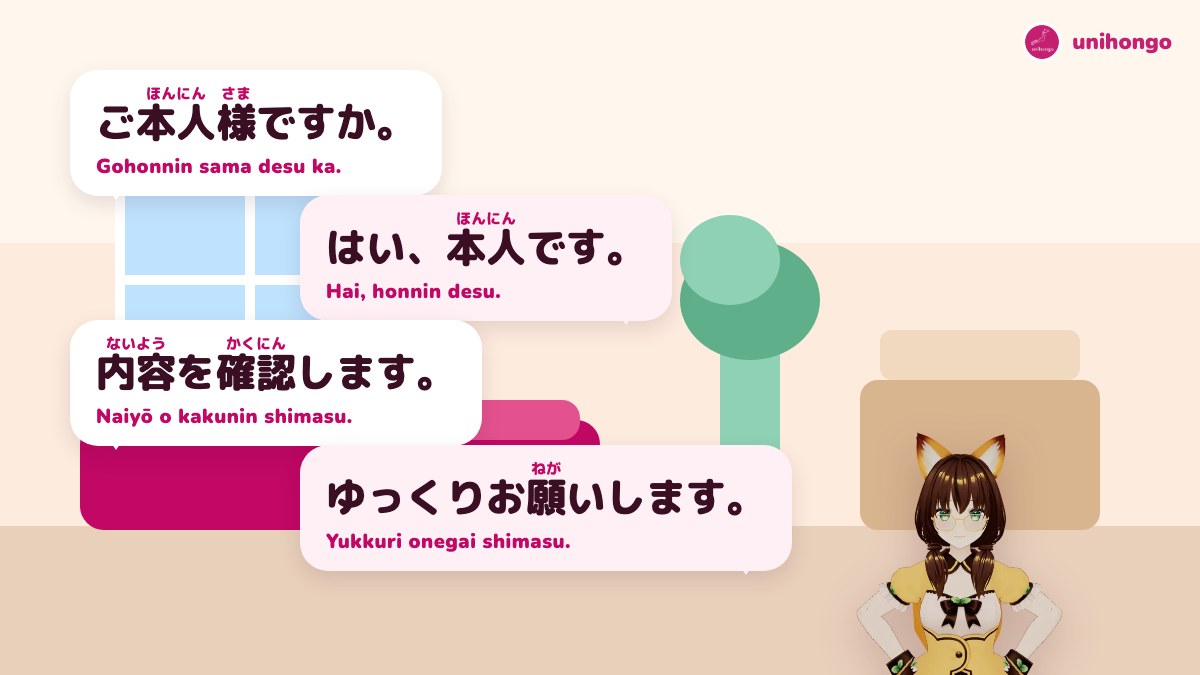
The call to you is short and formal. The caller gives a company name, confirms they are speaking to you, and reads back a few items from your application. Answer in short polite sentences. You do not have to understand every word: if you miss something, ask them to repeat it. A real screening call will not ask you to transfer money or reveal a password.
| Japanese | Romaji | Meaning |
|---|---|---|
| ご本人様でいらっしゃいますか。 | Gohonnin sama de irasshaimasu ka. | Caller: Am I speaking to the applicant? |
| はい、本人です。 | Hai, honnin desu. | You: Yes, speaking. |
| お申し込み内容の確認をさせていただきます。 | Omōshikomi naiyō no kakunin o sasete itadakimasu. | Caller: I'd like to confirm your application. |
| 生年月日を教えていただけますか。 | Seinengappi o oshiete itadakemasu ka. | Caller: Could you tell me your date of birth? |
| もう少しゆっくりお願いできますか。 | Mō sukoshi yukkuri onegai dekimasu ka. | You: Could you speak a little more slowly? |
| 審査の結果は不動産会社からご連絡します。 | Shinsa no kekka wa fudōsan gaisha kara gorenraku shimasu. | Caller: The agency will let you know the result. |
Emergency contact or guarantor? Not the same thing
Newcomers often hesitate to ask a friend to be an emergency contact because they confuse it with being a guarantor. The roles are different, and explaining the difference makes the request much easier.
| Japanese | Romaji | Meaning |
|---|---|---|
| 緊急連絡先になってもらえませんか。 | Kinkyū renrakusaki ni natte moraemasen ka. | Would you be my emergency contact? |
| お金の責任はありません。 | Okane no sekinin wa arimasen. | You won't have any financial responsibility. |
| 確認の電話が行くかもしれません。 | Kakunin no denwa ga iku kamo shiremasen. | You might get a call to confirm. |
| Point | Emergency contact | Personal guarantor |
|---|---|---|
| Japanese | 緊急連絡先 kinkyū renrakusaki | 連帯保証人 rentai hoshōnin |
| Pays your rent? | No | Yes, up to the stated limit |
| When contacted | When you cannot be reached | When rent or damages are unpaid |
| Typical requirement | Often a relative; some accept a friend or someone in Japan | Stable income, often a relative in Japan |
If the screening does not go through
Companies rarely explain a rejection, and it is not personal. Common reasons include a short remaining period of stay, a new job, income that looks low for the rent, or past late payments. You have options: ask the agent whether another guarantor company can be tried, look at a cheaper flat, add a personal guarantor, offer a larger deposit if the landlord accepts it, or look at housing that does not use guarantor companies, such as UR rental housing or a share house.
| Japanese | Romaji | Meaning |
|---|---|---|
| 別の保証会社で審査できますか。 | Betsu no hoshō gaisha de shinsa dekimasu ka. | Can the screening be done with another company? |
| 審査に落ちた理由は分かりますか。 | Shinsa ni ochita riyū wa wakarimasu ka. | Do you know why the screening failed? |
| 外国籍でも大丈夫な物件を探しています。 | Gaikokuseki demo daijōbu na bukken o sagashite imasu. | I'm looking for places that accept foreign nationals. |
After you move in: living with a guarantor company
Once the contract starts, most tenants never hear from the guarantor company again, apart from the renewal fee. Some companies, however, also collect the rent themselves by bank direct debit, kōza furikae (口座振替), and pass it on to the landlord. If your contract works this way, the company, not the landlord, is the one that contacts you when a payment fails, so keep enough money in the account on the debit date.
Keep the company's details with your contract, and tell the management company if your phone number, job or emergency contact changes; some contracts require you to report this. When you move out, the guarantee normally ends with the lease, and you do not need to cancel it separately, but ask if you are unsure. If you ever receive a call or message claiming to be from your guarantor company and demanding urgent payment to an unfamiliar account, check with the management company first.
| Japanese | Romaji | Meaning |
|---|---|---|
| 家賃は保証会社の口座振替になります。 | Yachin wa hoshō gaisha no kōza furikae ni narimasu. | Agent: Rent is paid by direct debit to the guarantor company. |
| 引き落とし日はいつですか。 | Hikiotoshi bi wa itsu desu ka. | When is the debit date? |
| 電話番号が変わりました。 | Denwa bangō ga kawarimashita. | My phone number has changed. |
| 今月の支払いが少し遅れそうです。 | Kongetsu no shiharai ga sukoshi okuresō desu. | This month's payment looks like it will be a little late. |
Rehearse the call with a patient listener
Start in Mocchi with a concrete request: ask for the six questions a guarantor company is most likely to ask on the phone, with natural answers about your own situation. Mocchi keeps track of the details you give, such as your job title, so the answers stay consistent when you practise again.
Then make it a real call. Open AI Sensei, pick Ibuki-sensei and ask for a guarantor company employee calling to confirm your application, speaking at normal speed. If you lose the thread, ask the Sensei to slow down in Japanese, exactly as you would on the real call.