
What the monthly cap does
Most people in public health insurance pay 30 percent of the cost of covered treatment at the counter, with different shares for small children and older people. For a long hospital stay or an operation, 30 percent can still be a large amount. The high-cost medical care benefit sets a ceiling, the jikofutan gendogaku (自己負担限度額), on what you pay for covered care in one calendar month, from the first day to the last.
The ceiling depends on whether you are under or over 70 and on your income band, which your insurer determines. Lower-income households have lower ceilings, and if you hit the ceiling several times in a year, a further reduced ceiling may apply.
| Japanese | Romaji | Meaning |
|---|---|---|
| 限度額認定証はありますか。 | Gendogaku ninteishō wa arimasu ka. | Do you have a limit certificate? |
| 医療費には上限があります。 | Iryōhi ni wa jōgen ga arimasu. | There's a ceiling on medical costs. |
| 今月の支払いが高くなりそうです。 | Kongetsu no shiharai ga takaku nari sō desu. | This month's bill looks like it will be high. |
Four words on the paperwork
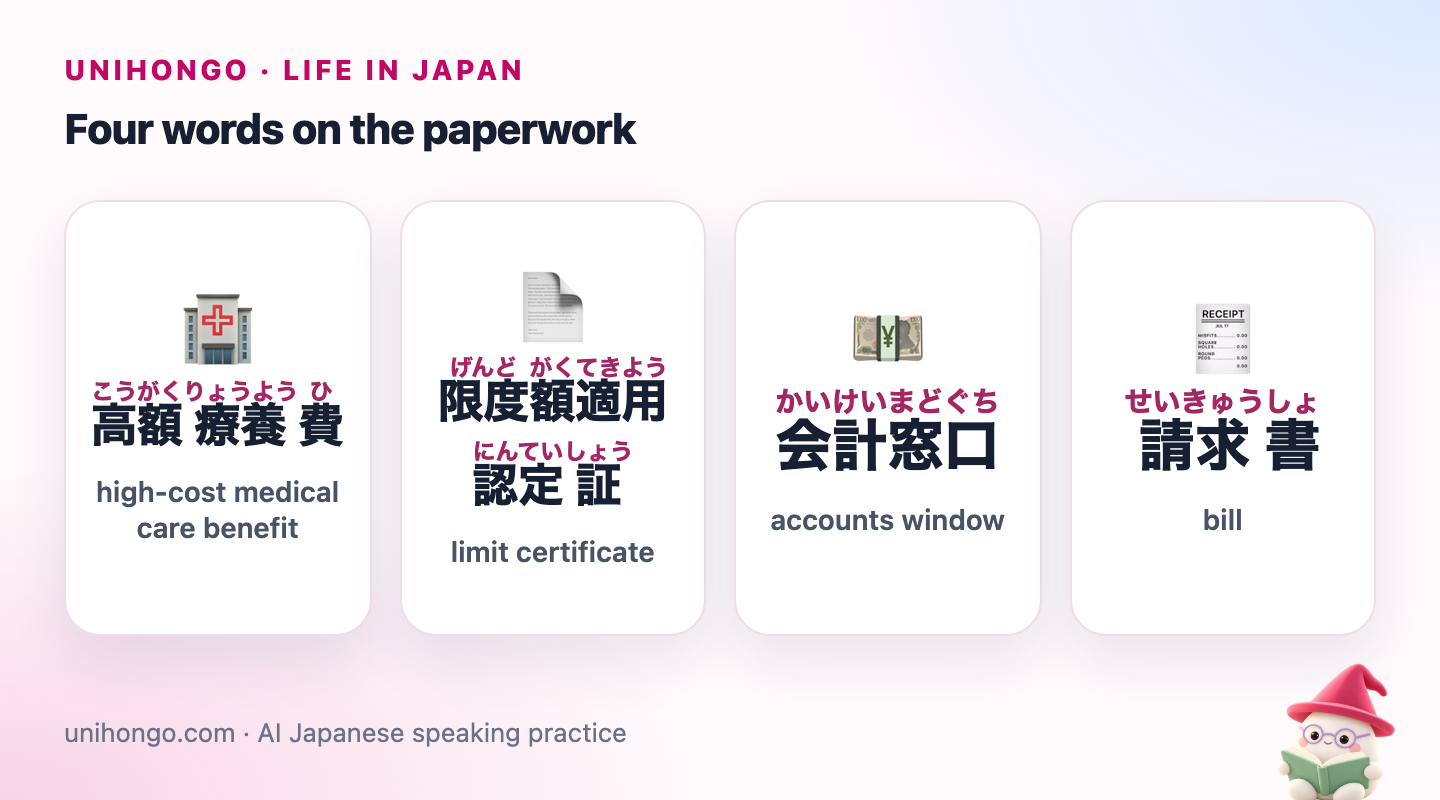
| Japanese | Romaji | Meaning |
|---|---|---|
| 高額療養費 | kōgaku ryōyōhi | high-cost medical care benefit |
| 限度額適用認定証 | gendogaku tekiyō ninteishō | limit certificate |
| 会計窓口 | kaikei madoguchi | accounts window |
| 請求書 | seikyūsho | bill |
| 自己負担限度額 | jikofutan gendogaku | your monthly cap |
Do not confuse the two key terms. The jikofutan gendogaku is the cap itself, an amount; the gendogaku tekiyō ninteishō is the certificate that lets the hospital apply it at the counter. Its income band is printed on it as a letter or category, called a kubun (区分), which the hospital reads to know your cap. Certificates have a validity period, so check the date before a new admission.
What counts towards the cap
The rules on what can be added together are where people get confused. In outline:
| Counts towards the cap | Never counts |
|---|---|
| Covered treatment, operations, tests | Standard charge for hospital meals |
| Covered medicines | Private or small-room charges (sagaku beddo dai) |
| Covered inpatient care | Treatment not covered by insurance |
| Covered outpatient visits | Documents, pyjama rental, toiletries |
- The cap is per calendar month. A stay from 20 March to 10 April is split into two months, each with its own cap.
- It is calculated for each person, and generally for each hospital or clinic, with inpatient and outpatient care, and medical and dental care, counted separately.
- Prescriptions filled at a pharmacy can be added to the clinic visit that issued them.
- For people under 70, bills above a set amount from different places, or from family members on the same insurance, can be combined; people over 70 can combine more freely.
- Only insurance-covered costs count.
Two ways to use the benefit
If you know in advance that a month will be expensive, for example a planned operation, arrange things so that you pay only up to the cap at the hospital. Otherwise, you can still get the excess back afterwards.
| Japanese | Romaji | Meaning |
|---|---|---|
| 来月入院するので、限度額認定証を申請したいです。 | Raigetsu nyūin suru node, gendogaku ninteishō o shinsei shitai desu. | I'm being admitted next month, so I'd like a limit certificate. |
| マイナ保険証で手続きできますか。 | Maina hokenshō de tetsuzuki dekimasu ka. | Can this be done with my My Number insurance card? |
| 高額療養費の支給申請書 | kōgaku ryōyōhi no shikyū shinseisho | high-cost medical care claim form |
| Point | Pay only up to the cap | Pay first, claim back |
|---|---|---|
| How | My Number card at a hospital that checks online, or a limit certificate | Pay the bill in full, then apply to your insurer |
| When to arrange | Before or at the start of treatment | After the month, within two years |
| Where to apply | Your insurer: employer insurance or the city office for kokuho | The same insurer |
| Cash needed | Only the capped amount plus uncovered costs | The full co-payment, refunded later |
With a My Number card registered as your insurance card, you agree on the reader to share your information, and the hospital applies your cap directly; no certificate is needed at hospitals that support online checks. If you do not use the card, ask your insurer for the limit certificate; employer insurance is applied for through your insurer or HR, and kokuho at the city office.
Reading a Japanese hospital bill
Hospital bills list the covered part in points, tensū, where one point equals ten yen, and then apply your share. Uncovered costs appear in a separate block. Look for these labels.
| Japanese | Romaji | Meaning |
|---|---|---|
| 保険点数 | hoken tensū | insurance points |
| 負担割合 | futan wariai | your share, e.g. 30% |
| 保険外負担 | hokengai futan | costs not covered by insurance |
| 食事療養費 | shokuji ryōyōhi | hospital meal charge |
| 差額ベッド代 | sagaku beddo dai | extra charge for a private room |
| 領収書 | ryōshūsho | receipt |
Hospitals usually bill at the end of each month and at discharge, so a long stay brings several bills. If a bill seems higher than your cap, check whether the excess is in the uncovered block, such as meals or a room charge, before asking.
At the accounts window
Hospital accounts staff deal with these questions every day, and larger hospitals have a medical social worker, iryō sōsharu wākā, in the consultation room, sōdanshitsu, who can explain the benefit and other support if paying is difficult.
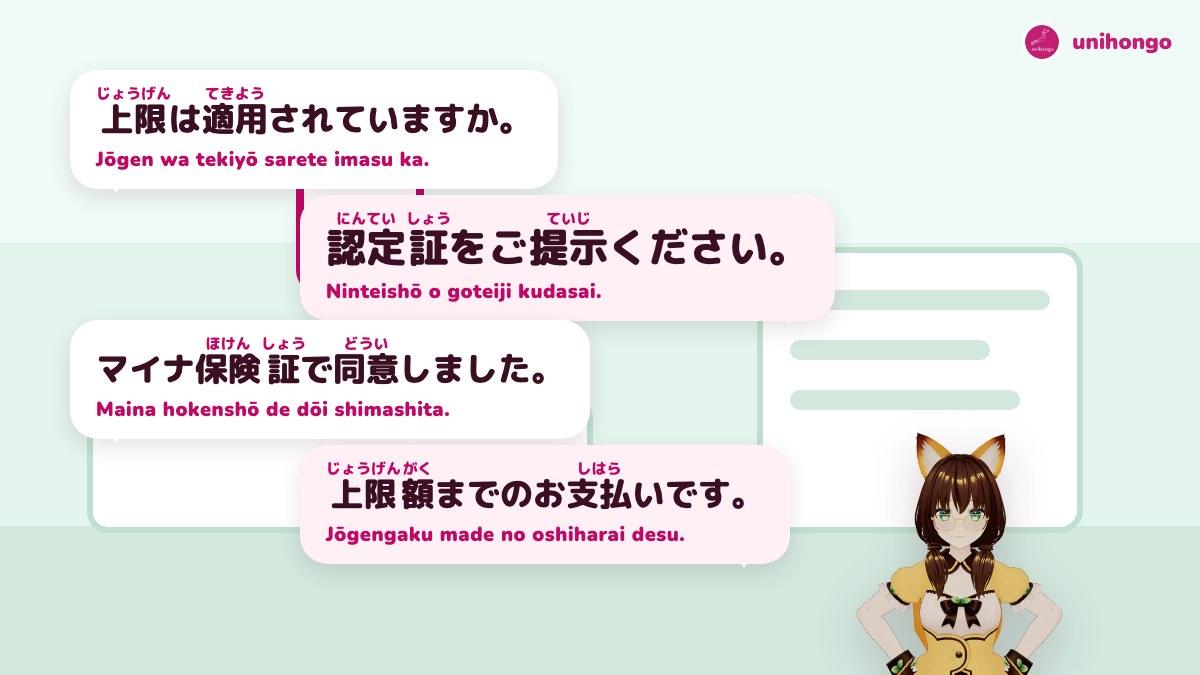
| Japanese | Romaji | Meaning |
|---|---|---|
| すみません、高額療養費は適用されていますか。 | Sumimasen, kōgaku ryōyōhi wa tekiyō sarete imasu ka. | You: Excuse me, has the high-cost benefit been applied? |
| 限度額認定証をお持ちでしたら、ご提示ください。 | Gendogaku ninteishō o omochi deshitara, goteiji kudasai. | Clerk: If you have a limit certificate, please show it. |
| マイナ保険証で同意しました。 | Maina hokenshō de dōi shimashita. | You: I agreed to share it with my My Number card. |
| では、上限額までのお支払いになります。 | Dewa, jōgengaku made no oshiharai ni narimasu. | Clerk: Then you'll pay up to your cap. |
| この保険外の金額は何ですか。 | Kono hokengai no kingaku wa nan desu ka. | You: What is this uncovered amount? |
| 支払いについて相談できる窓口はありますか。 | Shiharai ni tsuite sōdan dekiru madoguchi wa arimasu ka. | You: Is there somewhere I can ask about paying? |
What surprises people
- A stay across two months can cost more than the same stay within one month, because each month has its own cap.
- A private room chosen for comfort is outside the cap and can be expensive; ask before agreeing.
- Leaving a job mid-treatment changes your insurer, and you may need a new certificate.
- Kokuho members with unpaid premiums may find some procedures harder; ask the city office.
- The benefit covers people with private insurance too; private policies pay separately.
- A certificate applied for late in the month usually takes effect from the first day of the month of application, so apply as soon as you know.
- Treatment at several hospitals in one month may not be combined automatically at the counter; the rest comes back later as a refund.
Calling your insurer, and other help
If you are in employer insurance, the insurer's name and phone number are on your insurance documents or in the HR portal; if you are in national health insurance, call the insurance section of your city office. Have your insurance details, the patient's name and the hospital's name ready. Ask what the cap is for your income band, how to apply for the certificate or the refund, and whether your insurer sends the refund application automatically.
If paying even the capped amount is hard, say so early. Some insurers can lend the expected refund in advance at no interest, or arrange for the benefit to be paid directly to the hospital, and the hospital's medical social worker can explain other public support. Later, the medical expense deduction on a tax return can reduce your income tax for a year with high medical costs.
| Japanese | Romaji | Meaning |
|---|---|---|
| 高額療養費の申請方法を教えてください。 | Kōgaku ryōyōhi no shinsei hōhō o oshiete kudasai. | You: Please tell me how to apply for the benefit. |
| 保険証の記号と番号をお願いします。 | Hokenshō no kigō to bangō o onegai shimasu. | Insurer: Your insurance symbol and number, please. |
| 私の自己負担限度額はいくらですか。 | Watashi no jikofutan gendogaku wa ikura desu ka. | You: What is my monthly cap? |
| 申請書は後日お送りします。 | Shinseisho wa gojitsu ookuri shimasu. | Insurer: We'll send the form later. |
| 支払いが難しいので、相談したいです。 | Shiharai ga muzukashii node, sōdan shitai desu. | You: Paying is difficult, so I'd like some advice. |
| 区分はどれですか。 | Kubun wa dore desu ka. | You: Which income band am I in? |
| 多数回該当 | tasūkai gaitō | reduced cap after several high months |
Prepare before a planned stay
Before a planned admission, tell Mocchi what is happening and ask for the hospital money words as flashcards with /create-flashcards; Mocchi brings them back on the days before your stay with /review-flashcards. It can also explain any line on the hospital's admission papers.
Then rehearse the accounts window: in AI Sensei, ask Hana-sensei to play a hospital clerk while you check that the cap has been applied and ask about an uncovered charge, and ask Hana-sensei to repeat any number more slowly.