
How the reading quiz works
Each question shows a word in kanji and four readings in hiragana. Only one reading is correct; the other three are the mistakes learners actually make. Say each option aloud quietly before you choose; hearing the word often helps.
Here are four words from the quiz. Read them before you start, and notice the long vowel in りょうり and the plain ふ (not ぶ) at the start of ふべん.
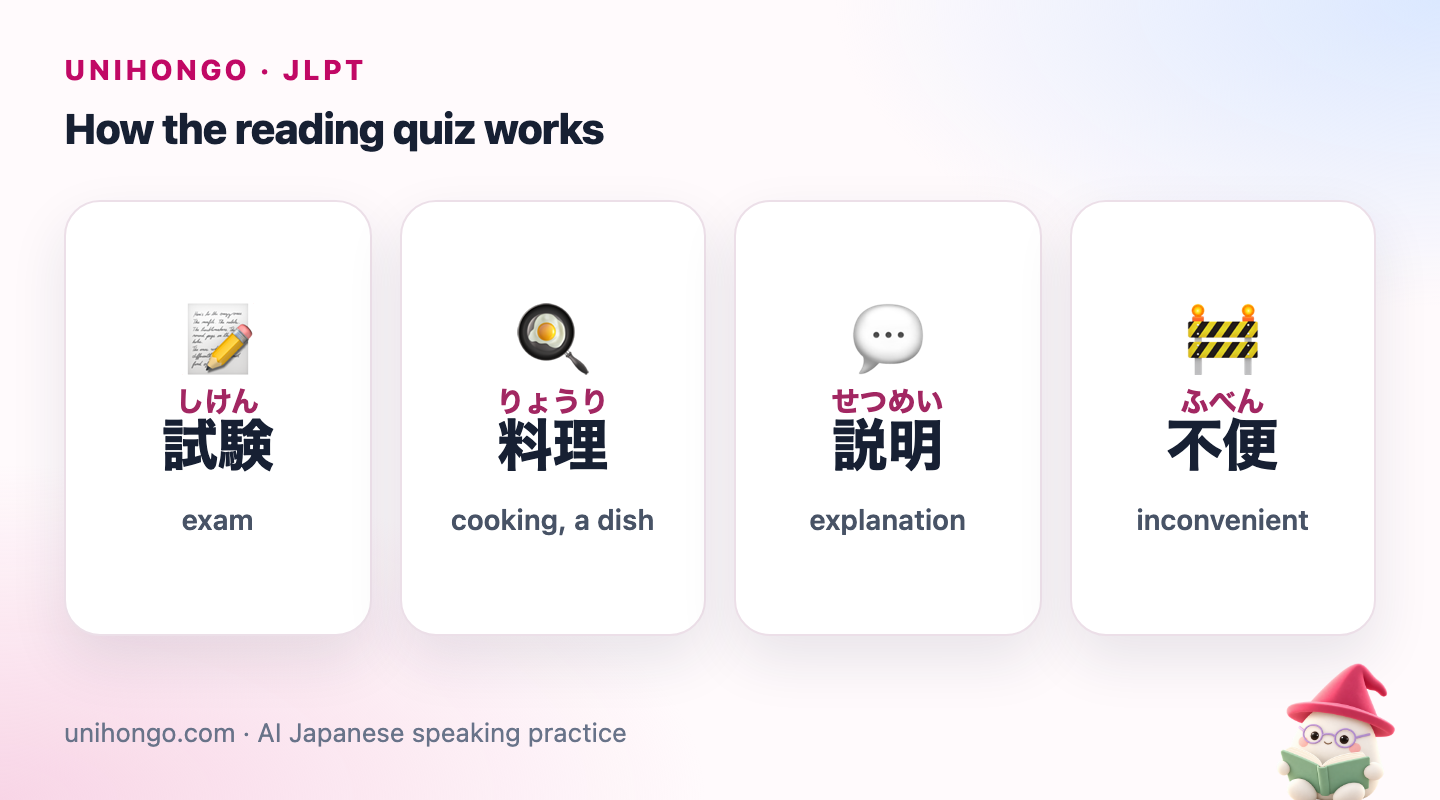
| Japanese | Romaji | Meaning |
|---|---|---|
| 試験 | shiken | exam |
| 料理 | ryōri | cooking, a dish |
| 説明 | setsumei | explanation |
| 不便 | fuben | inconvenient |
| 駅から遠くて不便です。 | Eki kara tōkute fuben desu. | It's far from the station and inconvenient. |
Questions 1-5
- 1. 試験 (a) しげん (b) じけん (c) しけい (d) しけん
- 2. 料理 (a) りょり (b) りょうりい (c) りょうり (d) りょうに
- 3. 説明 (a) せつみょう (b) せいめい (c) ぜつめい (d) せつめい
- 4. 不便 (a) ふべん (b) ふびん (c) ぶべん (d) ふへん
- 5. 特別 (a) とっべつ (b) とくべつ (c) とくへつ (d) とうべつ
Questions 6-10
This set mixes two-kanji words with very different reading patterns. Two of them contain a kanji whose reading changes in this word, so trust the whole word rather than the kanji alone.
- 6. 世界 (a) せいかい (b) せかい (c) よかい (d) せがい
- 7. 親切 (a) おやせつ (b) しんきり (c) しんさい (d) しんせつ
- 8. 去年 (a) きょねん (b) きょとし (c) こねん (d) さるねん
- 9. 地図 (a) ちと (b) じず (c) ちず (d) ちど
- 10. 運動 (a) うんとう (b) うんどう (c) うんどお (d) うどう
Questions 11-15
The last set includes two words written with one kanji plus kana. These usually take the native kun reading, which is a useful clue when the options mix on and kun readings.
- 11. 家族 (a) いえぞく (b) かぞう (c) かぞく (d) けぞく
- 12. 研究 (a) けんきゅう (b) けんきゅ (c) げんきゅう (d) けんく
- 13. 遠い (a) とうい (b) えんい (c) とい (d) とおい
- 14. 急ぐ (a) きゅうぐ (b) いそぐ (c) あせぐ (d) いそく
- 15. 生活 (a) せいかつ (b) せいかっ (c) しょうかつ (d) なまかつ
Answer key with reading notes
Each gloss gives the answer letter, the meaning and the trap that the wrong options were built on.
| Japanese | Romaji | Meaning |
|---|---|---|
| 試験 | shiken | 1 (d) exam: plain k, not voiced g or j |
| 料理 | ryōri | 2 (c) cooking: long ryō, short ri |
| 説明 | setsumei | 3 (d) explanation: mei here, not myō |
| 不便 | fuben | 4 (a) inconvenient: plain fu, voiced ben |
| 特別 | tokubetsu | 5 (b) special: toku stays full, no small tsu |
| 世界 | sekai | 6 (b) world: short se, not sei |
| 親切 | shinsetsu | 7 (d) kind: on readings, not oya or kiri |
| 去年 | kyonen | 8 (a) last year: kyo + nen |
| 地図 | chizu | 9 (c) map: zu, the voiced reading of 図 |
| 運動 | undō | 10 (b) exercise: long dō at the end |
| 家族 | kazoku | 11 (c) family: on reading ka, not kun ie |
| 研究 | kenkyū | 12 (a) research: long kyū |
| 遠い | tōi | 13 (d) far: written とおい in kana |
| 急ぐ | isogu | 14 (b) to hurry: kun reading with okurigana |
| 生活 | seikatsu | 15 (a) daily life: sei + katsu |
Several of these kanji have other readings in other words. 生 is sei in 生活 but nama in 生ビール and u in 生まれる. 便 is ben in 不便 but bin in 郵便 (yūbin, post). That is why learning kanji inside words works better than learning each kanji's readings as a list.
On reading or kun reading?
Most kanji have at least one on reading, which came from Chinese, and many have a kun reading, which is a native Japanese word. A simple rule covers most N4 words: two kanji together usually take on'yomi readings (家族 kazoku, 急行 kyūkō), and one kanji followed by kana usually takes the kun reading (家 ie, 急ぐ isogu).
The rule has exceptions, such as 一人 (hitori) and 大人 (otona), which have special readings for the whole word. But when you meet an unknown compound on the test, the on reading is the safest guess.
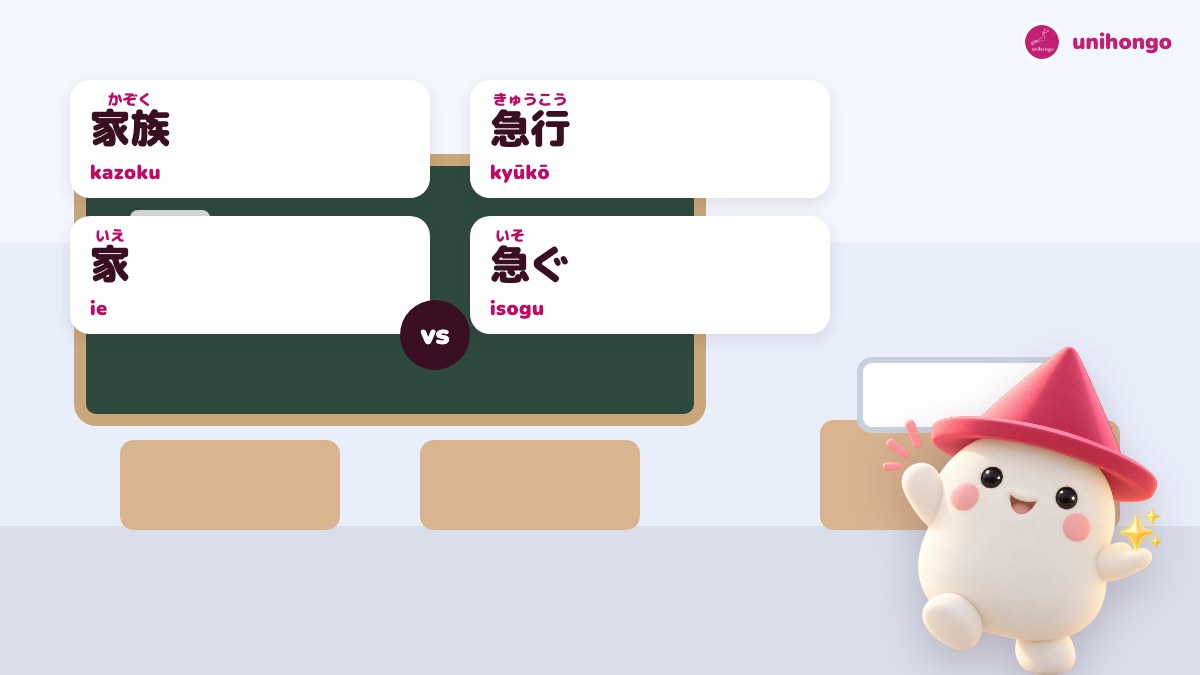
| Japanese | Romaji | Meaning |
|---|---|---|
| 家族 | kazoku | family (on reading ka) |
| 家 | ie | house (kun reading ie) |
| 急行 | kyūkō | express train (on reading kyū) |
| 急ぐ | isogu | to hurry (kun reading iso) |
The four reading traps at N4
| Trap | Example | How to check |
|---|---|---|
| Long or short vowel | ryōri, not ryori; sekai, not seikai | Say the word aloud and count the beats |
| Voiced or plain sound | fuben, not fubin; shiken, not shigen | Learn the word as a sound, not kanji by kanji |
| Small tsu or not | tokubetsu, not tokkubetsu | Listen for the short pause before the next sound |
| On or kun reading | kazoku, not iezoku | Compound means on; kanji plus kana means kun |
The voiced sounds deserve extra care. When two kanji join, the first sound of the second kanji sometimes becomes voiced: h to b, k to g, s to z, t to d. That is why 地図 is chizu and 不便 is fuben. There is no simple rule for when this happens, so the safest method is to learn each word as a sound.
Counting beats helps with the first and third traps. りょうり has three beats (ryo-u-ri) and とくべつ has four (to-ku-be-tsu). If an option has a different number of beats from the word you remember, it is probably wrong.
Score bands and what to study
| Score | What it suggests | Next step |
|---|---|---|
| 13-15 | N4 kanji readings are secure | Start N3 kanji words in sentences |
| 9-12 | Good recognition, details slip | Group misses by trap and review the rule |
| 5-8 | Many readings are guessed | Ten kanji words a day, read aloud with a sentence |
| 0-4 | N4 kanji are mostly new | Review the N5 kanji first, then add N4 slowly |
Reading questions are one part of the language knowledge section. To see how your kanji reading holds up next to vocabulary, grammar and listening, try the N4 paper at unihongo.com/jlpt-mock-test with its real time limits.
A short daily kanji routine
Start each day by asking Mocchi about one kanji you missed, for example /kanji 族. Mocchi shows the readings, common words and similar-looking kanji, and because it remembers which kanji gave you trouble, a later /review can bring them back at the right time.
Keep the routine small and regular. Five words a day, read aloud with an example sentence and reviewed two days later, usually does more than an hour once a week. When a word comes back and you still hesitate, write it once by hand: you do not need handwriting for the test, but writing slows you down enough to notice each part of the kanji.
Then spend a few minutes on Kotoba Tank at unihongo.com/games with an N4 word pack. Seeing the words at speed trains quick recognition, which is exactly what you need when the test clock is running.