
Four keigo verbs to know before you start
Much of keigo rests on a small set of special verbs. The four below appear in the quiz: two honorific verbs for what other people do, and two humble verbs for what you do.
Notice that the special verbs replace the ordinary verb completely. Meshiagaru has nothing in common with taberu, so these verbs have to be learnt as words, not as rules.
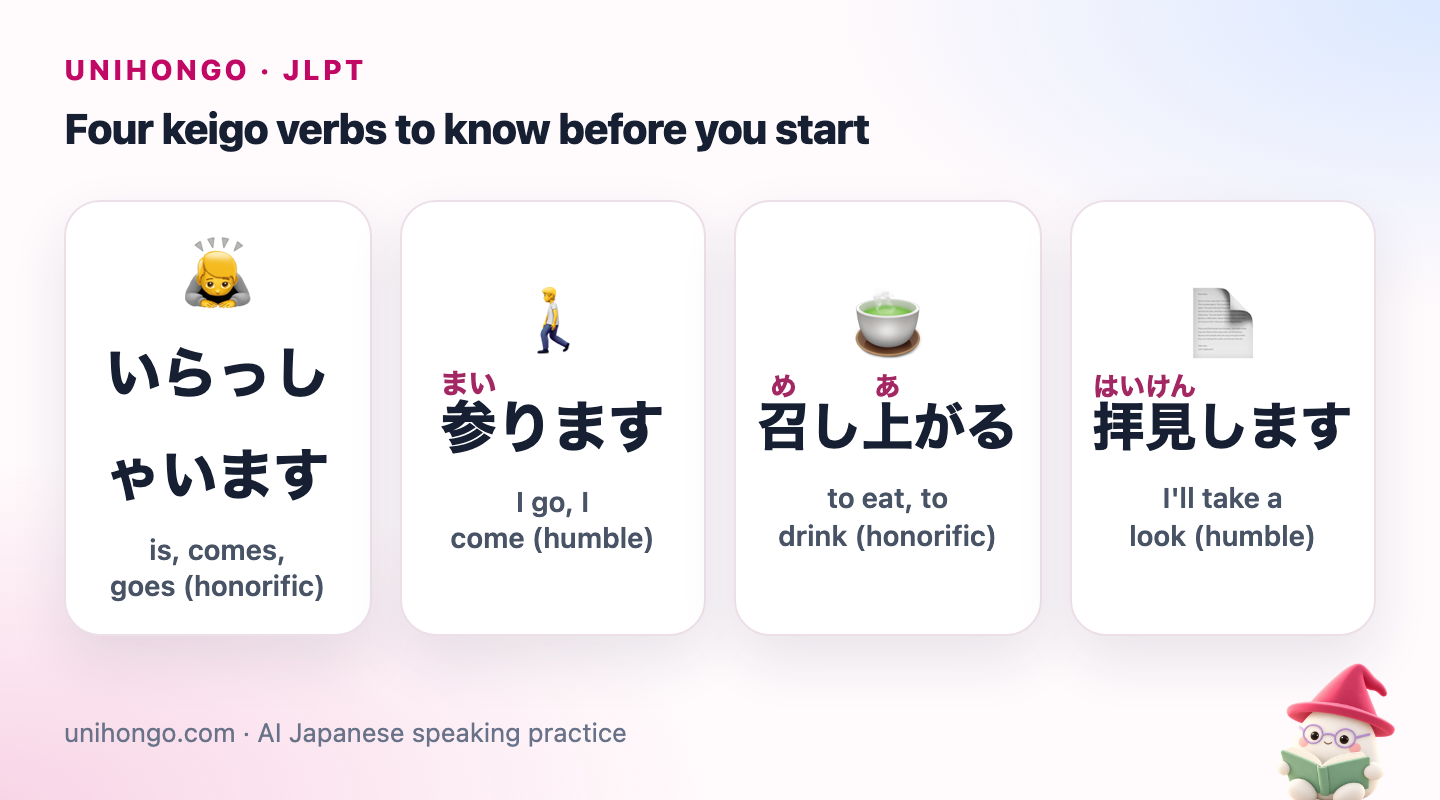
| Japanese | Romaji | Meaning |
|---|---|---|
| いらっしゃいます | irasshaimasu | is, comes, goes (honorific) |
| 参ります | mairimasu | I go, I come (humble) |
| 召し上がる | meshiagaru | to eat, to drink (honorific) |
| 拝見します | haiken shimasu | I'll take a look (humble) |
Questions 1-5: choosing the right verb
- 1. Which is the honorific form of 食べる? (a) いただく (b) 参る (c) 召し上がる (d) 拝見する
- 2. Which is the humble form of 行く? (a) いらっしゃる (b) おっしゃる (c) なさる (d) 参る
- 3. A shop clerk to a customer: 「こちらで 少々 ___ ください。」 (a) お待ち (b) 待ちして (c) お待ちして (d) 待たれて
- 4. You tell a client that your boss Tanaka is away from the desk: 「田中は ただいま 席を ___ 。」 (a) お外しになっています (b) 外しております (c) 外していらっしゃいます (d) お外しです
- 5. To your teacher: 「先生は 明日 何時に ___ か。」 (come) (a) 参ります (b) いらっしゃいます (c) 伺います (d) おります
Questions 6-10: direction and double keigo
For each question, first decide who does the action: you, or the person you are talking to. Then choose a humble or an honorific verb.
- 6. Which form is double keigo? (a) おっしゃる (b) 申し上げる (c) ご覧になる (d) おっしゃられる
- 7. To a client: 「資料を ___ 。」 (I looked at the documents) (a) 拝見しました (b) ご覧になりました (c) 見られました (d) お見になりました
- 8. Introducing yourself formally: 「私は スミスと ___ 。」 (a) おっしゃいます (b) 言われます (c) 申します (d) お言いします
- 9. To a guest: 「週末は 何を ___ か。」 (do) (a) いたします (b) なさいます (c) 申します (d) 参ります
- 10. 「先生に お土産を ___ 。」 (I gave) (a) くださいました (b) なさいました (c) 差し上げました (d) いらっしゃいました
Questions 11-15: real situations
- 11. You ask your manager whether they saw your email. Which is correct? (a) メールを ご覧になりましたか (b) メールを 拝見しましたか (c) メールを 見させていただきましたか (d) メールを お見えになりましたか
- 12. A client's host offers you tea. The natural reply: (a) 召し上がります (b) くださいます (c) おります (d) いただきます
- 13. A receptionist to a visitor: 「会議室まで ご案内 ___ 。」 (a) なさいます (b) いたします (c) くださいます (d) になります
- 14. To a client on the phone: 「明日 そちらに ___ 。」 (I will visit) (a) 伺います (b) いらっしゃいます (c) お越しになります (d) お見えになります
- 15. Which sentence is NOT correct keigo? (a) お客様が お越しに なりました (b) 部長が おっしゃいました (c) 先生が お見えに なりました (d) 社長が 申されました
Answer key: direction, form and reason
One point per question. Most wrong answers are real keigo pointed in the wrong direction.
| Japanese | Romaji | Meaning |
|---|---|---|
| 召し上がる | meshiagaru | 1 (c) honorific eat; itadaku is humble |
| 参る | mairu | 2 (d) humble go; irassharu is honorific |
| 少々お待ちください。 | Shōshō omachi kudasai. | 3 (a) o + stem + kudasai: please wait |
| 田中は席を外しております。 | Tanaka wa seki o hazushite orimasu. | 4 (b) own boss to a client: humble, no san |
| 何時にいらっしゃいますか。 | Nanji ni irasshaimasu ka. | 5 (b) honorific for the teacher's action |
| おっしゃられる | ossharareru | 6 (d) double keigo: ossharu plus rareru |
| 資料を拝見しました。 | Shiryō o haiken shimashita. | 7 (a) humble for my own action |
| スミスと申します。 | Sumisu to mōshimasu. | 8 (c) humble say: my name is Smith |
| 週末は何をなさいますか。 | Shūmatsu wa nani o nasaimasu ka. | 9 (b) honorific do, for the guest |
| お土産を差し上げました。 | Omiyage o sashiagemashita. | 10 (c) humble give, to a superior |
| メールをご覧になりましたか。 | Mēru o goran ni narimashita ka. | 11 (a) honorific see, for the manager |
| いただきます。 | Itadakimasu. | 12 (d) humble receive: thank you, I will |
| ご案内いたします。 | Goannai itashimasu. | 13 (b) go + noun + itasu: I will show you |
| 明日そちらに伺います。 | Ashita sochira ni ukagaimasu. | 14 (a) humble visit, for my action |
| 社長がおっしゃいました。 | Shachō ga osshaimashita. | 15 (d) mōsu is humble; use ossharu for the president |
Question 15 shows a very common slip. Mōsareru looks respectful because of the reru ending, but mōsu is a humble verb, and adding reru does not turn it into an honorific. For a superior, use the honorific verb ossharu.
Question 11 also catches people who overuse sasete itadaku. Mite sasete itadakimashita ka asks whether your manager humbly looked with your permission, which makes no sense; the honorific goran ni naru is the natural choice.
The direction checklist
Before any keigo sentence, ask two questions. Who does the action? And whose side is that person on, mine or the listener's? The answers decide the form.
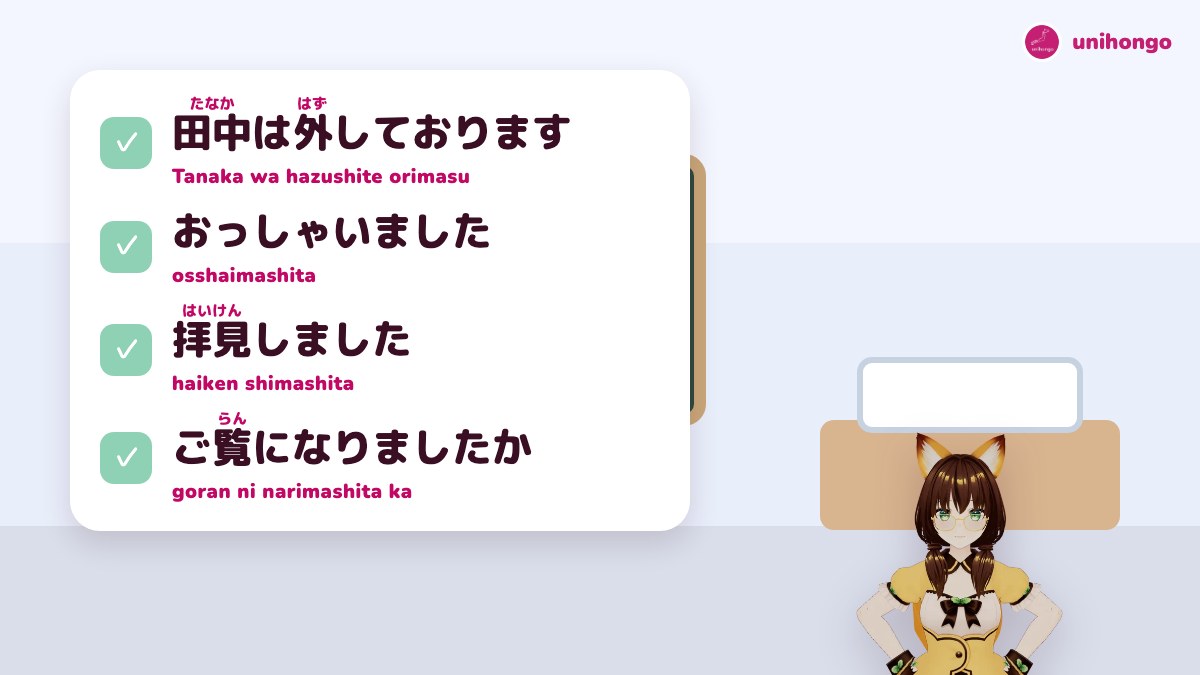
- The listener or an outsider acts: use honorific forms (irassharu, goran ni naru, ossharu).
- You or someone from your own group acts, talking to an outsider: use humble forms (mairu, haiken suru, mōsu), and drop san from your colleagues' names.
- Use one keigo device per verb. Ossharu is enough; ossharareru is too much.
- When unsure, polite desu and masu is safer than keigo pointed the wrong way.
Model dialogue: a call to a client's office
Here is a short phone call that uses several forms from the quiz. You are calling a client, and the receptionist answers. Read both parts aloud.
| Japanese | Romaji | Meaning |
|---|---|---|
| お電話ありがとうございます。山川商事でございます。 | Odenwa arigatō gozaimasu. Yamakawa Shōji de gozaimasu. | Receptionist: Thank you for calling. This is Yamakawa Trading. |
| さくら物産のスミスと申します。 | Sakura Bussan no Sumisu to mōshimasu. | You: My name is Smith, from Sakura Trading. |
| 佐藤部長はいらっしゃいますか。 | Satō buchō wa irasshaimasu ka. | You: Is Mr Satō, the department head, available? |
| 申し訳ございません。佐藤はただいま席を外しております。 | Mōshiwake gozaimasen. Satō wa tadaima seki o hazushite orimasu. | Receptionist: I'm sorry. Satō is away from his desk right now. |
| では、明日改めてお電話いたします。 | Dewa, ashita aratamete odenwa itashimasu. | You: Then I'll call again tomorrow. |
| かしこまりました。申し伝えます。 | Kashikomarimashita. Mōshitsutaemasu. | Receptionist: Certainly. I will pass that on. |
Notice that you say Satō buchō with honorific irassharu, because he belongs to the client's company, but the receptionist says Satō alone with humble orimasu, because he is in her own group. Same person, two different forms, both correct.
Score bands and next steps
| Score | Keigo level | What to practise |
|---|---|---|
| 13-15 | Ready for most business situations | Speak keigo aloud under time pressure |
| 9-12 | Forms known, direction sometimes slips | The direction checklist on every sentence |
| 5-8 | Special verbs still mixed up | Learn the ten special verbs in pairs |
| 0-4 | Keigo is new territory | Start with desu and masu, then add five verbs |
Keigo appears across the JLPT from N3 upwards, especially in listening, where shop and office announcements use it heavily. The N3 to N1 papers on unihongo.com/jlpt-mock-test include listening sections that show how well you understand keigo at natural speed.
Say it before you need it
Ask Mocchi to drill the verbs you missed: "Give me ten situations and let me answer with the right honorific or humble verb, then explain my mistakes." Mocchi keeps track of the forms you reverse, so your next /review starts with them.
Then speak. In AI Sensei, choose Yamada-sensei and ask for a job interview role, with Yamada-sensei as the interviewer. Introduce yourself with mōshimasu, talk about your current company with humble forms, and ask questions with honorifics. The session report afterwards lists corrections, so you can see which keigo slipped under pressure.