
What one week can and cannot do
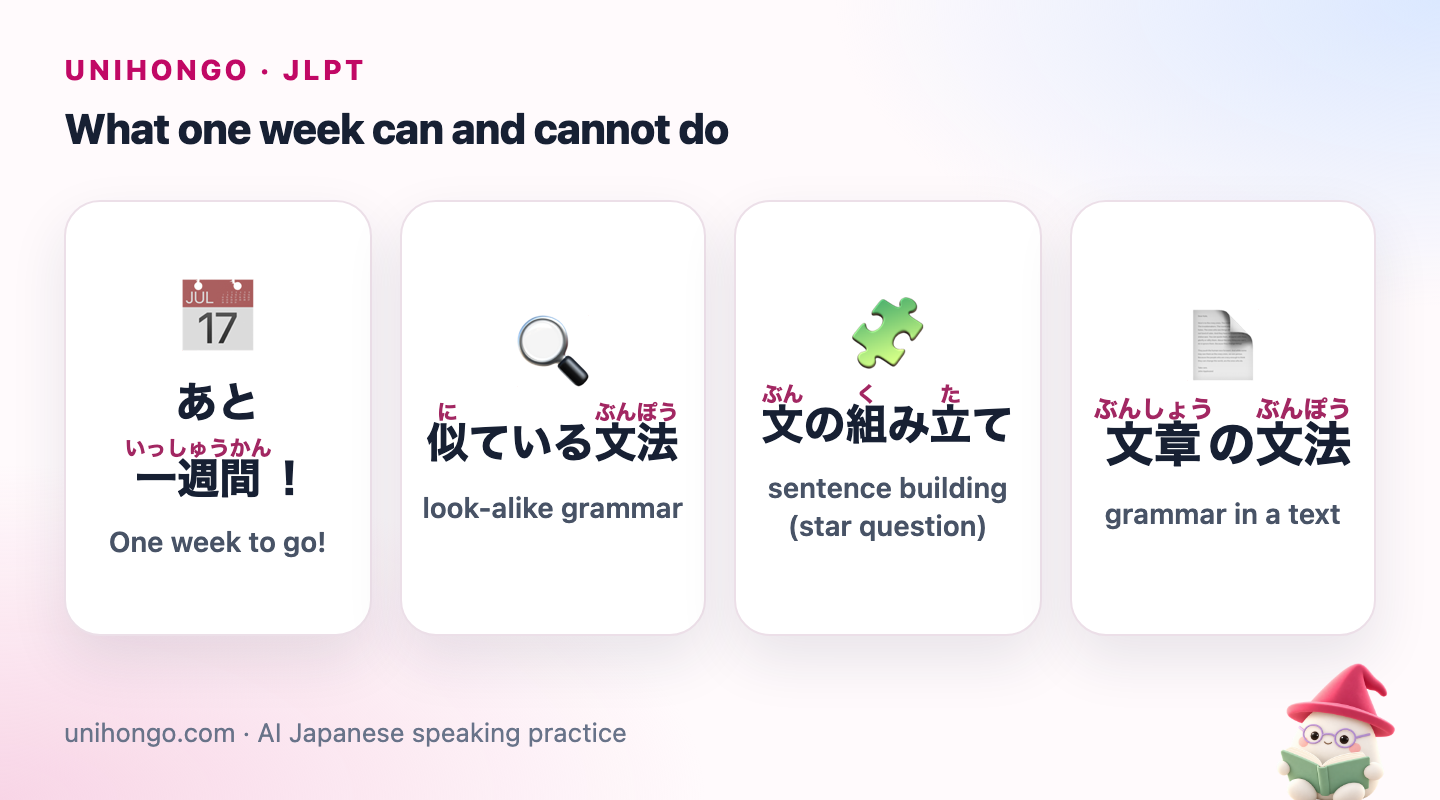
In the final week, your grammar score is mostly decided by what you already know. The aim is to stop giving points away. Three item families account for many careless losses: choosing the right form in a sentence (bun no bunpō), building a sentence from four pieces (bun no kumitate) and choosing the form that fits a paragraph (bunshō no bunpō). The four terms below are the ones you will see in study guides and on the official site.
| Japanese | Romaji | Meaning |
|---|---|---|
| あと一週間! | Ato isshūkan! | One week to go! |
| 似ている文法 | nite iru bunpō | look-alike grammar |
| 文の組み立て | bun no kumitate | sentence building (star question) |
| 文章の文法 | bunshō no bunpō | grammar in a text |
The seven days at a glance
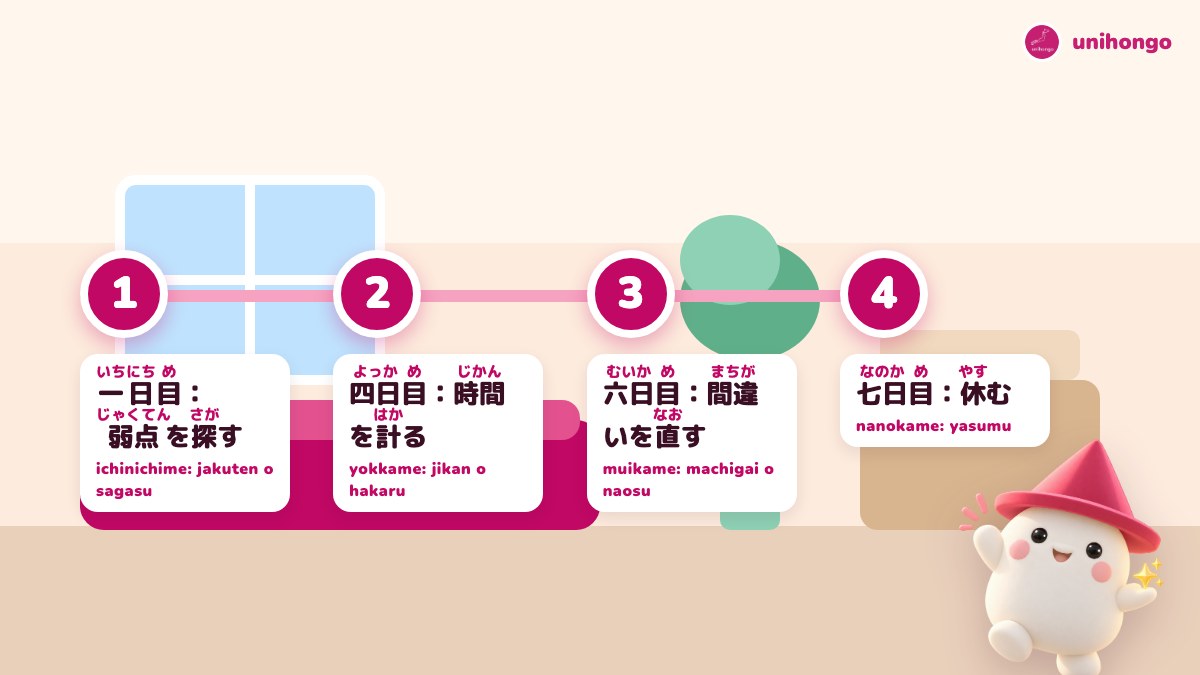
Each day has one main job. If you miss a day, skip it rather than doubling up; days 4 and 7 are the ones to protect.
| Day | Date (for 6 Dec 2026) | Main job | Output |
|---|---|---|---|
| 1 | Sun 29 Nov | Diagnose: one grammar section from a practice test | A list of every pattern you missed or guessed |
| 2 | Mon 30 Nov | Look-alike pairs from your list | One sentence per pattern, said aloud |
| 3 | Tue 1 Dec | Star questions: twenty items | A note of which piece you join first |
| 4 | Wed 2 Dec | Timed run: grammar plus reading | Minutes spent per part |
| 5 | Thu 3 Dec | Text grammar and connectors | Ten connectors with your own example |
| 6 | Fri 4 Dec | Error log: redo every wrong item | A short list of the last weak points |
| 7 | Sat 5 Dec | Light review, bag packed, early night | Nothing new |
Day 2: separate the look-alike pairs
The exam often places two similar patterns side by side in the choices. You do not need a long explanation for each; you need one clear rule and one sentence you can say. Here are three pairs that many learners mix up. Replace them with the ones from your own list.
Tame ni (in order to) follows a verb you control: hataraku, benkyō suru. Yō ni (so that) usually follows a potential form, a negative or a verb you do not control: hanaseru, wasurenai. Hazu means you expect something from evidence; beki means you think someone ought to do it.
| Japanese | Romaji | Meaning |
|---|---|---|
| 日本で働くために、日本語を勉強しています。 | Nihon de hataraku tame ni, nihongo o benkyō shite imasu. | I'm studying Japanese in order to work in Japan. |
| 日本語が話せるように、毎日練習しています。 | Nihongo ga hanaseru yō ni, mainichi renshū shite imasu. | I practise every day so that I can speak Japanese. |
| 忘れないように、メモしておきます。 | Wasurenai yō ni, memo shite okimasu. | I'll write it down so I don't forget. |
| 田中さんはもう着いたはずです。 | Tanaka-san wa mō tsuita hazu desu. | Tanaka-san should have arrived by now (I expect so). |
| 約束は守るべきです。 | Yakusoku wa mamoru beki desu. | You ought to keep your promises. |
The three tokoro forms are another favourite. The verb form before tokoro tells you the timing, so check the verb first, not the end of the sentence.
The three tokoro forms and bakari
| Japanese | Romaji | Meaning |
|---|---|---|
| 今からご飯を食べるところです。 | Ima kara gohan o taberu tokoro desu. | I'm just about to eat. |
| 今、ご飯を食べているところです。 | Ima, gohan o tabete iru tokoro desu. | I'm in the middle of eating. |
| 今、ご飯を食べたところです。 | Ima, gohan o tabeta tokoro desu. | I've just finished eating. |
| さっき起きたばかりです。 | Sakki okita bakari desu. | I only just got up. |
| 先月引っ越したばかりです。 | Sengetsu hikkoshita bakari desu. | I only moved last month. |
Ta tokoro means the moment just after the action. Ta bakari also means only just, but it can stretch further back and carries the feeling that it still feels recent: you can say sengetsu hikkoshita bakari, but sengetsu hikkoshita tokoro sounds wrong.
Day 3: a method for the star question
In sentence building, the sentence has four blanks and one carries a star. Learners often try every order in their head and lose minutes. A faster method has three steps.
| Japanese | Romaji | Meaning |
|---|---|---|
| 駅に着いたら、すぐ私に電話してください。 | Eki ni tsuitara, sugu watashi ni denwa shite kudasai. | Please call me as soon as you arrive at the station. |
- Find the pair that must stay together: a noun and its particle, a verb and the pattern after it, or two halves of a set expression.
- Look at the words just before and after the blanks; they often decide which piece goes first or last.
- Build the whole sentence, read it once in your head, and only then check which piece lands on the star.
- If you are stuck after a minute, choose the piece that is most often second in such sentences, mark the item and move on.
Imagine the pieces are tsuitara, eki ni, sugu and watashi ni. Eki ni must come before tsuitara, and watashi ni must sit right before denwa shite. Once those two joins are fixed, only one order is left.
Day 5: connectors decide the text grammar items
Text grammar items give you a short essay or letter with gaps. Many gaps are connectors, and the choice depends on the logic between two sentences: contrast, result, addition or restatement. Learn one example per connector and ask yourself which relationship the paragraph needs before you read the choices.
| Japanese | Romaji | Meaning |
|---|---|---|
| しかし、結果はよくなかった。 | Shikashi, kekka wa yoku nakatta. | However, the result was not good. (contrast) |
| そのため、電車が止まった。 | Sono tame, densha ga tomatta. | Because of that, the trains stopped. (result) |
| それに、値段も安い。 | Sore ni, nedan mo yasui. | On top of that, it's also cheap. (addition) |
| つまり、時間が足りないのだ。 | Tsumari, jikan ga tarinai no da. | In other words, there isn't enough time. (restatement) |
| ところが、誰も来なかった。 | Tokoro ga, dare mo konakatta. | But, unexpectedly, nobody came. (surprise) |
Notice the plain style. Text grammar passages are often written in da and dearu style, not desu and masu, so get used to reading plain endings as normal written Japanese, not as rude speech.
Days 4, 6 and 7: time, errors and rest
On day 4, do the grammar and reading parts of a practice test in one block with a timer, and write down how many minutes grammar took. If grammar eats into your reading time, the fix for exam day is simple: give each grammar item a fixed budget, choose and move on, and come back at the end only if time remains.
On day 6, redo every wrong item from the week without looking at your earlier answer. If you get it right and can say why, cross it off. What is left is your final list for the morning of the exam. On day 7, read that list once, say your example sentences aloud, pack your admission voucher, pencils and watch, and stop early.
- A pattern you got right by luck counts as wrong in your log.
- Write why the right answer works in your own words, not the book's.
- Never start a new grammar list on day 6 or 7.
Use your last week well with Mocchi
Paste a pair from your error log into Mocchi, for example /grammar compare hazu and beki with one exam-style question each, and Mocchi explains the difference with fresh sentences and then tests you. Mocchi remembers the patterns you keep missing, so on day 6 you can simply ask for a review of this week's weak points.
For the timed run on day 4, take the grammar and reading part of a JLPT mock test on Unihongo, which uses the real section structure and time limits and gives an estimated score.