
What this N4 quiz checks
The quiz has three sets of five questions: readings and meanings, verbs in context, and expressions. Every question has four options, and in most of them two options look possible until you read the whole sentence.
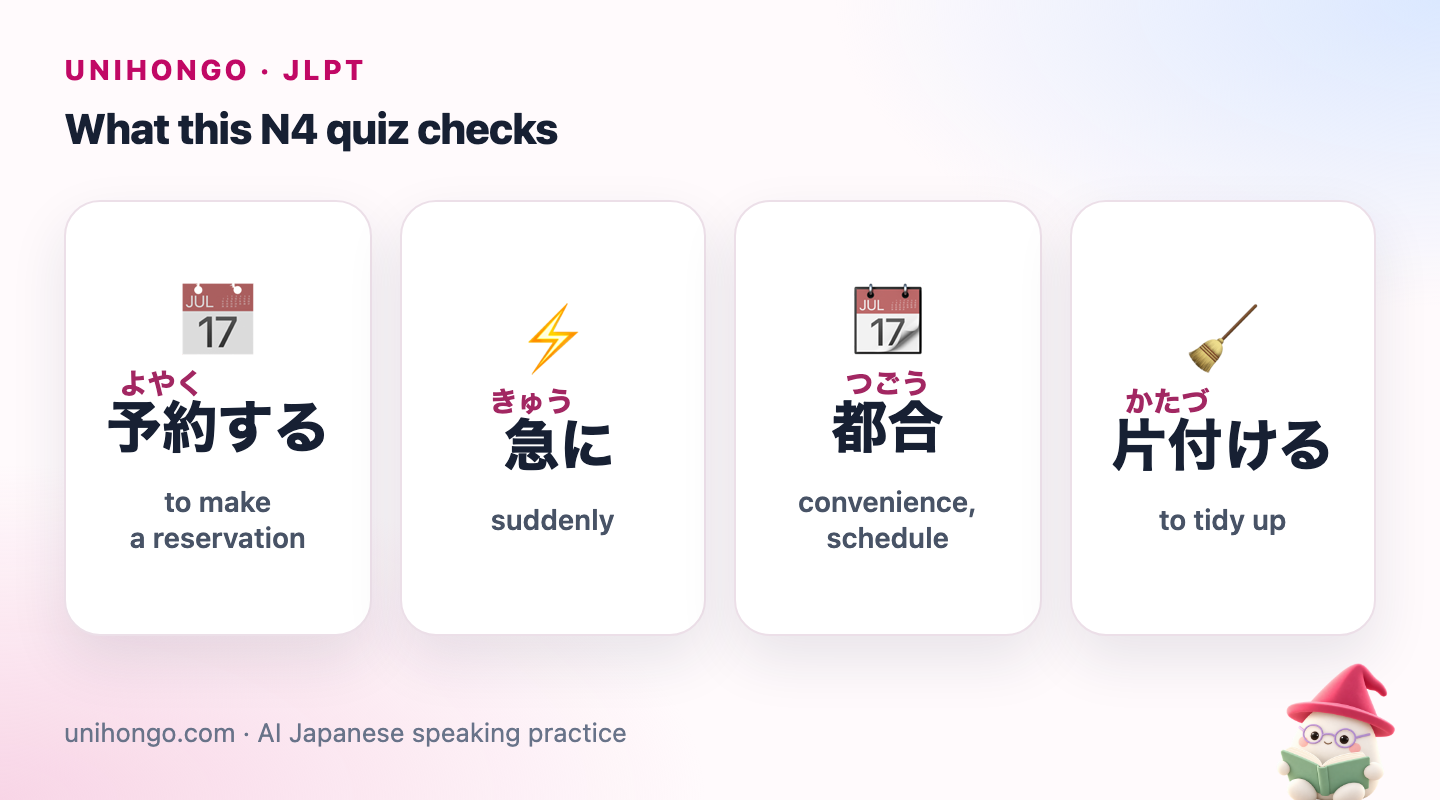
Here are four words you will meet in the quiz. They are typical N4 words: common in daily life, often written in kanji, and easy to confuse with a near neighbour.
Tsugō is a good example of why N4 vocabulary needs context. A dictionary gives convenience or circumstances, but in daily life it almost always appears in phrases about schedules: tsugō ga ii (that time works), tsugō ga warui (that time does not work) and go-tsugō wa ikaga desu ka (when would suit you?). Learning the phrase, not the dictionary word, is what lets you answer quickly.
| Japanese | Romaji | Meaning |
|---|---|---|
| 予約する | yoyaku suru | to make a reservation |
| 急に | kyū ni | suddenly |
| 都合 | tsugō | convenience, schedule |
| 片付ける | katazukeru | to tidy up |
| 月曜日は都合が悪いです。 | Getsuyōbi wa tsugō ga warui desu. | Monday doesn't work for me. |
Questions 1-5: readings and meanings
- 1. How do you read 予約? (a) ようやく (b) よやく (c) よやっく (d) ようやっく
- 2. 「急に 雨が ___ きました。」 (a) 落ちて (b) 出して (c) 降って (d) 下りて
- 3. What does 都合が悪い mean? (a) it doesn't suit my schedule (b) the weather is bad (c) I feel sick (d) it is dangerous
- 4. 「部屋を ___ から、出かけます。」 (a) 集めて (b) 届けて (c) 調べて (d) 片付けて
- 5. Which word means to be surprised? (a) がっかりする (b) びっくりする (c) すっきりする (d) のんびりする
Questions 6-10: verbs and adjectives in context
Read the full sentence before choosing. The clue is often after the blank.
- 6. 「この 道は 車が 多いので、 ___ です。」 (a) 危ない (b) 細かい (c) 珍しい (d) 優しい
- 7. How do you read 運転? (a) うんでん (b) うんどう (c) うでん (d) うんてん
- 8. 「試験に ___ ために、毎日 勉強しています。」 (a) 卒業する (b) 入学する (c) 合格する (d) 出席する
- 9. Which is closest in meaning to さっき? (a) あとで (b) いつも (c) ずっと (d) 少し前に
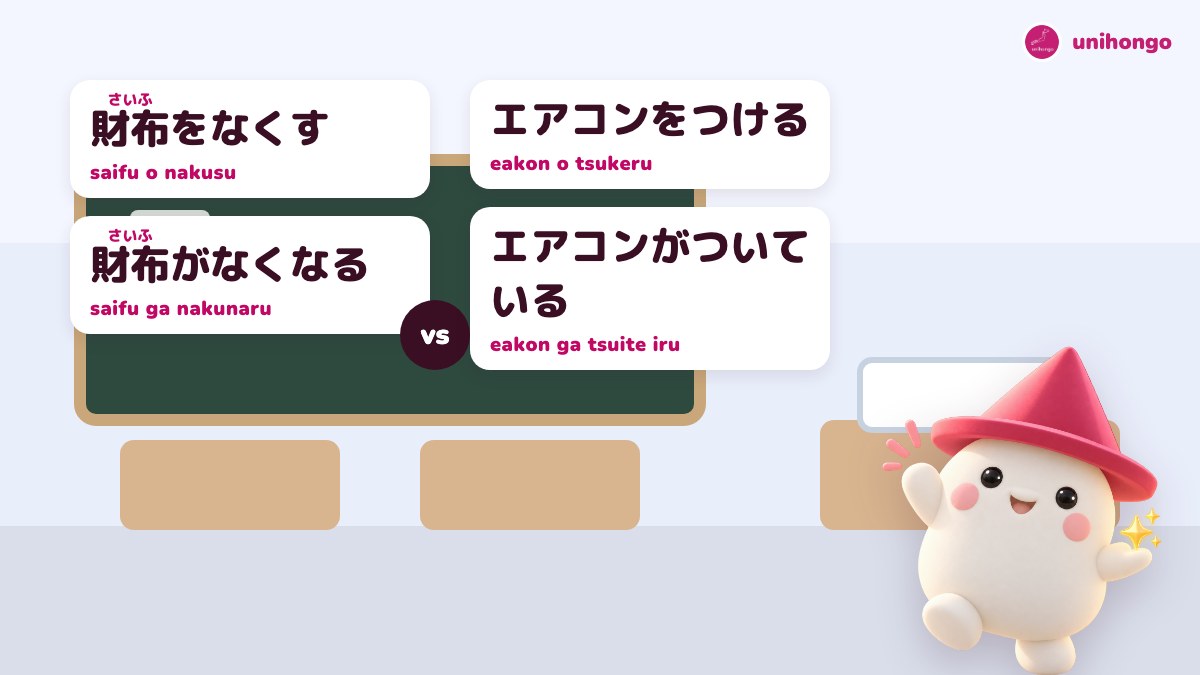
- 10. 「どこかで 財布を ___ しまいました。今 さがしています。」 (a) なくして (b) なくなって (c) こわれて (d) さがして
Questions 11-15: expressions and set phrases
- 11. 「エアコンが ___ いるので、部屋が すずしいです。」 (a) つけて (b) ついて (c) あいて (d) しまって
- 12. What does バスが なかなか 来ない mean? (a) the bus came quickly (b) the bus just won't come (c) the bus comes often (d) the bus came by chance
- 13. 「図書館の 本は 月曜日までに ___ ください。」 (a) 帰って (b) 借りて (c) 戻って (d) 返して
- 14. Which word is about the weather? (a) 台風 (b) 地震 (c) 火事 (d) 事故
- 15. 「会議の 準備が ___ 。」 (a) なりました (b) しました (c) できました (d) ありました
Answers 1-8 with explanations
| Japanese | Romaji | Meaning |
|---|---|---|
| 予約 | yoyaku | 1 (b) reservation: short yo, not long yō |
| 急に雨が降ってきました。 | Kyū ni ame ga futte kimashita. | 2 (c) It suddenly started raining: rain falls, furu |
| 都合が悪い | tsugō ga warui | 3 (a) it doesn't suit my schedule; a soft way to say no |
| 部屋を片付けてから、出かけます。 | Heya o katazukete kara, dekakemasu. | 4 (d) I'll tidy my room, then go out |
| びっくりする | bikkuri suru | 5 (b) be surprised; gakkari suru is be disappointed |
| この道は危ないです。 | Kono michi wa abunai desu. | 6 (a) dangerous: many cars, so the road is risky |
| 運転 | unten | 7 (d) driving; undō is exercise |
| 試験に合格するために | shiken ni gōkaku suru tame ni | 8 (c) in order to pass the exam |
Answers 9-15 with explanations
| Japanese | Romaji | Meaning |
|---|---|---|
| さっき | sakki | 9 (d) a moment ago, close to sukoshi mae ni |
| 財布をなくしてしまいました。 | Saifu o nakushite shimaimashita. | 10 (a) I lost my wallet: nakusu takes o |
| エアコンがついています。 | Eakon ga tsuite imasu. | 11 (b) the AC is on: tsuku takes ga |
| バスがなかなか来ない。 | Basu ga nakanaka konai. | 12 (b) the bus just won't come |
| 本を返してください。 | Hon o kaeshite kudasai. | 13 (d) please return the book; kaeru is go home |
| 台風 | taifū | 14 (a) typhoon; jishin is an earthquake |
| 準備ができました。 | Junbi ga dekimashita. | 15 (c) everything is ready: junbi ga dekiru |
Question 13 is also worth a second look. Kaesu (return something, 返す) and kaeru (go home, 帰る) use different kanji but sound almost the same. Library books, borrowed money and lost property are all returned with kaesu.
Notice how many answers turned on a particle. Questions 10, 11 and 15 all depend on whether the sentence uses を or が. When you learn a verb, learn the particle in front of it at the same time.
The trap N4 uses most: verb pairs
Japanese has many pairs of verbs that share a root: one for doing something to a thing (transitive, with を) and one for what happens to the thing (intransitive, with が). English often uses one verb for both, such as open or turn on, so learners pick by sound and lose points.
A useful check: if you can ask who did it, you need the を verb. If the thing changed by itself, or you only describe the result, you need the が verb. The result state uses ている: the light is on is denki ga tsuite iru.
| Japanese | Romaji | Meaning |
|---|---|---|
| ドアを開けます。 | Doa o akemasu. | I open the door. |
| ドアが開きます。 | Doa ga akimasu. | The door opens. |
| 電気を消しました。 | Denki o keshimashita. | I turned off the light. |
| 電気が消えました。 | Denki ga kiemashita. | The light went off. |
Your score and next steps
| Score | Reading of your result | What to do next |
|---|---|---|
| 13-15 | Strong N4 vocabulary | Practise full sections under time limits |
| 9-12 | Good base, weak on near-misses | Study verb pairs and adverbs in sentences |
| 5-8 | Readings and phrases both need work | Ten words a day with one example each |
| 0-4 | Much of N4 vocabulary is new | Review N5 first, then build up N4 by topic |
Check where your points went. Misses on questions 1 and 7 are reading problems: you know the word by sound but not by its kanji, or the other way round. Misses on 10, 11 and 15 are particle and verb-pair problems. Misses on 3, 9 and 12 are phrase problems, where the words are known but the expression is not.
Each type needs a different fix. Readings improve with reading aloud and short daily review. Verb pairs improve when you always learn the two verbs together with their particles. Phrases improve when you meet them in dialogues and say them yourself, so a short conversation is worth more than a list.
A one-week plan for the words you missed
- Day 1: type "/vocab N4 transitive and intransitive verb pairs, with a short example for each" to Mocchi, then copy the pairs you missed into your notebook.
- Days 2-5: ask Mocchi for a five-question /quiz each day on the same words in new sentences. Mocchi remembers which pairs slipped last time and puts them back in.
- Day 6: retake this quiz in reverse order, from question 15 to 1.
- Day 7: take the N4 paper at unihongo.com/jlpt-mock-test with its real time limits. The estimated score tells you whether vocabulary is now keeping pace with grammar and listening.