
The question lines you will hear again and again
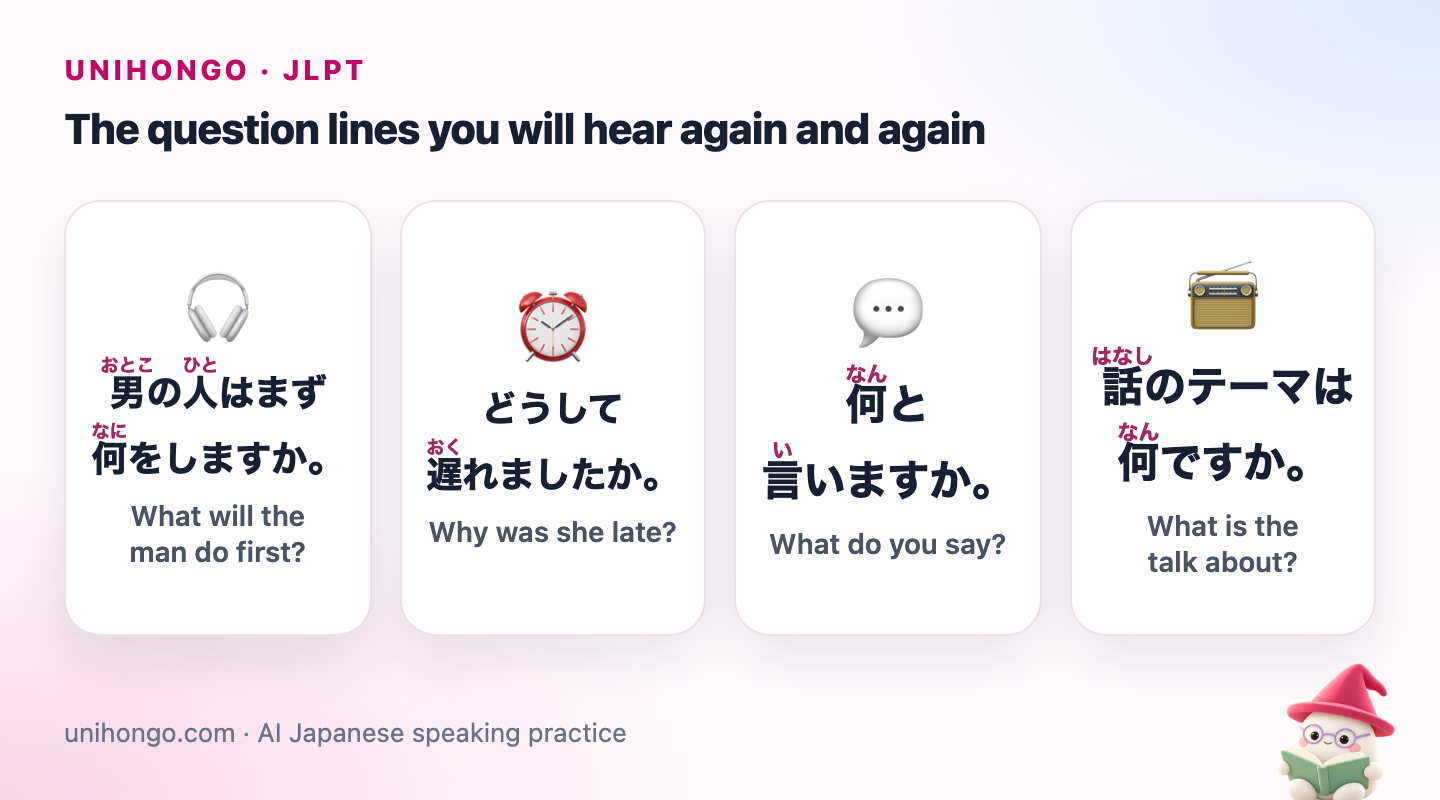
Every JLPT listening item starts with a question, and the same few question shapes come back at every level. If you can recognise them instantly, your brain is free for the conversation. These four cover a large share of the section: what someone will do first, why something happened, what you would say in a situation, and what a talk is mainly about.
Listen for the question word. Mazu nani o (what first) means the conversation will contain several tasks and probably a change of order. Dōshite (why) means you are waiting for a reason, and the first reason mentioned is often not the real one. Nan to iimasu ka (what do you say) belongs to utterance-expression items with a picture. Tēma or nani ni tsuite (about what) signals a summary question.
| Japanese | Romaji | Meaning |
|---|---|---|
| 男の人はまず何をしますか。 | Otoko no hito wa mazu nani o shimasu ka. | What will the man do first? |
| どうして遅れましたか。 | Dōshite okuremashita ka. | Why was she late? |
| 何と言いますか。 | Nan to iimasu ka. | What do you say? |
| 話のテーマは何ですか。 | Hanashi no tēma wa nan desu ka. | What is the talk about? |
| 女の人は何が一番大切だと言っていますか。 | Onna no hito wa nani ga ichiban taisetsu da to itte imasu ka. | What does the woman say is most important? |
The six question types at a glance
The JLPT uses six listening question types, but no level uses all six. Knowing which ones your level has tells you how the booklet will look and how much reading you can do before the audio.
| Type (Japanese name) | Levels | What happens | Main tip |
|---|---|---|---|
| Task-based (課題理解) | N5 to N1 | A conversation; you decide what someone will do next or first | Track the order of tasks and every change of plan |
| Point (ポイント理解) | N5 to N1 | You hear the question, get time to read the choices, then hear the talk | Use the reading time; you know exactly what to wait for |
| Summary (概要理解) | N3 to N1 | A monologue or talk; the question and choices often come only after it | Listen for the speaker's main point, not details |
| Utterance expressions (発話表現) | N5 to N3 | A picture with an arrow; choose what that person says | Decide who is speaking and to whom before the options play |
| Quick response (即時応答) | N5 to N1 | One short line, then three spoken replies; nothing printed | Answer at once, then clear your head for the next line |
| Integrated (統合理解) | N2 and N1 | A longer talk, often with several speakers or options to compare | Make a mini table of options as you listen |
The exact number of items per type differs by level and can change, so treat the official sample paper for your level as the final word. The strategies below still apply whatever the count.
Task-based items: catch the change of plan
Task-based items are built around a trap. Someone plans to do A, then the other speaker says something that makes B come first, or makes A unnecessary. If you choose the first task you heard, you usually lose the point. Listen for sono mae ni (before that), yappari (on second thought), sore wa ii kara (no need for that) and saki ni (first, ahead).
Here is a typical office exchange. The question before it is: what will the man do first?
| Japanese | Romaji | Meaning |
|---|---|---|
| 会議の資料、もうコピーした? | Kaigi no shiryō, mō kopī shita? | Woman: Have you copied the meeting handouts yet? |
| まだです。今からします。 | Mada desu. Ima kara shimasu. | Man: Not yet. I'll do it now. |
| あ、その前に部長にメールを送ってくれる? | A, sono mae ni buchō ni mēru o okutte kureru? | Woman: Oh, before that, could you send the manager an email? |
| わかりました。じゃ、メールを先に送ります。 | Wakarimashita. Ja, mēru o saki ni okurimasu. | Man: Understood. I'll send the email first, then. |
| コピーは十部でいいよ。 | Kopī wa jūbu de ii yo. | Woman: Ten copies will be fine. |
The answer is the email. The copies and the number ten are there to tempt you. Notice the register too: the woman speaks casually to a junior colleague, and the man answers politely. Exam conversations often mix registers like this, so practise understanding both.
Point and summary items: wait for the real reason
In point items you hear the question first and then get a short pause to read the choices. Use it. Read all four choices and notice what makes them different: a time, a place, a reason. Then you only need to catch that one difference.
The trap in point items is the first reason. Speakers often mention a reason, then correct it with demo, jitsu wa or betsu ni sore wa kankei nakute. In summary items the trap is detail: the speaker gives examples, but the question asks about the opinion or main point, which often comes at the end with tsumari, kekkyoku or to iu wake desu.
| Japanese | Romaji | Meaning |
|---|---|---|
| 電車が遅れたんですか。 | Densha ga okureta n desu ka. | Man: Was your train late? |
| いえ、実は寝坊しちゃって。 | Ie, jitsu wa nebō shichatte. | Woman: No, actually I overslept. |
| 結局、行かないことにしました。 | Kekkyoku, ikanai koto ni shimashita. | In the end, I decided not to go. |
| つまり、練習が一番大事だということです。 | Tsumari, renshū ga ichiban daiji da to iu koto desu. | In short, practice is what matters most. |
Utterance and quick-response items: think social, not grammar
Utterance expressions (N5 to N3) show a picture: someone wants to borrow something, apologise, or leave the office before others. The wrong choices are often perfectly grammatical but say the wrong thing socially, for example offering instead of asking. Before the options play, decide whether the person is asking, offering, thanking or apologising.
Quick response is the fastest part of the section. You hear one line and three possible replies, with nothing printed. Many of the lines are set phrases with a set answer, so learning pairs pays off more than any trick.
| Japanese | Romaji | Meaning |
|---|---|---|
| ペンを貸してもらえませんか。 | Pen o kashite moraemasen ka. | Could you lend me a pen? (asking) |
| ペンを貸しましょうか。 | Pen o kashimashō ka. | Shall I lend you a pen? (offering, the classic wrong choice) |
| お先に失礼します。 | Osaki ni shitsurei shimasu. | Colleague: I'll be leaving before you. |
| お疲れさまでした。 | Otsukaresama deshita. | You: Thanks for your work today. |
| ちょっと手伝ってもらえる? | Chotto tetsudatte moraeru? | Friend: Could you give me a hand? |
| うん、いいよ。何をすればいい? | Un, ii yo. Nani o sureba ii? | You: Sure. What should I do? |
If you hesitate on a quick-response item, pick your best guess and let it go. The next line starts within seconds, and a lost item costs less than a lost next item.
Integrated items at N2 and N1: build a tiny table
Integrated comprehension gives you more information than you can hold in your head: three courses described by a shop clerk, four ideas discussed by a family, two people choosing between options. The question often asks what one person will choose, or which option each speaker prefers.
The fix is a tiny table. As soon as you hear that there are options, write 1, 2, 3, 4 down the margin and add one or two words for each feature: price, time, a minus sign for a drawback. Then mark each speaker's preference with an initial. You are not writing Japanese sentences, only enough to compare.
- Write numbers and symbols, not words, whenever you can (8:30, ×, ↑, ¥).
- Use katakana or romaji for names; whichever is faster for you.
- Mark changes of plan with an arrow from the old choice to the new one.
- Stop writing when the question starts and listen to the question.
Your listening routine for the next six weeks
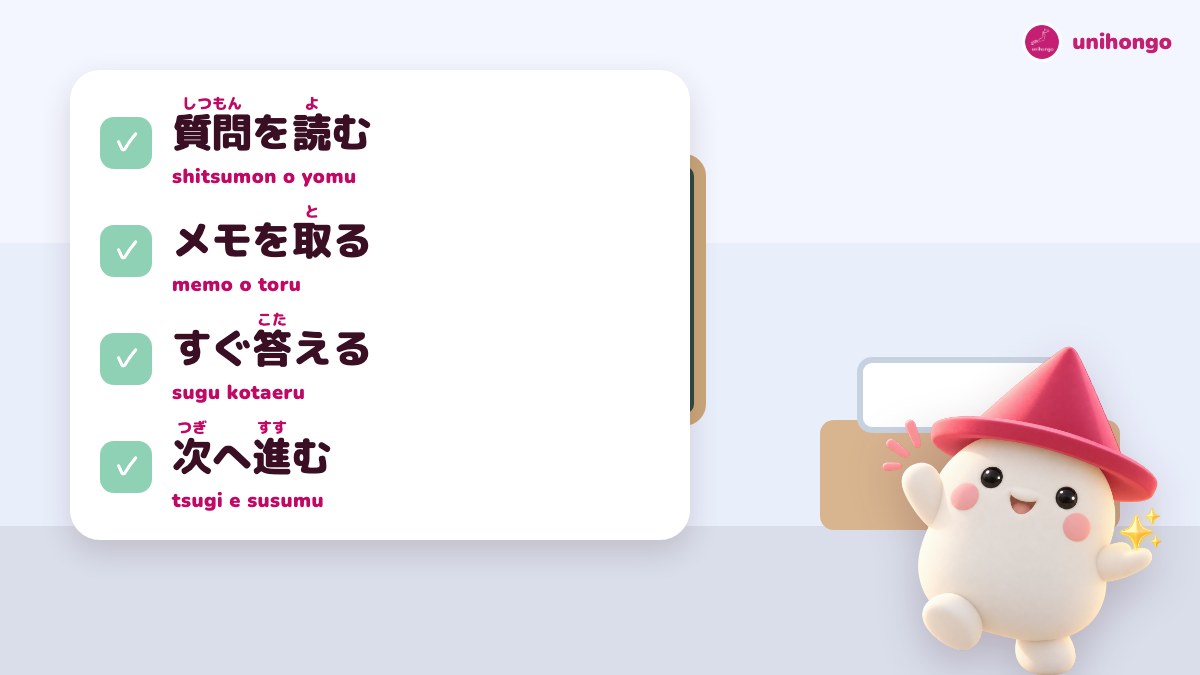
A short daily routine works better than one long session a week. The checklist below is what to do before and during every item on the day, and it is also what you practise at home until it is automatic.
| Week | Daily focus | Weekend task |
|---|---|---|
| 1 | Task-based items; circle signal words in transcripts | One full listening section, timed |
| 2 | Point items; practise reading choices in the pause | Review every wrong item and shadow the key line |
| 3 | Quick response; learn twenty set phrase pairs | One full listening section, timed |
| 4 | Summary or utterance items for your level | Shadow two long dialogues at full speed |
| 5 | Integrated items (N2, N1) or mixed review (N5 to N3) | Full mock test with the listening section last |
| 6 | Light mixed items only; no new material | Rest the day before the exam |
Common listening mistakes
- Thinking about the previous item during the next one. Mark an answer and let it go; one item is never worth two.
- Choosing the first task or reason you hear. In task-based and point items, the first one is often the trap.
- Writing full words in Japanese. Notes should be numbers, initials and arrows.
- Ignoring register. Casual contractions such as chatta and teru are normal in exam dialogues, so train your ear on them.
- Practising only with transcripts. Reading a dialogue is not the same skill; always do the first pass without text.
Train these habits with Unihongo
Ask Mocchi something like: /jlpt give me an N3 task-based listening transcript with a change of plan and four choices. Mocchi writes the dialogue, lets you answer, and then explains which line decides the answer and why the other choices are traps. Because Mocchi keeps track of the question types you keep getting wrong, later practice can lean towards them.
When you are ready to test stamina, take a full JLPT mock test on Unihongo for your level. It has the real sections and time limits, including a listening section, and gives you an estimated score so you can see whether listening is really your weakest section.