

The idea: three checkpoints, nine weeks
A plan is useful when it tells you what success looks like. Instead of a list of chapters, this one gives you sentences you should be able to say without notes on day 20, day 40 and day 60. Everything in between exists to get you there.
Keep the motto simple: a little every day. Short, regular sessions beat long weekend marathons for memory, and they are easier to keep when life gets busy.
The checkpoints also protect you from the most common trap of self-study: moving on because the calendar says so, not because the material has stuck. If a checkpoint goes badly, you know exactly which weeks to revisit, and you have lost a few days rather than a month. If it goes well, you have proof of progress that you can hear in your own voice, which is a far better motivator than a page count.
Write the three checkpoint days in your calendar now, before you start. Treat them like appointments: on those days you do no new material, only the checkpoint test, review of whatever wobbled and a recording of yourself saying the lines.
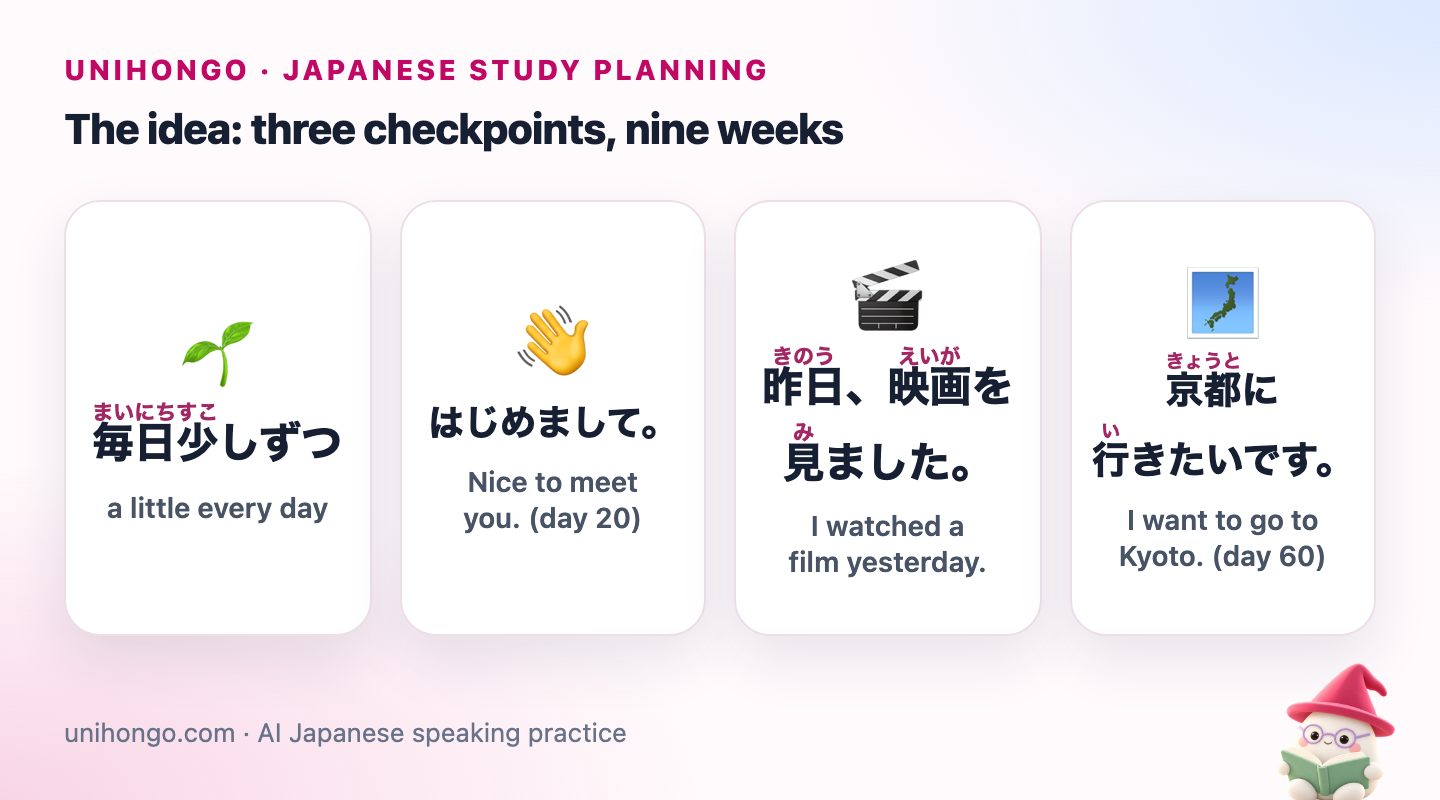
| Japanese | Romaji | Meaning |
|---|---|---|
| 毎日少しずつ | mainichi sukoshi zutsu | a little every day |
| はじめまして。 | Hajimemashite. | Nice to meet you. (day 20) |
| 昨日、映画を見ました。 | Kinō, eiga o mimashita. | I watched a film yesterday. |
| 京都に行きたいです。 | Kyōto ni ikitai desu. | I want to go to Kyoto. (day 60) |
The nine weeks at a glance
Each week has one grammar focus and one speaking task. The word themes are suggestions; swap them for words from your own life, because words you need are the ones you remember.
| Week | Days | Grammar focus | Word themes | Speaking task |
|---|---|---|---|---|
| 1 | 1 to 7 | X wa Y desu, questions with ka, no for possession | Greetings, jobs, countries, numbers 1 to 100 | A 20-second self-introduction |
| 2 | 8 to 14 | Kore, sore, are; arimasu and imasu | Things in your room and bag, places in town | Describe what is in your room |
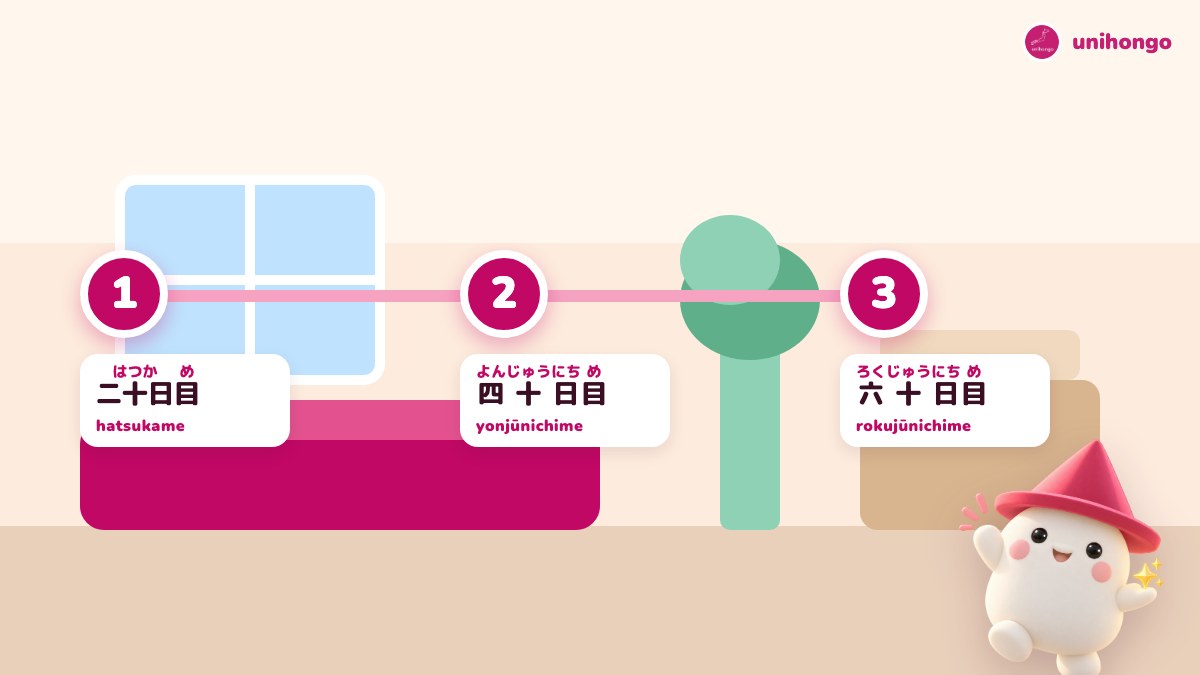
| 3 | 15 to 21 | Present masu verbs; particles o, ni, de, e | Daily verbs, times, days of the week | Your daily routine (checkpoint 1 on day 20) |
| 4 | 22 to 28 | Mashita and masen deshita | Food, drinks, shops | What you did yesterday |
| 5 | 29 to 35 | I-adjectives and na-adjectives, present and past | Weather, feelings, describing places | Describe your last trip or weekend |
| 6 | 36 to 42 | Mashō, masen ka; tsumori desu | Hobbies, invitations, plans | Invite someone and talk about plans (checkpoint 2 on day 40) |
| 7 | 43 to 49 | Te-form and te kudasai | Instructions, directions, body | Ask for things politely |
| 8 | 50 to 56 | Te mo ii desu ka; tai desu | Travel, transport, hotels | Ask permission and say what you want |
| 9 | 57 to 60 | Review only | Your weakest words | Checkpoint 3: a three-minute talk about yourself |
Checkpoint 1, day 20: who you are and your day
On day 20, cover the English and say these lines with your own details. You pass if you can say them at a steady pace without looking. Small mistakes in particles are normal at this stage; hesitation of several seconds means you need two more days of review before moving on.
| Japanese | Romaji | Meaning |
|---|---|---|
| はじめまして。アレックスです。 | Hajimemashite. Arekkusu desu. | Nice to meet you. I'm Alex. |
| カナダから来ました。 | Kanada kara kimashita. | I'm from Canada. |
| 毎朝七時に起きます。 | Maiasa shichiji ni okimasu. | I get up at seven every morning. |
| 会社まで電車で行きます。 | Kaisha made densha de ikimasu. | I go to work by train. |
| 夜はうちで日本語を勉強します。 | Yoru wa uchi de nihongo o benkyō shimasu. | In the evening I study Japanese at home. |
Checkpoint 2, day 40: yesterday and the weekend
By day 40 you add the past tense and adjectives, which lets you tell a short story. Try to link three or four sentences in a row, as if a friend had asked how your weekend was.
| Japanese | Romaji | Meaning |
|---|---|---|
| 週末は何をしましたか。 | Shūmatsu wa nani o shimashita ka. | Friend: What did you do at the weekend? |
| 土曜日に友達と買い物に行きました。 | Doyōbi ni tomodachi to kaimono ni ikimashita. | On Saturday I went shopping with a friend. |
| 天気がよくて、楽しかったです。 | Tenki ga yokute, tanoshikatta desu. | The weather was good and it was fun. |
| 日曜日はどこにも行きませんでした。 | Nichiyōbi wa doko ni mo ikimasen deshita. | On Sunday I didn't go anywhere. |
| 来週、一緒に映画を見ませんか。 | Raishū, issho ni eiga o mimasen ka. | Would you like to see a film together next week? |
Yokute is the te-form of yoi, good, and it links two clauses: the weather was good, and. Do not worry if you are not producing it yet; understanding it is enough on day 40.
Checkpoint 3, day 60: asking, permission and wishes
The final checkpoint is about getting things done: asking someone to do something, asking whether you may do something, and saying what you want. These three patterns cover a surprising number of situations at a station, a hotel or a shop.
All three are built on the te-form or the masu stem, which is why weeks 7 and 8 matter so much. For the checkpoint, do more than say the lines: finish with a three-minute talk about yourself that joins everything from the 60 days, your name and job, your routine, last weekend, and one thing you want to do next year. Record it and keep it; it is the starting point for your next plan.
| Japanese | Romaji | Meaning |
|---|---|---|
| もう少しゆっくり話してください。 | Mō sukoshi yukkuri hanashite kudasai. | Please speak a little more slowly. |
| ここで写真を撮ってもいいですか。 | Koko de shashin o totte mo ii desu ka. | May I take photos here? |
| 荷物を預けてもいいですか。 | Nimotsu o azukete mo ii desu ka. | May I leave my luggage with you? |
| 来年、日本で働きたいです。 | Rainen, Nihon de hatarakitai desu. | I want to work in Japan next year. |
| おすすめは何ですか。 | Osusume wa nan desu ka. | What do you recommend? |
When the plan slips
Almost every 60-day plan slips somewhere: a busy week at work, a cold, a trip. The plan survives if you decide in advance what to do when it happens.
- Missed one or two days: carry on from where you stopped; do not try to double up.
- Missed a whole week: repeat the last week's review and speaking task, then continue. The plan becomes 67 days, which is fine.
- Lost motivation: go back to your recordings from the first week and listen to them. Hearing how far you have come usually restarts the habit faster than any new resource.
- Failed a checkpoint: spend two or three days only on review and speaking, then try again. Do not add new grammar on top of shaky grammar.
- Bored: change the word themes, not the grammar order. Learn words for your hobby, your job or a trip you are planning.
Common mistakes in a 60-day plan
- Learning words as single items. A word in a phrase, such as densha de iku, is easier to use than densha alone.
- Studying grammar in silence. If you never say the sentence, you will not be able to say it in a conversation.
- Adding a new app or book every week. One main resource plus review is enough for 60 days.
- Measuring progress by pages finished. Measure it by the checkpoint lines you can say without notes.
- Leaving speaking until the end. A short speaking minute in every session makes day 60 much easier.
Let Mocchi run the plan with you
Type /plan to Mocchi and describe your level, your goal and how much time you have on a typical weekday. Mocchi builds a personal 60-day path with small daily tasks, and finished tasks tick themselves off as you work through them in the chat. If week 7 takes longer, type /adjust-plan and ask for the te-form week to be stretched; Mocchi reshapes the rest of the plan around it.
Speaking steps in the plan open AI Sensei. For checkpoint 3, ask Hana-sensei to play a hotel receptionist and try asking to leave your luggage and what the Sensei recommends nearby.