

The five kinds of session
Before you fill in days, decide what kinds of session exist. These five cover everything a learner needs in a week. Each session type has a simple job, so you never sit down wondering what to do.
The reason to separate them is that each one is easy to skip for a different reason. Review feels boring, so it gets pushed back until the pile is too big. Speaking feels uncomfortable, so it quietly disappears. Listening feels passive, so it turns into background noise. Giving each its own slot on a named day stops any one of them from vanishing, and the catch-up slot means a missed session moves rather than disappears.
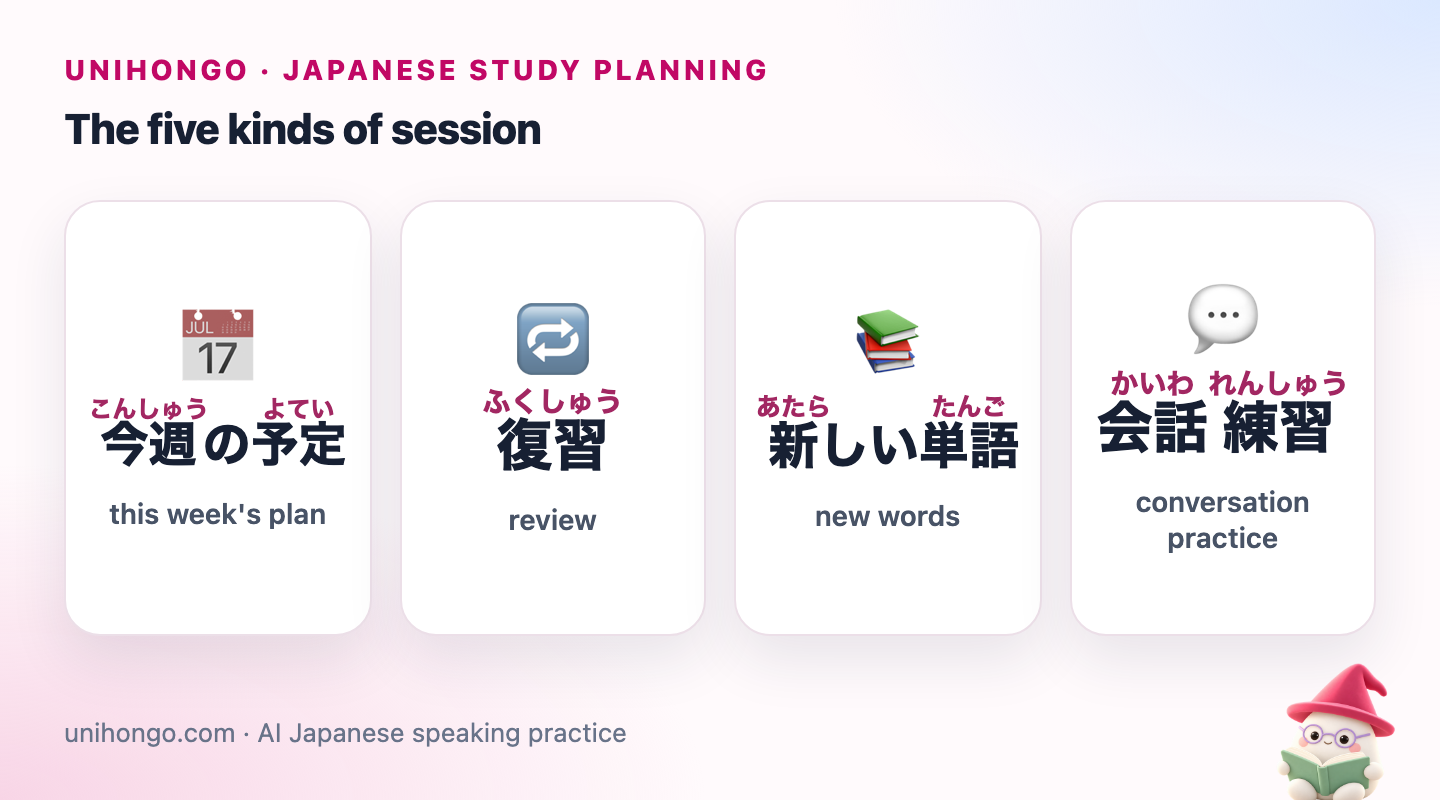
| Japanese | Romaji | Meaning |
|---|---|---|
| 今週の予定 | konshū no yotei | this week's plan |
| 復習 | fukushū | review |
| 新しい単語 | atarashii tango | new words |
| 会話練習 | kaiwa renshū | conversation practice |
| Session type | Job | Typical length |
|---|---|---|
| New material | One grammar point or a set of new words, with examples | 20 to 40 minutes |
| Review | Flashcards and old example sentences, said aloud | 10 to 20 minutes |
| Listening | One short audio, listened to three times | 15 to 30 minutes |
| Speaking | Say sentences aloud, shadow, or talk with a partner | 15 to 30 minutes |
| Catch-up | Whatever you skipped; if nothing, rest | Any length |
Days of the week and time words in Japanese
If you write your schedule in Japanese, you practise these words every single day. They also appear in every beginner textbook and in JLPT N5, so the effort pays twice.
| Japanese | Romaji | Meaning |
|---|---|---|
| 月曜日 | getsuyōbi | Monday |
| 火曜日 | kayōbi | Tuesday |
| 水曜日 | suiyōbi | Wednesday |
| 木曜日 | mokuyōbi | Thursday |
| 金曜日 | kin'yōbi | Friday |
| 土曜日 | doyōbi | Saturday |
| 日曜日 | nichiyōbi | Sunday |
| 朝、昼、夜 | asa, hiru, yoru | morning, midday, evening |
Template 1: the light week
For busy weeks, new jobs or learners with young children. Roughly two hours in total, mostly in short sessions that fit a commute or a lunch break.
| Day | Session | What to do |
|---|---|---|
| Mon | New material (20 min) | One grammar point with three examples |
| Tue | Review (15 min) | Flashcards, then say Monday's examples |
| Wed | Listening (20 min) | One short dialogue, three passes |
| Thu | Review (15 min) | Flashcards and old sentences |
| Fri | Rest | Nothing planned |
| Sat | Speaking (30 min) | Talk about your week aloud or with a partner |
| Sun | Catch-up and weekly review (20 min) | Finish what you skipped, answer the five questions |
Template 2: the standard week
A little over four hours. This suits most learners with a regular job or classes who want steady progress, and it is the one to start with if you are not sure.
| Day | Morning (short) | Evening (longer) |
|---|---|---|
| Mon | Review, 10 min | New grammar, 30 min |
| Tue | Review, 10 min | Listening, 25 min |
| Wed | Review, 10 min | New words in phrases, 30 min |
| Thu | Review, 10 min | Speaking and shadowing, 25 min |
| Fri | Review, 10 min | Reading a short text, 25 min |
| Sat | Free | Speaking with a partner or tutor, 40 min |
| Sun | Free | Catch-up and weekly review, 30 min |
The short morning review is the secret of this template. It keeps old material alive without eating into the evening, and it can be done on a phone on the way to work.
Friday reading is deliberately light, because many people are tired at the end of the week. If Friday is often a social evening for you, swap it with Sunday's catch-up and keep the reading for a quiet morning. The template is a shape, not a rule; what matters is that each of the five kinds of session appears at least once.
Template 3: the intensive week
About eight hours, for exam preparation or a period with free time. Only choose it if you have done the standard week for a while; jumping straight to intensive often ends in a crash in week three.
- Every weekday: 15 minutes of review in the morning and a 60-minute evening block split into new material and one skill (listening, reading or speaking, in rotation).
- Saturday: a 90-minute block with a timed practice section if you are preparing for the JLPT, or a long conversation session if you are not.
- If you are preparing for the exam on Sunday 6 December 2026, switch to this template no later than six weeks before, and go back to the standard week in the final week so you arrive rested.
- Sunday: 30 minutes of catch-up and the weekly review, then rest.
- One evening a week may be dropped without guilt; that is the built-in catch-up.
Write your own week in Japanese
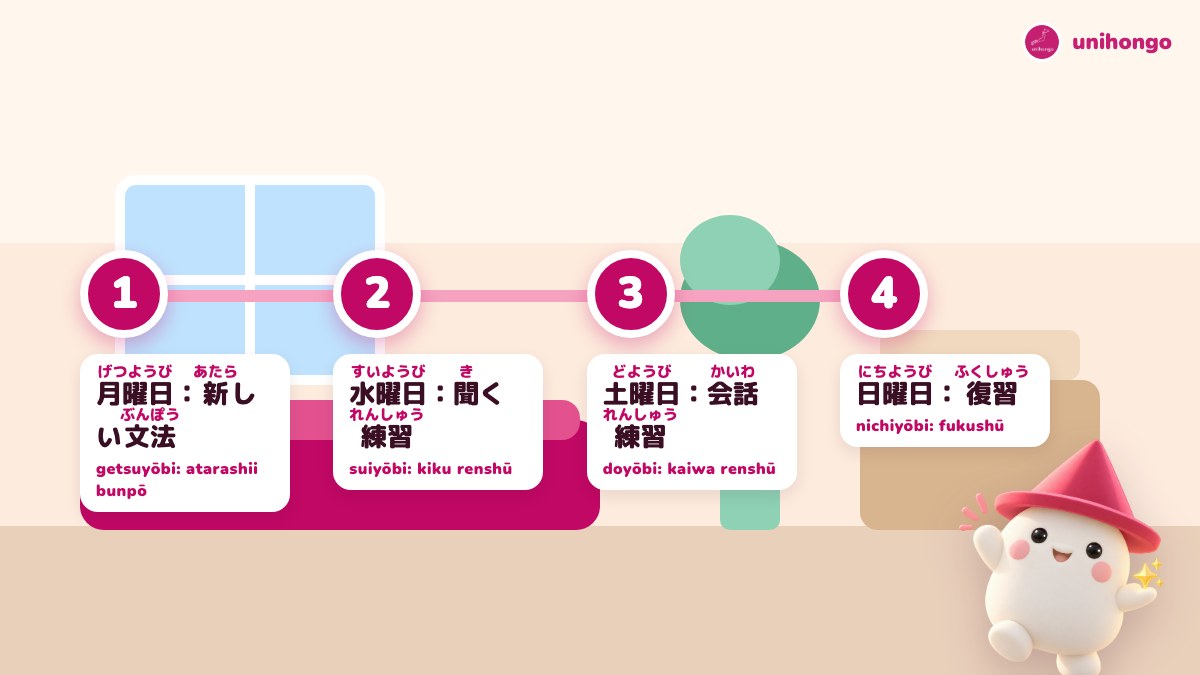
Once a template fits, write it in Japanese. Short lines are enough, and they are also a good first writing task. Read your plan aloud each morning, and on Sunday say what you did in the past tense.
The pattern is always the same: day, wa, what you do, and a masu verb. Beginners can keep to benkyō shimasu and fukushū shimasu; more advanced learners can add time and place, such as densha de or asa ni, and try the past tense and the volitional form on Sunday, as in raishū wa motto hanashimashō.
| Japanese | Romaji | Meaning |
|---|---|---|
| 月曜日は新しい文法を勉強します。 | Getsuyōbi wa atarashii bunpō o benkyō shimasu. | On Monday I study new grammar. |
| 火曜日は単語を復習します。 | Kayōbi wa tango o fukushū shimasu. | On Tuesday I review words. |
| 木曜日はシャドーイングをします。 | Mokuyōbi wa shadōingu o shimasu. | On Thursday I do shadowing. |
| 金曜日は休みます。 | Kin'yōbi wa yasumimasu. | On Friday I rest. |
| 今週は五日勉強しました。 | Konshū wa itsuka benkyō shimashita. | This week I studied on five days. |
Itsuka here means five days. Counting days in Japanese is irregular for the first ten (futsuka, mikka, yokka, itsuka), so this weekly sentence is also a small counter drill.
The Sunday review: five questions
A template is only a starting point. Answer these five questions every Sunday and change one thing at a time.
- Which session did I skip most often, and why? Move it to a different time rather than deleting it.
- Did I speak Japanese aloud at least three times this week?
- Is my review pile growing? If yes, add review time before adding new material.
- Which day felt too heavy? Shorten it by ten minutes.
- What is the one thing I want to be able to do by next Sunday?
Keep your answers in the same notebook or file as your schedule. After a month, read them in order; patterns appear quickly, such as a session that is always skipped on the same day, and they tell you how to redesign the template instead of blaming your discipline.
Fill in your week with Mocchi
Tell Mocchi your template and your busiest days, for example: I'm on the standard week, Wednesday is always busy, what should each session cover? Mocchi suggests session contents that fit your level and goal. On review days, /review-flashcards runs your cards with spaced repetition, so the morning review slot is ready-made.
For the Saturday speaking slot, open AI Sensei and ask Yamada-sensei to chat about your week. At the end you get a session report with corrections and new vocabulary, which is a good list for Monday's new-material session.