
Four particles in four short phrases
Here are four short phrases, each built around one particle from the quiz. Read them aloud and notice how much the single particle tells you: an activity in a place, a destination, something that exists, and a person you ask.
Keep these four in mind while you take the quiz. Many questions are variations on them.
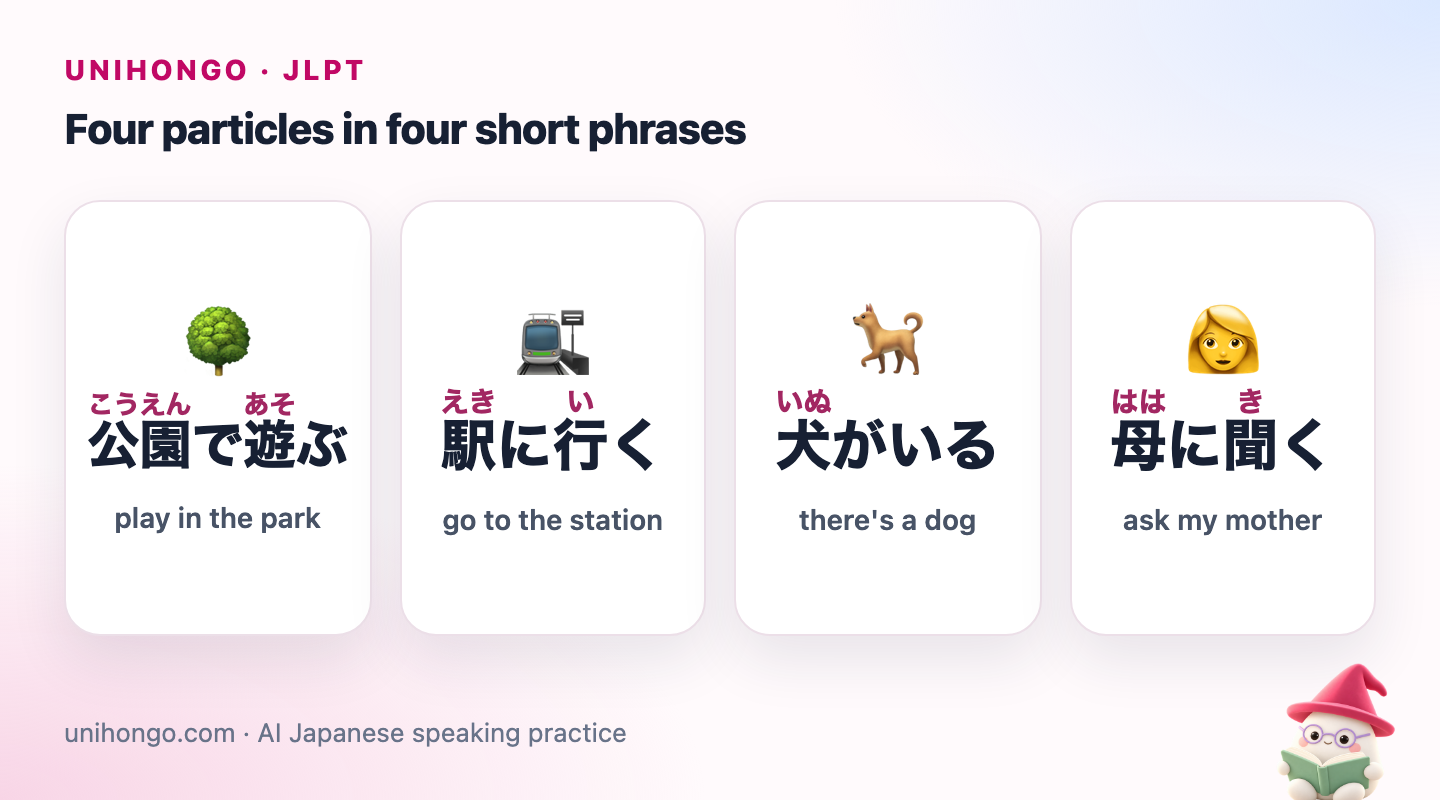
| Japanese | Romaji | Meaning |
|---|---|---|
| 公園で遊ぶ | kōen de asobu | play in the park |
| 駅に行く | eki ni iku | go to the station |
| 犬がいる | inu ga iru | there's a dog |
| 母に聞く | haha ni kiku | ask my mother |
Questions 1-5: place, means and company
Choose one particle for each blank. Say the full sentence aloud with your choice before moving on; a wrong particle often sounds wrong before you can explain why.
- 1. 「毎日 電車 ___ 会社に 行きます。」 (a) で (b) に (c) を (d) が
- 2. 「机の 上 ___ 本が あります。」 (a) で (b) を (c) へ (d) に
- 3. 「友だち ___ 映画を 見ました。」 (with a friend) (a) に (b) を (c) と (d) が
- 4. 「この 道 ___ まっすぐ 行って ください。」 (a) に (b) で (c) が (d) を
- 5. 「田中さん ___ どの 人ですか。」 (a) は (b) が (c) を (d) に
Questions 6-10: time, limits and material
- 6. 「誰 ___ 来ましたか。」 (a) は (b) が (c) を (d) に
- 7. 「毎朝 七時 ___ 起きます。」 (a) で (b) に (c) を (d) が
- 8. 「家から 駅 ___ 歩いて 十分です。」 (a) までに (b) で (c) を (d) まで
- 9. 「レポートは 金曜日 ___ 出して ください。」 (a) までに (b) まで (c) で (d) から
- 10. 「この いすは 木 ___ 作りました。」 (a) に (b) を (c) で (d) が
Questions 11-15: verbs that choose their particle
In this set the verb decides the particle. Question 11 has two correct answers, so read its instruction carefully.
- 11. Choose TWO correct answers: 「先生 ___ 本を 借りました。」 (a) に (b) から (c) で (d) を
- 12. 「八時に 部屋 ___ 出ます。」 (a) で (b) が (c) を (d) に
- 13. I bought apples, oranges and other things: 「りんご ___ みかんを 買いました。」 (a) や (b) と (c) も (d) の
- 14. 「マリアさんは 日本語 ___ 話せます。」 (a) で (b) に (c) へ (d) が
- 15. 「これは 私 ___ 傘です。」 (a) が (b) の (c) に (d) と
Answer key: the particle and the reason
One point per question. For question 11, you need both answers for the point.
| Japanese | Romaji | Meaning |
|---|---|---|
| 電車で会社に行きます。 | Densha de kaisha ni ikimasu. | 1 (a) de marks the means: by train |
| 机の上に本があります。 | Tsukue no ue ni hon ga arimasu. | 2 (d) ni marks where something exists |
| 友達と映画を見ました。 | Tomodachi to eiga o mimashita. | 3 (c) to: together with a friend |
| この道をまっすぐ行ってください。 | Kono michi o massugu itte kudasai. | 4 (d) o marks the path you move along |
| 田中さんはどの人ですか。 | Tanaka san wa dono hito desu ka. | 5 (a) wa: Tanaka is the known topic |
| 誰が来ましたか。 | Dare ga kimashita ka. | 6 (b) a question word as subject takes ga |
| 七時に起きます。 | Shichiji ni okimasu. | 7 (b) ni marks a clock time |
| 駅まで歩いて十分です。 | Eki made aruite juppun desu. | 8 (d) made: as far as the station |
| 金曜日までに出してください。 | Kin'yōbi made ni dashite kudasai. | 9 (a) made ni: by Friday, a deadline |
| 木で作りました。 | Ki de tsukurimashita. | 10 (c) de marks the material |
| 先生から本を借りました。 | Sensei kara hon o karimashita. | 11 (a) and (b): ni and kara both mark the lender |
| 部屋を出ます。 | Heya o demasu. | 12 (c) o marks the place you leave |
| りんごやみかんを買いました。 | Ringo ya mikan o kaimashita. | 13 (a) ya: examples from a longer list |
| 日本語が話せます。 | Nihongo ga hanasemasu. | 14 (d) ga with a potential verb |
| 私の傘です。 | Watashi no kasa desu. | 15 (b) no shows whose it is |
Questions 5 and 6 are a pair worth remembering. In Tanaka san wa dono hito desu ka, Tanaka is already known and you ask which person he or she is. In dare ga kimashita ka, the unknown part is the subject itself, so it takes ga. A question word never takes wa as the subject.
Question 12 also accepts kara in real life (heya kara deru), but it is not among the options. O suggests leaving a place behind, while kara stresses the starting point.
Ni or de? The split that causes most errors
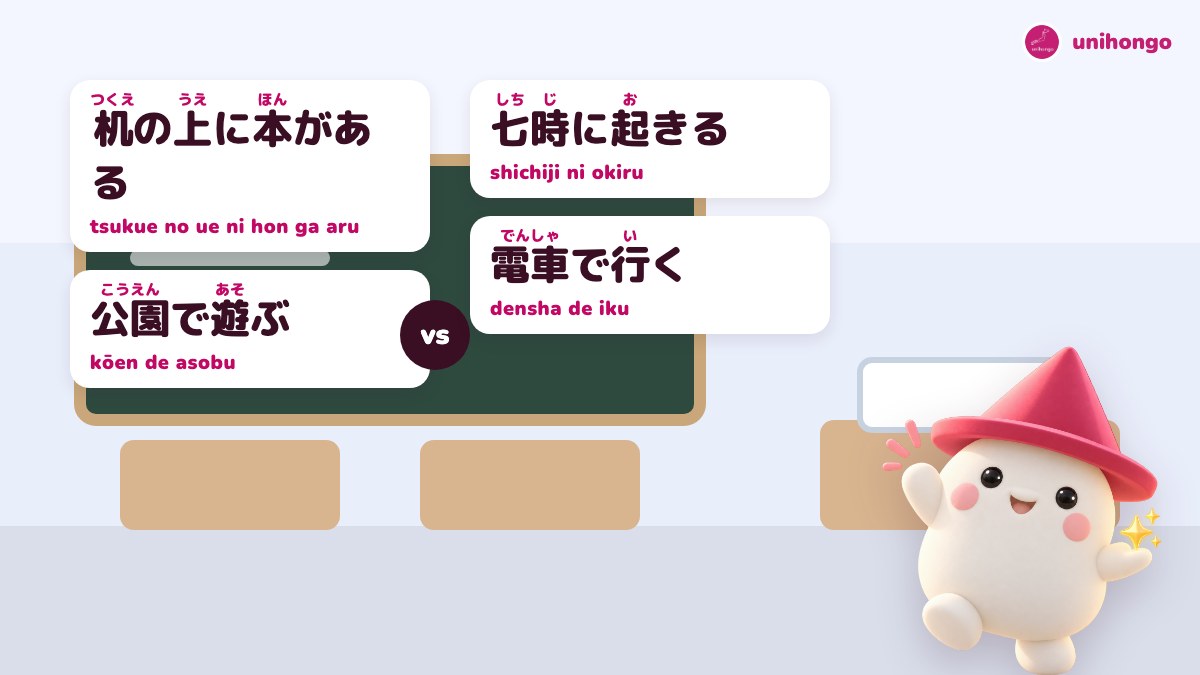
English uses at or in for both, so learners guess. Japanese asks a different question: is something simply there, or is something happening there? Existence verbs (iru, aru, sumu) and destinations take ni. Actions (eat, study, work, play) take de.
One verb shows the split clearly. Sumu takes ni (Tōkyō ni sunde iru), but hataraku takes de (Tōkyō de hataraite iru), because living is a state of being somewhere, while working is an activity.
| Japanese | Romaji | Meaning |
|---|---|---|
| 東京に住んでいます。 | Tōkyō ni sunde imasu. | I live in Tokyo. |
| 東京で働いています。 | Tōkyō de hataraite imasu. | I work in Tokyo. |
| 駅の前で待っています。 | Eki no mae de matte imasu. | I'm waiting in front of the station. |
| 駅の前にカフェがあります。 | Eki no mae ni kafe ga arimasu. | There's a café in front of the station. |
One common exception catches intermediate learners: events. Even though aru usually takes ni, a party, a meeting or a concert that takes place somewhere takes de, because an event is something that happens: kōen de omatsuri ga aru, there is a festival in the park.
Score bands for particles
| Score | Particle level | Next step |
|---|---|---|
| 13-15 | Particles are reliable | Work on wa and ga in longer texts |
| 9-12 | Mostly right, some pairs blur | Drill the pairs you missed with contrasting sentences |
| 5-8 | Main uses known, details missing | One particle a day, with five sentences about you |
| 0-4 | Particles still feel random | Learn each particle's main job with one model sentence |
If you are preparing for the JLPT, particles appear in grammar, reading and listening alike. A full paper on the JLPT mock test page at unihongo.com/jlpt-mock-test shows how much particle errors are costing you across all sections.
Wa and ga: what the quiz only touched
Questions 5 and 6 touched the most discussed pair in Japanese grammar. A full explanation takes a whole article, but three rules cover most sentences you will meet at N5 to N3.
First, wa marks a topic that both speakers already have in mind, and the new information comes after it. Second, ga marks new or focused information, especially the answer to who or what. Third, inside a describing clause, the subject takes ga even when the main sentence uses wa: watashi ga katta hon wa omoshiroi, the book I bought is interesting.
Wa can also show contrast. Niku wa tabemasu ga, sakana wa tabemasen means I do eat meat, but not fish. The contrast is what the second wa adds.
| Japanese | Romaji | Meaning |
|---|---|---|
| 誰がケーキを食べたの? | Dare ga kēki o tabeta no? | Who ate the cake? (casual) |
| 弟が食べたよ。 | Otōto ga tabeta yo. | My little brother did. |
| 私が買った本は面白い。 | Watashi ga katta hon wa omoshiroi. | The book I bought is interesting. |
| 肉は食べますが、魚は食べません。 | Niku wa tabemasu ga, sakana wa tabemasen. | I eat meat, but not fish. |
Make particles automatic
- Ask Mocchi: "/quiz me on ni and de with places, ten questions, and explain each answer." Mocchi quizzes you, explains the choice each time, and remembers the pairs you mix up so the next quiz targets them.
- Follow up with "/explain" on any sentence from a book or article where a particle surprises you; Mocchi breaks the sentence down part by part.
- Then play Sentence Builder on unihongo.com/games, where you put words in order. Building sentences forces you to place the particles yourself, which is closer to speaking than picking from four options.