
Four N4 patterns before you start
Each card below shows a pattern from the quiz in a short sentence. Read them aloud and check that you could explain each one in a few words. If one is unfamiliar, study it before the quiz rather than guessing.
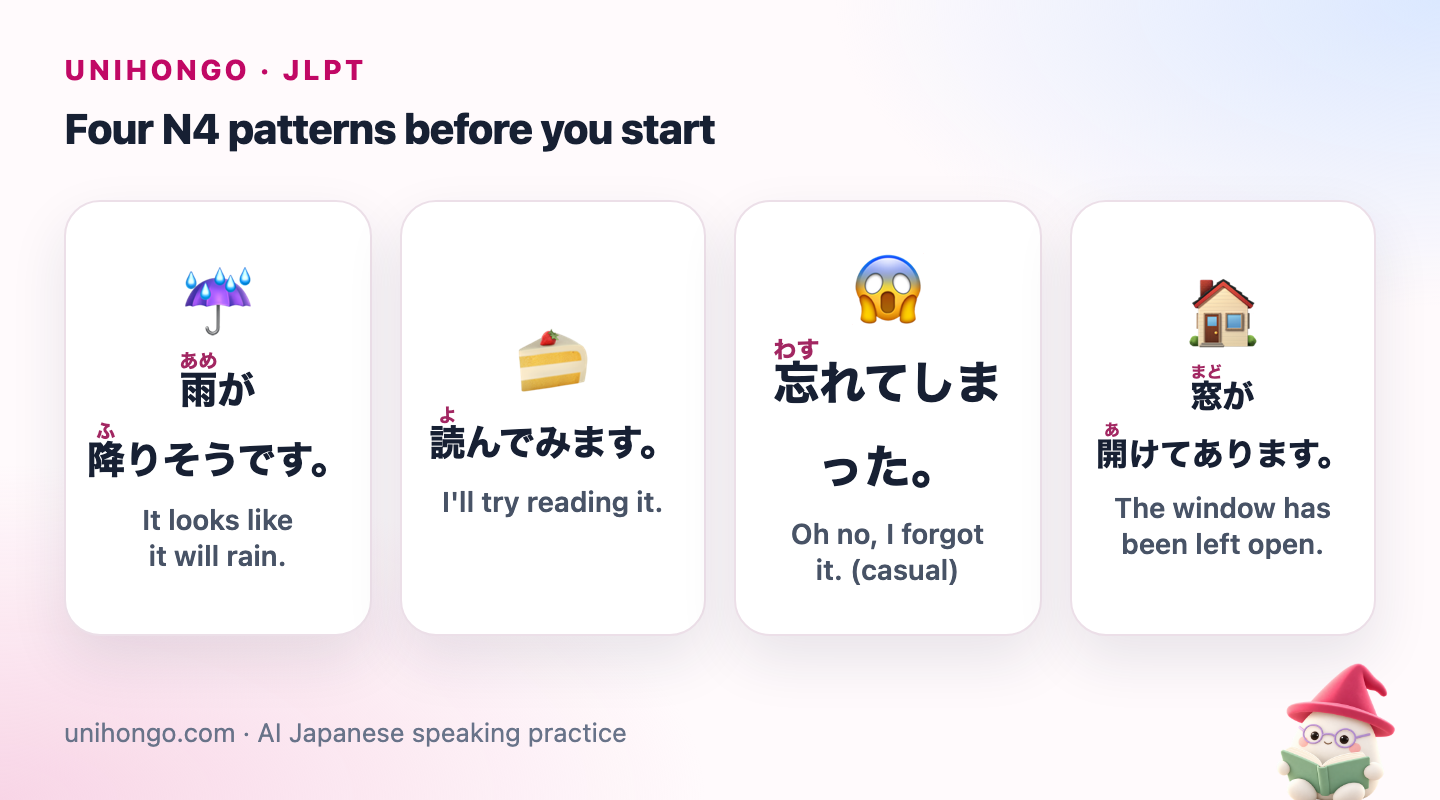
| Japanese | Romaji | Meaning |
|---|---|---|
| 雨が降りそうです。 | Ame ga furisō desu. | It looks like it will rain. |
| 読んでみます。 | Yonde mimasu. | I'll try reading it. |
| 忘れてしまった。 | Wasurete shimatta. | Oh no, I forgot it. (casual) |
| 窓が開けてあります。 | Mado ga akete arimasu. | The window has been left open. |
The first card uses sō desu after the verb stem, which means it looks like. After the plain form, ame ga furu sō desu, the same sō desu means I hear that, so the form in front of it changes the meaning completely.
The last two cards are worth a second look. Te shimau often adds regret or completion, and te aru describes the result of something someone did on purpose, so mado ga akete aru implies a person opened it, usually for a reason.
Questions 1-5
- 1. 「空が 暗いですね。雨が ___ そうです。」 (a) 降る (b) 降って (c) 降り (d) 降った
- 2. 「この ケーキ、おいしいか どうか 食べて ___ 。」 (a) みます (b) おきます (c) あります (d) います
- 3. 「旅行の 前に、ホテルを 予約して ___ 。」 (a) なります (b) すぎます (c) やすいです (d) おきます
- 4. 「練習して、日本語が 話せる ___ なりました。」 (a) ために (b) ように (c) のに (d) そうに
- 5. 「テストで 百点を 取って、先生に ほめ ___ 。」 (a) られました (b) させました (c) ました (d) ています
Questions 6-10
This set focuses on who does what to whom: causative, giving and receiving, and reasons. Question 10 asks for the option that does NOT fit, so read it twice.
- 6. 「母は わたしに 毎日 野菜を 食べ ___ 。」 (makes me eat) (a) られます (b) ます (c) たがります (d) させます
- 7. 「友だちが 本を 貸して ___ 。」 (a) あげました (b) もらいました (c) くれました (d) さしあげました
- 8. 「お金が ___ 、買えません。」 (a) ないで (b) なかった (c) ないの (d) なくて
- 9. 「字が 小さくて、読み ___ です。」 (a) にくい (b) やすい (c) たい (d) ながら
- 10. Which option CANNOT fill the blank? 「時間が ___ 、手伝って ください。」 (a) あったら (b) あると (c) あれば (d) あるなら
Questions 11-15
- 11. 「田中さんは 来ると 言っていたから、もうすぐ 来る ___ です。」 (a) ため (b) はず (c) ばかり (d) ながら
- 12. 「今から 家を 出る ___ です。すぐ 行きます。」 (a) ばかり (b) まま (c) ながら (d) ところ
- 13. 「電気を つけた ___ 寝て しまいました。」 (a) まま (b) ところ (c) ばかり (d) ながら
- 14. 「日本語が 話せる ___ 、毎日 練習しています。」 (a) ために (b) まま (c) ように (d) ばかり
- 15. 「この 部屋に 入っては ___ 。」 (a) ください (b) いけません (c) しまいます (d) あげます
Answer key: why each answer fits
| Japanese | Romaji | Meaning |
|---|---|---|
| 雨が降りそうです。 | Ame ga furisō desu. | 1 (c) masu stem + sō: it looks like rain |
| 食べてみます。 | Tabete mimasu. | 2 (a) te miru: try it and see |
| ホテルを予約しておきます。 | Hoteru o yoyaku shite okimasu. | 3 (d) te oku: do it in advance |
| 話せるようになりました。 | Hanaseru yō ni narimashita. | 4 (b) yō ni naru: I have become able to |
| 先生に褒められました。 | Sensei ni homeraremashita. | 5 (a) passive: I was praised by my teacher |
| 野菜を食べさせます。 | Yasai o tabesasemasu. | 6 (d) causative: she makes me eat vegetables |
| 友達が本を貸してくれました。 | Tomodachi ga hon o kashite kuremashita. | 7 (c) kureru: the giver is the subject |
| お金がなくて、買えません。 | Okane ga nakute, kaemasen. | 8 (d) nakute gives the reason |
| 字が小さくて、読みにくいです。 | Ji ga chiisakute, yominikui desu. | 9 (a) stem + nikui: hard to read |
| 時間があったら、手伝ってください。 | Jikan ga attara, tetsudatte kudasai. | 10 (b) aru to cannot take a request; attara can |
| もうすぐ来るはずです。 | Mō sugu kuru hazu desu. | 11 (b) hazu: should, based on a reason |
| 今から家を出るところです。 | Ima kara ie o deru tokoro desu. | 12 (d) dictionary form + tokoro: about to |
| 電気をつけたまま寝てしまいました。 | Denki o tsuketa mama nete shimaimashita. | 13 (a) ta form + mama: left as it was |
| 話せるように、毎日練習しています。 | Hanaseru yō ni, mainichi renshū shite imasu. | 14 (c) yō ni with an ability verb |
| この部屋に入ってはいけません。 | Kono heya ni haitte wa ikemasen. | 15 (b) te wa ikemasen: you must not |
Three contrasts that cost the most points
Look back at your wrong answers. If they cluster, it is probably around one of these three contrasts. Each is a choice between two real patterns, which is why it feels unfair the first time.
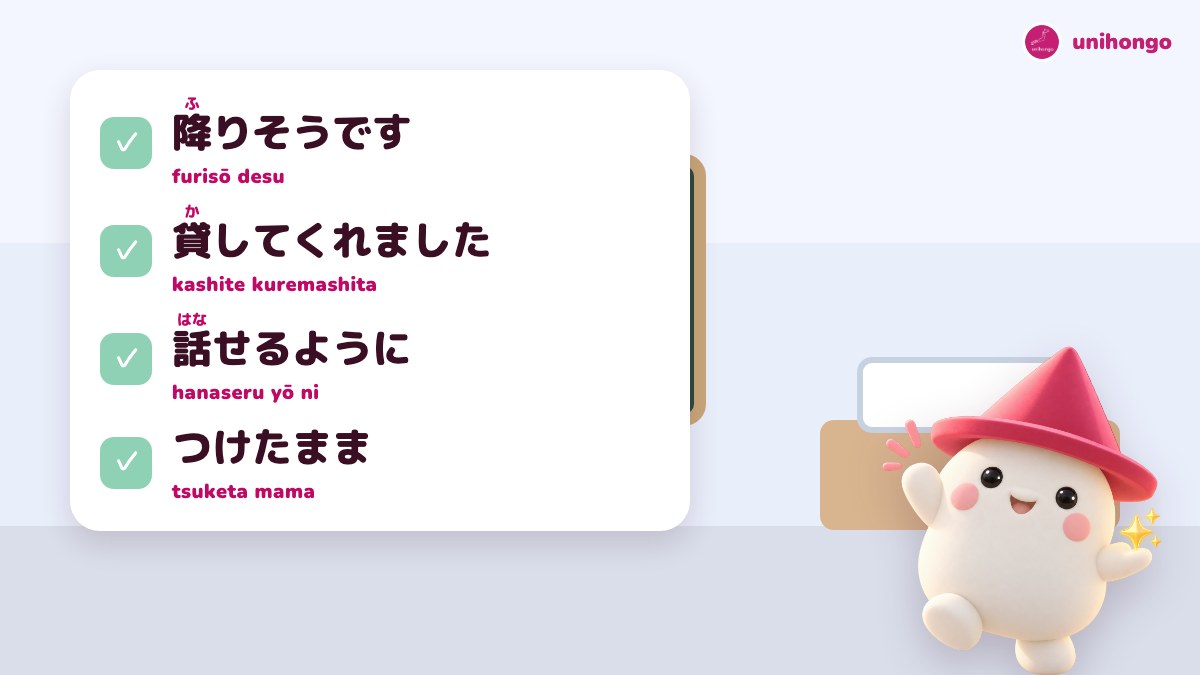
| Japanese | Romaji | Meaning |
|---|---|---|
| 友達に本を貸してもらいました。 | Tomodachi ni hon o kashite moraimashita. | I had my friend lend me a book. |
| 妹に本を貸してあげました。 | Imōto ni hon o kashite agemashita. | I lent my little sister a book. |
| 忘れないようにメモします。 | Wasurenai yō ni memo shimasu. | I'll write it down so I don't forget. |
- Tame ni or yō ni: tame ni follows verbs you choose to do (iku tame ni); yō ni follows ability, change and negative verbs (hanaseru yō ni, wasurenai yō ni).
- Kureru, ageru or morau: decide who is the subject. Giver as subject and you receive, kureru. Giver as subject and someone else receives, ageru. You as subject, giver with ni, morau.
- Tokoro, bakari and mama: dictionary form + tokoro is about to; ta form + tokoro is just did; ta form + bakari is only just did, often with a feeling that little time has passed; ta form + mama is left as it was.
What your score says
| Score | Meaning | Suggested focus |
|---|---|---|
| 13-15 | N4 grammar is ready | Full timed papers and listening |
| 9-12 | Solid, but contrasts still slip | The three contrasts above, five sentences each |
| 5-8 | Forms known, usage unclear | One pattern a day, used in a spoken sentence |
| 0-4 | N4 grammar is mostly new | Finish N5 review, then a textbook's N4 chapters |
When you score well here, check yourself under real conditions with the N4 mock test at unihongo.com/jlpt-mock-test. It has the actual sections and time limits, and the grammar questions there sit next to reading passages that use the same patterns.
Mini dialogue: N4 grammar between friends
The quiz tested each pattern alone. In real conversation they arrive together, often in casual form. Here is a short exchange between two friends planning a picnic that uses five patterns from the quiz. Read both parts aloud, then cover the Japanese and try to say it from the English.
| Japanese | Romaji | Meaning |
|---|---|---|
| 明日、雨が降りそうだね。 | Ashita, ame ga furisō da ne. | Aya: It looks like it'll rain tomorrow. |
| じゃあ、傘を持っていこう。 | Jā, kasa o motte ikō. | Ken: Then let's take umbrellas. |
| お弁当、作っておくね。 | Obentō, tsukutte oku ne. | Aya: I'll make lunch boxes in advance. |
| ありがとう。この前も作ってくれたよね。 | Arigatō. Kono mae mo tsukutte kureta yo ne. | Ken: Thanks. You made them for me last time too. |
| うん。でも、カメラを忘れてしまった。 | Un. Demo, kamera o wasurete shimatta. | Aya: Yeah. But I've gone and forgotten my camera. |
| 大丈夫、僕のを貸してあげるよ。 | Daijōbu, boku no o kashite ageru yo. | Ken: No problem, I'll lend you mine. |
Notice that casual speech keeps the grammar but drops desu and masu: furisō da ne, tsukutte oku ne, wasurete shimatta. In fast speech you will often hear te oku shortened to toku (tsukuttoku) and te shimau to chau (wasurechatta). The N4 listening section uses these short forms, so learn to recognise them even if you do not use them yet.
Make the patterns speakable
Start with Mocchi. Type "/grammar kureru vs morau vs ageru, then give me five sentences to fill in" and work through them. Mocchi explains each pattern with new examples and remembers which contrast confused you, so the next quiz begins there.
Then take the patterns into a conversation. In AI Sensei, choose Sakura-sensei and ask for a role as a friend planning a weekend trip. Try to say te oku (I'll book the hotel in advance), sō desu (it looks like it will rain) and kureru (thanks for helping me). Ask Sakura-sensei to slow down if needed; the session report afterwards shows which forms came out right.