
Four lines that carry the whole visit
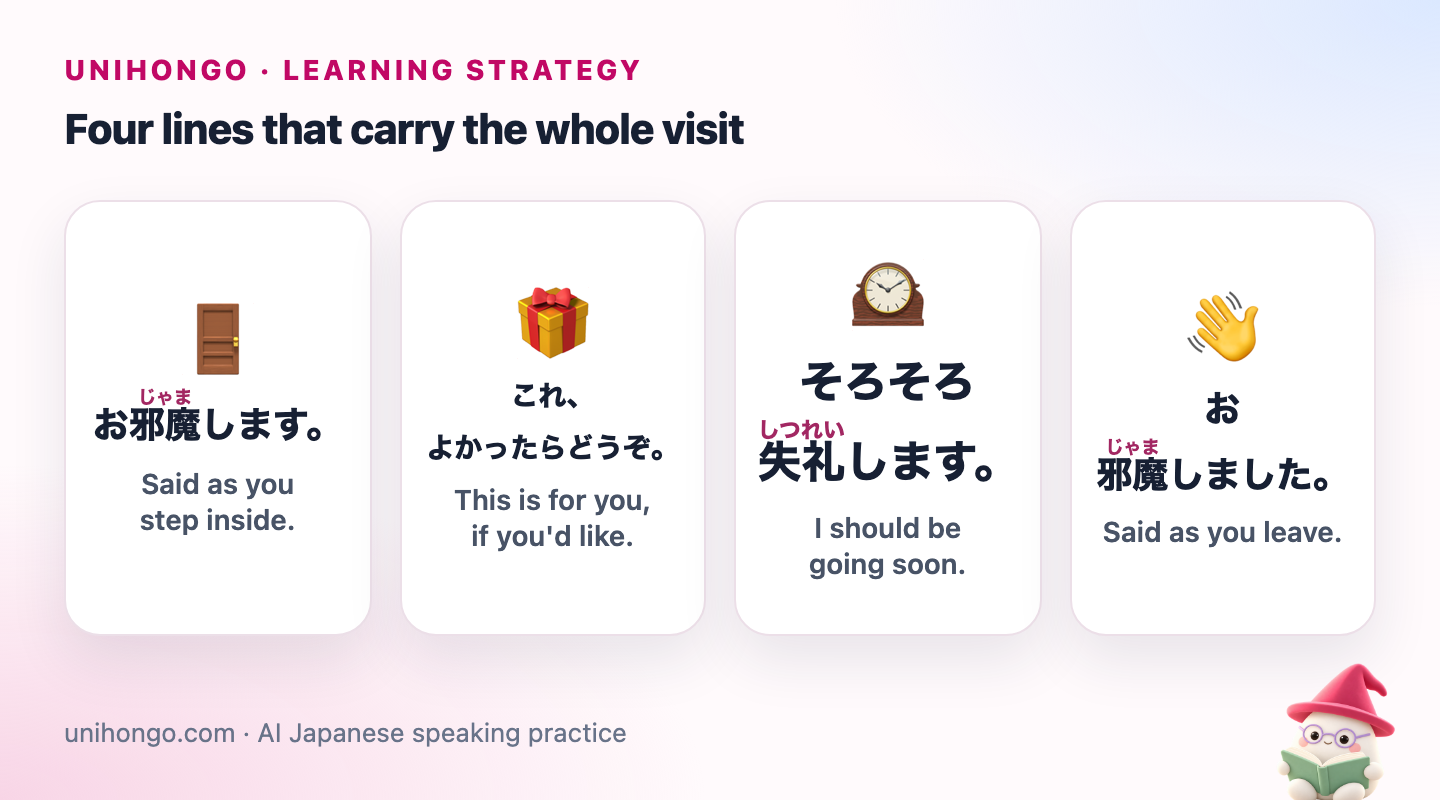
If you learn nothing else, learn these four. Ojamashimasu goes with stepping inside, and it is one of the few Japanese phrases that has no English version, so do not look for one; say it and step in. Kore, yokattara dōzo is the modern, light way to hand over a gift. Sorosoro shitsurei shimasu announces that you are leaving without stating it bluntly. Ojamashimashita is the same intrusion word in the past tense and it closes the visit at the door.
All four are polite form, which is the right register with a friend's family, a host family, a colleague or anyone older. With a close friend your own age in their own flat, the first and last lines stay the same, said a little more lightly; the middle two become kore, dōzo and sorosoro kaeru ne.
| Japanese | Romaji | Meaning |
|---|---|---|
| お邪魔します。 | Ojamashimasu. | Said as you step inside. |
| これ、よかったらどうぞ。 | Kore, yokattara dōzo. | This is for you, if you'd like. |
| そろそろ失礼します。 | Sorosoro shitsurei shimasu. | I should be going soon. |
| お邪魔しました。 | Ojamashimashita. | Said as you leave. |
Why your own hallway is the right place to practise
A home visit is unusual among speaking situations because it is almost scripted. The door, the shoes, the gift, the seat, the drink, the goodbye: the order barely changes, and the host's lines at each point are nearly the same from one family to the next. That means you can rehearse it physically, not just in your head. Your own front door is a genkan if you decide it is; your kitchen table is the host's table.
The second reason to rehearse is that nerves hit at the door. The first ten seconds of the visit, with the host smiling and waiting, are when learners forget everything. If ojamashimasu has been said twenty times in your own hallway, it will come out at theirs. Everything after that is slower and easier.
This guide is arranged as a listening script: the host's line first, then yours. That is deliberate. The lines you say are easy to look up; the lines you will hear are what catch people out.
At the door: the greeting and the gift
Arrive on time or a few minutes after, not early; a host who is still cooking does not want you at the door at five to. Greet, thank them for the invitation, and hand over the gift in the first minute or two, usually once you are inside and standing, sometimes after you have sat down if the host is busy. The modest lines are expected; nobody takes them literally.
| Japanese | Romaji | Meaning |
|---|---|---|
| 今日はお招きありがとうございます。 | Kyō wa omaneki arigatō gozaimasu. | Thank you for inviting me today. |
| どうぞ、お上がりください。 | Dōzo, oagari kudasai. | Host: Please come in (come up). |
| 失礼します。 | Shitsurei shimasu. | Excuse me. (as you step up) |
| これ、お口に合うといいんですが。 | Kore, okuchi ni au to ii n desu ga. | I hope this is to your taste. |
| わざわざ、ありがとうございます。 | Wazawaza, arigatō gozaimasu. | Host: You shouldn't have, thank you. |
| 靴はこちらでいいですか。 | Kutsu wa kochira de ii desu ka. | Are my shoes all right here? |
| Bring | Why it works | Be careful with |
|---|---|---|
| Sweets or snacks from a good shop, individually wrapped | Easy to share, easy to store, a safe default anywhere | Very large boxes for a small household |
| Fruit or a seasonal item | Reads as thoughtful; seasonal gifts are appreciated in Japan | Anything that needs to be eaten today |
| Something from your own country or region | Gives the table something to talk about | Strong flavours the family may not know what to do with |
| A drink the family can share | Works for an evening meal | Alcohol when you do not know whether they drink |
Tsumaranai mono desu ga, it is a boring thing but, is the line textbooks teach for gifts. It is still heard, mostly from older speakers and in formal situations, but many younger people find it stiff; yokattara dōzo or okuchi ni au to ii n desu ga sound warmer and are safe with anyone. Wazawaza, literally going to the trouble, is the host's standard thanks and needs no reply beyond a smile and iie.
Shoes, slippers and finding your seat
The genkan is the lowered area just inside the door; you take your shoes off there and step up onto the floor. Turn the shoes to face the door after you take them off, or the host will quietly do it. Slippers are usually set out; wear them on wooden floors, take them off before tatami, and swap into the toilet slippers if a pair is waiting outside the bathroom door. Inside, wait to be told where to sit rather than taking the best seat.
| Japanese | Romaji | Meaning |
|---|---|---|
| スリッパをどうぞ。 | Surippa o dōzo. | Host: Here are some slippers. |
| ありがとうございます。 | Arigatō gozaimasu. | Thank you. |
| どうぞ、お座りください。 | Dōzo, osuwari kudasai. | Host: Please have a seat. |
| どこに座ればいいですか。 | Doko ni suwareba ii desu ka. | Where should I sit? |
| 素敵なお家ですね。 | Suteki na ouchi desu ne. | What a lovely home. |
| トイレをお借りしてもいいですか。 | Toire o okari shite mo ii desu ka. | May I use the toilet? |
Doko ni suwareba ii desu ka uses the ba conditional plus ii, the standard way to ask what you should do: nani o moteba ii desu ka, what should I bring? Toire o okari shite mo ii desu ka, literally may I borrow the toilet, is the fixed polite phrase and sounds far better than toire wa doko desu ka in someone's home.
One sentence of admiration is enough. Praising every object in the room, or asking what things cost, makes a host uncomfortable; suteki na ouchi desu ne and then a question about the neighbourhood is plenty.
Drinks and the meal: what the host says and what you answer
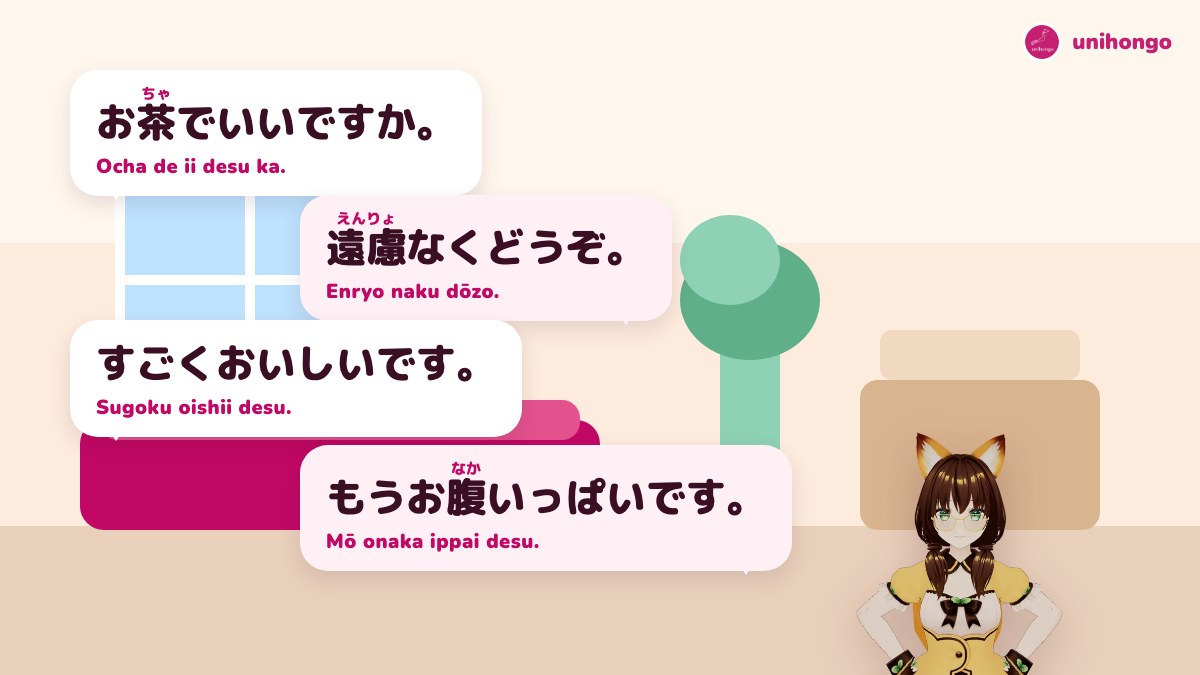
The host will offer a drink almost immediately, usually with a choice already narrowed to make it easy for you: ocha de ii desu ka, is tea all right? Say yes and thank them. If a meal follows, you will hear enryo naku, do not hold back, and the host will keep offering more. In many families the first offer of seconds is turned down lightly and the second accepted, but this varies a lot; if you want more, say so with a smile. Itadakimasu before eating and gochisōsama deshita after are not optional in someone's home.
| Japanese | Romaji | Meaning |
|---|---|---|
| 何か飲みますか。お茶でいいですか。 | Nanika nomimasu ka. Ocha de ii desu ka. | Host: Something to drink? Is tea all right? |
| はい、お茶をお願いします。 | Hai, ocha o onegai shimasu. | You: Yes, tea please. |
| どうぞ、遠慮なく食べてください。 | Dōzo, enryo naku tabete kudasai. | Host: Please, help yourself. |
| いただきます。 | Itadakimasu. | You: Said before eating. |
| これ、すごくおいしいです。 | Kore, sugoku oishii desu. | You: This is really delicious. |
| おかわりはいかがですか。 | Okawari wa ikaga desu ka. | Host: Would you like some more? |
| ありがとうございます。少しだけ。 | Arigatō gozaimasu. Sukoshi dake. | You: Thank you, just a little. |
| もうお腹いっぱいです。ごちそうさまでした。 | Mō onaka ippai desu. Gochisōsama deshita. | You: I'm full. Thank you for the meal. |
Sukoshi dake, just a little, is the gentle way to accept seconds. If you cannot eat something, say it early and plainly: X wa chotto nigate de, I'm not good with X, is softer than kirai and is understood at once. Finishing what is on your plate is appreciated, and leaving a little is not rude, so do not force the last mouthful.
Leaving well: the two-step goodbye
Leaving is where visitors from direct cultures get it slightly wrong, by standing up and going. The Japanese pattern is two steps. First, at a pause, you announce that you should be going soon; the host may protest mildly, and you give a small reason. Then, at the door with your shoes on, you thank them for the whole day and say ojamashimashita. The host often sees you to the door or even the street, and a short message the next day closes the loop.
| Japanese | Romaji | Meaning |
|---|---|---|
| そろそろ失礼します。 | Sorosoro shitsurei shimasu. | You: I should be going soon. |
| まだいいじゃないですか。 | Mada ii ja nai desu ka. | Host: It's still early, stay a bit. |
| 明日は早いので。 | Ashita wa hayai node. | You: I have an early start tomorrow. |
| 今日は本当にありがとうございました。 | Kyō wa hontō ni arigatō gozaimashita. | You: Thank you so much for today. |
| お邪魔しました。 | Ojamashimashita. | You: Said at the door as you go. |
| 気をつけて帰ってね。 | Ki o tsukete kaette ne. | Host: Get home safely. |
| 昨日はごちそうさまでした。 | Kinō wa gochisōsama deshita. | Next-day message: Thank you for yesterday's meal. |
Node at the end of ashita wa hayai node leaves the sentence unfinished on purpose; the so I must go is understood, and finishing it would sound heavy. Between friends the whole sequence is lighter: sorosoro kaeru ne, then jā ne at the door, then a sticker and kinō wa arigatō the next morning.
The rehearsal: walk the visit at home this week
Here is how to turn the script into something your mouth knows. Each evening takes a few minutes and uses your own door, hallway, floor and table. Say the host's line yourself, then answer it; the point is to hear both sides.
- Day 1, the door: open your own front door, say ojamashimasu, step in, say shitsurei shimasu as you step up, and turn your shoes to face the door.
- Day 2, the gift: pick up anything in a bag, hand it over with both hands and kore, yokattara dōzo, then answer yourself with wazawaza arigatō gozaimasu.
- Day 3, the seat and the drink: ask doko ni suwareba ii desu ka, sit, play the host with ocha de ii desu ka, answer hai, onegai shimasu.
- Day 4, the meal: itadakimasu, one compliment, a polite sukoshi dake, gochisōsama deshita.
- Day 5, the goodbye: sorosoro shitsurei shimasu at the table, the reason, ojamashimashita at the door; then type the next-day thank-you.
- Day 6, the whole visit in order, polite; day 7, the whole visit casual, as if at a friend's flat.
Mistakes that are easy to avoid
- Saying ojamashimasu when you leave. Entering is ojamashimasu; leaving is ojamashimashita.
- Walking onto the floor in shoes, or onto tatami in slippers. Shoes stop in the genkan; slippers stop at the tatami edge.
- Handing over the gift at the end of the visit. It comes early, in the first few minutes.
- Toire wa doko desu ka in someone's home. Borrow it: toire o okari shite mo ii desu ka.
- Standing up and leaving in one move. Announce it with sorosoro first, then thank them at the door.
- Using casual forms with a friend's parents because the friend is casual with you. Stay polite with anyone older in the house.
A host who talks back before the real one does
The lines above are easier to remember once something has said the host's half to you. Open AI Sensei, pick Sakura-sensei, and ask Sakura-sensei to play a friend's mother welcoming you for dinner: Sakura-sensei will offer the slippers, the tea and the seconds, protest when you try to leave, and tell you afterwards in the session report which replies were off. Ask her to go slowly the first time and to switch to a casual friend the second time.
For the written side, Mocchi, Unihongo's study assistant, is the place to get the next-day thank-you message corrected: paste your draft with /correct and it will fix the politeness level and say why. Signing in at unihongo.com/login takes less time than wrapping the gift, and a free account covers both.