

The story: 初詣
Read the text once from beginning to end. The narrator is a foreign student spending New Year with a Japanese friend's family.
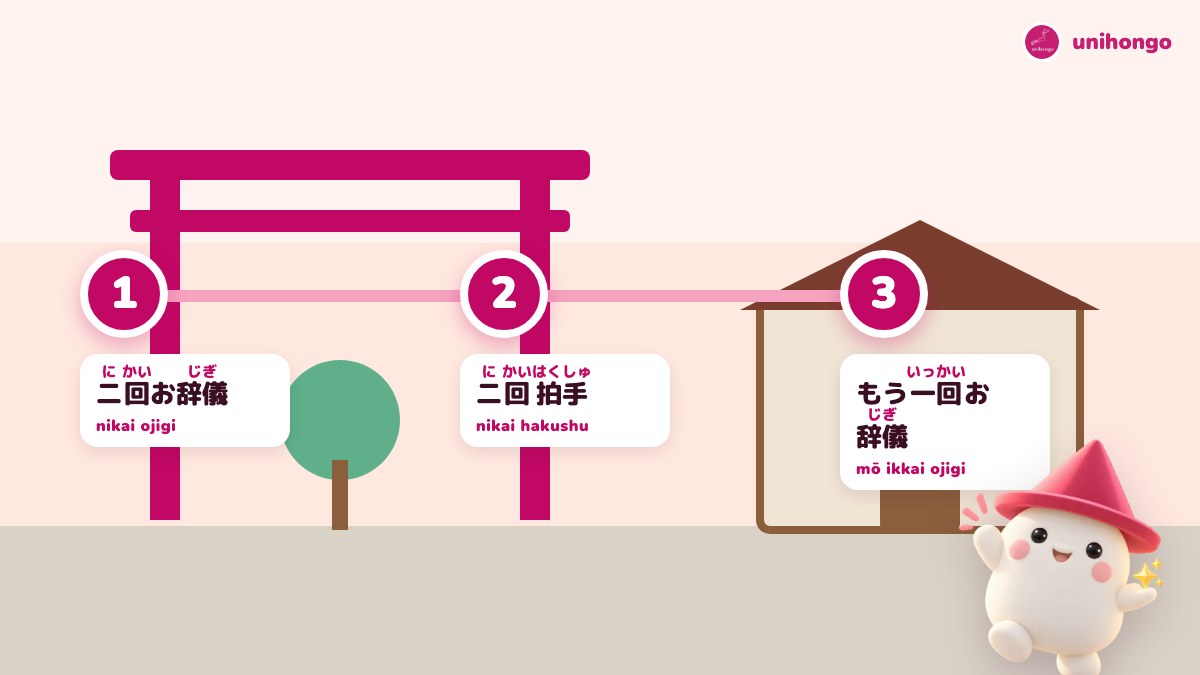
Many words in this text are about a ritual, so try to picture each step as you read: the gate, the water basin, the queue, the offering box, the bows and claps. If you have visited a Japanese shrine, your memory will do half the reading for you; if not, the scene figure further down shows the main steps.
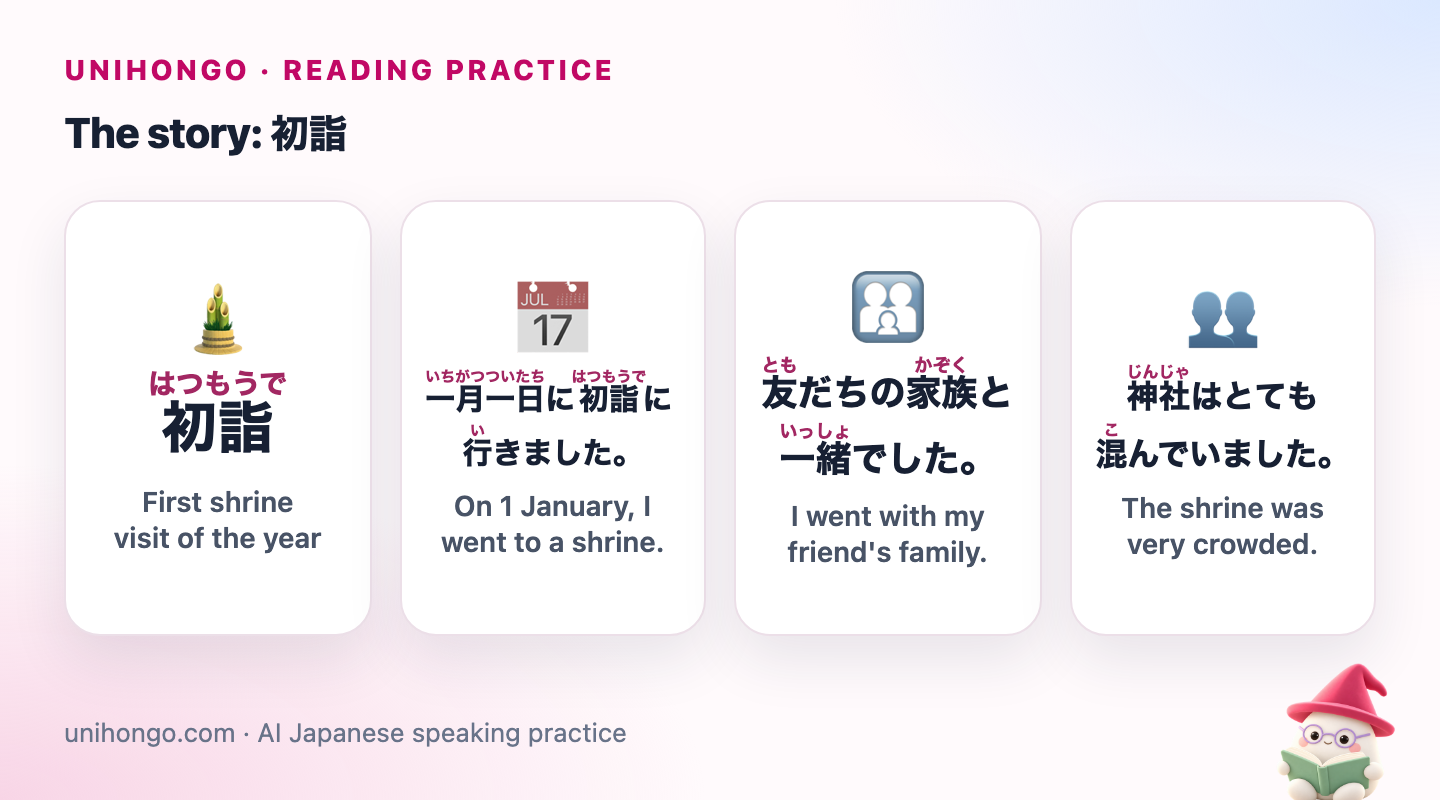
| Japanese | Romaji | Meaning |
|---|---|---|
| 初詣 | Hatsumōde | First shrine visit of the year |
| 一月一日に初詣に行きました。 | Ichigatsu tsuitachi ni hatsumōde ni ikimashita. | On 1 January, I went to a shrine. |
| 友だちの家族と一緒でした。 | Tomodachi no kazoku to issho deshita. | I went with my friend's family. |
| 神社はとても混んでいました。 | Jinja wa totemo konde imashita. | The shrine was very crowded. |
| 鳥居の前で、友だちのお母さんがお辞儀をしました。 | Torii no mae de, tomodachi no okāsan ga ojigi o shimashita. | In front of the torii gate, my friend's mother bowed. |
| 私も同じようにお辞儀をしてから、中に入りました。 | Watashi mo onaji yō ni ojigi o shite kara, naka ni hairimashita. | I bowed the same way, then went in. |
| 手水舎で手と口をきれいにしました。 | Temizuya de te to kuchi o kirei ni shimashita. | At the water basin, I rinsed my hands and mouth. |
| 三十分ぐらい並んで、やっとお参りできました。 | Sanjuppun gurai narande, yatto omairi dekimashita. | After queuing for half an hour, I could finally pray. |
| お賽銭を入れて、二回お辞儀をして、二回手をたたきました。 | Osaisen o irete, nikai ojigi o shite, nikai te o tatakimashita. | I dropped in a coin, bowed twice and clapped twice. |
| それから、もう一回お辞儀をしました。 | Sorekara, mō ikkai ojigi o shimashita. | Then I bowed once more. |
| 私は日本語が上手になるようにお願いしました。 | Watashi wa nihongo ga jōzu ni naru yō ni onegai shimashita. | I prayed that my Japanese would get better. |
| その後、おみくじを引きました。 | Sono ato, omikuji o hikimashita. | After that, I drew a fortune slip. |
| おみくじを引いたことはありましたが、大吉は初めてでした。 | Omikuji o hiita koto wa arimashita ga, daikichi wa hajimete deshita. | I'd drawn fortunes before, but never a great blessing. |
| 帰りに、屋台で甘酒を飲みました。 | Kaeri ni, yatai de amazake o nomimashita. | On the way back, I had amazake at a stall. |
| 寒かったので、とてもおいしく感じました。 | Samukatta node, totemo oishiku kanjimashita. | It was cold, so it tasted wonderful. |
| 今年はいい一年になると思います。 | Kotoshi wa ii ichinen ni naru to omoimasu. | I think this will be a good year. |
Vocabulary notes
Shrine words appear on signs at every shrine in Japan, so they are worth learning even if you only visit as a tourist.
| Japanese | Romaji | Meaning |
|---|---|---|
| 神社 | jinja | Shinto shrine |
| 鳥居 | torii | shrine gate |
| お辞儀 | ojigi | a bow |
| 手水舎 | temizuya | purification water basin |
| 並ぶ | narabu | to line up, to queue |
| お参り | omairi | a visit to pray |
| お賽銭 | osaisen | coin offering |
| おみくじ | omikuji | paper fortune |
| 大吉 | daikichi | great blessing (best fortune) |
| 屋台 | yatai | food stall |
手水舎 is read temizuya by many people and chōzuya by others; both are heard, and shrines themselves differ. 一月一日 is usually read ichigatsu tsuitachi: the first day of a month has the special reading tsuitachi. お賽銭 uses a rare kanji, so many signs write it in kana, おさいせん. The usual routine at the basin is to rinse the left hand, the right hand, then pour a little water into your cupped hand to rinse your mouth, without touching the ladle to your lips.
Grammar notes: sequence, wishes, experience and hopes
Four N4 patterns carry the story. The line from the text comes first, then a new example.
| Japanese | Romaji | Meaning |
|---|---|---|
| お辞儀をしてから、中に入りました。 | Ojigi o shite kara, naka ni hairimashita. | From the text: I bowed, and then went in. |
| 手を洗ってから、食べてください。 | Te o aratte kara, tabete kudasai. | Please wash your hands before you eat. |
| 日本語が上手になるようにお願いしました。 | Nihongo ga jōzu ni naru yō ni onegai shimashita. | From the text: I prayed my Japanese would improve. |
| 家族が元気でいられるようにお願いしました。 | Kazoku ga genki de irareru yō ni onegai shimashita. | I prayed that my family would stay healthy. |
| おみくじを引いたことはありました。 | Omikuji o hiita koto wa arimashita. | From the text: I had drawn fortunes before. |
| 着物を着たことがあります。 | Kimono o kita koto ga arimasu. | I've worn a kimono before. |
| いい一年になると思います。 | Ii ichinen ni naru to omoimasu. | From the text: I think it'll be a good year. |
| 今年は忙しい年になると思います。 | Kotoshi wa isogashii toshi ni naru to omoimasu. | I think this will be a busy year. |
〜てから stresses that the first action comes before the second; plain 〜て only links them. 〜ように with お願いする or 祈る expresses what you wish for, and it takes a plain verb, often a potential or なる form. In the experience sentence, the story uses the past ありました because it describes the narrator's experience up to that moment, then contrasts it with は: fortunes before, yes, but a 大吉, never.
What people say at New Year
The greeting あけましておめでとうございます is used from 1 January and through roughly the first week or two of the month; exactly how long varies by person and region. It is usually followed by 今年もよろしくお願いします, a request for continued goodwill in the new year. Before New Year, the matching phrase is よいお年を, have a good year ahead.
At the shrine itself, conversation is light. People compare fortunes, buy charms called お守り and chat in the queue. If you go with a Japanese family, follow what they do and ask quietly if you are unsure: これでいいですか, is this right?
| Japanese | Romaji | Meaning |
|---|---|---|
| あけましておめでとうございます。 | Akemashite omedetō gozaimasu. | Happy New Year. (polite) |
| 今年もよろしくお願いします。 | Kotoshi mo yoroshiku onegai shimasu. | I look forward to another good year with you. |
| おみくじ、何だった? | Omikuji, nan datta? | Friend: What did your fortune say? (casual) |
| 大吉だった! | Daikichi datta! | I got a great blessing! (casual) |
| お守りを買いたいんですが。 | Omamori o kaitai n desu ga. | I'd like to buy a charm. |
| これでいいですか。 | Kore de ii desu ka. | Am I doing this right? |
Reading traps in this text
- 同じように in sentence 6 means in the same way. It is a different ように from the wish in sentence 11, 上手になるように. The first follows 同じ and describes manner; the second follows a plain verb and states a wish.
- 友だちの家族と一緒でした uses 一緒 with です: I was together with my friend's family. You do not need a verb such as 行く.
- やっとお参りできました uses できる directly after a noun: I could finally do my prayer. お参りする becomes お参りできる.
- 大吉は初めてでした uses は for contrast: fortunes before, yes, but a great blessing, never.
- おいしく感じました uses the adverb form of おいしい with 感じる: it felt delicious, a slightly more personal way to say it tasted good.
Check your understanding
Answer these three questions. The answers follow.
- How long did the narrator queue before praying?
- What did the narrator pray for?
- Why did the amazake taste so good?
Answers
| Japanese | Romaji | Meaning |
|---|---|---|
| 三十分ぐらい並びました。 | Sanjuppun gurai narabimashita. | 1. About thirty minutes. |
| 日本語が上手になるようにお願いしました。 | Nihongo ga jōzu ni naru yō ni onegai shimashita. | 2. For their Japanese to improve. |
| 寒かったからです。 | Samukatta kara desu. | 3. Because it was cold. |
Answer 3 turns the story's 〜ので into 〜から. When you answer a why question, 〜からです is the natural ending; 〜のでです does not exist.
A read-aloud routine
- Read the title and the first four lines slowly, keeping hatsumōde and omairi clear.
- Practise the counting words: nikai, ikkai, sanjuppun. Hold the small っ in ikkai and sanjuppun for a beat.
- Read sentences 8 to 10 as one smooth sequence, the way you would describe the ritual to a friend.
- Read the whole story twice: once slowly, once at a natural speed.
- Say the New Year greetings with a small bow, as you would to a neighbour on 2 January.
A short routine for the holidays
If you are reading this before New Year, use it as a rehearsal. Ask Mocchi on Unihongo to /explain the sentence お賽銭を入れて、二回お辞儀をして、二回手をたたきました, then ask for three more sentences describing a temple visit, so you can see how the vocabulary changes when there is no clapping.
Then go to AI Sensei, pick Sakura-sensei and ask Sakura-sensei to play your friend's mother at the shrine. Greet her for the New Year, ask whether you are doing the bows correctly and tell her what your fortune said. Ask her to stay polite with you and casual with her own daughter, and listen for the difference.