
Four lines for the gym floor
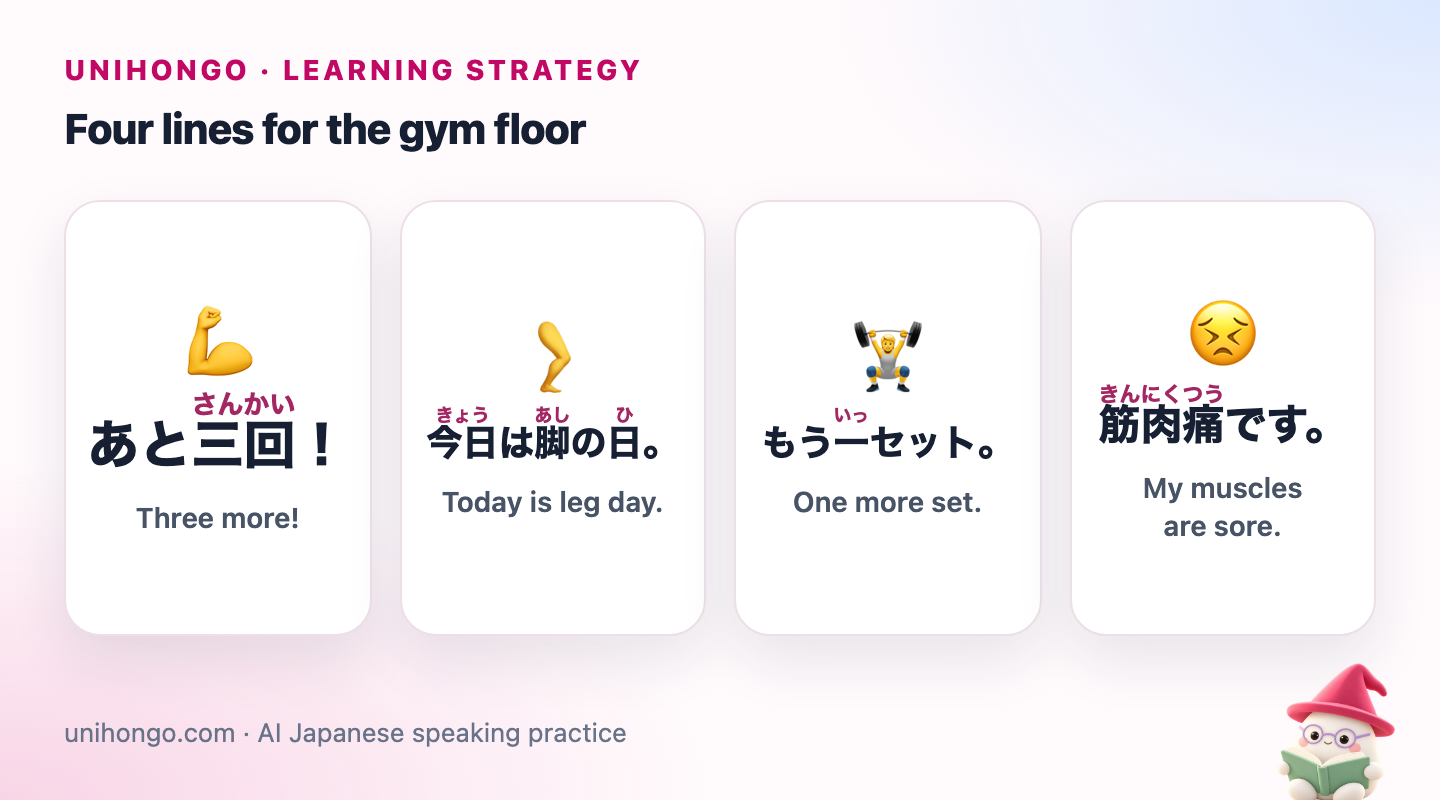
These are the four you will say most, and they are all short enough to say with a bar in your hands. Ato sankai, three more, is what a training partner or a trainer shouts at the end of a set, and it is the kind of sentence you will hear in Japanese gyms and sports anime alike. Kyō wa ashi no hi, today is leg day, follows the pattern X no hi used for any themed day. Mō issetto, one more set, uses setto with the small tsu that one always triggers in front of s. Kinnikutsū, muscle soreness, is the word for the morning after, and saying kinnikutsū desu to a Japanese friend will get sympathy and a laugh.
The gym suits this kind of learning for a simple reason: everything repeats. You count the same numbers for every set, you do the same exercises each week, and the structure of a session barely changes. Repetition without effort is what vocabulary needs, and a workout provides it free of charge.
| Japanese | Romaji | Meaning |
|---|---|---|
| あと三回! | Ato sankai! | Three more! |
| 今日は脚の日。 | Kyō wa ashi no hi. | Today is leg day. |
| もう一セット。 | Mō issetto. | One more set. |
| 筋肉痛です。 | Kinnikutsū desu. | My muscles are sore. |
Counting reps and sets
Reps use the counter kai, times, and sets use setto. The difficulty with kai is that one, six, eight and ten change their sound in front of it, and no amount of reading the table makes that automatic; saying it two hundred times a week does. Count every rep from the first warm-up set, and in a month the sound changes will be in your mouth without thought. Ten reps and three sets is jukkai, san setto; many Japanese lifters say the English-style ten reps, san setto too, so either is understood.
| Japanese | Romaji | Meaning |
|---|---|---|
| 十回、三セット。 | Jukkai, san setto. | Ten reps, three sets. |
| あと一回! | Ato ikkai! | One more! |
| もう一回。 | Mō ikkai. | Once more. |
| 一分休憩。 | Ippun kyūkei. | One-minute rest. |
| 次はスクワット。 | Tsugi wa sukuwatto. | Next is squats. |
| 重さを上げます。 | Omosa o agemasu. | I'm going up in weight. |
| Reps | Japanese | Note |
|---|---|---|
| 1 | 一回 ikkai | small tsu: ik-kai |
| 2 | 二回 nikai | regular |
| 3 | 三回 sankai | regular |
| 4 | 四回 yonkai | yon, never shi, with kai |
| 5 | 五回 gokai | regular |
| 6 | 六回 rokkai | small tsu: rok-kai |
| 7 | 七回 nanakai | nana, not shichi, in counting |
| 8 | 八回 hakkai | hachikai is also heard |
| 9 | 九回 kyūkai | kyū, never ku, with kai |
| 10 | 十回 jukkai | jikkai in careful speech; both are fine |
Body words that come up while you train
Every exercise has a body part, and saying it before you start is a natural way to learn the words. The pattern is kyō wa X o kitaemasu, today I'm training X, or the shorter X no hi, X day. Kitaeru means to forge or strengthen, and it is the verb Japanese lifters use for muscles; renshū suru is for skills, not for your back.
| Japanese | Romaji | Meaning |
|---|---|---|
| 今日は腕を鍛えます。 | Kyō wa ude o kitaemasu. | Today I'm training arms. |
| 背中と肩の日です。 | Senaka to kata no hi desu. | It's back and shoulders day. |
| 胸を鍛えます。 | Mune o kitaemasu. | I'm working chest. |
| 腹筋を百回。 | Fukkin o hyakkai. | A hundred sit-ups. |
| 太ももが痛い。 | Futomomo ga itai. | My thighs hurt. (casual) |
| 筋肉がつきました。 | Kinniku ga tsukimashita. | I've put on muscle. |
| 体重が減りました。 | Taijū ga herimashita. | I've lost weight. |
| ストレッチをします。 | Sutoretchi o shimasu. | I stretch. |
Fukkin is both the abdominal muscles and the exercise, so fukkin o suru means to do sit-ups or crunches. Kinniku ga tsuku, muscle attaches, is the idiomatic way to say you have gained muscle; taijū ga heru, weight decreases, is the neutral way to say you have lost weight, with no hint of dieting.
Itai is the all-purpose word for pain, from a sore thigh to an injury, so add the body part to make it useful: koshi ga itai, my lower back hurts, is the one you hope never to need after deadlifts.
Narrate the session in three lines
A workout is a sequence, and sequences are the easiest thing to describe in Japanese because the order words do the work. Mazu, first; tsugi ni, next; saigo ni, finally. Say the three lines during the cool-down, when you are walking or stretching and can talk, and finish with kyō wa kore de owari, that is it for today. In the masu form it is also exactly what you would say to a trainer who asks what you did.
| Japanese | Romaji | Meaning |
|---|---|---|
| まず、ストレッチをします。 | Mazu, sutoretchi o shimasu. | First, I stretch. |
| 次に、ベンチプレスを十回、三セット。 | Tsugi ni, benchipuresu o jukkai, san setto. | Next, bench press, ten reps, three sets. |
| 最後に、十分走ります。 | Saigo ni, juppun hashirimasu. | Finally, I run for ten minutes. |
| 今日はこれで終わり。 | Kyō wa kore de owari. | That's it for today. |
| 週に三回、ジムに行きます。 | Shū ni sankai, jimu ni ikimasu. | I go to the gym three times a week. |
| 最近、筋トレを始めました。 | Saikin, kintore o hajimemashita. | I recently started weight training. |
Kintore, short for kinniku torēningu, is the everyday word for weight training and the word you will see on Japanese fitness videos and in gym names. Notice that kai does double duty: sankai is three reps inside a set and three times inside a week, so shū ni sankai uses the same counter you have been shouting at the rack.
Listening between sets
Rest periods are the study slot. A rest between sets is short, you are standing still, and your earphones are already in, so swap the music for a short Japanese clip and let it play while you breathe. The rule is familiar material only: a dialogue you have already read, a slow learner podcast, a song whose lyrics you know. The point is to hear Japanese you half know many times while your attention is somewhere else, which is exactly how listening gets fast.
Cardio is different. Twenty minutes on a bike or a treadmill can take a longer, easier podcast, and because your hands are free on a bike you can even shadow quietly, saying lines over the top. Never read on a treadmill, and never let a phrase app take your eyes during a lift; counting is the only study the bar allows.
| Japanese | Romaji | Meaning |
|---|---|---|
| 休憩中に聞きます。 | Kyūkeichū ni kikimasu. | I listen during the rest. |
| 音楽の代わりに日本語。 | Ongaku no kawari ni Nihongo. | Japanese instead of music. |
| 走りながらポッドキャストを聞きます。 | Hashirinagara poddokyasuto o kikimasu. | I listen to a podcast while running. |
| 同じ会話を何回も聞きます。 | Onaji kaiwa o nankai mo kikimasu. | I listen to the same dialogue many times. |
Nankai mo, many times, is the counter kai again with the question word in front: nankai, how many times; nankai mo, however many times, many times. It is the gym's own grammar point.
A three-day plan to start
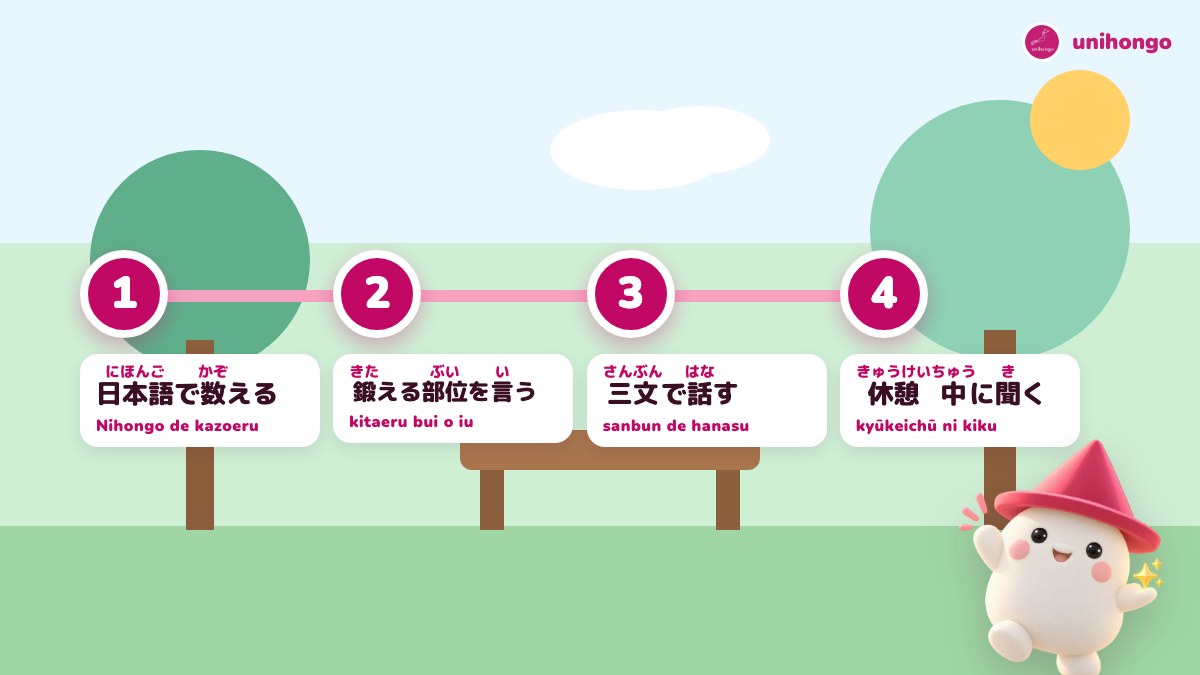
Give the first week one job per session so none of them slows the workout. Day one is counting only; day two adds body words; day three adds the three-line narration and the listening. After that, do all four every session; they take no extra time, because they replace English counting, silence and music rather than adding anything.
| Day | Japanese job | What it looks like |
|---|---|---|
| Day 1 | Count every rep in Japanese | Ikkai, nikai, sankai from the warm-up to the last set; nothing else |
| Day 2 | Name the body part before each exercise | Kyō wa mune no hi; mune o kitaemasu; keep counting |
| Day 3 | Narrate and listen | Three lines in the cool-down; one familiar clip between sets |
| Week 2 on | All four, every session | Add one new exercise name a week, and the word for whatever hurts |
A short exchange at the rack
Gyms are quiet places socially, in Japan and elsewhere, and the one conversation you may have with a stranger is about equipment. The exchange is short and polite, with the te-form and a few set phrases. Otsukaresama desu, said on the way out to someone you have shared a rack with, is the gym version of goodbye and is used in Japanese gyms between regulars.
| Japanese | Romaji | Meaning |
|---|---|---|
| これ、使っていますか。 | Kore, tsukatte imasu ka. | You: Are you using this? |
| あと一セットです。 | Ato issetto desu. | Other: One more set. |
| じゃあ、待ちます。 | Jā, machimasu. | You: Then I'll wait. |
| どうぞ、終わりました。 | Dōzo, owarimashita. | Other: Go ahead, I'm done. |
| ありがとうございます。 | Arigatō gozaimasu. | You: Thank you. |
| 交互に使いますか。 | Kōgo ni tsukaimasu ka. | You: Shall we alternate? |
| お疲れ様です。 | Otsukaresama desu. | You: Good work. (leaving) |
Kōgo ni tsukau, to use in turns, is the offer to share a bench or rack between sets; it is a polite thing to suggest and a common one in busy gyms. Tsukatte imasu ka is in the te-iru form because you are asking about a state, is this in use, not an action.
Mistakes that cost a set
- Reading on the bench. Eyes belong on the bar; Japanese that needs eyes waits for the rest.
- Counting in Japanese only when it is convenient. The sound changes come from doing it every set, including the easy ones.
- Shichi and ku with kai. Counting uses nana and kyū: nanakai, kyūkai.
- Renshū suru for muscles. Skills are practised; muscles are kitaeru.
- New, difficult audio during training. The gym is for familiar Japanese heard many times, not for first listens.
- Skipping the three lines. The narration is the only part that turns counting into sentences.
A trainer who counts in Japanese
Counting alone is fine, but counting with someone shouting ato sankai is better. In AI Sensei, ask Ibuki-sensei to be your personal trainer: tell Ibuki-sensei today's body part, let Ibuki-sensei call the reps and ask what comes next, and describe the session in three lines at the end. He will keep the Japanese slow if you ask, and his session report will show which counters you stumbled on.
For the words, Mocchi, Unihongo's study assistant, can turn the exercises you do into flashcards with /create-flashcards, using a photo of the machine if you like, and quiz you on the body parts with /quiz on the walk home. Sign in once at unihongo.com/login on the phone already in your gym bag, and the free account does the rest.