
The frame in action: one picture, four sentences
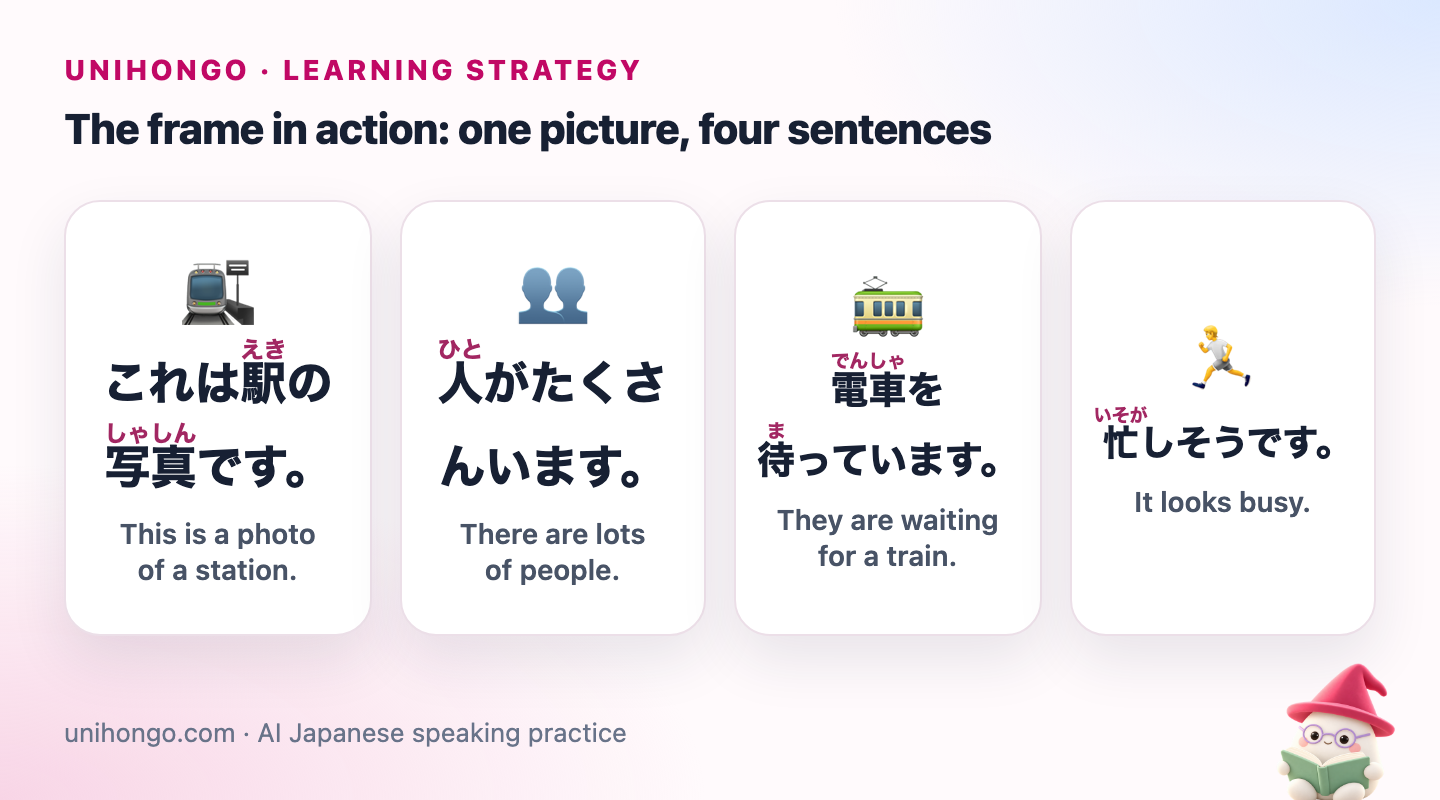
Here is the whole drill on one photo of a station platform. The first sentence names the place with desu. The second says who is there with imasu. The third says what they are doing with te imasu. The fourth gives the feeling with sō desu. You could stop there in an exam and have done the task; everything else in this post is about making those four sentences easy and then adding to them.
| Japanese | Romaji | Meaning |
|---|---|---|
| これは駅の写真です。 | Kore wa eki no shashin desu. | This is a photo of a station. |
| 人がたくさんいます。 | Hito ga takusan imasu. | There are lots of people. |
| 電車を待っています。 | Densha o matte imasu. | They are waiting for a train. |
| 忙しそうです。 | Isogashisō desu. | It looks busy. |
The four questions
The frame is a set of four questions you ask yourself, in order, every time. Each question has one grammar pattern as its answer, so once you know the four patterns you never have to decide how to start. The questions are also exactly what a teacher or examiner asks when you dry up, so learning them means you understand the prompt too.
| Japanese | Romaji | Meaning |
|---|---|---|
| どこですか。 | Doko desu ka. | Where is it? |
| 誰がいますか。 | Dare ga imasu ka. | Who is there? |
| 何をしていますか。 | Nani o shite imasu ka. | What are they doing? |
| どんな感じですか。 | Donna kanji desu ka. | What is the feeling? |
| Question | Pattern | Example |
|---|---|---|
| Where | Place + desu, or kore wa X no shashin desu | Kōen desu. It's a park. |
| Who or what | X ga imasu (people, animals), X ga arimasu (things) | Kodomo ga futari imasu. There are two children. |
| What doing | Verb te-form + imasu | Sakkā o shite imasu. They're playing football. |
| How it feels | Adjective stem + sō desu, or adjective + desu | Tanoshisō desu. It looks fun. |
Grammar the drill needs
Four patterns carry the frame, and two more sharpen it. Imasu and arimasu say what exists and take ga. The te imasu form says what is happening now; it is also used for states like clothes (bōshi o kabutte imasu, wearing a hat). Sō desu attached to an adjective stem means looks or seems, from what you can see. To omoimasu adds your opinion. Position words tell the listener where to look; put them before the thing with ni.
| Japanese | Romaji | Meaning |
|---|---|---|
| 左に木があります。 | Hidari ni ki ga arimasu. | There is a tree on the left. |
| 真ん中に女の人がいます。 | Mannaka ni onna no hito ga imasu. | There is a woman in the middle. |
| 右の男の人は電話をしています。 | Migi no otoko no hito wa denwa o shite imasu. | The man on the right is on the phone. |
| 帽子をかぶっています。 | Bōshi o kabutte imasu. | She is wearing a hat. |
| 雨が降りそうです。 | Ame ga furisō desu. | It looks like it will rain. |
| たぶん冬だと思います。 | Tabun fuyu da to omoimasu. | I think it's probably winter. |
| 手前にテーブルがあります。 | Temae ni tēburu ga arimasu. | There is a table in the foreground. |
| 奥に山が見えます。 | Oku ni yama ga miemasu. | You can see mountains in the background. |
Note the particle shift in the third sentence. The man was introduced with ga; once he is the topic you describe, he takes wa. New information takes ga, known information takes wa. In a four-sentence description that usually means ga in sentence two and wa in sentence three.
Miemasu, can be seen, is the natural verb for things in the distance. Oku ni yama ga arimasu is correct; oku ni yama ga miemasu sounds like someone looking at a picture.
Five practice pictures, described
Here are five ordinary pictures described in the frame, four sentences each. Read each set aloud, then cover the Japanese and rebuild it from the English. The pictures are deliberately dull: a café, a park in autumn, a kitchen, a classroom and a platform at night. The drill is for ordinary scenes, because exams and daily life are full of them.
| Japanese | Romaji | Meaning |
|---|---|---|
| カフェです。 | Kafe desu. | Café: It's a café. |
| 窓の近くに女の人が一人います。 | Mado no chikaku ni onna no hito ga hitori imasu. | Café: There is one woman near the window. |
| コーヒーを飲みながら本を読んでいます。 | Kōhī o nominagara hon o yonde imasu. | Café: She is reading while drinking coffee. |
| 静かそうです。 | Shizukasō desu. | Café: It looks quiet. |
| 秋の公園です。 | Aki no kōen desu. | Park: It's a park in autumn. |
| ベンチに男の人がいて、犬が走っています。 | Benchi ni otoko no hito ga ite, inu ga hashitte imasu. | Park: A man is on a bench and a dog is running. |
| 葉が赤くなっています。 | Ha ga akaku natte imasu. | Park: The leaves have turned red. |
| 気持ちよさそうです。 | Kimochi yosasō desu. | Park: It looks pleasant. |
| 台所です。 | Daidokoro desu. | Kitchen: It's a kitchen. |
| お父さんと子どもがいます。 | Otōsan to kodomo ga imasu. | Kitchen: There is a father and a child. |
| 一緒にカレーを作っています。 | Issho ni karē o tsukutte imasu. | Kitchen: They are making curry together. |
| 楽しそうです。 | Tanoshisō desu. | Kitchen: It looks fun. |
| 教室です。 | Kyōshitsu desu. | Classroom: It's a classroom. |
| 学生が五人ぐらいいます。 | Gakusei ga gonin gurai imasu. | Classroom: There are about five students. |
| 先生の話を聞いています。 | Sensei no hanashi o kiite imasu. | Classroom: They are listening to the teacher. |
| ちょっと眠そうです。 | Chotto nemusō desu. | Classroom: They look a bit sleepy. |
| 夜の駅のホームです。 | Yoru no eki no hōmu desu. | Platform: It's a station platform at night. |
| サラリーマンが何人かいます。 | Sararīman ga nannin ka imasu. | Platform: There are a few office workers. |
| スマホを見ています。 | Sumaho o mite imasu. | Platform: They are looking at their phones. |
| 疲れていそうです。 | Tsukarete isō desu. | Platform: They look tired. |
Two forms deserve a note. Ii becomes yosasō (looks good), so kimochi ii becomes kimochi yosasō. Tsukarete iru, to be tired, is a te-iru state, so looks tired is tsukarete isō desu, not tsukaresō desu, which would mean looks like they will get tired.
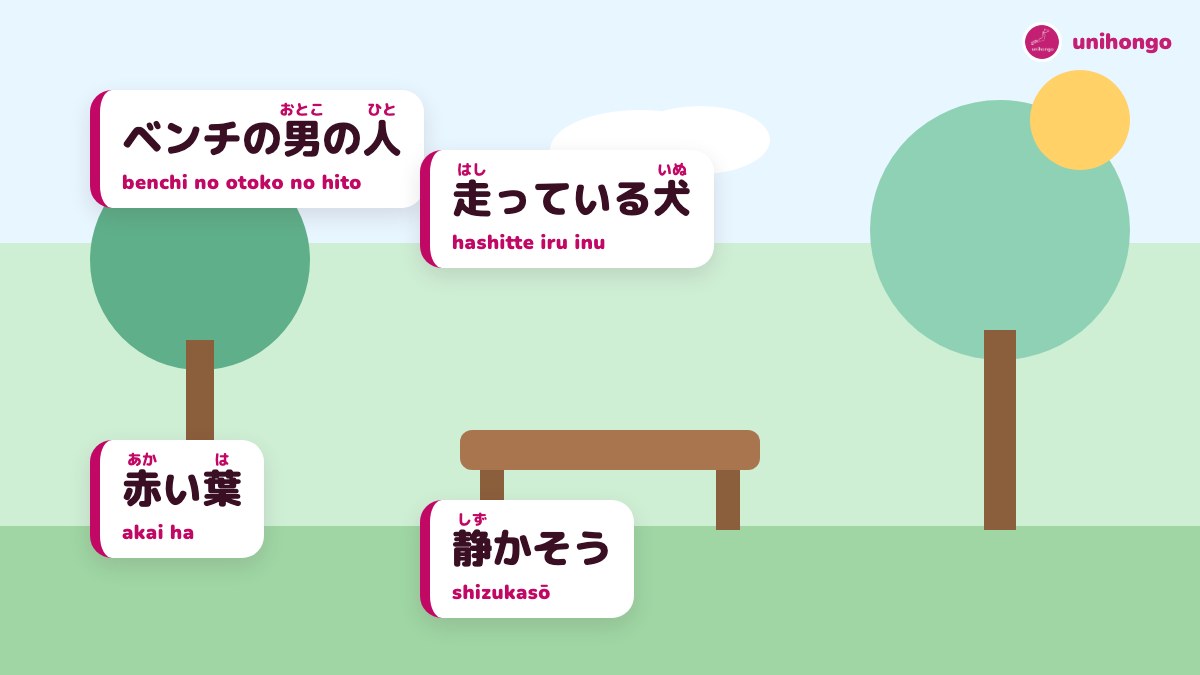
A park in autumn, labelled
The scene below shows the second picture with its labels, so you can see how the four sentences map onto what is actually in the frame. Describe it yourself before reading the labels, then compare. If you said something the labels do not, that is fine; pictures have more in them than four sentences, and the frame is a floor, not a ceiling.
| Japanese | Romaji | Meaning |
|---|---|---|
| ベンチに男の人が座っています。 | Benchi ni otoko no hito ga suwatte imasu. | A man is sitting on a bench. |
| 犬がボールを追いかけています。 | Inu ga bōru o oikakete imasu. | A dog is chasing a ball. |
| 木の葉が赤いです。 | Ki no ha ga akai desu. | The leaves on the trees are red. |
| 人が少なくて、静かそうです。 | Hito ga sukunakute, shizukasō desu. | There are few people, so it looks quiet. |
A daily drill with your own photos
The drill becomes a habit when the pictures are yours. Your phone already holds hundreds of scenes you know well, and describing a photo you took is easier and more interesting than describing a textbook picture. One photo a day, sixty seconds, out loud, in the frame order. The checklist keeps it honest.
- Pick a photo without choosing: the most recent, or scroll and stop at random.
- Start the timer, then say the four sentences in order: place, people or things, action, feeling.
- If a word is missing, say nanika (something) and keep going; look it up afterwards.
- Once a week, write one photo's four sentences down and get them corrected.
- Every second week, add a fifth sentence that guesses something: the season, the time, what happened next.
The nanika rule matters. The drill is about producing four sentences without stopping, and a missing noun is not a reason to stop. Learners who pause to look up every word never get to sentence four.
Levelling up: guesses and feelings
When four sentences come easily, add the two kinds of sentence that make a description sound like a person rather than a caption. Guesses use deshō (probably), kamoshiremasen (might be) and to omoimasu (I think). Feelings use kanji ga shimasu, it has a feeling of, and your own reaction. These are also what examiners reward and what a friend showing you a photo actually wants to hear.
| Japanese | Romaji | Meaning |
|---|---|---|
| 週末でしょう。 | Shūmatsu deshō. | It's probably the weekend. |
| 家族かもしれません。 | Kazoku kamoshiremasen. | They might be a family. |
| これから出かけると思います。 | Korekara dekakeru to omoimasu. | I think they're about to go out. |
| ちょっと寂しい感じがします。 | Chotto sabishii kanji ga shimasu. | It has a slightly lonely feel. |
| 私も行ってみたいです。 | Watashi mo itte mitai desu. | I'd like to go there too. |
| いい写真ですね。 | Ii shashin desu ne. | That's a nice photo. |
Mistakes in picture descriptions
- Arimasu for people. A woman is onna no hito ga imasu; the same woman's bag is kaban ga arimasu.
- Wa for new things. The first mention of each person or object takes ga; wa comes once they are the topic.
- Isogashii desu for looks busy. If you are judging from the picture, say isogashisō desu.
- E instead of shashin. E is a painting or drawing; a photo is shashin, and most exam and app pictures are shashin.
- Stopping at a missing word. Say nanika and keep the four sentences moving.
A partner for the drill
The drill works alone, but it works better with someone who asks the questions. Mocchi, Unihongo's study assistant, can set the picture for you: ask it to describe a simple everyday scene in English, describe it back in Japanese in four sentences, and let Mocchi correct the sentences and ask one follow-up. Because it keeps track of what you keep missing, it will notice if ga and wa keep swapping. Later, /correct takes a weekly written description.
For the spoken version, hold a photo in front of you in AI Sensei, tell Haru-sensei what is in it, and ask Haru-sensei to keep asking what else Haru-sensei should know about it. Both start with a free account at unihongo.com/login, and the first picture can be whatever is on your phone right now.