
Four sentences for a learner on a budget
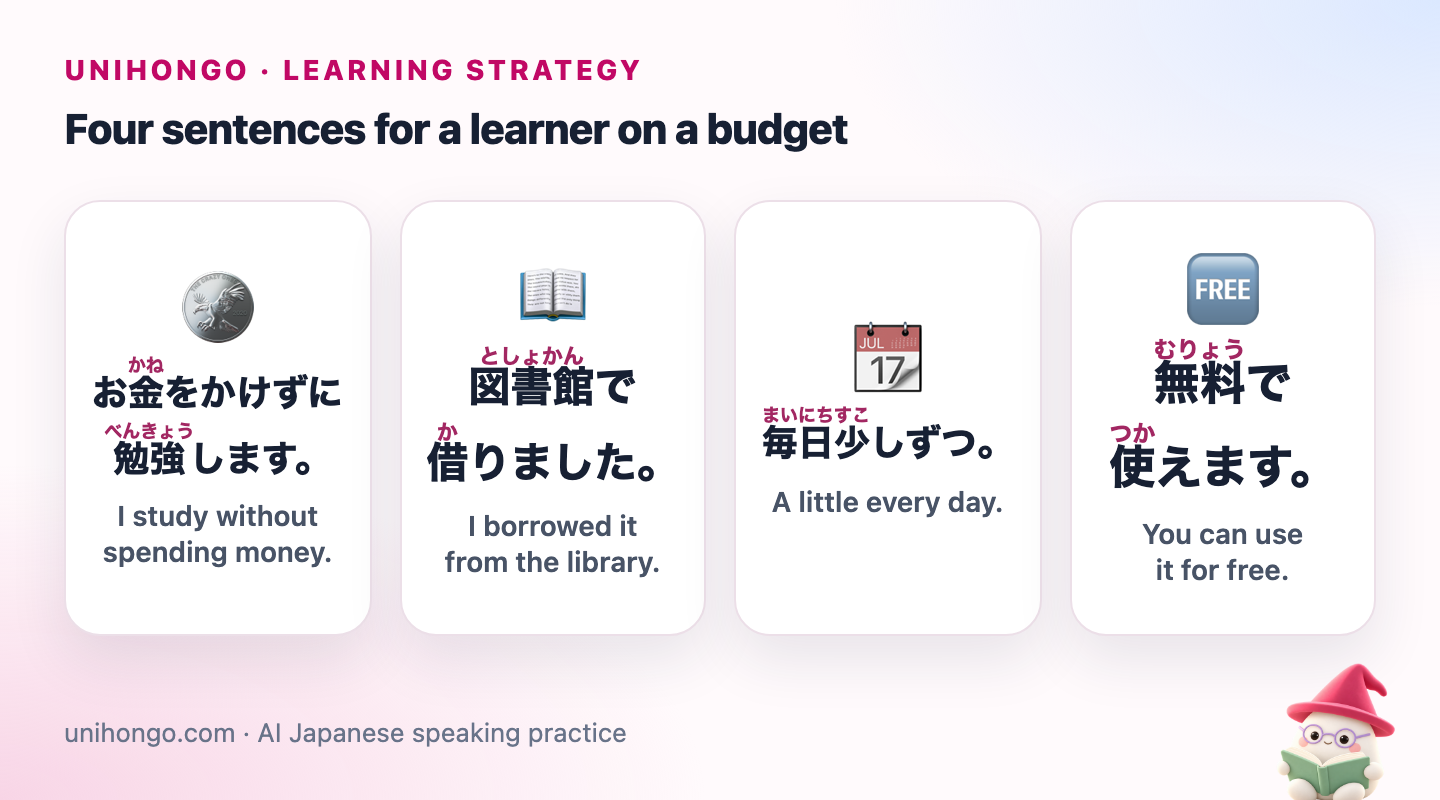
Start with the Japanese of your own situation, because you will be saying it to exchange partners and to anyone who asks how you study. Okane o kakezu ni, without spending money, uses the zu ni form, which means without doing; it is slightly formal and exactly right here. Toshokan de karimashita is the sentence that will save you the most. Mainichi sukoshi zutsu is the whole method in four words. Muryō de tsukaemasu is what you will read on every free tool you find.
| Japanese | Romaji | Meaning |
|---|---|---|
| お金をかけずに勉強します。 | Okane o kakezu ni benkyō shimasu. | I study without spending money. |
| 図書館で借りました。 | Toshokan de karimashita. | I borrowed it from the library. |
| 毎日少しずつ。 | Mainichi sukoshi zutsu. | A little every day. |
| 無料で使えます。 | Muryō de tsukaemasu. | You can use it for free. |
What free actually covers
Be precise about what free is good at, because it is not the same for every skill. Input is almost completely covered: the kana have free charts and free drill games, every grammar point has several free explanations, graded readers and learner news exist at no cost, and there is more free Japanese audio and video than anyone could finish. Output is partly covered: you can write and speak alone for free, and get some feedback from exchange partners and free study assistants. What is thin is the thing a paid teacher provides: someone whose job is to notice your mistakes and to expect you back on Thursday.
| Skill | Free sources that work | Where free thins out |
|---|---|---|
| Kana and kanji | Free charts, writing practice sheets, a free kana game, kanji dictionaries | Nothing; this is fully free |
| Grammar | Free online grammar guides, library textbooks, learner forums | A structured path after the beginner guides |
| Vocabulary | Spaced-repetition decks, words from your own reading | Nothing, if you build your own cards |
| Reading | Learner news sites, graded readers at the library, public-domain stories, manga with furigana | Nothing; free reading goes all the way up |
| Listening | Slow podcasts, public broadcaster learner programmes, video with Japanese subtitles | Nothing, apart from the time to find good ones |
| Speaking | Talking to yourself, language exchange, free AI practice | Regular correction from someone whose job it is |
| Writing | A daily line, exchange partners, free correction tools | Detailed feedback on anything longer than a paragraph |
Your public library deserves a special mention. Many lend the standard textbook series, graded readers and even audio, so the one thing free learners often end up buying, a textbook, can be borrowed and returned. Toshokan de karimashita is a sentence to be proud of.
The first weeks, step by step
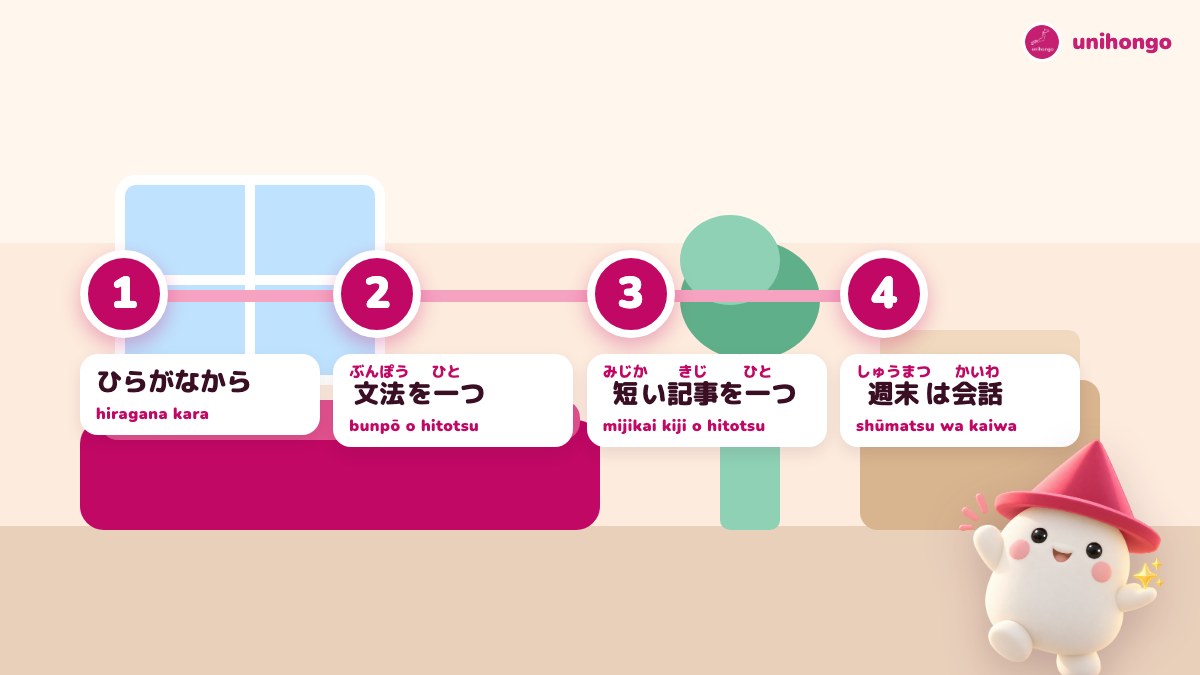
Here is a start that costs nothing and gives each week one job. The sentences are what you would say about each stage; say them out loud as you reach it, because talking about your own studying is some of the earliest real speaking you can do.
| Japanese | Romaji | Meaning |
|---|---|---|
| ひらがなから始めます。 | Hiragana kara hajimemasu. | I'm starting with hiragana. |
| 今週は文法を一つだけ。 | Konshū wa bunpō o hitotsu dake. | This week, just one grammar point. |
| 毎朝、単語を五つ覚えます。 | Maiasa, tango o itsutsu oboemasu. | Every morning I learn five words. |
| 短い記事を一つ読みます。 | Mijikai kiji o hitotsu yomimasu. | I read one short article. |
| 週末は会話の練習です。 | Shūmatsu wa kaiwa no renshū desu. | Weekends are for conversation practice. |
- Weeks 1-2: hiragana, then katakana, with a free chart and a free kana game; write each row by hand once a day. Nothing else.
- Weeks 3-6: one grammar point a week from a free guide, with five sentences of your own; ten words a day from a free deck or your own cards.
- Weeks 7-10: a short learner-news article or graded-reader page every day, read aloud; keep the grammar point a week.
- Weeks 11-12: add a slow podcast on the commute and set up one language exchange; say three sentences about your day, out loud, every evening.
- After that: keep the four habits and raise the level of the reading, not the number of resources.
Free listening and reading that works
The free input problem is not scarcity but choice. The fix is to pick by level, not by interest, for the first months: a learner news site, a slow podcast made for learners and a children's book or manga with furigana will teach you more than the drama you cannot follow. Interest comes back later, when native material is within reach, and by then your free sources are the whole of Japanese media.
| Japanese | Romaji | Meaning |
|---|---|---|
| やさしいニュースを読みます。 | Yasashii nyūsu o yomimasu. | I read easy news (news for learners). |
| ふりがな付きの漫画 | furigana tsuki no manga | manga with furigana |
| 子ども向けの本 | kodomo muke no hon | books aimed at children |
| ゆっくり話すポッドキャスト | yukkuri hanasu poddokyasuto | a podcast that speaks slowly |
| 日本語の字幕で見ます。 | Nihongo no jimaku de mimasu. | I watch with Japanese subtitles. |
| 分からない言葉は三つまで。 | Wakaranai kotoba wa mittsu made. | Unknown words: three at most. |
Muke, aimed at, and tsuki, with attached, are two suffixes you will see on every free resource: shokyūsha muke, for beginners; onsei tsuki, with audio. Mittsu made, up to three, is the rule that keeps reading from turning into dictionary work: look up three words per page and guess the rest.
Free speaking: the hard part, honestly
Speaking for free has a price, and the price is your own language. A language exchange is fair only if half the time goes to the other person's Japanese-free goal, which usually means teaching them your language. Budget for that honestly and it works; try to take more than half and the partner disappears. The sentences below set up a fair exchange and run it in Japanese.
Before an exchange, do the free thing that costs the least and that most learners skip: talk to yourself. Narrate what you are doing, in the kitchen, on the walk, in the shower. It produces more Japanese in a week than most paid lessons, and it means the exchange partner meets someone who already speaks.
| Japanese | Romaji | Meaning |
|---|---|---|
| 英語を教えますから、日本語を教えてください。 | Eigo o oshiemasu kara, Nihongo o oshiete kudasai. | I'll teach you English, so please teach me Japanese. |
| 半分は日本語、半分は英語で。 | Hanbun wa Nihongo, hanbun wa Eigo de. | Half in Japanese, half in English. |
| 週に一回、どうですか。 | Shū ni ikkai, dō desu ka. | Once a week, how about that? |
| ゆっくり話してもらえますか。 | Yukkuri hanashite moraemasu ka. | Could you speak slowly? |
| 今の、合っていますか。 | Ima no, atte imasu ka. | Was that right, what I just said? |
| 直してもらえると嬉しいです。 | Naoshite moraeru to ureshii desu. | I'd be glad if you corrected me. |
Replace Eigo with your own language. Naoshite moraeru to ureshii desu asks for correction in the softest way, and partners who hear it tend to correct more; without it, most people politely let mistakes pass, which is the main weakness of exchange as a method.
Habits that cost nothing
- Labels: sticky notes with the Japanese word on ten objects at home, replaced when you stop noticing them.
- The daily line: one sentence about today, written down, in the past tense. A year of these is a diary and a record of progress.
- Shadowing: play a sentence from a slow podcast and say it over the top, a few lines a day, matching the rhythm.
- Self-talk: narrate one slot of the day, such as cooking or the commute, out loud, every day.
- Phone in Japanese: free reading practice on every screen, with your settings app as the dictionary.
- One resource per skill: a rule, not a suggestion. Add a new one only when you have finished the old one.
Where free stops
Here is the honest part. Free learners rarely stall for lack of material; they stall because nobody notices when they stop, and because nobody tells them that the sentence they have been saying for six months is wrong. Correction and accountability are what teachers are paid for, and no free tool fully replaces a person who expects you on Thursday and remembers last week's mistake.
Free also stops at exams with stakes and at the stage where beginner guides run out and you need a sequenced path through intermediate grammar. And it stops, quietly, at speaking: exchange partners are kind, which is a problem, and self-talk has no listener. None of this means you must pay. It means you should know, in advance, what you would be paying for, so that if you ever do, it is for the right thing: feedback and structure, not more input.
| Japanese | Romaji | Meaning |
|---|---|---|
| 独学で勉強しています。 | Dokugaku de benkyō shite imasu. | I'm studying on my own (self-taught). |
| 先生はいません。 | Sensei wa imasen. | I don't have a teacher. |
| 間違いに気づきにくいです。 | Machigai ni kizukinikui desu. | It's hard to notice my own mistakes. |
| そろそろ先生を探そうかな。 | Sorosoro sensei o sagasō ka na. | Maybe it's time to look for a teacher. (casual) |
Dokugaku, self-study, is the word Japanese speakers will use about you, usually with admiration. Nikui on kizukinikui means hard to do; its opposite, yasui, gives wakariyasui, easy to understand, which is what you want every free resource to be.
Mistakes free learners make
- Collecting resources. A folder of bookmarks is not studying; one guide, one reader, one podcast is.
- All input, no output. Reading and listening feel like progress; speaking and writing are where the gaps show, and where free learners most need to push themselves.
- Never being checked. Ask for correction from exchange partners and tools in so many words, or mistakes settle in.
- Taking more than half of an exchange. The partner stops replying, and the free speaking practice ends.
- Jumping to native material too early. Learner news and graded readers are not a compromise; they are the fastest route to the drama you want.
- Treating free as a permanent principle. It is a strategy for now; decide later, with experience, whether feedback is worth paying for.
A free account that remembers what you got wrong
The two things free usually lacks are correction and a plan that notices when you drift, and a free account on Unihongo gives you a version of both. Mocchi, Unihongo's study assistant, builds a personal study plan with /plan around your level, your goal and the free materials you already use, ticks the daily tasks off in the chat, and corrects the sentences you send it with /correct, remembering which mistakes keep coming back so later reviews return to them. For vocabulary from your own free reading, /create-flashcards turns the words into cards and /review-flashcards spaces the reviews.
When you want a listener for the self-talk, AI Sensei will play a patient exchange partner who never lets a mistake pass politely. Everything in this section runs on the free account; unihongo.com/login is the only door, and a library card is the other thing you need.