

The text: 私の朝 (My morning)
Read the whole text first without looking at the English. Try to catch three things: what time the writer gets up, how they get to the station, and what changes on Sunday. Then read it again sentence by sentence with the glosses.
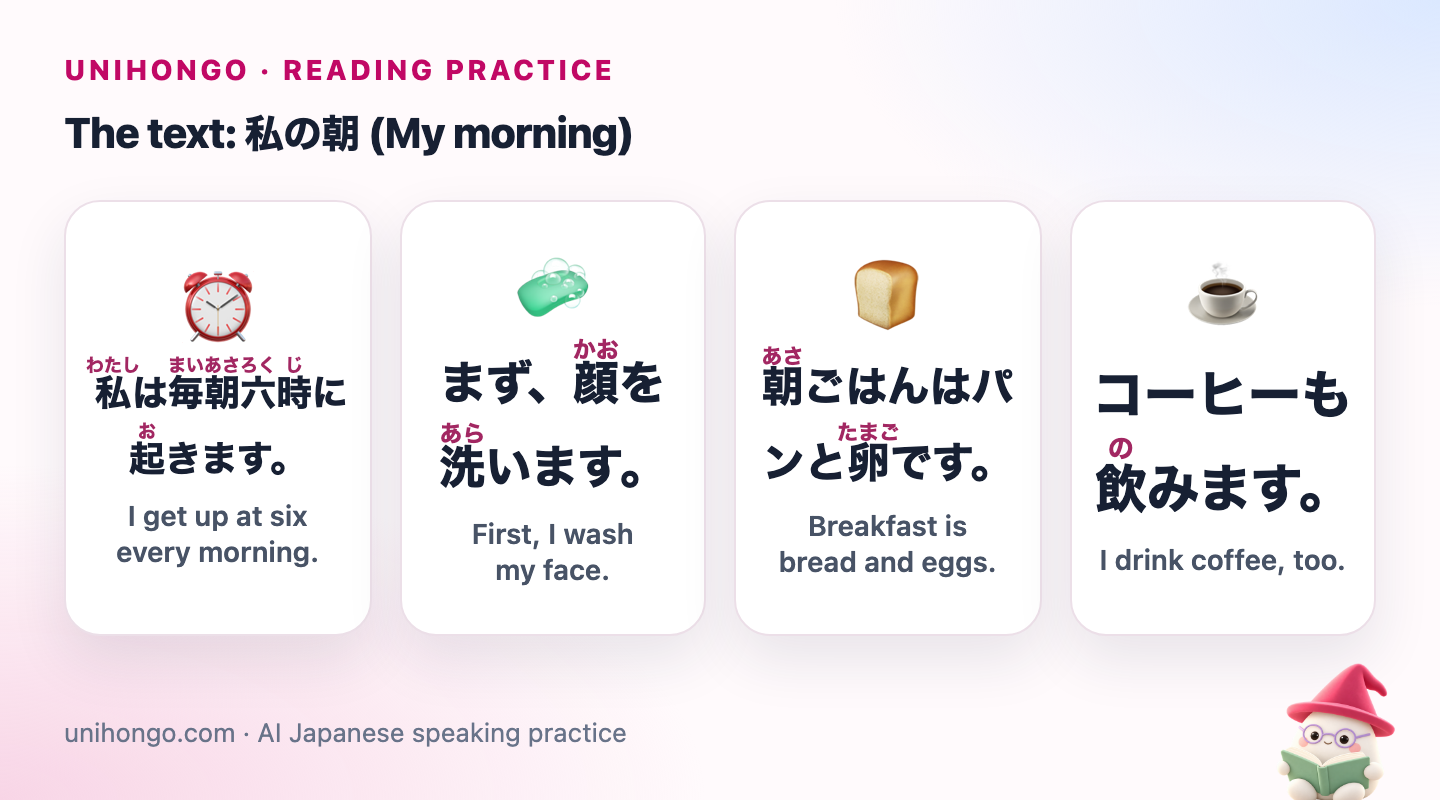
| Japanese | Romaji | Meaning |
|---|---|---|
| 私は毎朝六時に起きます。 | Watashi wa maiasa rokuji ni okimasu. | I get up at six every morning. |
| まず、顔を洗います。 | Mazu, kao o araimasu. | First, I wash my face. |
| 朝ごはんはパンと卵です。 | Asagohan wa pan to tamago desu. | Breakfast is bread and eggs. |
| コーヒーも飲みます。 | Kōhī mo nomimasu. | I drink coffee, too. |
| それから、七時半に家を出ます。 | Sore kara, shichiji han ni ie o demasu. | Then I leave home at half past seven. |
| 駅まで歩いて十分です。 | Eki made aruite juppun desu. | The station is a ten-minute walk away. |
| 電車には人がたくさんいます。 | Densha ni wa hito ga takusan imasu. | There are a lot of people on the train. |
| 八時半に会社に着きます。 | Hachiji han ni kaisha ni tsukimasu. | I arrive at the office at half past eight. |
| 時々、コンビニでお茶を買います。 | Tokidoki, konbini de ocha o kaimasu. | Sometimes I buy tea at a convenience store. |
| 日曜日の朝はゆっくり起きます。 | Nichiyōbi no asa wa yukkuri okimasu. | On Sunday mornings I take my time getting up. |
| 九時ごろまで寝ます。 | Kuji goro made nemasu. | I sleep until about nine. |
| 私は朝が好きです。 | Watashi wa asa ga suki desu. | I like mornings. |
Notice that the writer uses the present ます form for the whole text. In Japanese, the same form describes habits (I get up at six every day) and future plans (I will get up at six tomorrow). Words like 毎朝, every morning, and 時々, sometimes, tell you it is a habit.
Vocabulary notes
Most of these words appear in every N5 word list. Learn them as chunks with their particle, for example 家を出ます rather than just 出ます, because the particle is the part learners forget.
| Japanese | Romaji | Meaning |
|---|---|---|
| 毎朝 | maiasa | every morning (no particle needed) |
| 起きます | okimasu | to get up, to wake up |
| 顔を洗います | kao o araimasu | to wash your face |
| 朝ごはん | asagohan | breakfast |
| 家を出ます | ie o demasu | to leave home |
| 歩いて | aruite | on foot, by walking |
| 着きます | tsukimasu | to arrive (at a place に) |
| 時々 | tokidoki | sometimes |
| ゆっくり | yukkuri | slowly, without hurrying |
| ごろ | goro | about, around (with clock times) |
毎朝 behaves like 毎日 (every day) and 毎晩 (every night): it does not take に. Saying 毎朝に起きます is a common beginner slip. In the same way, ごろ attaches to a clock time (九時ごろ, around nine), while ぐらい usually attaches to an amount of time (十分ぐらい, about ten minutes). In everyday speech many people mix them, but this split is what textbooks and the JLPT expect.
Grammar notes: four patterns in the text
The text is built on four small patterns. Each one is shown with the sentence from the text and one new example so you can see the pattern working in a different place.
| Japanese | Romaji | Meaning |
|---|---|---|
| 六時に起きます。 | Rokuji ni okimasu. | I get up at six. (text) |
| 十一時に寝ます。 | Jūichiji ni nemasu. | I go to bed at eleven. (new example) |
| まず、顔を洗います。 | Mazu, kao o araimasu. | First, I wash my face. (text) |
| まず、歯をみがきます。 | Mazu, ha o migakimasu. | First, I brush my teeth. (new example) |
| 駅まで歩いて十分です。 | Eki made aruite juppun desu. | It's a ten-minute walk to the station. (text) |
| 家から会社まで一時間です。 | Ie kara kaisha made ichijikan desu. | It's an hour from home to work. (new example) |
| コーヒーも飲みます。 | Kōhī mo nomimasu. | I drink coffee, too. (text) |
| 紅茶も好きです。 | Kōcha mo suki desu. | I like black tea, too. (new example) |
| Pattern | Meaning | Watch out for |
|---|---|---|
| Time + に + verb | at a clock time | No に after 毎朝, 今日, あした |
| まず / それから | first / then | Put a comma after them in writing |
| A から B まで | from A to B | まで alone can mean up to or until |
| N も | N too, also | も replaces を, は and が |
The last pattern trips up many learners: も takes the place of を, は or が, so コーヒーをも飲みます is wrong. With other particles such as に or で, も is added after them: 駅でも買います, I buy it at the station too.
Comprehension questions
Answer in Japanese before you look at the model answers. Short answers are fine: Japanese often drops the subject when it is obvious, so you do not need to start with 私は.
- What time does the writer get up on weekdays?
- How does the writer get to the station, and how long does it take?
- What does the writer do differently on Sunday mornings?
| Japanese | Romaji | Meaning |
|---|---|---|
| 六時に起きます。 | Rokuji ni okimasu. | Answer 1: At six. |
| 歩いて行きます。十分です。 | Aruite ikimasu. Juppun desu. | Answer 2: On foot. It takes ten minutes. |
| 九時ごろまで寝ます。 | Kuji goro made nemasu. | Answer 3: The writer sleeps until about nine. |
For question 2, notice that the text never says 歩いて行きます. It says 駅まで歩いて十分です, literally to the station, walking, ten minutes. Turning that information into your own sentence is exactly what N5 reading questions test.
The morning as a timeline
If the text felt long, draw it as a timeline. Seeing the times in a row makes the に pattern obvious and helps you remember the order of the verbs. The picture below shows the weekday half of the text.
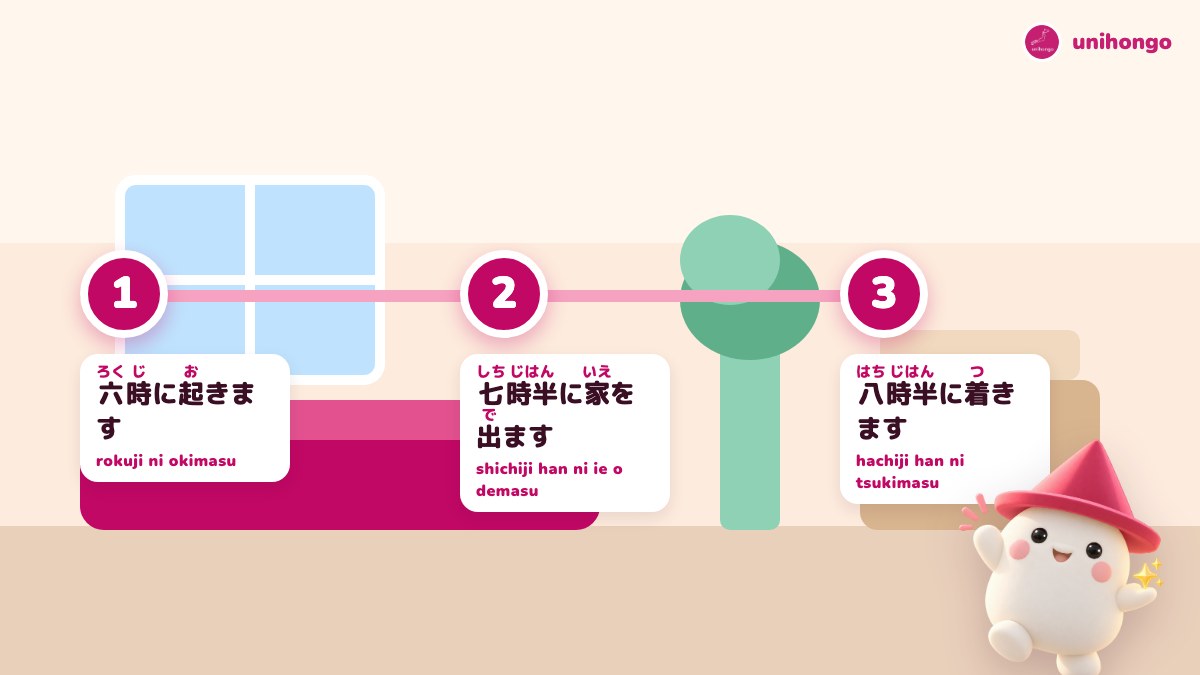
- 6:00: get up and wash your face (起きます, 顔を洗います).
- Breakfast: bread, eggs and coffee (パン, 卵, コーヒー).
- 7:30: leave home and walk to the station (家を出ます, 歩いて).
- 8:30: arrive at the office (会社に着きます).
- Sunday: sleep until about nine (九時ごろまで寝ます).
Rewrite it about your own morning
The best way to keep a text is to make it yours. Keep the structure and change the details. Here are model lines you can adapt: swap in your own time, food and transport.
| Japanese | Romaji | Meaning |
|---|---|---|
| 私は毎朝七時に起きます。 | Watashi wa maiasa shichiji ni okimasu. | I get up at seven every morning. |
| 朝ごはんはごはんとみそしるです。 | Asagohan wa gohan to misoshiru desu. | Breakfast is rice and miso soup. |
| 朝ごはんは食べません。 | Asagohan wa tabemasen. | I don't eat breakfast. |
| 駅までバスで五分です。 | Eki made basu de gofun desu. | The station is five minutes by bus. |
| 学校まで自転車で行きます。 | Gakkō made jitensha de ikimasu. | I go to school by bicycle. |
- Common mistake: 七時に半 instead of 七時半に. The half goes straight after the hour, and に comes last.
- Common mistake: 朝ごはんを食べるます. The ます form of 食べる is 食べます; the る drops.
- Common mistake: using で for walking. 歩いて already means on foot, so 歩いてで is wrong; use で with vehicles such as バスで and 電車で.
A read-aloud routine for this text
- Listen in your head first: read each line silently and mark where you would pause, usually after は, を and the comma.
- Read slowly and clearly, one sentence at a time. Keep long vowels long: kōhī has two long vowels, and nichiyōbi has one.
- Read again at a natural speed, keeping ます short and light. In ordinary speech the final u of ます often sounds very weak.
- Shadow yourself: record your reading, play it back, and speak along with your own voice to smooth the rhythm.
- Cover the text and retell it from the timeline above in four or five sentences.
Turn this text into a speaking habit
If one sentence still feels unclear, paste it into Mocchi, Unihongo's study assistant, with /explain, for example /explain 駅まで歩いて十分です。 Mocchi breaks the sentence into words, explains the particles and remembers the points you keep missing, so a later /review can bring back まで or ごろ if they gave you trouble. When you want a new text at the same level, type /read and ask for another N5 story about a daily routine.
Then say it out loud to someone. In AI Sensei, choose Haru-sensei and ask Haru-sensei to listen while you describe your own morning, then to ask you two questions about it, such as what time you leave home. Ask him to speak slowly if you need to. The session report afterwards lists any corrections, which you can feed back into your rewritten text.