
Four lines to end the day
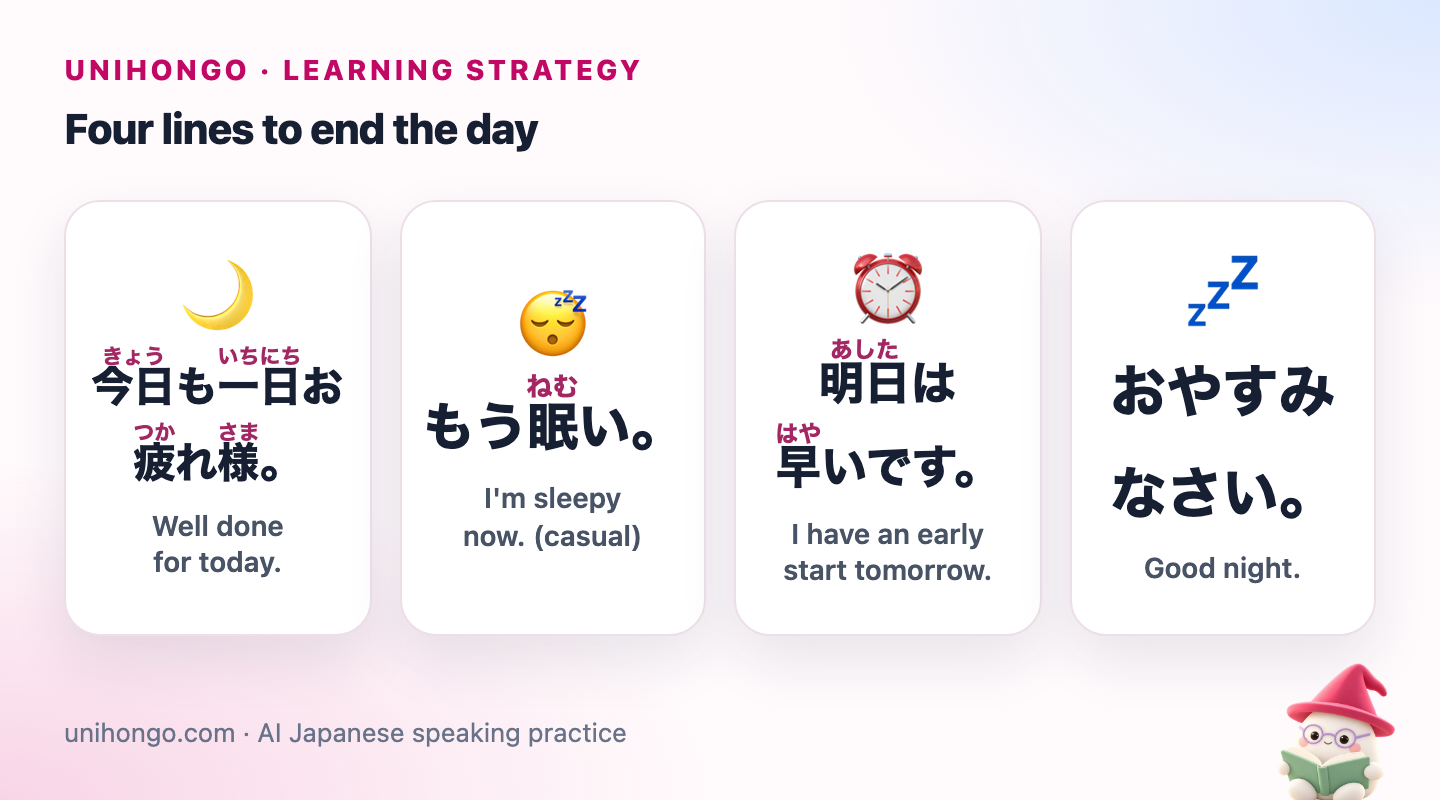
Start with the four sentences you will say most nights. Kyō mo ichinichi otsukaresama, well done for today, is what families and flatmates say to each other in the evening, and it works just as well said to yourself; the casual otsukaresama without deshita is for people you live with. Mō nemui announces that you are done. Ashita wa hayai desu warns that tomorrow starts early, which is also an excuse to leave any conversation. Oyasuminasai closes the day.
| Japanese | Romaji | Meaning |
|---|---|---|
| 今日も一日お疲れ様。 | Kyō mo ichinichi otsukaresama. | Well done for today. |
| もう眠い。 | Mō nemui. | I'm sleepy now. (casual) |
| 明日は早いです。 | Ashita wa hayai desu. | I have an early start tomorrow. |
| おやすみなさい。 | Oyasuminasai. | Good night. |
Why ten calm minutes beat an hour of cramming
Most learners who study at night do the wrong thing at the wrong time: a new grammar point at eleven, a kanji list at midnight. The material is hard, the brain is tired, and the session ends in frustration or a second wind that ruins sleep. The reverse works better for most people: do the hard, new material earlier, and make bedtime the moment you go back over what you already touched that day or that week.
Review has another advantage at night. It needs no desk, no screen and no decisions. You already know the words; you are just making sure they are still there and saying them in a sentence. That is the kind of task you can do in the dark, which means it can happen on the nights when nothing else would.
Be honest with yourself about screens, though. If the review needs your phone, keep it to a single app and a dim screen, or do the spoken parts first and the phone part last so you are not scrolling at the end. Some people find any screen keeps them awake; if that is you, make the routine entirely spoken.
Review the day in three sentences
The heart of the routine is three past-tense sentences about today: where you went or what you did, who was there or what happened, and how it felt. The grammar is the masu past (ikimashita, tabemashita) and the past of adjectives (tanoshikatta, taihen deshita). The sentences should be short and true; a boring day in correct Japanese is the goal.
| Japanese | Romaji | Meaning |
|---|---|---|
| 今日は仕事に行きました。 | Kyō wa shigoto ni ikimashita. | Today I went to work. |
| 友達とご飯を食べました。 | Tomodachi to gohan o tabemashita. | I had a meal with a friend. |
| ちょっと疲れました。 | Chotto tsukaremashita. | I got a bit tired. |
| 楽しかったです。 | Tanoshikatta desu. | It was fun. |
| 大変でした。 | Taihen deshita. | It was tough. |
| 何もしませんでした。 | Nani mo shimasen deshita. | I didn't do anything. |
| 明日は買い物に行きます。 | Ashita wa kaimono ni ikimasu. | Tomorrow I'm going shopping. |
| 明日は休みです。 | Ashita wa yasumi desu. | Tomorrow is a day off. |
Notice the two kinds of past. I-adjectives like tanoshii change themselves: tanoshikatta desu. Na-adjectives and nouns leave the adjective alone and change desu: taihen deshita, yasumi deshita. Say one of each every night and the distinction will stop needing thought.
Nani mo shimasen deshita, I did nothing, is a perfectly good sentence and some nights it is the only honest one. Follow it with yukkuri shimashita, I took it easy, and the day sounds better.
Sleep and tiredness words
Japanese has a rich vocabulary for being tired, and it is one of the first areas where learners sound natural because the words are so common. Nemui is sleepy, tsukareta is tired, kutakuta is worn out, and gussuri describes sleeping deeply. Yofukashi is staying up late, and nebō is oversleeping; both are nouns that take suru.
| Japanese | Romaji | Meaning |
|---|---|---|
| 今日はくたくたです。 | Kyō wa kutakuta desu. | I'm worn out today. |
| 昨日は夜更かししました。 | Kinō wa yofukashi shimashita. | I stayed up late last night. |
| ぐっすり寝たい。 | Gussuri netai. | I want to sleep deeply. (casual) |
| 目覚ましを七時にセットします。 | Mezamashi o shichiji ni setto shimasu. | I'll set the alarm for seven. |
| 寝坊しないように。 | Nebō shinai yō ni. | So that I don't oversleep. |
| もう寝る時間です。 | Mō neru jikan desu. | It's time for bed. |
| Word | Meaning | When you use it |
|---|---|---|
| 寝る neru | to go to bed, to lie down to sleep | Mō nemasu: I'm going to bed. The everyday verb |
| 眠る nemuru | to be asleep, to sleep (the state) | Yoku nemuremashita: I slept well. Slightly more written |
| 休む yasumu | to rest, to take a day off | Osaki ni yasumimasu: I'll turn in before you (polite) |
| 眠い nemui | sleepy | Mō nemui: I could sleep right now |
| 疲れた tsukareta | tired | Kyō wa tsukareta: today wore me out |
The ten minutes, minute by minute
Here is the routine as a timeline. It starts after you have brushed your teeth and ends with the light off. Nothing in it is new; everything in it is something you met earlier in the day or week.
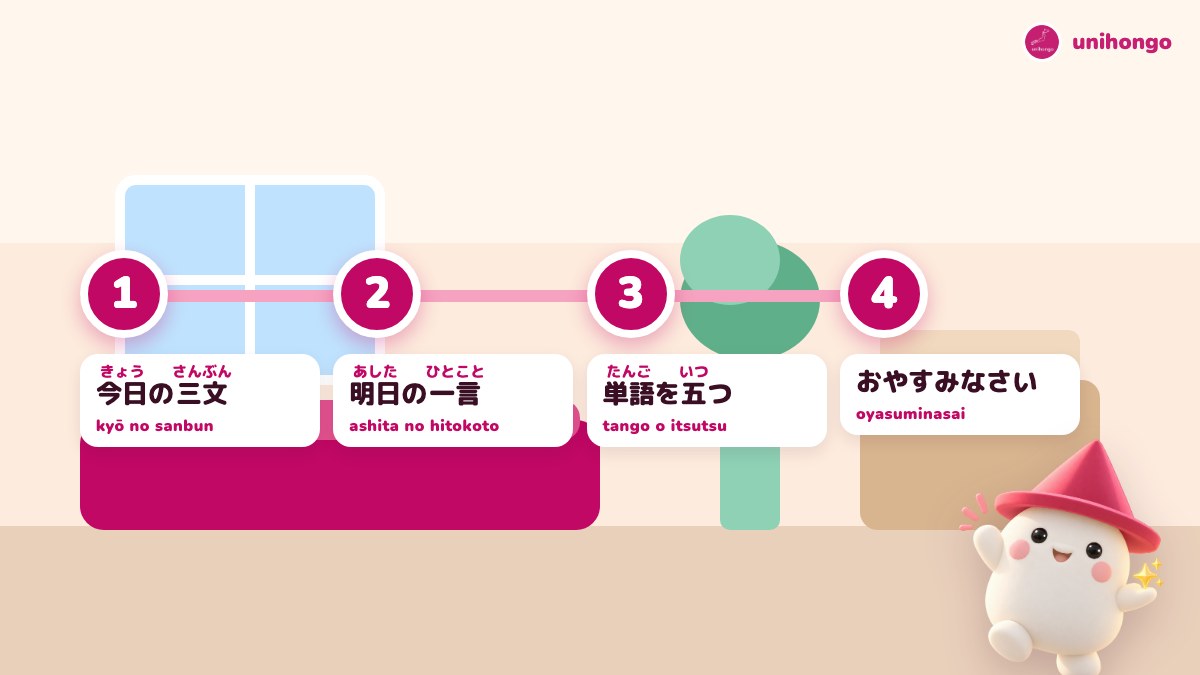
- Minutes 0-1: kyō mo ichinichi otsukaresama, said to yourself or whoever is there.
- Minutes 1-4: three sentences about today, in the past tense, out loud and quietly.
- Minutes 4-5: one sentence about tomorrow, with a time or a place.
- Minutes 5-8: five words from this week, each in a short sentence; note the one that did not come.
- Minutes 8-10: one minute of slow listening if you like, then oyasuminasai and the light off.
The word you could not recall is the most valuable output of the routine. Write it on a sticky note or in a notes app before the light goes off, and it becomes the first thing you review tomorrow at lunch or on the train.
Good night to family, flatmates and friends
If you live with Japanese speakers, the routine ends with a real conversation. Osaki ni, before you, is the key phrase: osaki ni neru ne to a flatmate, osaki ni yasumimasu to a host family. Yukkuri yasunde ne, rest well, is a kind thing to say to someone who has had a long day. Over text, oyasumi with a wavy line or a moon is normal between friends.
| Japanese | Romaji | Meaning |
|---|---|---|
| お先に寝るね。 | Osaki ni neru ne. | I'm going to bed before you. (casual) |
| お先に休みます。 | Osaki ni yasumimasu. | I'll turn in before you. (polite, to a host) |
| ゆっくり休んでね。 | Yukkuri yasunde ne. | Rest well. (casual) |
| また明日。 | Mata ashita. | See you tomorrow. |
| おやすみ〜 | Oyasumi | Night! (text message) |
| おやすみなさい。いい夢を。 | Oyasuminasai. Ii yume o. | Good night. Sweet dreams. |
Ii yume o, literally a good dream, is understood but a little sweet; it is something you say to a child or a partner rather than a flatmate. At work, leaving at night, the phrase is osaki ni shitsurei shimasu, not oyasuminasai, though colleagues who are close do say oyasumi to each other after a late shift.
Listen, do not scroll
If you want audio before sleep, make it slow, familiar and short: a passage you have already read, a dialogue from earlier in the week, a slow podcast episode you have heard once. The aim is recognition, not comprehension of something new. Set a timer so it stops on its own, and keep the screen face down.
Some learners fall asleep to Japanese radio or a drama and feel it helps; others find it keeps them awake or that they remember nothing. Try a week of each and keep what lets you sleep. The routine's spoken part is the part that counts; the listening is a bonus.
| Japanese | Romaji | Meaning |
|---|---|---|
| 寝る前に少し聞きます。 | Neru mae ni sukoshi kikimasu. | I listen a little before bed. |
| ラジオを聞きながら寝ます。 | Rajio o kikinagara nemasu. | I fall asleep listening to the radio. |
| 十分でタイマーをかけます。 | Juppun de taimā o kakemasu. | I set a ten-minute timer. |
Mistakes that spoil a bedtime routine
- Learning new kanji at midnight. Bedtime is for words you met already; new material belongs earlier in the day.
- Tanoshii deshita for it was fun. I-adjectives change themselves: tanoshikatta desu.
- Nemui when you mean tired. Nemui is sleepy; if your body aches after a long day, that is tsukareta.
- Saying oyasuminasai to a boss as you leave the office. That is osaki ni shitsurei shimasu; oyasuminasai is for home.
- Making the routine long. Ten minutes every night beats forty minutes twice a week, and five minutes on a bad night keeps the habit alive.
A study buddy that does not keep you up
Two or three nights a week, give the three sentences to Mocchi, Unihongo's study assistant, with a request such as: correct these gently and keep them short, then ask me one question about tomorrow. Mocchi fixes the past tense, asks its one question and stops, and because it keeps track of the points you keep missing, the morning review it offers next day starts from tonight's mistakes. /review-flashcards is a quiet way to spend the five-word block if you prefer cards to memory.
Keep the voice work for daytime: AI Sensei is better at noon than at midnight. A free account at unihongo.com/login is all it takes to send tonight's three sentences before the light goes off.