
The weekend in four sentences
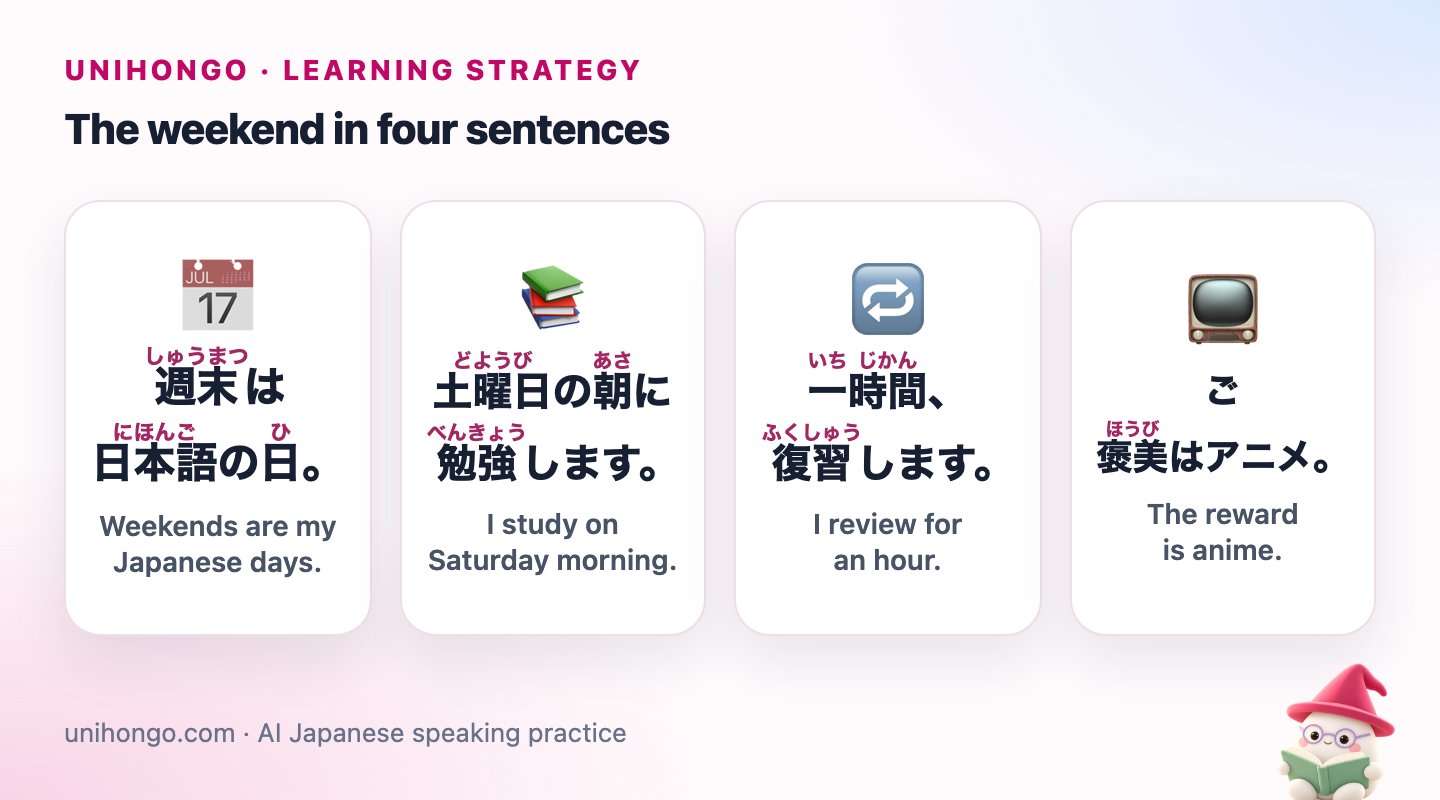
Before the schedule, the sentences you will say about it. Shūmatsu wa Nihongo no hi, weekends are Japanese days, is the kind of plain declaration that helps a habit stick when you say it to other people. The others say when you study, what you do and what you get at the end, and they use the time and duration patterns you need for talking about any routine.
| Japanese | Romaji | Meaning |
|---|---|---|
| 週末は日本語の日。 | Shūmatsu wa Nihongo no hi. | Weekends are my Japanese days. |
| 土曜日の朝に勉強します。 | Doyōbi no asa ni benkyō shimasu. | I study on Saturday morning. |
| 一時間、復習します。 | Ichijikan, fukushū shimasu. | I review for an hour. |
| ご褒美はアニメ。 | Gohōbi wa anime. | The reward is anime. |
Why one weekend block is not enough on its own
The problem with weekend-only study is not effort but forgetting. Whatever you learn on Saturday has six days to fade before you see it again, and most of it will. The fix is small: ten minutes on three or four weekdays, spent only on reviewing Saturday's words and sentences, not on anything new. Those minutes are the thread that keeps the weekend blocks connected.
The second problem is passivity. Two hours is long enough that the second hour tends to drift into watching and reading rather than producing. The order below fixes that by putting speaking in the middle, before the energy runs out and before the reward.
What the weekend is genuinely good for is the things that need a stretch of attention: a new grammar point with your own examples, thirty minutes of speaking, a whole episode in Japanese. Keep those for Saturday, and keep the weekday minutes for maintenance.
The two-hour block, piece by piece
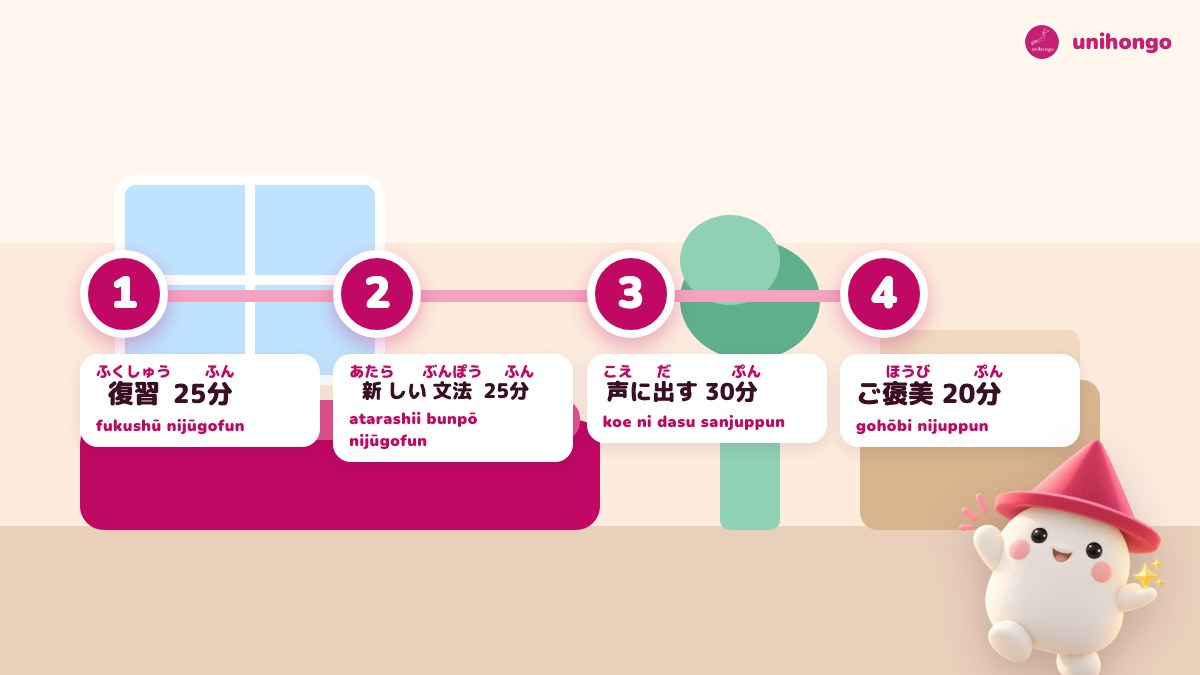
Here is the block. The minutes are a guide; the order is the rule. Put a timer on each part, because the review block in particular always wants to become forty minutes.
| Block | Minutes | What you do | Why here |
|---|---|---|---|
| Review | 25 | Last week's words and sentences, said from memory, then checked | Most likely to be forgotten, quickest to rescue, gets you talking |
| New | 25 | One grammar point or one topic, with four sentences of your own | Fresh attention, and the review has warmed you up |
| Break | 10 | Stand up, water, no phone | Two hours without a break turns passive |
| Speak | 30 | Out loud: your week, a dialogue, a roleplay | Before the fun, or it is the part that gets skipped |
| Enjoy | 20 | An episode, a song, a game, a manga chapter | A reward that is still Japanese |
| Plan | 10 | Write the five weekday reviews and next Saturday's new topic | A plan written now is a plan that happens |
Four sentences of your own in the new block is the number that matters. Reading an explanation feels like learning; writing four sentences you would actually say is learning, and those four sentences become next week's review.
Review: the lines you need in the first block
Review is easier if you do it in Japanese, including the admin. These sentences are what you would say to a teacher during review, and saying them to yourself keeps the block in the language. Daitai wakarimashita, I mostly understood, is honest and useful; oboete imasen, I do not remember, is the sentence that tells you what to review again on Tuesday.
| Japanese | Romaji | Meaning |
|---|---|---|
| 先週、何を勉強しましたか。 | Senshū, nani o benkyō shimashita ka. | What did I study last week? |
| この単語、まだ覚えていません。 | Kono tango, mada oboete imasen. | I haven't memorised this word yet. |
| もう一度、お願いします。 | Mō ichido, onegai shimasu. | Once more, please. |
| だいたい分かりました。 | Daitai wakarimashita. | I mostly understood. |
| これは先週の復習です。 | Kore wa senshū no fukushū desu. | This is last week's review. |
| 三つ間違えました。 | Mittsu machigaemashita. | I got three wrong. |
Speaking: thirty minutes about your own week
The speaking block does not need a partner to start. Describe last week in the past tense and next week in the plain future, then answer the question a Japanese friend would ask on a Monday: shūmatsu wa nani o shimashita ka. The vocabulary is days of the week, busy and free, and the verbs of ordinary life. When you have said it to the wall, say it to a partner or an AI teacher and let them ask follow-up questions.
| Japanese | Romaji | Meaning |
|---|---|---|
| 今週は忙しかったです。 | Konshū wa isogashikatta desu. | This week was busy. |
| 月曜日は残業でした。 | Getsuyōbi wa zangyō deshita. | Monday was overtime. |
| 週末は何をしますか。 | Shūmatsu wa nani o shimasu ka. | Friend: What are you doing at the weekend? |
| 土曜日は日本語を勉強して、日曜日は家でゆっくりします。 | Doyōbi wa Nihongo o benkyō shite, nichiyōbi wa ie de yukkuri shimasu. | You: Saturday I study Japanese, and Sunday I take it easy at home. |
| 来週は暇です。 | Raishū wa hima desu. | Next week I'm free. |
| 来週も頑張ります。 | Raishū mo ganbarimasu. | I'll keep at it next week too. |
The te-form joins the two days into one sentence: benkyō shite, then yukkuri shimasu. It is the single most useful piece of grammar for describing a weekend, because weekends are always two things.
A Saturday morning, start to finish
Here is what the block looks like on a real Saturday, starting at nine with coffee. The review happens before you are fully awake, which is fine, because it is familiar. The new grammar gets the clearest half hour. Speaking happens at ten-thirty, out loud, in a room where nobody minds. The episode at eleven is the reward, and the plan is written before lunch while the week is still in your head.
If Saturday mornings are impossible, Sunday afternoon works, but choose one and keep it. A block that moves around the weekend is a block that gets moved out of it.
Fun that still counts
The last twenty minutes are not a trick; they are part of the routine, and they should be something you would do anyway. An anime episode with Japanese subtitles, a song whose lyrics you look up, a manga chapter, a vocabulary game. The only rule is that it is in Japanese and that it comes after the speaking, not instead of it.
Make the reward a little bit useful by picking one thing from it to bring to next week's review: a line from the episode, a word from the song. That one line is enough; the point of the block is enjoyment, and a reward that becomes homework stops being a reward.
| Japanese | Romaji | Meaning |
|---|---|---|
| ご褒美に一話見ます。 | Gohōbi ni ichiwa mimasu. | As a reward I'll watch one episode. |
| この歌の歌詞を調べます。 | Kono uta no kashi o shirabemasu. | I'll look up this song's lyrics. |
| 今日のセリフはこれ。 | Kyō no serifu wa kore. | Today's line is this one. (casual) |
Keeping it up: the skip rule and the minimum
Every routine gets skipped. The question is what happens next. The skip rule is that a missed weekend costs nothing as long as the next block starts with review as usual; you do not double up, you do not restart, you just review a little longer. The minimum is the thing you do when the weekend is really gone: ten minutes on Sunday night saying the words you got wrong last time, so the chain is bent but not broken.
Japanese has a word for the person who quits after three days: mikka bōzu, the three-day monk, a real and common idiom. Saying mikka bōzu ni naranai yō ni, so that I do not become a three-day monk, is a small joke that Japanese friends will recognise, and a useful thing to say to yourself on the fourth weekend.
| Japanese | Romaji | Meaning |
|---|---|---|
| 今週はサボっちゃった。 | Konshū wa sabocchatta. | I skipped this week. (casual) |
| 来週からまた頑張ります。 | Raishū kara mata ganbarimasu. | From next week I'll get back to it. |
| 三日坊主にならないように。 | Mikka bōzu ni naranai yō ni. | So I don't quit after three days. |
| 続けることが大事です。 | Tsuzukeru koto ga daiji desu. | Keeping going is what matters. |
Saboru, to skip or slack off, is a casual verb everyone uses about study and work; sabocchatta adds the regretful shimau. In a polite setting say yasunde shimaimashita, I ended up taking it off.
Mistakes that break weekend routines
- Starting with new material. Review first, or last week's words are gone by the time you reach them.
- Letting the fun come first. An episode at the start becomes three episodes and no speaking.
- A block with no weekday thread. Ten minutes of review on three weekdays is what makes the two hours hold.
- Reading about grammar instead of writing four sentences. The sentences are the learning.
- Restarting the whole plan after a missed week. Review and continue; the plan was fine.
Hand the plan to a study assistant
Mocchi, Unihongo's study assistant, is built for exactly this shape of week. Type /plan and tell it: two hours on Saturday morning, ten minutes on weekdays, my level and my goal. It builds a 60-day path with small daily tasks that fit that pattern, the weekday tasks are the reviews, and finished tasks tick themselves off; if a weekend disappears, /adjust-plan moves things rather than piling them up. The Saturday speaking block opens AI Sensei from the plan, where Ibuki-sensei can ask about your week and keep asking.
Everything above runs on a free account, and unihongo.com/login takes less time to open than the coffee takes to brew on Saturday.