
Why narrating dinner works
Most speaking practice fails for a simple reason: there is nothing to talk about. In a kitchen there is always something to talk about, and it is in front of you. You do not have to invent a sentence about your hobbies; you describe the onion. The vocabulary is concrete, the actions repeat every evening, and nobody is listening, so you can say the sentence three times until it comes out smoothly.
The second reason is that kitchen Japanese is everywhere in Japan. Recipe sites, packet instructions, the cooking segment of a morning programme, the host at a dinner table explaining what is in the bowl: they all use the same small set of verbs. Learn them while stirring and you will recognise them everywhere else.
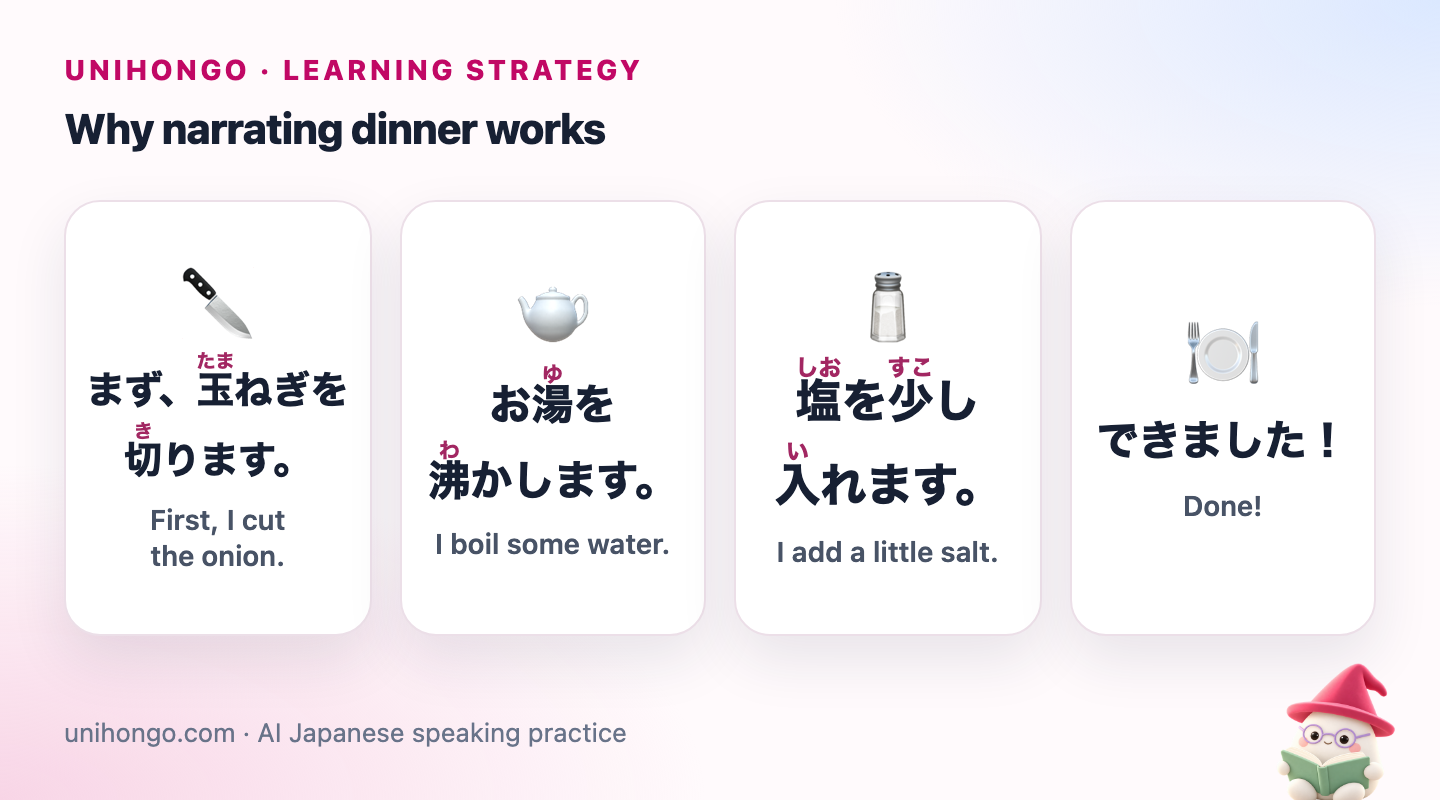
The four sentences below are the skeleton of any cooking narration: an action in order, boiling water, adding seasoning, and announcing the result. Say them tonight even if you only make toast.
| Japanese | Romaji | Meaning |
|---|---|---|
| まず、玉ねぎを切ります。 | Mazu, tamanegi o kirimasu. | First, I cut the onion. |
| お湯を沸かします。 | Oyu o wakashimasu. | I boil some water. |
| 塩を少し入れます。 | Shio o sukoshi iremasu. | I add a little salt. |
| できました! | Dekimashita! | Done! |
The ten verbs that cover most dinners
You do not need the whole vocabulary of a cookbook. Ten verbs describe almost every weekday meal, and they split neatly into preparation verbs (wash, peel, cut, mix) and heat verbs (fry, stir-fry, simmer, boil). Say each one in the masu form while you do the action, with the ingredient and the particle o in front of it.
| Japanese | Romaji | Meaning |
|---|---|---|
| 野菜を洗います。 | Yasai o araimasu. | I wash the vegetables. |
| にんじんの皮をむきます。 | Ninjin no kawa o mukimasu. | I peel the carrot. |
| 肉を炒めます。 | Niku o itamemasu. | I stir-fry the meat. |
| 卵を焼きます。 | Tamago o yakimasu. | I fry an egg. |
| じゃがいもを煮ます。 | Jagaimo o nimasu. | I simmer the potatoes. |
| パスタを茹でます。 | Pasuta o yudemasu. | I boil the pasta. |
| よく混ぜます。 | Yoku mazemasu. | I mix it well. |
| 味見をします。 | Ajimi o shimasu. | I taste it. |
| Verb | What it means | Typical dish |
|---|---|---|
| 焼く yaku | Cook with direct heat: grill, pan-fry, bake | Grilled fish, pancakes, bread |
| 炒める itameru | Stir-fry quickly in a little oil | Fried rice, vegetable stir-fry |
| 揚げる ageru | Deep-fry in plenty of oil | Tempura, karaage |
| 煮る niru | Simmer in seasoned liquid | Nikujaga, stewed pumpkin |
| 茹でる yuderu | Boil food in plain water | Pasta, eggs, spinach |
| 沸かす wakasu | Bring water itself to the boil | Tea, the pot before the pasta |
The heat verbs are the ones learners mix up, because English uses fry and boil for several different things. The table shows how Japanese divides them.
Say it in order: mazu, tsugi ni, saigo ni
A list of verbs becomes a narration when you put order words in front of them. Mazu (first), tsugi ni (next), sorekara (and then) and saigo ni (finally) are exactly what a Japanese recipe or cooking video uses, so your sentences will match what you hear. Cooking rice is a good first sequence because it has four clear steps.
| Japanese | Romaji | Meaning |
|---|---|---|
| まず、米をとぎます。 | Mazu, kome o togimasu. | First, I rinse the rice. |
| 次に、水を入れます。 | Tsugi ni, mizu o iremasu. | Next, I add the water. |
| それから、三十分待ちます。 | Sorekara, sanjuppun machimasu. | Then I wait thirty minutes. |
| 最後に、スイッチを押します。 | Saigo ni, suitchi o oshimasu. | Finally, I press the switch. |
| 音楽を聞きながら料理します。 | Ongaku o kikinagara ryōri shimasu. | I cook while listening to music. |
The last line shows nagara, while doing. It attaches to the masu stem: kiki-nagara, while listening; kiri-nagara, while cutting. It is the natural way to describe multitasking in the kitchen and sounds much better than two separate sentences.
Togu is the special verb for rinsing rice. Arau would be understood, but anyone who cooks Japanese rice will say togu, and the rice packet says it too.
Tasting, judging and fixing
Tasting is where kitchen Japanese turns into real conversation, because these are the sentences a host, a partner or a cooking teacher actually says. Usui means thin or weak in flavour, koi means strong or rich, and chōdo ii means just right. Add sugiru, too much, to any adjective stem to complain about it: karasugiru, too spicy; amasugiru, too sweet.
| Japanese | Romaji | Meaning |
|---|---|---|
| ちょっと薄いですね。 | Chotto usui desu ne. | It's a bit bland. (polite) |
| ちょっと濃いかな。 | Chotto koi ka na. | Maybe a bit strong. (casual) |
| もう少し塩を足します。 | Mō sukoshi shio o tashimasu. | I'll add a little more salt. |
| ちょうどいいです。 | Chōdo ii desu. | It's just right. |
| 辛すぎました。 | Karasugimashita. | It turned out too spicy. |
| 焦げちゃった! | Kogechatta! | It burned! (casual) |
Tasu, to add more, is the verb for adjusting. Shio o tasu, mizu o tasu. The casual kogechatta is a contraction of kogete shimatta, it ended up burning, with the regretful shimau folded in. You will say it more often than you would like.
The fifteen-minute kitchen routine
This routine runs inside the cooking you were going to do anyway. It does not add time; it adds talking. Keep your phone on the counter only for a dictionary, and keep the sentences short, because a long sentence while handling a knife is a bad idea.
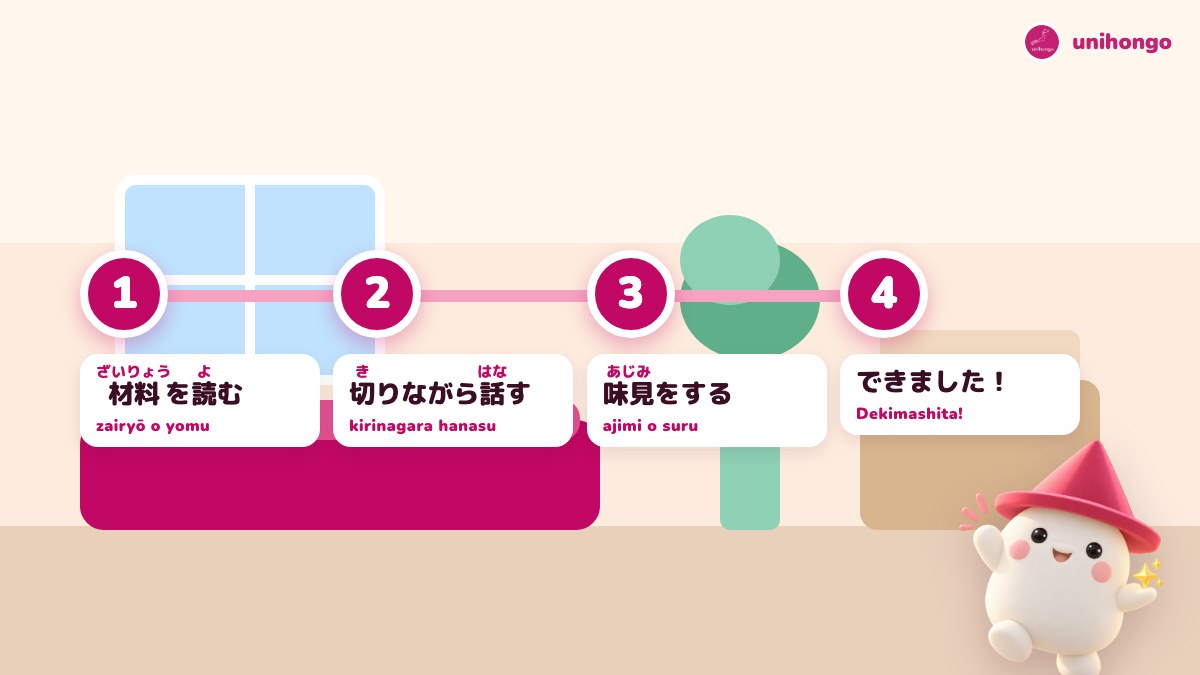
- Minutes 0-2: read the ingredient names aloud in Japanese; look up at most two.
- Minutes 2-10: narrate every action in the masu form as you do it, with mazu, tsugi ni, sorekara.
- Minutes 10-13: taste and say one judgement sentence, then what you will do about it.
- Minutes 13-15: announce the dish (kyō wa karē desu) and say dekimashita.
Three evenings a week is enough. On the other evenings, just say the first and last lines. The point is that the kitchen becomes a place where Japanese happens, not a place where you feel guilty about not studying.
One Japanese dish a week
A Japanese recipe teaches kitchen vocabulary in the order a Japanese cook thinks, which no word list can do. Choose one dish a week, learn its five key words before you start, and narrate it from a Japanese recipe site or video rather than a translation. Miso soup is the ideal first dish: ten minutes, five steps, and you will make it again.
| Japanese | Romaji | Meaning |
|---|---|---|
| 今週は味噌汁を作ります。 | Konshū wa misoshiru o tsukurimasu. | This week I'm making miso soup. |
| だしを取ります。 | Dashi o torimasu. | I make the dashi stock. |
| 豆腐を入れます。 | Tōfu o iremasu. | I add the tofu. |
| 味噌を溶きます。 | Miso o tokimasu. | I dissolve the miso. |
| 火を止めます。 | Hi o tomemasu. | I turn off the heat. |
| 卵焼き | tamagoyaki | rolled omelette (week two) |
| 肉じゃが | nikujaga | meat and potato stew (week three) |
| 親子丼 | oyakodon | chicken and egg rice bowl (week four) |
Dashi o toru, literally to take the stock, is the fixed expression; nobody says dashi o tsukuru in a kitchen. Miso o toku, to dissolve the miso, is another fixed pair. Learning verb and noun together like this is the quickest way to sound like someone who cooks.
Cooking with someone: a short kitchen dialogue
When a friend or partner is in the kitchen, the register drops to casual and the sentences get shorter. This exchange has the four moves you need: offering help, asking for something, asking someone to taste, and judging the result together.
| Japanese | Romaji | Meaning |
|---|---|---|
| 何か手伝おうか? | Nanika tetsudaō ka? | Friend: Shall I help with something? |
| じゃあ、お皿を出してくれる? | Jā, osara o dashite kureru? | You: Then could you get the plates out? |
| いいよ。何枚? | Ii yo. Nanmai? | Friend: Sure. How many? |
| 二枚で。ちょっと味見してみて。 | Nimai de. Chotto ajimi shite mite. | You: Two. Try tasting this. |
| うん、おいしい! | Un, oishii! | Friend: Mm, delicious! |
| もうちょっと塩がいるかな。 | Mō chotto shio ga iru ka na. | You: Maybe it needs a bit more salt. |
With a host family or an older relative, lift the same lines into polite form: tetsudaimashō ka (shall I help?), osara o dashite kuremasen ka (could you get the plates?). The vocabulary does not change, only the endings.
Mistakes that are easy to fix
- Boiling the water with yuderu. Water is wakasu; food is yuderu.
- Using yaku for everything cooked in a pan. Quick stir-frying in oil is itameru; deep-frying is ageru.
- Saying ryōri o ryōri shimasu. Ryōri suru means to cook in general; for a specific dish use tsukuru: karē o tsukurimasu.
- Narrating in long sentences. Keep to noun + o + verb while your hands are busy, then add order words.
- Forgetting to taste out loud. The judgement sentences are the part you will actually use with other people.
Keep the kitchen talking
After a week of narration you will have a handful of sentences you are not sure about: a particle, a verb choice, the tasting line that felt wrong. Paste them into Mocchi, Unihongo's study assistant, with /correct and it will fix them and say why, and because it keeps track of what you keep missing, next week's review will come back to the same point. You can also ask it for the five key words of the dish you plan to cook on Sunday.
For the spoken side, open AI Sensei, choose Hana-sensei and ask Hana-sensei to be a cooking-class teacher: you tell Hana-sensei what you are making step by step, and Hana-sensei asks what comes next and whether it needs more salt. A free account at unihongo.com/login is enough to try both tonight, with dinner on the stove.