

The text: スーパーで (At the supermarket)
Read the text once without the English. Look for three pieces of information: what is for dinner, what the writer does not buy, and why the writer does not need a bag.
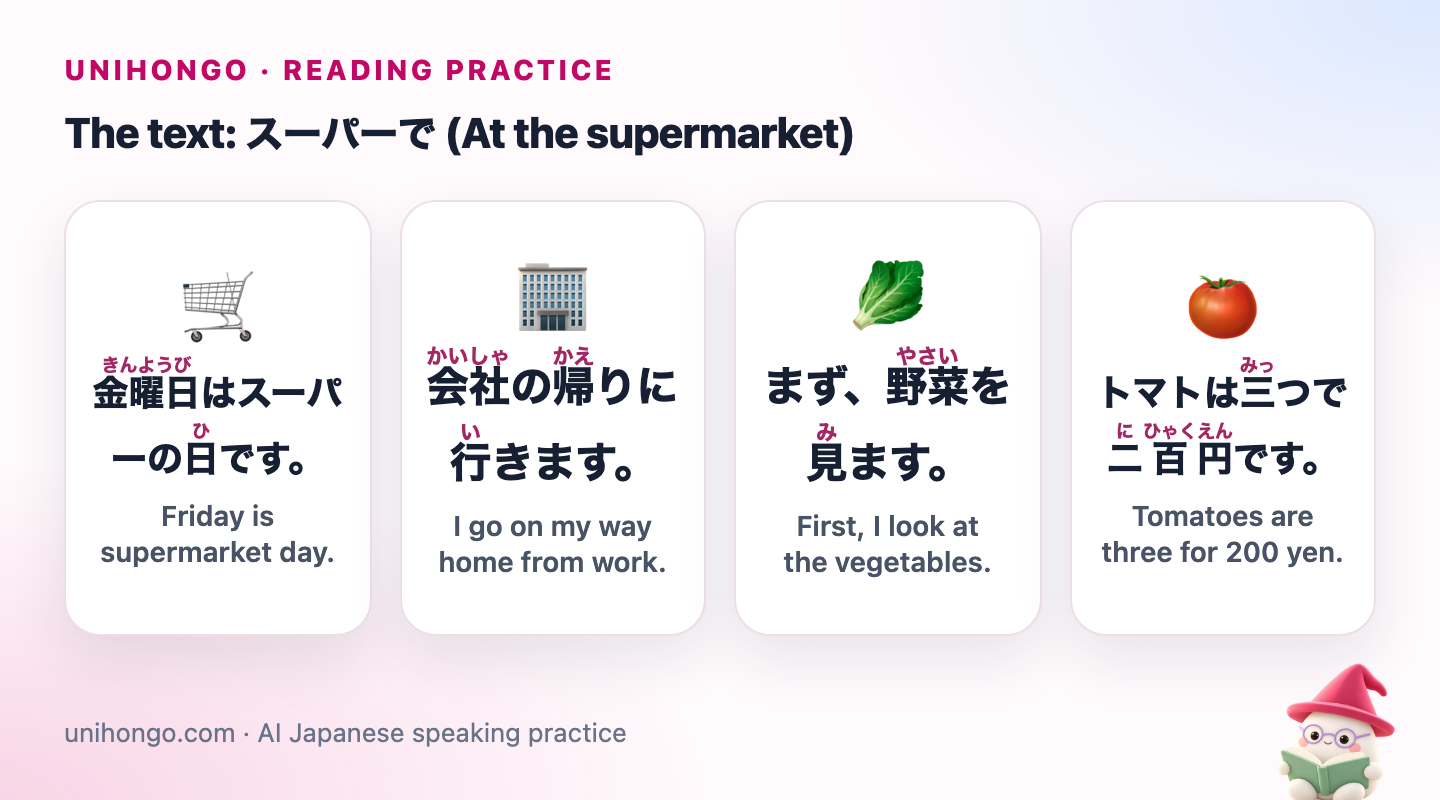
| Japanese | Romaji | Meaning |
|---|---|---|
| 金曜日はスーパーの日です。 | Kin'yōbi wa sūpā no hi desu. | Friday is supermarket day. |
| 会社の帰りに行きます。 | Kaisha no kaeri ni ikimasu. | I go on my way home from work. |
| まず、野菜を見ます。 | Mazu, yasai o mimasu. | First, I look at the vegetables. |
| トマトは三つで二百円です。 | Tomato wa mittsu de nihyaku en desu. | Tomatoes are three for 200 yen. |
| とても安いです。 | Totemo yasui desu. | That's very cheap. |
| 今日の晩ごはんは魚です。 | Kyō no bangohan wa sakana desu. | Tonight's dinner is fish. |
| さけのパックを一つ買います。 | Sake no pakku o hitotsu kaimasu. | I buy one pack of salmon. |
| 牛乳と卵もかごに入れます。 | Gyūnyū to tamago mo kago ni iremasu. | I also put milk and eggs in the basket. |
| お菓子は買いません。 | Okashi wa kaimasen. | I don't buy any sweets. |
| レジの人が「袋はいりますか。」と言います。 | Reji no hito ga 'Fukuro wa irimasu ka.' to iimasu. | The cashier says, 'Do you need a bag?' |
| 私は「いいえ、大丈夫です。」と言います。 | Watashi wa 'Iie, daijōbu desu.' to iimasu. | I say, 'No, I'm fine.' |
| エコバッグを持っていますから。 | Eko baggu o motte imasu kara. | That's because I have a reusable bag. |
| 全部で千二百円です。 | Zenbu de sen nihyaku en desu. | It comes to 1,200 yen in total. |
| 家に帰って、晩ごはんを作ります。 | Ie ni kaette, bangohan o tsukurimasu. | I go home and make dinner. |
Sentence 12 starts with no subject and ends in から, because. Japanese often gives the reason after the main statement, as a separate sentence: I said no. Because I have a bag. You will see this a lot in casual writing and hear it constantly in speech.
Vocabulary notes
The food words here are the ones you see on supermarket signs every day. Learn the item together with how you buy it: a pack, a basket, a bag.
| Japanese | Romaji | Meaning |
|---|---|---|
| スーパー | sūpā | supermarket (short for sūpā māketto) |
| 帰りに | kaeri ni | on the way home |
| 野菜 | yasai | vegetables |
| 晩ごはん | bangohan | dinner, evening meal |
| さけ | sake | salmon (also read shake) |
| 牛乳 | gyūnyū | milk |
| 卵 | tamago | egg |
| かご | kago | shopping basket |
| お菓子 | okashi | sweets, snacks |
| レジ | reji | checkout, cash register |
| 袋 | fukuro | bag |
| 全部で | zenbu de | in total, altogether |
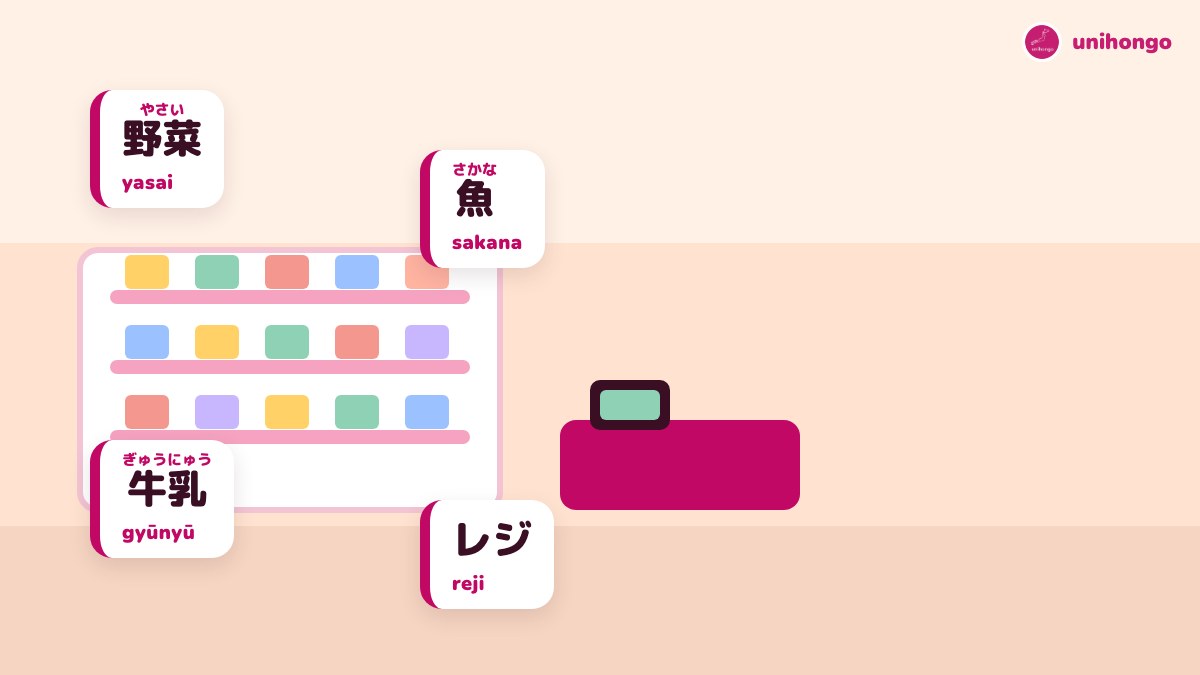
The scene below shows the four places the writer passes through. Labels like these hang from the ceiling in most Japanese supermarkets, so learning to read them saves a lot of wandering. Milk is often labelled 牛乳 on the carton, and the dairy aisle sign may say 乳製品, dairy products, which is above N5 but easy to guess once you know 乳.
Grammar notes: four patterns in the text
Each pattern below is shown with its line from the text and one new example. These four cover most of what you need to talk about shopping at N5.
| Japanese | Romaji | Meaning |
|---|---|---|
| トマトは三つで二百円です。 | Tomato wa mittsu de nihyaku en desu. | で for a total: three for 200 yen. (text) |
| りんごは五つで五百円です。 | Ringo wa itsutsu de gohyaku en desu. | Apples are five for 500 yen. (new example) |
| 牛乳と卵もかごに入れます。 | Gyūnyū to tamago mo kago ni iremasu. | N を/も place に 入れます: put in. (text) |
| パンを袋に入れます。 | Pan o fukuro ni iremasu. | I put the bread in the bag. (new example) |
| お菓子は買いません。 | Okashi wa kaimasen. | は + ません: I don't buy sweets. (text) |
| お肉は食べません。 | Oniku wa tabemasen. | I don't eat meat. (new example) |
| 「いいえ、大丈夫です。」と言います。 | 'Iie, daijōbu desu.' to iimasu. | Quote + と言います: say. (text) |
| 店の人は「ありがとうございます。」と言います。 | Mise no hito wa 'Arigatō gozaimasu.' to iimasu. | The staff say, 'Thank you.' (new example) |
Notice お菓子は買いません rather than お菓子を買いません. Both are correct, but は in a negative sentence adds a contrast: I buy fish, milk and eggs, but sweets, no. This use of は is one of the most natural things you can learn at N5.
In 入れます the thing goes with を and the container goes with に. If you swap them, the sentence means something odd, like putting the basket into the milk.
Comprehension questions
Try to answer each question in Japanese with a short sentence. Then compare with the model answers.
- What is the writer having for dinner tonight?
- Which thing does the writer decide not to buy?
- Why does the writer not need a bag?
| Japanese | Romaji | Meaning |
|---|---|---|
| 魚です。さけです。 | Sakana desu. Sake desu. | Answer 1: Fish. Salmon. |
| お菓子は買いません。 | Okashi wa kaimasen. | Answer 2: Sweets. |
| エコバッグを持っていますから。 | Eko baggu o motte imasu kara. | Answer 3: Because the writer has a reusable bag. |
Question 3 is a typical N5 why question. The answer ends in から, and in a reading test the reason is usually in the sentence just before or just after the event, as it is here.
The checkout exchange, out loud
The text reports the conversation at the till. Here is the same moment as a mini dialogue, with a few lines cashiers often say. Wording differs between shops, so treat these as common examples rather than a script.
| Japanese | Romaji | Meaning |
|---|---|---|
| 袋はいりますか。 | Fukuro wa irimasu ka. | Cashier: Do you need a bag? |
| いいえ、大丈夫です。 | Iie, daijōbu desu. | You: No, I'm fine. |
| 一つお願いします。 | Hitotsu onegai shimasu. | You: One, please. (if you want a bag) |
| ポイントカードはお持ちですか。 | Pointo kādo wa omochi desu ka. | Cashier: Do you have a points card? |
| いいえ、ありません。 | Iie, arimasen. | You: No, I don't. |
| 全部で千二百円です。 | Zenbu de sen nihyaku en desu. | Cashier: That's 1,200 yen altogether. |
A read-aloud routine for this text
- Read the prices slowly first: mittsu de nihyaku en, sen nihyaku en. Prices are where most learners stumble.
- Read the whole text at a slow, even pace, pausing at commas and before と言います.
- Read the two quoted lines in a different voice, as if you were the cashier and then the customer. It makes the quotation pattern easy to hear.
- Read again at a natural speed and time yourself. Aim to finish in under a minute after a few days.
- Close the page and retell the shop trip in five sentences, starting with 金曜日はスーパーの日です.
Watch the long vowels: sūpā has two, gyūnyū has two and daijōbu has one. Shortening them is the most common pronunciation slip in this text, and in gyūnyū it can make the word hard to recognise.
Take the text to the checkout
Reading the dialogue is one thing; answering a cashier who speaks quickly is another. Ask Mocchi, Unihongo's study assistant, to /explain any sentence that still feels slippery, for example the one with と言います, or type /read and ask for a new N5 shopping text with different food so you meet the same patterns again. Mocchi keeps a note of the words you miss and brings them back in later reviews.
Then rehearse the real thing. Open AI Sensei, pick Sakura-sensei and ask Sakura-sensei to play a supermarket cashier who asks about bags and points cards. Retell the story of your shopping trip to her first, then switch to the checkout role-play, and look at the corrections in the session report.