
The four lines every lunch starts with
Before the routine, the sentences. These four cover the question you will hear, the answer you will give, and the two set phrases that frame a Japanese meal. Kyō no ohiru wa nani? is casual, the way a colleague who knows you well would ask; with desu ka on the end it becomes polite. Itadakimasu and gochisōsama deshita have no real English equivalent; they are said at the start and end of eating, and in this routine they double as the bell that starts and ends your Japanese time.
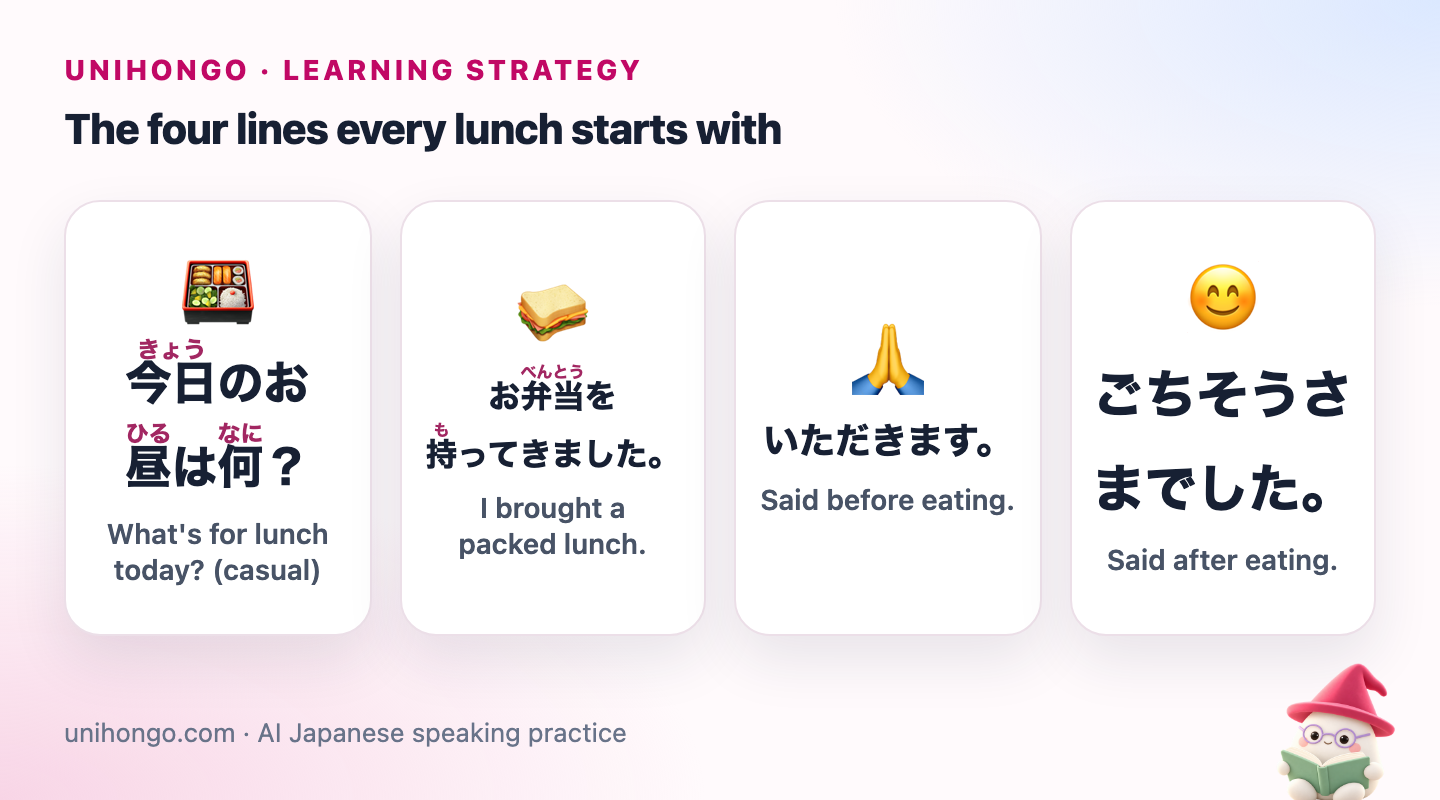
| Japanese | Romaji | Meaning |
|---|---|---|
| 今日のお昼は何? | Kyō no ohiru wa nani? | What's for lunch today? (casual) |
| お弁当を持ってきました。 | Obentō o motte kimashita. | I brought a packed lunch. |
| いただきます。 | Itadakimasu. | Said before eating. |
| ごちそうさまでした。 | Gochisōsama deshita. | Said after eating. |
The twenty-minute template
The template is four blocks of five minutes. The first two happen while you eat; the last two happen after, with the box closed. You can run it at a desk, in a cafeteria or on a bench, and it needs nothing except your lunch and, for the last block, earphones or a notes app.
| Minutes | What you do | Japanese you use |
|---|---|---|
| 0-5 | Name what is in front of you, item by item | Nouns: gohan, sarada, pan, tamago, and the dish name |
| 5-10 | Say three sentences about the lunch | Kyō no ohiru wa X desu; one adjective; one opinion |
| 10-15 | Review yesterday's five words and sentences | Yesterday's diary line, said from memory |
| 15-20 | Listen to something short, or write a one-line diary | Past tense: X deshita, oishikatta desu |
If you eat with colleagues, swap the first two blocks for the conversation in the section below and keep the last two for after you sit back down. The template bends; the end point does not. Always finish with the one-line diary, because it is what you will review tomorrow.
Lunch words you will use every day
Japanese has several words for lunch depending on where it comes from. Obentō is a packed lunch from home or a shop; konbini bentō is the convenience-store version; shashoku is a company cafeteria; teishoku is a set meal at a restaurant; gaishoku is eating out in general. These sentences let you say what kind of lunch today is.
| Japanese | Romaji | Meaning |
|---|---|---|
| 今日は外で食べます。 | Kyō wa soto de tabemasu. | Today I'm eating out. |
| コンビニで買いました。 | Konbini de kaimashita. | I bought it at a convenience store. |
| 自分で作りました。 | Jibun de tsukurimashita. | I made it myself. |
| 社食で食べます。 | Shashoku de tabemasu. | I eat in the company cafeteria. |
| お昼は十二時からです。 | Ohiru wa jūniji kara desu. | Lunch is from twelve. |
| 休憩は一時間です。 | Kyūkei wa ichijikan desu. | The break is one hour. |
| おにぎりとお茶です。 | Onigiri to ocha desu. | Rice balls and tea. |
Three sentences about your lunch
The second block is three sentences: what it is, how it is, what you think. The first uses the topic pattern kyō no ohiru wa X desu. The second is an adjective about quantity, taste or temperature. The third is an opinion, usually with demo (but) or oishii (delicious). Here is the pattern with a boring salad, so you can see that the Japanese does not need an interesting lunch.
| Japanese | Romaji | Meaning |
|---|---|---|
| 今日のお昼はサラダとパンです。 | Kyō no ohiru wa sarada to pan desu. | Today's lunch is salad and bread. |
| ちょっと量が少ないです。 | Chotto ryō ga sukunai desu. | It's a bit small. |
| でも、おいしいです。 | Demo, oishii desu. | But it's good. |
| お腹がすきました。 | Onaka ga sukimashita. | I'm hungry. |
| お腹いっぱいです。 | Onaka ippai desu. | I'm full. |
| ちょっと冷めています。 | Chotto samete imasu. | It's gone a bit cold. |
| 温めてきます。 | Atatamete kimasu. | I'll go and heat it up. |
Onaka ga suita (literally my stomach has emptied) is the normal way to say hungry; the polite past sukimashita is what you say in an office. Samete iru is for food that has gone cold; tsumetai is for food that is meant to be cold. Both come up constantly at lunch.
Talking about lunch with a coworker
In a Japanese office the lunch question is mō tabemashita ka, have you eaten yet, and it is often an invitation in disguise. Answer with mada desu and you have a conversation. This exchange is in the polite form, which is right for a colleague you do not know well; with a close coworker drop to mō tabeta? and mada.
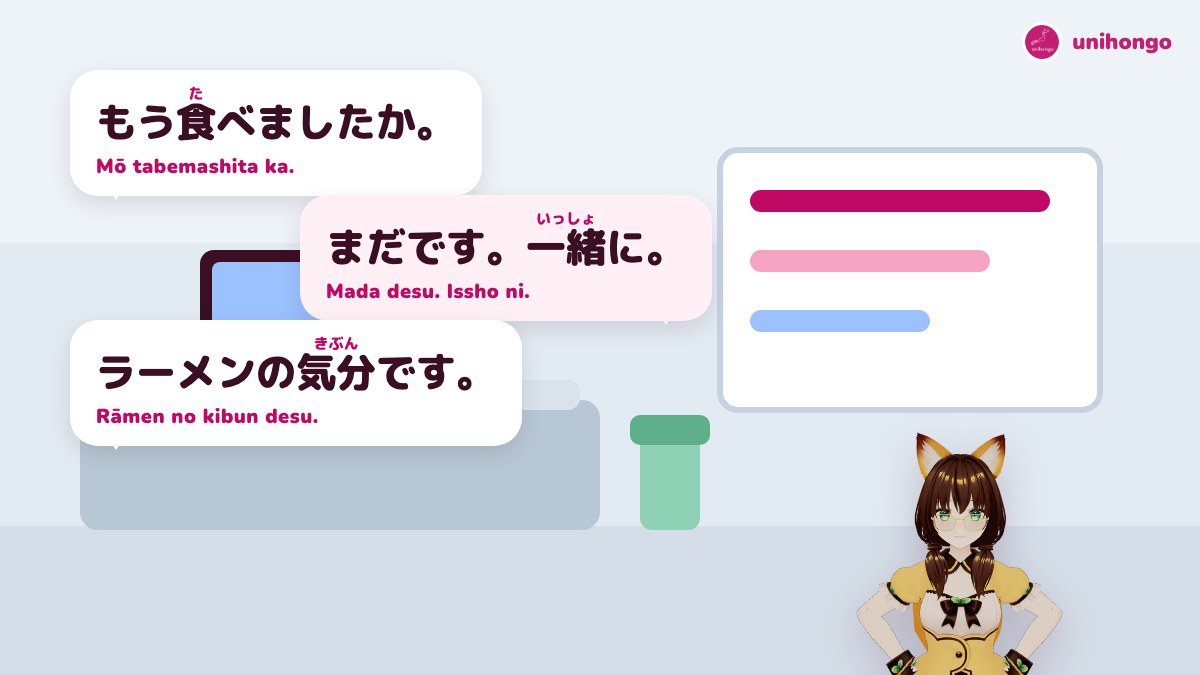
| Japanese | Romaji | Meaning |
|---|---|---|
| お昼、もう食べましたか。 | Ohiru, mō tabemashita ka. | Coworker: Have you had lunch yet? |
| まだです。一緒に行きませんか。 | Mada desu. Issho ni ikimasen ka. | You: Not yet. Shall we go together? |
| いいですね。何にしますか。 | Ii desu ne. Nani ni shimasu ka. | Coworker: Sounds good. What will you have? |
| 今日はラーメンの気分です。 | Kyō wa rāmen no kibun desu. | You: I feel like ramen today. |
| 近くにおいしい店がありますよ。 | Chikaku ni oishii mise ga arimasu yo. | Coworker: There's a good place nearby. |
| じゃあ、そこにしましょう。 | Jā, soko ni shimashō. | You: Let's go there, then. |
X no kibun desu, I feel like X, is the natural way to say what you fancy eating. Nani ni shimasu ka, what will you have, uses ni suru, to decide on, which is also what you say when you order: rāmen ni shimasu.
The five-minute review that makes it stick
The third block is the one people skip, and it is the one that makes the routine work. Say yesterday's diary line from memory, then yesterday's five words. If you cannot remember a word, that is the word for today. Then close with a sentence about the afternoon, because ending in Japanese keeps the habit attached to the break rather than to the food.
| Japanese | Romaji | Meaning |
|---|---|---|
| 今日のお昼はカレーでした。 | Kyō no ohiru wa karē deshita. | Today's lunch was curry. (diary line) |
| おいしかったです。 | Oishikatta desu. | It was good. |
| 午後も頑張ります。 | Gogo mo ganbarimasu. | I'll do my best this afternoon too. |
| 眠くなってきた。 | Nemuku natte kita. | I'm getting sleepy. (casual) |
| コーヒーを買ってきます。 | Kōhī o katte kimasu. | I'll go and buy a coffee. |
When the break shrinks
- Ten minutes: name the food, say one sentence, write the diary line. Skip the review.
- Eating at your desk while working: say the first and last lines only, in your head.
- Eating with colleagues who do not speak Japanese: run the review and diary afterwards, on the way back.
- A bad day: only gochisōsama deshita and the diary line. Two sentences keep the chain unbroken.
- Friday: instead of new sentences, say the five diary lines of the week in a row, as one story.
Mistakes to catch early
- Oishii deshita instead of oishikatta desu for the past tense of an i-adjective.
- Hirugohan o tabemasu ka as an invitation. It is grammatical, but issho ni ikimasen ka (shall we go together?) is what people say.
- Saying ranchi for a packed lunch. Ranchi is a restaurant lunch; a box from home is obentō.
- Studying grammar in the break. Lunch is for producing sentences; keep new grammar for the evening.
- Letting the review block disappear. Without it, the diary lines are written once and never seen again.
Lunch with a study assistant in your pocket
The diary line is more useful when someone reads it. Send it to Mocchi, Unihongo's study assistant, with a request such as: correct this lunch diary line and give me one better adjective for it. Mocchi fixes the sentence, explains the change and, because it keeps track of the points you miss, notices when oishii deshita has turned up for the third time. On a slow day, /vocab lunch gives you five new words to use tomorrow.
For the last five minutes, a round of Vocabulary Dash with your own lunch words is faster than a flashcard app and ends on its own. The whole routine runs on a free account; unihongo.com/login is where it starts, ideally at 12:05 tomorrow.