
Four lines that are always welcome
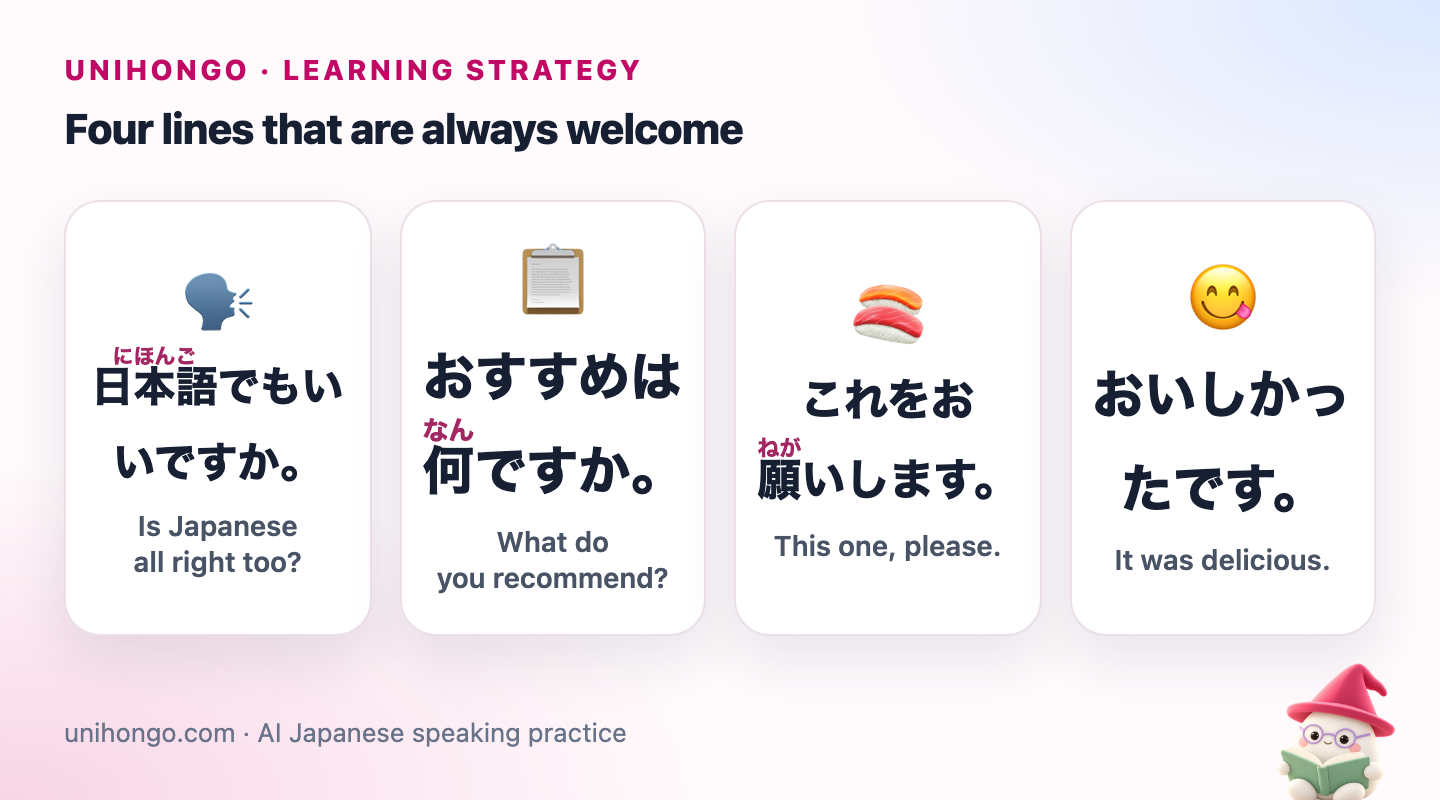
These four are short, polite and easy for staff to respond to in either language, which is what makes them safe. Nihongo de mo ii desu ka asks permission without making a speech. Osusume wa nan desu ka hands the staff a question they answer twenty times a night. Kore o onegai shimasu, with a finger on the menu, works whatever the dish is called. Oishikatta desu is the compliment every kitchen wants to hear and needs no follow-up.
| Japanese | Romaji | Meaning |
|---|---|---|
| 日本語でもいいですか。 | Nihongo de mo ii desu ka. | Is Japanese all right too? |
| おすすめは何ですか。 | Osusume wa nan desu ka. | What do you recommend? |
| これをお願いします。 | Kore o onegai shimasu. | This one, please. |
| おいしかったです。 | Oishikatta desu. | It was delicious. |
When practising is welcome, and when it is not
The restaurant is a workplace first. Whether your Japanese is a pleasure or a nuisance depends almost entirely on timing and on how quickly you take a hint. A quiet Tuesday evening with one table is a good moment; a Friday rush with a queue outside is not, however good your Japanese is. The staff's first reply tells you everything: if they answer in Japanese and smile, carry on; if they answer in the local language, that is the answer, and you switch without comment.
Think about who is working, too. A Japanese owner at the counter of a small place may enjoy the exchange; a student on their first week, who may not speak Japanese at all, does not need to be tested. And a Japanese-speaking waiter is still at work: a few lines, not a conversation, unless they start one.
| Good moment | Leave it |
|---|---|
| A quiet hour with few tables | A rush, a queue, or a waiter moving fast |
| Staff greet you in Japanese | Staff greet you in the local language and keep to it |
| The owner or chef comes to the table | A new or clearly busy server |
| They ask about your Japanese first | You would have to steer the conversation to it |
| Ordering, paying and one compliment | Grammar questions, corrections, or asking them to repeat for practice |
Read the menu before you speak
Most of the Japanese in a restaurant is on the menu, and reading it is practice you can do without anyone's permission. Learn the category words and you can navigate any Japanese menu abroad, where the dish names are usually written in Japanese with a translation beside them. Teishoku is a set meal on a tray; don is a rice bowl with a topping; ippin ryōri are small single dishes; honjitsu no osusume is today's recommendation, and ranchi setto is the lunch deal.
| Japanese | Romaji | Meaning |
|---|---|---|
| 定食 | teishoku | set meal with rice, soup and sides |
| 丼 | don | rice bowl with a topping |
| 一品料理 | ippin ryōri | small single dishes, a la carte |
| 本日のおすすめ | honjitsu no osusume | today's recommendation |
| ランチセット | ranchi setto | lunch set |
| 刺身 | sashimi | sliced raw fish |
| 焼き鳥 | yakitori | grilled chicken skewers |
| 枝豆 | edamame | boiled soybeans in the pod |
| 飲み物 | nomimono | drinks |
| 辛口 / 甘口 | karakuchi / amakuchi | dry / sweet (sake); hot / mild (curry) |
Ordering: a short exchange that covers everything
Here is an order in six lines. The staff lines are the standard polite forms used in any Japanese restaurant, so if you can recognise them here you will recognise them in Tokyo. Hitotsu, one, is the counter you need for most orders; futatsu is two. Ijō de, that is all, closes the order cleanly and stops the waiter waiting for more.
| Japanese | Romaji | Meaning |
|---|---|---|
| ご注文はお決まりですか。 | Gochūmon wa okimari desu ka. | Staff: Are you ready to order? |
| はい。鮭の定食を一つお願いします。 | Hai. Sake no teishoku o hitotsu onegai shimasu. | You: Yes. One salmon set meal, please. |
| お飲み物はいかがですか。 | Onomimono wa ikaga desu ka. | Staff: Anything to drink? |
| お茶をお願いします。 | Ocha o onegai shimasu. | You: Tea, please. |
| 以上でお願いします。 | Ijō de onegai shimasu. | You: That's all, thank you. |
| かしこまりました。 | Kashikomarimashita. | Staff: Certainly. |
| すみません、お水をもらえますか。 | Sumimasen, omizu o moraemasu ka. | You: Excuse me, could I get some water? |
Kashikomarimashita is the very polite I understand that staff use; you do not say it back. If you miss a question, sumimasen, mō ichido onegai shimasu asks for a repeat once; if you miss it twice, switch languages with a smile rather than making them say it a third time.
Small talk, only if it comes to you
If the staff ask about your Japanese, or the owner has a quiet moment and comes over, you have a small conversation on offer. Keep your side to short, true sentences and let them lead. The one topic that always works is the food: ask what they recommend next time, or what a dish is. Avoid asking where someone is from unless they raise it; let them tell you.
| Japanese | Romaji | Meaning |
|---|---|---|
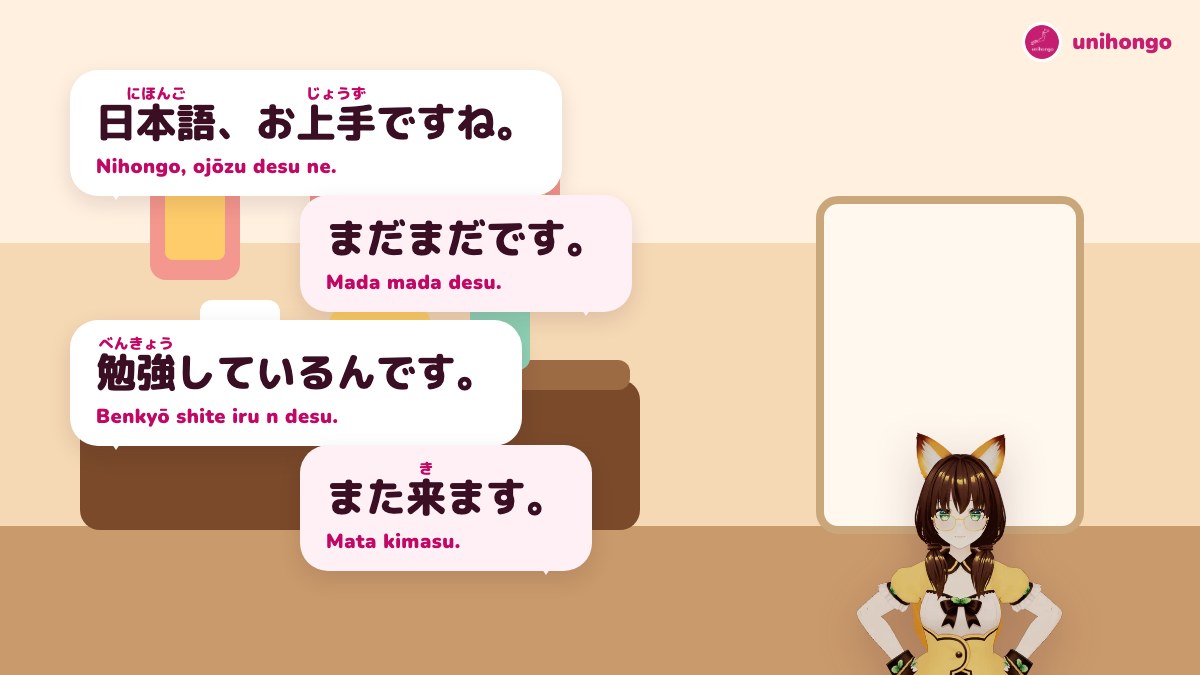
| 日本語、お上手ですね。 | Nihongo, ojōzu desu ne. | Staff: Your Japanese is good. |
| いえいえ、まだまだです。 | Ieie, mada mada desu. | You: Oh no, I've still a long way to go. |
| 日本語を勉強しているんです。 | Nihongo o benkyō shite iru n desu. | You: I'm studying Japanese, you see. |
| 日本に行ったことがありますか。 | Nihon ni itta koto ga arimasu ka. | Staff: Have you been to Japan? |
| 来年、行く予定です。 | Rainen, iku yotei desu. | You: I'm planning to go next year. |
| これは何ですか。 | Kore wa nan desu ka. | You: What is this? |
| また来ます。 | Mata kimasu. | You: I'll come again. |
Mada mada desu is the standard modest reply to a compliment and is expected; a plain arigatō is not wrong, but mada mada desu is what a Japanese speaker would say. N desu on benkyō shite iru n desu adds the explaining tone, as if answering why your Japanese exists at all.
The three-line rule, and paying
A good restaurant visit for a learner is three lines: the permission question, the order, the compliment. Anything more should come from the staff's side. The rule protects them from your enthusiasm, and it protects you from the deflation of being switched to English after a long sentence. If a conversation starts, enjoy it; if it does not, three lines were the practice, and they were real.
Paying is the last chance for a line. Okaikei o onegai shimasu asks for the bill, and in many places abroad you pay at the table rather than at the register as in Japan, so follow local habit. Tipping is a local custom, not a Japanese one: do what you would do at any restaurant in your country.
| Japanese | Romaji | Meaning |
|---|---|---|
| お会計をお願いします。 | Okaikei o onegai shimasu. | The bill, please. |
| カードで払えますか。 | Kādo de haraemasu ka. | Can I pay by card? |
| 別々にできますか。 | Betsubetsu ni dekimasu ka. | Can we pay separately? |
| ごちそうさまでした。 | Gochisōsama deshita. | Thank you for the meal. |
| 英語で大丈夫です。 | Eigo de daijōbu desu. | English is fine. (switching back) |
Eigo de daijōbu desu, or the name of your own language in place of Eigo, is the graceful way to switch back when you have lost the thread: it tells the staff you are fine either way and ends the test for both of you.
Make it a monthly routine
One visit teaches a few lines; a visit a month with a shape teaches a situation. Give each visit a before, a during and an after, and raise the goal by one line each time.
- Before: read the menu online, choose three dishes you can say, and decide the one new line for this visit (a question about the dish, a request for less spice, a second drink).
- During: the permission question, the order, the compliment, the bill, plus the one new line if the moment allows. Nothing else unless they start it.
- After: on the way home, write the exchange as you remember it, including what the staff said, and note the line you did not understand.
- Next time: the line you did not understand is the first thing you prepare.
Mistakes that make it awkward
- Asking Nihongo de mo ii desu ka a second time after a no. Once is a question; twice is pressure.
- Correcting the staff, or asking them to check your grammar. They are working.
- Assuming staff are Japanese, or asking where they are really from.
- Reading a long rehearsed speech. Short lines that leave room for an answer are the point.
- Saying ijō desu with nothing in front of it. Ijō de onegai shimasu, or kore de ijō desu, is the natural close.
- Tipping or not tipping by Japanese rules. You are in your own country; follow its habits.
Rehearse the order before you sit down
The lines go in more easily when you have said them to someone who answers like a waiter. In AI Sensei, ask Yamada-sensei to run a small Japanese restaurant: Yamada-sensei greets you, asks what you will have, offers a drink and brings the bill, and Yamada-sensei's report afterwards lists what you said well and what to fix. Ask him to play a busy waiter once, so you practise switching back gracefully, and a chatty owner once, so you practise the small talk.
Mocchi, Unihongo's study assistant, is where the written half happens: send it the restaurant's menu names and ask for the readings, or paste your remembered exchange and ask what the waiter probably said in the gaps. The free account at unihongo.com/login works on the phone you take to the restaurant, so the rehearsal can happen in the queue.