
The words of the live house
Live music Japanese is mostly katakana with a few kanji words that run the evening. Raibu is a show, and raibu ni iku, to go to a gig, is the verb phrase. The venue is a raibu hausu or, in musicians' slang, a hako, a box. The two times on every poster are kaijō, when the doors open, and kaien, when the music starts; they are usually thirty to sixty minutes apart. Tickets are maeuri, advance, or tōjitsu, same day. Buppan is the merchandise table, ankōru is the encore and setto risuto is the set list.
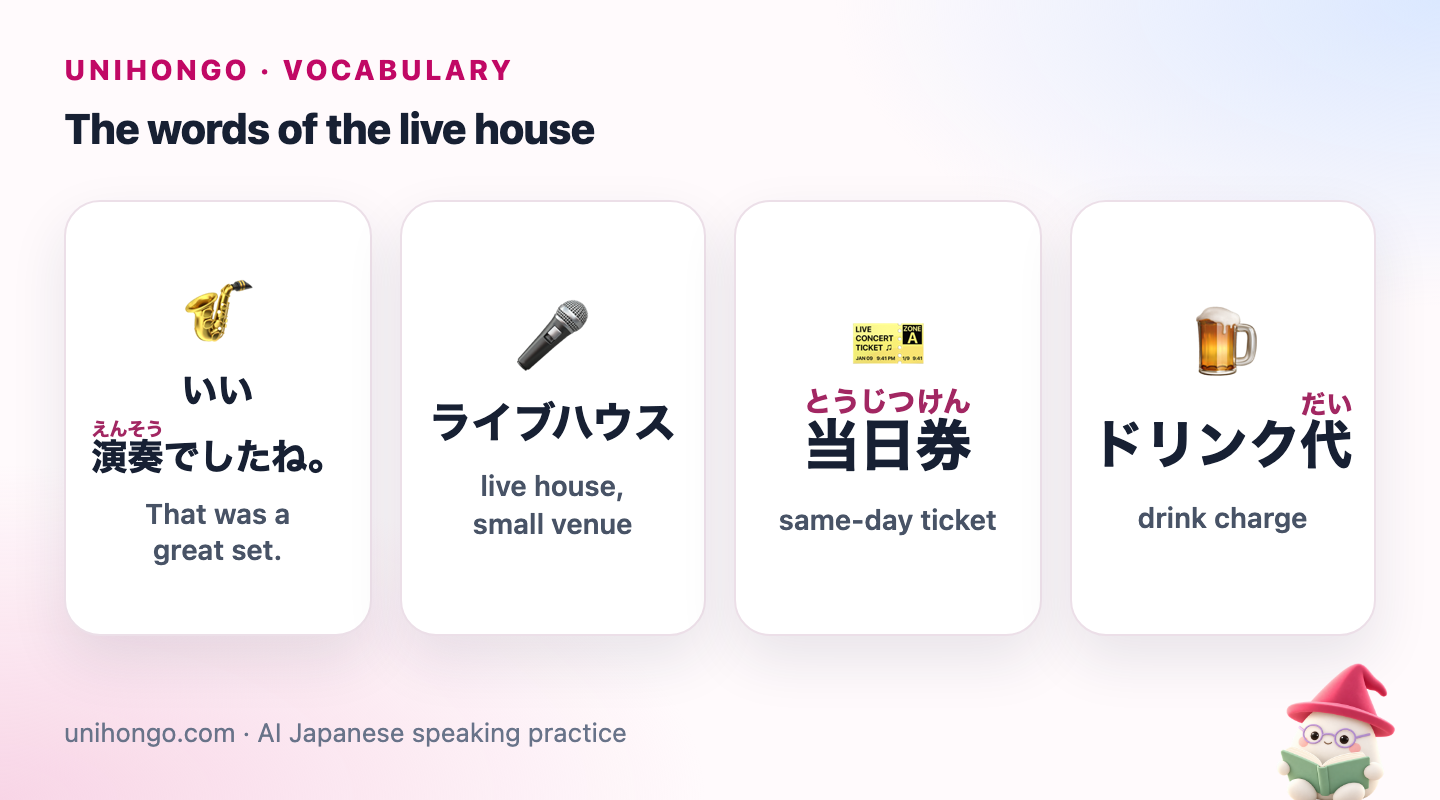
The first card is the sentence you will want after the last tune. The next three are the words you meet at the door.
| Japanese | Romaji | Meaning |
|---|---|---|
| いい演奏でしたね。 | Ii ensō deshita ne. | That was a great set. |
| ライブハウス | raibu hausu | live house, small venue |
| 当日券 | tōjitsuken | same-day ticket |
| ドリンク代 | dorinku dai | drink charge |
| 開場 | kaijō | doors open |
| 開演 | kaien | show starts |
| 前売り | maeuri | advance ticket |
| 物販 | buppan | merchandise table |
| セットリスト | setto risuto | set list |
| アンコール | ankōru | encore |
| ライブに行きます。 | Raibu ni ikimasu. | I'm going to a gig. |
Three rooms, three vocabularies
A jazz fan in Japan moves between three kinds of room, and the manners differ. In a live house you stand or sit, buy a drink with your token and applaud when you like. In a jazz bar the band plays sets while you drink at a table, and there is often a music charge per set. In a jazz kissa you drink coffee, the records are loud and in some old ones talking is discouraged; customs vary by shop and by era, so read the sign at the door. The table keeps the words apart.
| Japanese | Romaji | Meaning |
|---|---|---|
| チャージはいくらですか。 | Chāji wa ikura desu ka. | How much is the cover charge? |
| ミュージックチャージ | myūjikku chāji | music charge, per set in a jazz bar |
| おしゃべりはご遠慮ください。 | Oshaberi wa goenryo kudasai. | Sign: Please refrain from talking. |
| 今日の出演は誰ですか。 | Kyō no shutsuen wa dare desu ka. | Who's playing today? |
| Room | What you pay | The manner |
|---|---|---|
| ライブハウス raibu hausu | ticket plus a drink charge | stand or sit, applaud freely |
| ジャズバー jazu bā | a music charge per set plus drinks | table service, quiet talk between tunes |
| ジャズ喫茶 jazu kissa | a coffee | listen to records; some ask for silence |
| ジャズフェス jazu fesu | a festival pass | outdoors, several stages, loud is fine |
Goenryo kudasai, please refrain, is the polite sign language for a rule. In a jazz kissa it can cover talking, phone calls and photographs; a quick look at the other customers tells you how strictly it is meant.
At the door: ticket, drink charge, entry order
The door exchange has a fixed shape. You say whether you have an advance ticket or want a same-day one, give the number of people, pay the drink charge and get a token. Advance tickets carry a seiri bangō, an entry number, and the staff call numbers in order before letting same-day buyers in. None of this needs a full sentence from you; the staff do the talking, and you answer with a number and hai.
Register note: door staff use polite shop forms, and you answer in plain polite forms. Hitori desu and Maeuri de yoyaku shite imasu are enough; a sumimasen to get attention and an onegai shimasu after a request cover everything else.
| Japanese | Romaji | Meaning |
|---|---|---|
| 当日券はありますか。 | Tōjitsuken wa arimasu ka. | You: Do you have same-day tickets? |
| 前売りで予約しています。 | Maeuri de yoyaku shite imasu. | You: I have an advance reservation. |
| 一人です。 | Hitori desu. | You: One person. |
| ドリンク代は別になります。 | Dorinku dai wa betsu ni narimasu. | Staff: The drink charge is separate. |
| ワンドリンク制です。 | Wan dorinku sei desu. | Staff: It's a one-drink system. |
| 整理番号順にご入場ください。 | Seiri bangō jun ni gonyūjō kudasai. | Staff: Please enter in order of your entry number. |
| こちらのコインをバーでお使いください。 | Kochira no koin o bā de otsukai kudasai. | Staff: Use this token at the bar. |
| 完売 | kanbai | Sign: sold out |
Reading the schedule
Venue schedules, in print and online, are dense but formulaic. The date is followed by the act, then kaijō and kaien times, then prices labelled maeuri and tōjitsu, then a note about the drink charge. Taiban means several bands share the bill, common in rock live houses and less so in jazz clubs. Shutsuen is an appearance, so shutsuensha are the performers. A jazz bar lists sets as fāsuto setto and sekando setto, with their own start times. Reading one schedule a day is a cheap and very practical reading habit.
| Japanese | Romaji | Meaning |
|---|---|---|
| 開場十八時、開演十九時 | kaijō jūhachiji, kaien jūkuji | Schedule: doors 18:00, show 19:00 |
| 前売り・当日 | maeuri, tōjitsu | Schedule: advance and same-day prices |
| 別途ドリンク代 | betto dorinku dai | Schedule: drink charge extra |
| 対バン | taiban | shared bill, several bands |
| 出演者 | shutsuensha | performers |
| ファーストセットは二十時からです。 | Fāsuto setto wa nijūji kara desu. | The first set starts at eight. |
| 予約はメールで受け付けています。 | Yoyaku wa mēru de uketsukete imasu. | Reservations are taken by email. |
Betto, separately, is the written cousin of betsu ni. When you see betto dorinku dai on a schedule, add the drink charge to the ticket price in your head before you decide.
During the set: what you hear and what you do
Jazz etiquette in Japan is close to what you know: applause after a solo is normal in most clubs, though some quieter rooms applaud only at the end of a tune, so watch the regulars for the first number. Between tunes the leader does the MC, pronounced emushī, which is the talk: introducing the band, naming the tune, thanking the room. At the end you may hear Ankōru! from the crowd; in a small club a single enthusiastic Mō ikkyoku, one more, from a regular can be enough.
| Japanese | Romaji | Meaning |
|---|---|---|
| 次の曲は、スタンダードから。 | Tsugi no kyoku wa, sutandādo kara. | Leader: The next tune is a standard. |
| メンバー紹介をします。 | Menbā shōkai o shimasu. | Leader: Let me introduce the band. |
| ベース、田中さん。 | Bēsu, Tanaka-san. | Leader: On bass, Tanaka. |
| 最後の曲です。 | Saigo no kyoku desu. | Leader: This is the last tune. |
| アンコール! | Ankōru! | Crowd: Encore! |
| もう一曲! | Mō ikkyoku! | Regular: One more! (casual) |
| 休憩を挟みます。 | Kyūkei o hasamimasu. | Leader: We'll take a break. |
After the show: talking with the band
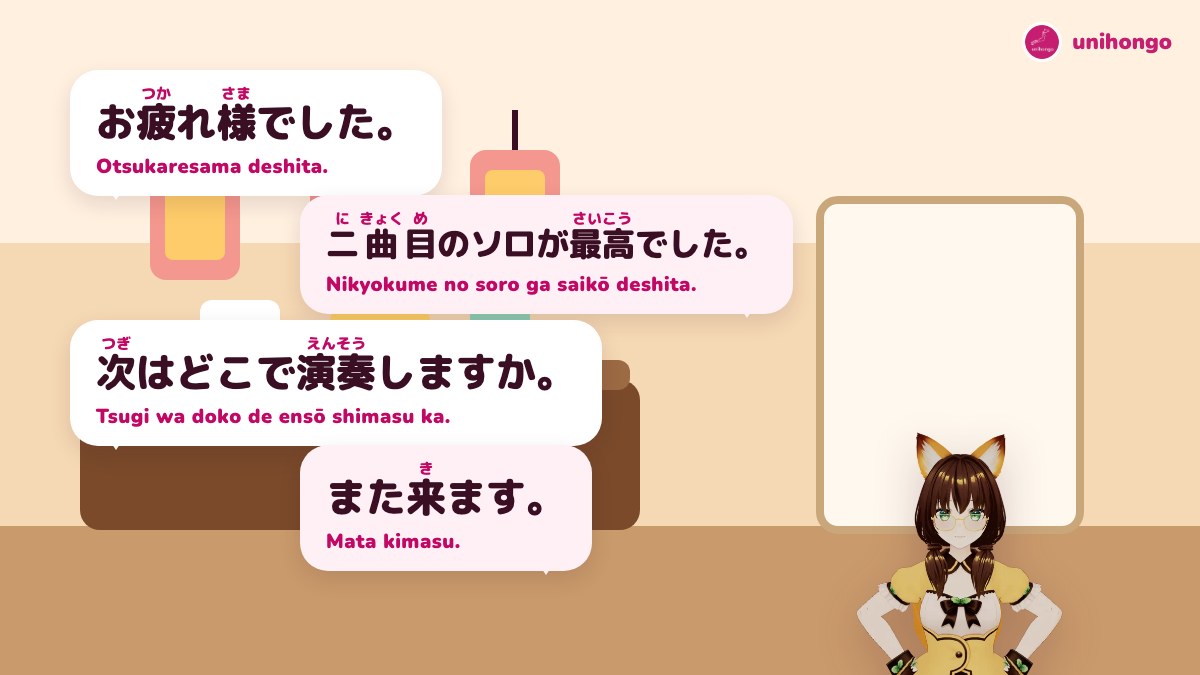
The real language practice happens at the merchandise table or the bar, where musicians in small clubs sell CDs and talk to whoever stops. Open with Otsukaresama deshita, which thanks them for the work and is what Japanese fans say first; then say something specific. Keep the questions simple and let them answer; musicians are used to talking about their instruments and their schedule, and most will slow down for a foreign fan.
| Japanese | Romaji | Meaning |
|---|---|---|
| お疲れ様でした。いい演奏でした。 | Otsukaresama deshita. Ii ensō deshita. | You: Thank you for the show. It was a great set. |
| ありがとうございます。どちらから? | Arigatō gozaimasu. Dochira kara? | Bassist: Thank you. Where are you from? |
| カナダからです。二曲目のソロが最高でした。 | Kanada kara desu. Nikyokume no soro ga saikō deshita. | You: Canada. Your solo on the second tune was superb. |
| あれはオリジナルなんです。 | Are wa orijinaru nan desu. | Bassist: That one's an original. |
| 次はどこで演奏しますか。 | Tsugi wa doko de ensō shimasu ka. | You: Where do you play next? |
| 来週、新宿のライブハウスです。 | Raishū, Shinjuku no raibu hausu desu. | Bassist: Next week, a live house in Shinjuku. |
| CDを一枚ください。また来ます。 | Shīdī o ichimai kudasai. Mata kimasu. | You: One CD, please. I'll come again. |
Nan desu after a noun, as in orijinaru nan desu, adds a note of explanation: it's actually an original. Musicians use it constantly when telling you about a tune, and you can use it back: Jazu ga suki nan desu, the thing is, I love jazz.
Describing a performance
Fans in Japan describe music with a small set of words, and they are worth learning because they are what you will hear at the bar and read in reviews. Ensō is the performance, oto the sound, gurūvu the groove, and nori, from noru, to ride, the feel of a tune that carries the room. Kakkoii, cool, is the most common praise for an instrumentalist; sugoi is the all-purpose one. For the sound of the room, oto ga ii, the sound is good, is a compliment to the venue.
| Japanese | Romaji | Meaning |
|---|---|---|
| ピアノのソロにしびれました。 | Piano no soro ni shibiremashita. | The piano solo gave me chills. |
| 最後の曲で盛り上がりましたね。 | Saigo no kyoku de moriagarimashita ne. | The room really came alive on the last tune. |
| この箱は音がいいですね。 | Kono hako wa oto ga ii desu ne. | This venue sounds great. (fan slang) |
| やっぱり生で聴くと違います。 | Yappari nama de kiku to chigaimasu. | Hearing it live is just different. |
| ドラムのノリがよかった。 | Doramu no nori ga yokatta. | The drummer's feel was great. (casual) |
| Word | Reading | Use it for |
|---|---|---|
| 演奏 | ensō | the performance itself |
| ノリがいい | nori ga ii | a tune or band with a great feel |
| グルーヴ | gurūvu | groove, said as in English |
| かっこいい | kakkoii | a cool solo or player |
| しびれる | shibireru | to be thrilled, literally to go numb |
| 盛り上がる | moriagaru | the room gets lively |
| 音がいい | oto ga ii | the venue's sound is good |
| 生で聴く | nama de kiku | to hear it live |
Mistakes and register notes
- Konsāto for a club gig. Konsāto is a hall concert with seats; a club show is a raibu. Raibu ni itta, I went to a gig, is what a fan says.
- Arguing about the drink charge. It is standard and staff cannot waive it; Hai, onegai shimasu and the token is yours.
- Jōzu desu ne to a professional. Jōzu is praise for a learner's skill and can sound patronising to a working musician. Say Kakkoyokatta desu or Ii ensō deshita instead.
- Talking through a quiet tune in a jazz bar. Between tunes is fine; during a ballad, regulars go silent. Follow the room.
- Hako in front of the staff. Hako, box, is musicians' slang for a venue; it is friendly with a band and odd with the ticket desk, where raibu hausu or omise is better.
- Mō ikkyoku shouted alone in a hall. In a small club it is charming; in a seated concert hall, applause does the asking.
Make your gig calendar a study plan
A music fan has something most learners lack: dates. Every show on your calendar is a deadline, and the vocabulary between now and then is small. Read the venue's schedule for the show, rehearse the door exchange, go, and afterwards tell someone in Japanese what you heard.
Mocchi, the study assistant on Unihongo, is a good place for the last step. After the show, type /kaiwa and say you want to talk about a jazz gig you just saw; Mocchi suggests the conversation and sends you to AI Sensei, where you can pick Ibuki-sensei and ask Ibuki-sensei to play a fellow fan at the bar who asks which tune you liked and why. He uses what Mocchi has noted about your level, so the questions stay answerable, and the session report lists the words you reached for and missed. You can start before the next show with a free account at unihongo.com/login, which takes less time than finding the venue.