
The words of the field
Birding Japanese divides into the bird, the gear and the ground. The bird is a yachō in guides and a tori in conversation; a flock is a mure, a chick a hina, a nest a su. Male and female are osu and mesu, and plumage changes are natsubane and fuyubane, summer and winter plumage. The gear is sōgankyō, binoculars; bōen renzu, a long lens; and zukan, the field guide. The ground is where the word choice matters: mizube is any waterside, higata a tidal flat, kasenjiki the open land along a river, and hayashi or mori the woods.
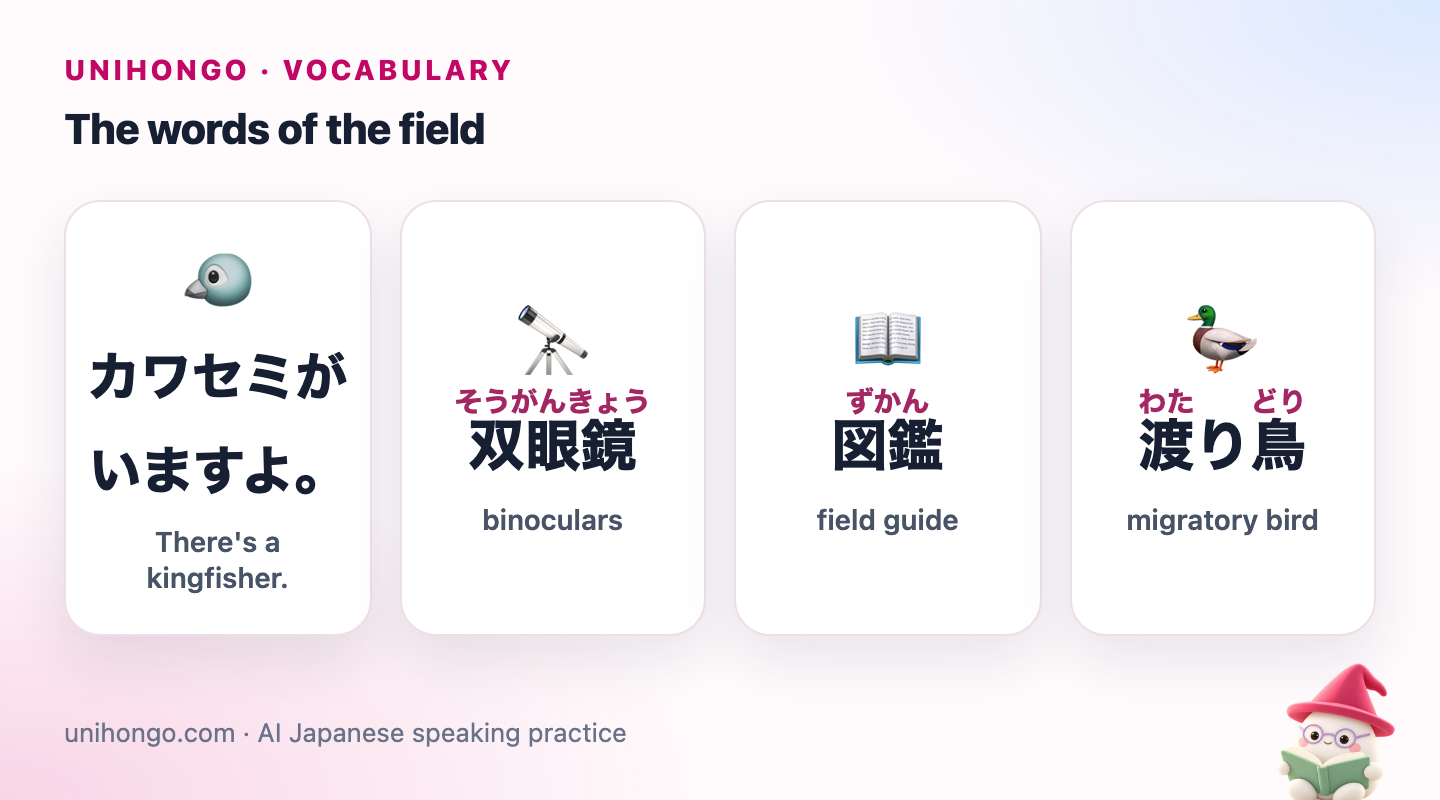
The first card is the sentence a local will say to you on your first walk. The next three are the three things in your bag and in the sky.
| Japanese | Romaji | Meaning |
|---|---|---|
| カワセミがいますよ。 | Kawasemi ga imasu yo. | There's a kingfisher. |
| 双眼鏡 | sōgankyō | binoculars |
| 図鑑 | zukan | field guide |
| 渡り鳥 | wataridori | migratory bird |
| 野鳥 | yachō | wild bird |
| 群れ | mure | a flock |
| 巣 | su | nest |
| ヒナ | hina | chick |
| 干潟 | higata | tidal flat |
| 河川敷 | kasenjiki | riverside open land |
| 鳥見に行きます。 | Torimi ni ikimasu. | I'm going birding. (birders' word) |
Resident, migrant and the seasonal words
Every field guide entry gives a bird's status in one word, and the words organise the whole year of birding. Ryūchō stay all year. Natsudori arrive in spring to breed; fuyudori arrive in autumn to winter; tabidori only pass through on migration. Hyōchō is a bird that moves short distances within Japan with the seasons, between the hills and the lowlands; a meichō is a vagrant blown off course, and a chinchō is any rarity that brings birders from far away. Shonin, first confirmation, is the word birders use for the first sighting of a migrant each season, and it fills club newsletters in April and October.
| Japanese | Romaji | Meaning |
|---|---|---|
| ツバメは夏鳥です。 | Tsubame wa natsudori desu. | Swallows are summer visitors. |
| 今年のジョウビタキの初認です。 | Kotoshi no jōbitaki no shonin desu. | First daurian redstart of the year. |
| この鳥はこの辺にいつもいますか。 | Kono tori wa kono hen ni itsumo imasu ka. | Is this bird always around here? |
| 冬に渡ってきます。 | Fuyu ni watatte kimasu. | Local: They migrate here in winter. |
| 私にはライファーです。 | Watashi ni wa raifā desu. | That's a lifer for me. |
| Word | Reading | Meaning |
|---|---|---|
| 留鳥 | ryūchō | resident, present all year |
| 渡り鳥 | wataridori | migrant, general word |
| 夏鳥 | natsudori | summer visitor, comes to breed |
| 冬鳥 | fuyudori | winter visitor |
| 旅鳥 | tabidori | passage migrant |
| 珍鳥 | chinchō | rarity |
| 初認 | shonin | first sighting of the season |
| ライファー | raifā | a lifer, your first ever |
Wataru, to cross over, is the verb behind wataridori, and watatte kuru, to migrate here, is how locals describe the arrival. Watatte iku is the departure.
Reading a field guide entry
A Japanese zukan is laid out like any good field guide, and once you know eight labels you can read the whole thing. Zenchō is the total length in centimetres. Bunpu is distribution, often shown on a small map of Japan. Seisoku kankyō is habitat. Jiki is the season, and the status word sits beside it. Nakigoe is the voice, split into saezuri, song, and jinaki, calls, with the sound written in katakana. Tokuchō is the key identification feature and nita shu are similar species, the part worth reading twice.
| Japanese | Romaji | Meaning |
|---|---|---|
| 全長 | zenchō | Guide: total length |
| 分布 | bunpu | Guide: distribution |
| 生息環境 | seisoku kankyō | Guide: habitat |
| 鳴き声 | nakigoe | Guide: voice |
| さえずり | saezuri | song |
| 地鳴き | jinaki | call |
| 特徴 | tokuchō | Guide: key features |
| 似た種 | nita shu | Guide: similar species |
| 全長十七センチ。水辺に生息する。 | Zenchō jūnana senchi. Mizube ni seisoku suru. | Guide: Length 17 cm. Lives by water. |
Pointing out a bird
Getting another person onto a bird is a language skill in any country, and Japanese birders use the same tricks: clock positions, landmarks and height. Jūji no hōkō is the ten o'clock direction; temae is nearer, oku is further; teppen is the top of the tree, and ne is the roots. Hikui eda and takai eda are low and high branches. The question Doko desu ka starts it, and the reply Miemashita, I've got it, ends it. Keep your voice low: hisohiso goe, a whisper, is the register of the whole walk.
| Japanese | Romaji | Meaning |
|---|---|---|
| どこですか。 | Doko desu ka. | You: Where is it? |
| 十時の方向、手前の木です。 | Jūji no hōkō, temae no ki desu. | Local: Ten o'clock, the nearer tree. |
| てっぺんの枝にとまっています。 | Teppen no eda ni tomatte imasu. | Local: It's perched on the topmost branch. |
| 見えました! | Miemashita! | You: Got it! |
| まだ見えません。 | Mada miemasen. | You: I can't see it yet. |
| 今、飛びました。 | Ima, tobimashita. | Local: It just flew. |
| 二羽います。 | Niwa imasu. | Local: There are two. |
Tomaru, to perch, is the verb for a bird on a branch, the same verb as to stop. Count birds with wa: ichiwa, niwa, sanwa, with sanba also heard; for big flocks people just say takusan.
A walk with a local birder
The moment that makes birding social is a stranger showing you a bird. In Japan it often starts with a quiet Imasu yo, there's one, from someone already looking. Say thank you, ask where, and when you find it say something about it. If it is your first, say so; Hajimete mimashita is the line that turns a stranger into a companion for the next hundred metres. The kingfisher dialogue below is the one you will have on almost any Japanese river path.
| Japanese | Romaji | Meaning |
|---|---|---|
| あそこの枝にカワセミがいますよ。 | Asoko no eda ni kawasemi ga imasu yo. | Local: There's a kingfisher on that branch. |
| どこですか。 | Doko desu ka. | You: Where? |
| 右の低い枝、水面の近くです。 | Migi no hikui eda, suimen no chikaku desu. | Local: The low branch on the right, near the water. |
| あ、見えました!きれいですね。 | A, miemashita! Kirei desu ne. | You: Ah, got it! Beautiful. |
| この川では一年中見られますよ。 | Kono kawa de wa ichinenjū miraremasu yo. | Local: You can see them here all year. |
| 初めて見ました。ライファーです。 | Hajimete mimashita. Raifā desu. | You: My first ever. A lifer. |
| よかったですね。今、魚をくわえています。 | Yokatta desu ne. Ima, sakana o kuwaete imasu. | Local: Lucky you. It's holding a fish now. |
Joining a Japanese bird walk
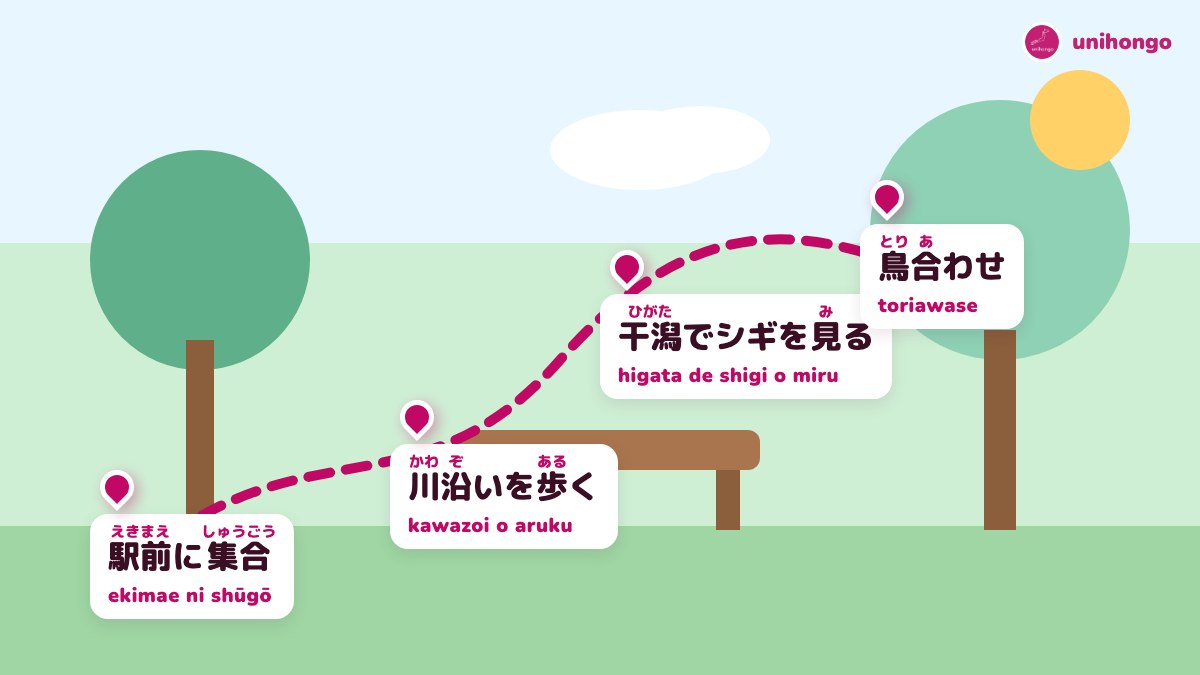
A tanchōkai, organised by a local branch of the Wild Bird Society or a town club, is the easiest way to bird with locals. Most meet at a station or park gate at a set time, walk a fixed route for two or three hours, and end with a toriawase, the tally, when the leader reads out every species seen and the group answers with what they saw. Visitors are usually welcome; some walks ask for a small fee and some for advance notice, so check the branch page. The register is polite throughout, and the leader is addressed as rīdā or by name with san.
| Japanese | Romaji | Meaning |
|---|---|---|
| 参加してもいいですか。 | Sanka shite mo ii desu ka. | You: May I join? |
| 初めてです。よろしくお願いします。 | Hajimete desu. Yoroshiku onegai shimasu. | You: It's my first time. Please look after me. |
| 今日のコースは川沿いです。 | Kyō no kōsu wa kawazoi desu. | Leader: Today's route is along the river. |
| 最後に鳥合わせをします。 | Saigo ni toriawase o shimasu. | Leader: We'll do the tally at the end. |
| 何種類見ましたか。 | Nanshurui mimashita ka. | Leader: How many species did you see? |
| 二十種類くらいです。 | Nijisshurui kurai desu. | You: About twenty. |
| お世話になりました。 | Osewa ni narimashita. | You: Thank you for looking after me today. |
Shurui, kinds, is the counter for species on a tally: nanshurui, how many species. Osewa ni narimashita at the end thanks the leader for the whole morning and is the phrase that gets you invited back.
Mistakes and register notes
- Aru for a bird. Tori ga arimasu describes a picture of a bird; the living bird is imasu.
- Hiki for birds. Birds take the counter wa: ichiwa, niwa, sanwa. Hiki is for mammals and insects, and birders notice.
- Loud voices on the path. Japanese bird walks are quiet affairs; speak at the volume the leader uses, which is usually lower than you expect.
- Saezuri for every sound. Saezuri is song, typically in the breeding season; the short winter contact calls are jinaki. Guides separate them, and so do birders.
- Playing calls from your phone. Many clubs ask you not to, and some reserves forbid it; ask before you play anything.
- Approaching a nest for a photo. Su ni chikazukanai, do not approach nests, is the one rule every club states; the kingfisher you walk up to is the kingfisher that leaves.
A birder's study routine
Birding gives you a notebook, a weekly walk and a list that grows, which is a study plan in disguise. Write the day's list in Japanese, say it aloud, and add one sentence per bird: where it was and what it was doing.
If you want a reading habit to go with the walks, sign in to Unihongo and tell Mocchi, the study assistant, that you bird; it keeps notes about your interests, so when you type /read it can write a short passage about a kingfisher or a winter duck at your level rather than a generic one, and explain the field words you ask about. For the spoken side, AI Sensei can play the local on the path: choose Hana-sensei, ask Hana-sensei to be a birder who has just found something, and get yourself onto the bird from Hana-sensei's directions, then tell Hana-sensei it is a lifer. The session report afterwards lists the direction words you missed. The account is free at unihongo.com/login, and the first passage is shorter than a guide entry.
Your turn
Say these out loud after your next walk, before looking back at the phrase rows.
- Describe where you birded: the kind of place, the weather, how long.
- Name three birds you saw with the counter wa, and say which are residents and which visitors.
- Point a bird out to someone: direction, nearer or further, which branch.
- Read one field-guide entry aloud: length, habitat, voice, similar species.
- Tell a local which bird was your lifer and thank them for the walk.