
The verbs of bonsai care
Bonsai Japanese is built on a few nouns that become verbs with suru or a particle. Sentei, pruning, becomes sentei suru. Harigane, wire, pairs with kakeru: harigane o kakeru, to apply wire. Uekae, repotting, is the noun form of uekaeru. Mizuyari is watering, from mizu o yaru, to give water, with yaru being the normal verb for plants and animals. If you learn the noun, you can usually guess the verb, and if you learn the verb, you can read the noun on a care sheet.
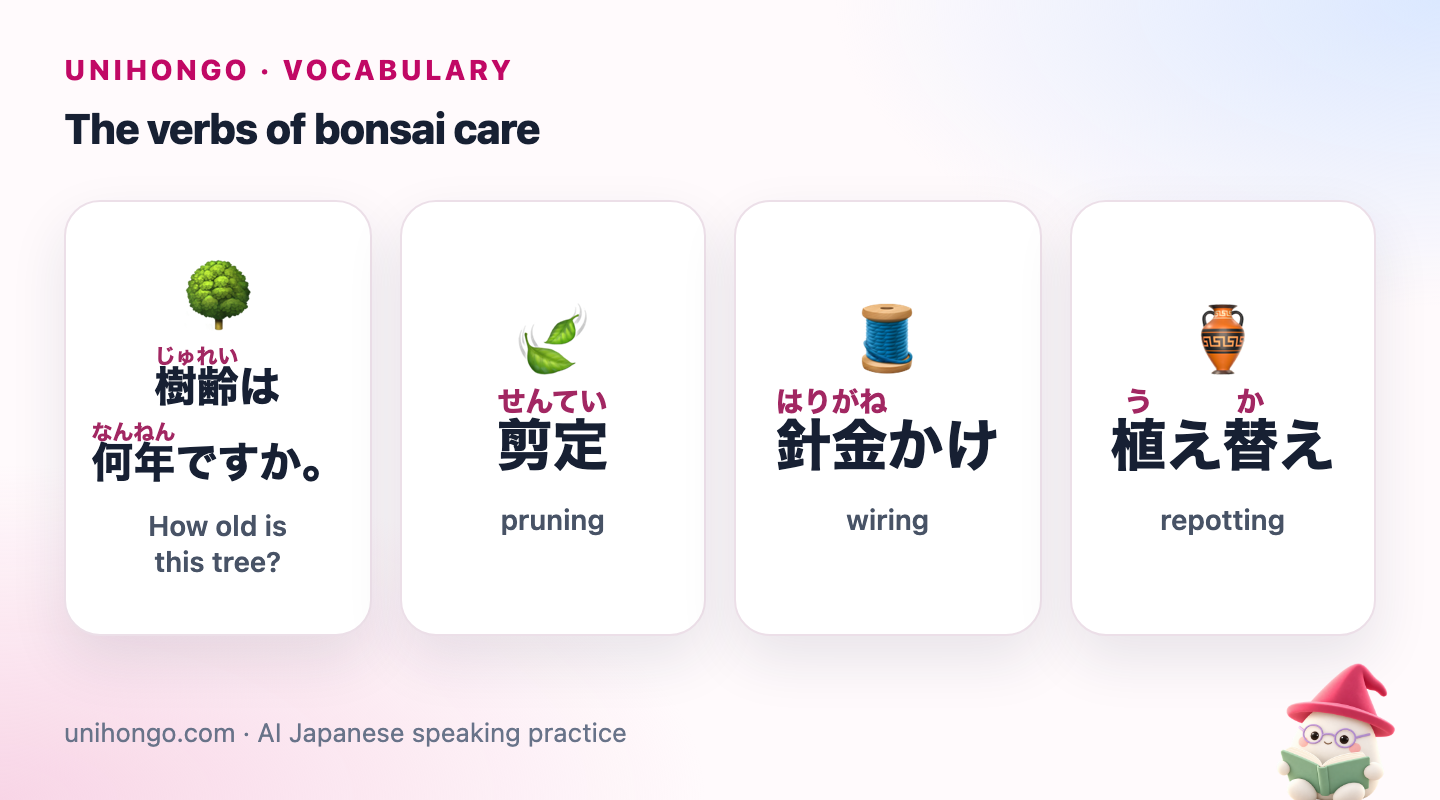
The first card is the question you will ask most, and the next three are the three jobs of the year.
| Japanese | Romaji | Meaning |
|---|---|---|
| 樹齢は何年ですか。 | Jurei wa nannen desu ka. | How old is this tree? |
| 剪定 | sentei | pruning |
| 針金かけ | harigane kake | wiring |
| 植え替え | uekae | repotting |
| 水やり | mizuyari | watering |
| 芽摘み | metsumi | pinching buds |
| 葉刈り | hagari | leaf pruning, defoliation |
| 肥料をやります。 | Hiryō o yarimasu. | I give it fertiliser. |
| 枝を剪定します。 | Eda o sentei shimasu. | I prune the branches. |
| 春に植え替えます。 | Haru ni uekaemasu. | I repot in spring. |
Tree names you will meet
Species names on labels are usually written in kanji or katakana, and the common ones repeat everywhere. Pines dominate: kuromatsu, black pine; akamatsu, red pine; goyōmatsu, five-needle pine. Shinpaku is the Chinese juniper that beginners are steered towards because it is tough. Deciduous trees are momiji, Japanese maple; keyaki, zelkova; and ume, plum, which flowers in late winter. Satsuki, the azalea, has its own exhibitions in early summer.
| Japanese | Romaji | Meaning |
|---|---|---|
| 真柏を育てています。 | Shinpaku o sodatete imasu. | I grow a Chinese juniper. |
| もみじは秋の紅葉がきれいです。 | Momiji wa aki no kōyō ga kirei desu. | The maple's autumn colours are beautiful. |
| 初心者には真柏がおすすめです。 | Shoshinsha ni wa shinpaku ga osusume desu. | Grower: For beginners I recommend a juniper. |
| 松は難しいですか。 | Matsu wa muzukashii desu ka. | Are pines difficult? |
| Japanese | Reading | Tree |
|---|---|---|
| 黒松 | kuromatsu | Japanese black pine |
| 五葉松 | goyōmatsu | five-needle pine |
| 真柏 | shinpaku | Chinese juniper |
| もみじ | momiji | Japanese maple |
| 欅 | keyaki | zelkova |
| 梅 | ume | plum, flowering apricot |
| 皐月 | satsuki | satsuki azalea |
| 杜松 | toshō | needle juniper |
Sodateru, to raise, is the verb for growing a bonsai, the same verb used for children. Tsukuru, to make, is also used by growers for shaping a tree over years, as in kono ki o tsukutta hito, the person who made this tree.
The parts of the tree and the pot
When growers talk about a tree they move from the base upwards: nebari, the surface roots; miki, the trunk; eda, the branches; and the overall jukei, the form. The pot is hachi, the soil yōdo, and moss on the surface is koke. Every tree has a shōmen, a front, from which it is meant to be viewed, and asking which side is the front is a sign that you know what you are looking at.
| Japanese | Romaji | Meaning |
|---|---|---|
| 根張りがいいですね。 | Nebari ga ii desu ne. | The root spread is lovely. |
| 幹 | miki | trunk |
| 枝ぶり | edaburi | the shape of the branches |
| 樹形 | jukei | tree form |
| この木の正面はどちらですか。 | Kono ki no shōmen wa dochira desu ka. | Which side is the front of this tree? |
| 鉢 | hachi | pot |
| 用土 | yōdo | soil mix |
| 苔 | koke | moss |
| 小品盆栽 | shōhin bonsai | small bonsai, under about twenty centimetres |
At a garden or shop: what to ask
Bonsai gardens, bonsai en, often sell trees and welcome visitors; some famous ones are in the Ōmiya area north of Tokyo, though gardens exist across the country. Staff expect three kinds of question: what suits a beginner, how to care for it, and whether it can be taken home. The last gets a careful answer, because exporting live plants needs paperwork and many countries restrict soil and species. Keep the questions polite and simple; the answers will be long.
| Japanese | Romaji | Meaning |
|---|---|---|
| 初心者向けの木はありますか。 | Shoshinsha muke no ki wa arimasu ka. | Do you have trees suitable for beginners? |
| 室内でも育てられますか。 | Shitsunai demo sodateraremasu ka. | Can it be grown indoors? |
| 水やりは一日何回ですか。 | Mizuyari wa ichinichi nankai desu ka. | How many times a day do I water it? |
| 冬はどうすればいいですか。 | Fuyu wa dō sureba ii desu ka. | What should I do in winter? |
| 海外に持ち帰れますか。 | Kaigai ni mochikaeremasu ka. | Can I take it abroad? |
| 真柏なら丈夫ですよ。 | Shinpaku nara jōbu desu yo. | Staff: A juniper is hardy. |
| 外に置いてください。 | Soto ni oite kudasai. | Staff: Please keep it outside. |
Asking a grower: a conversation
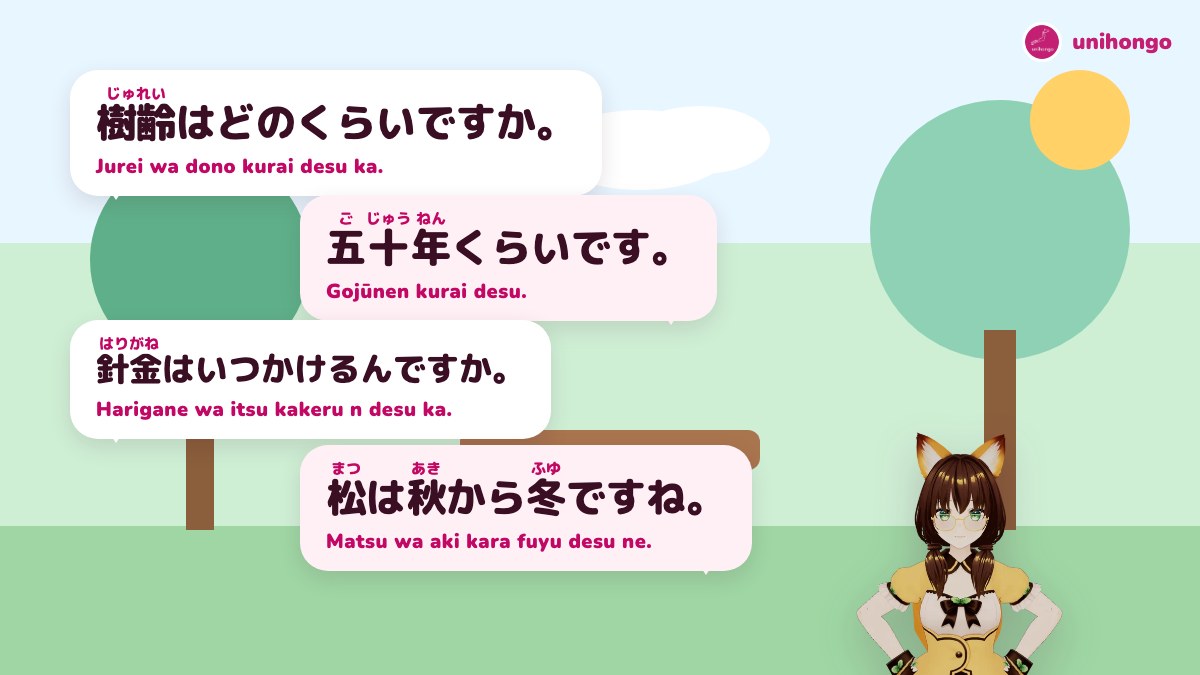
This is the exchange that makes the hobby a language. You ask about age, wiring and repotting; the grower answers with timing and reasons. The timing in the dialogue is a common guideline for pines, but it differs by species, climate and the grower's own habits, so treat every answer as that grower's practice rather than a rule.
| Japanese | Romaji | Meaning |
|---|---|---|
| この松は樹齢どのくらいですか。 | Kono matsu wa jurei dono kurai desu ka. | You: Roughly how old is this pine? |
| 五十年くらいです。父の代から育てています。 | Gojūnen kurai desu. Chichi no dai kara sodatete imasu. | Grower: About fifty. We've grown it since my father's time. |
| 針金はいつかけるんですか。 | Harigane wa itsu kakeru n desu ka. | You: When do you do the wiring? |
| 松は秋から冬ですね。枝が折れにくい時期です。 | Matsu wa aki kara fuyu desu ne. Eda ga orenikui jiki desu. | Grower: Pines, autumn to winter. The branches don't snap so easily then. |
| 植え替えは何年ごとですか。 | Uekae wa nannen goto desu ka. | You: How often do you repot? |
| 若い木は二、三年に一回です。 | Wakai ki wa ni, sannen ni ikkai desu. | Grower: Young trees every two or three years. |
| 勉強になります。 | Benkyō ni narimasu. | You: I'm learning a lot. |
Benkyō ni narimasu, this is educational for me, is the perfect thing to say to anyone explaining their craft. It thanks them, it is modest, and it invites them to keep going.
A year of care, in Japanese
Growers think in seasons, and the words for each job attach to a season. The table gives a common pattern for temperate Japan; your own trees and climate will differ, and every grower you meet will have a slightly different calendar. Learn the pattern as language first.
| Japanese | Romaji | Meaning |
|---|---|---|
| 春は植え替えの季節です。 | Haru wa uekae no kisetsu desu. | Spring is repotting season. |
| 夏は朝と夕方に水をやります。 | Natsu wa asa to yūgata ni mizu o yarimasu. | In summer I water morning and evening. |
| 冬は風を避けて置きます。 | Fuyu wa kaze o yokete okimasu. | In winter I keep it out of the wind. |
| 梅雨にもみじの葉を刈ります。 | Tsuyu ni momiji no ha o karimasu. | In the rainy season I cut the maple's leaves. |
| Season | Typical jobs | Japanese |
|---|---|---|
| spring, haru | repotting, pinching buds | 植え替え、芽摘み |
| rainy season, tsuyu | leaf pruning on maples | 葉刈り |
| summer, natsu | watering twice a day, shading | 水やり、遮光 |
| autumn, aki | wiring, fertiliser | 針金かけ、肥料 |
| winter, fuyu | protection from wind and frost, dormancy | 保護、休眠 |
Praise, modesty and the mistakes to avoid
When someone shows you a tree, praise it with rippa, magnificent, or a specific compliment on the nebari or edaburi. The owner will deny it: Iie, mada mada desu, no, it still has a long way to go. This is not false modesty but the normal shape of the exchange, and you should answer the same way when your own tree is praised.
| Japanese | Romaji | Meaning |
|---|---|---|
| 立派な木ですね。 | Rippa na ki desu ne. | What a magnificent tree. |
| いえいえ、まだまだです。 | Ieie, mada mada desu. | Owner: Oh no, it's still a long way off. |
| 枝ぶりがきれいですね。 | Edaburi ga kirei desu ne. | The branch shape is beautiful. |
| 何年育てているんですか。 | Nannen sodatete iru n desu ka. | How many years have you been growing it? |
- Pronouncing it bonzai. The word is bonsai with a clear s; bonzai sounds like the war cry banzai to Japanese ears.
- Kiru for pruning. Kiru is just cutting; sentei suru is the hobby word, and growers notice the difference.
- Waiyā for wire. You will be understood, but harigane is the bonsai word, and harigane o kakeru the phrase.
- Asking the price of a tree in a garden that is not clearly a shop. Many gardens display trees that are not for sale; ask Kore wa hanbai shite imasu ka, is this for sale, before Ikura desu ka.
- Touching a tree or turning a pot without asking. Say Sawatte mo ii desu ka first; the front of a tree is set deliberately.
- Taking a seedling home in your luggage. Soil and live plants are controlled at most borders; ask the nursery and your own customs rules first.
Grow your Japanese alongside your trees
A bonsai hobby is slow, and that suits language study. Each session with a tree is a chance for three sentences: what the tree is, what you are doing to it, and what you noticed. Over a season those sentences become a working vocabulary without a word list.
For the reading side, Japanese bonsai websites and care sheets are dense but repetitive, and Mocchi, Unihongo's study assistant, is a good way in. Paste one sentence from a care page with /explain and Mocchi breaks it down word by word, including the technical terms; ask for /create-flashcards with a photo of your own tree and the care verbs become cards you review with /review-flashcards. Mocchi keeps track of which verbs you keep confusing, so the reviews narrow onto them. When you want to say it, pick Yamada-sensei in AI Sensei, ask Yamada-sensei to play a nursery owner, and run the questions from this post; the session report afterwards shows the corrections. It all works on a free account at unihongo.com/login, in the ten minutes after watering.
Your turn
Say these about a tree you own or admire, before checking the phrase rows.
- What species is it, and how long have you had it?
- What did you last do to it, with the proper care verb?
- Which season is which job, in your own climate?
- Praise a friend's tree on one specific point, then reply modestly to praise of yours.
- Ask a grower three questions you would genuinely like answered.