
The words coffee people use
Coffee Japanese is mostly loanwords plus a handful of native words for roasting and taste. The loanwords are easy to recognise once you know the katakana: hando dorippu is hand drip or pour-over, shinguru orijin is single origin, burendo is blend. The native words carry the real conversation: iri for roast level, baisen for roasting, mame for beans, and the flavour pair sanmi and nigami, acidity and bitterness.
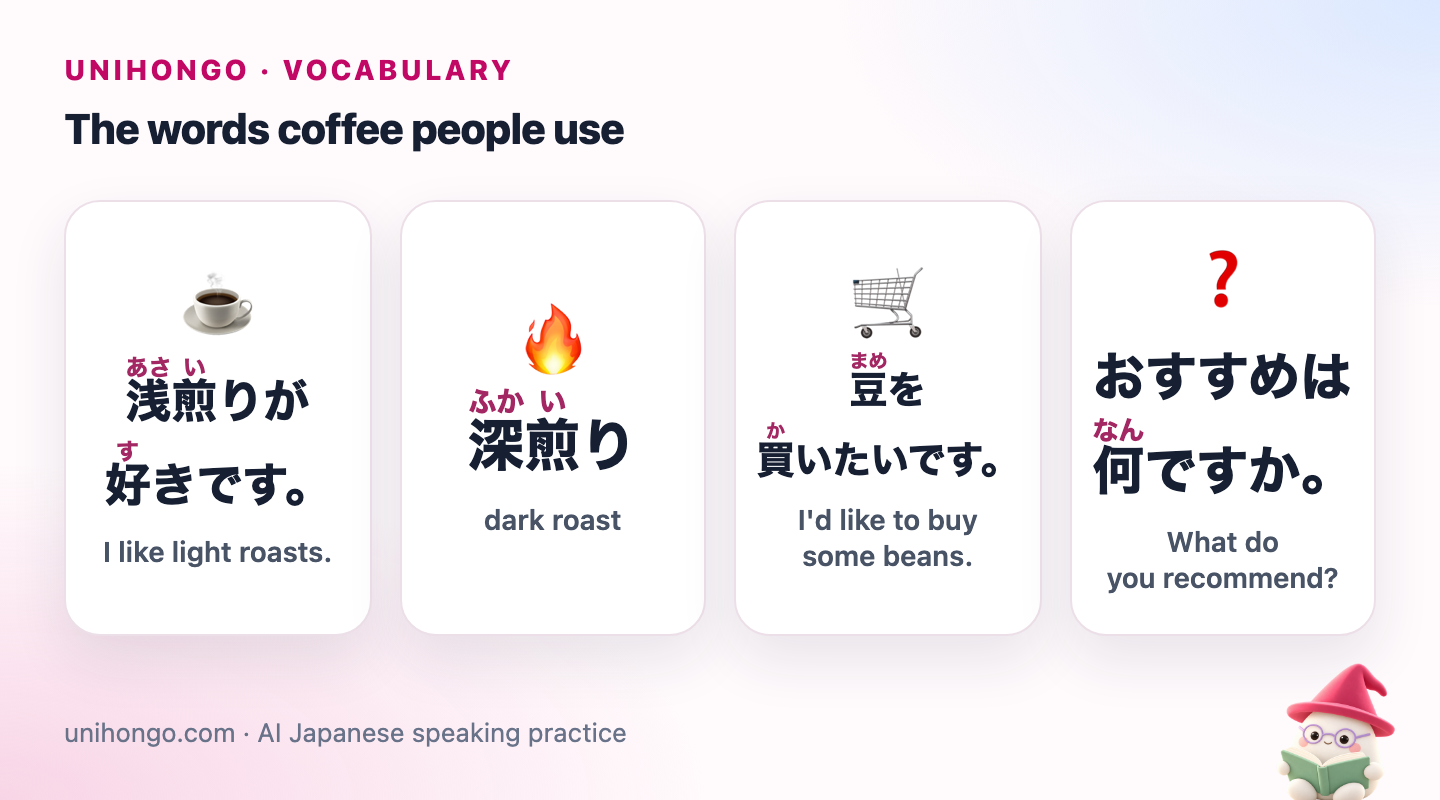
Start with the four cards below. The first is the sentence a barista most wants to hear, because it tells them what to recommend. The other three are the words you will say every time you buy a bag.
| Japanese | Romaji | Meaning |
|---|---|---|
| 浅煎りが好きです。 | Asairi ga suki desu. | I like light roasts. |
| 深煎り | fukairi | dark roast |
| 豆を買いたいです。 | Mame o kaitai desu. | I'd like to buy some beans. |
| おすすめは何ですか。 | Osusume wa nan desu ka. | What do you recommend? |
| 中煎り | chūiri | medium roast |
| 焙煎 | baisen | roasting |
| シングルオリジン | shinguru orijin | single origin |
| ハンドドリップ | hando dorippu | pour-over, hand drip |
| 豆のままでお願いします。 | Mame no mama de onegai shimasu. | Whole beans, please. |
| 粉でお願いします。 | Kona de onegai shimasu. | Ground, please. |
Kissaten and specialty café: two vocabularies
The kissaten and the specialty café sell the same drink but talk about it differently. In a kissaten the pride is the blend, the choice is hot or iced, and a refill is normal. In a specialty café the talk is about origin, roast date and method. Neither is better, and many coffee lovers in Japan go to both. The table shows which words belong where, so you do not ask a seventy-year-old master about his single origins.
| Japanese | Romaji | Meaning |
|---|---|---|
| ブレンドをホットで。 | Burendo o hotto de. | The house blend, hot. |
| 今日の豆は何ですか。 | Kyō no mame wa nan desu ka. | What are today's beans? |
| 焙煎日はいつですか。 | Baisen bi wa itsu desu ka. | What is the roast date? |
| マスター、いつものをお願いします。 | Masutā, itsumo no o onegai shimasu. | Regular: The usual, please. |
| Kissaten | Specialty café | What the words tell you |
|---|---|---|
| burendo, the house blend | shinguru orijin, single origin | Blend culture versus origin culture |
| hotto or aisu, hot or iced | dorippu or esupuresso, method | Temperature first versus method first |
| okawari, a refill | teisutingu, a tasting | Comfort versus exploration |
| masutā, the owner | barisuta, the barista | Who you talk to |
| mōningu, the morning set | baisen bi, the roast date | What is written on the board |
Itsumo no, the usual, is a line you earn after a few visits. Hearing a master say Itsumo no de ii? to you is a small milestone in a Japanese coffee life, and it happens sooner than you expect in a neighbourhood kissaten.
Ordering with preferences
The most useful grammar in a café is the particle de on its own: it means please make it this way and lets you drop the verb. Hotto de, koime de, miruku nashi de. Pair it with the flavour words and you can order exactly what you like without a full sentence. For a question, the pattern X ga sukunai no wa dore desu ka, which one has less X, works for acidity, bitterness and body.
Register note: these short de phrases are polite enough with a friendly nod and a sumimasen, because the staff are the ones using polite forms. If you want to sound a little more careful, add onegai shimasu at the end.
| Japanese | Romaji | Meaning |
|---|---|---|
| 酸味が少ないのはどれですか。 | Sanmi ga sukunai no wa dore desu ka. | Which one has less acidity? |
| 苦味が強いのが好きです。 | Nigami ga tsuyoi no ga suki desu. | I like a strong, bitter one. |
| 濃いめでお願いします。 | Koime de onegai shimasu. | A little stronger, please. |
| 薄めで大丈夫です。 | Usume de daijōbu desu. | A little weaker is fine. |
| ミルクなしで。 | Miruku nashi de. | No milk. |
| 砂糖はいりません。 | Satō wa irimasen. | No sugar for me. |
| 店内で飲みます。 | Tennai de nomimasu. | I'll drink it here. |
| 持ち帰りで。 | Mochikaeri de. | To go. |
What you'll hear when you buy beans
Buying beans is where learners freeze, because the staff questions come in polite shop language and arrive fast. There are only four of them. Whether to grind, how to grind, how much, and whether you want the bag sealed. The humble form ohiki shimasu, shall we grind for you, is the one that surprises people; it is just hiku, to grind, dressed up for a customer.
| Japanese | Romaji | Meaning |
|---|---|---|
| お飲み物はお決まりですか。 | Onomimono wa okimari desu ka. | Staff: Have you decided on a drink? |
| こちらでお召し上がりですか。 | Kochira de omeshiagari desu ka. | Staff: Will you be drinking here? |
| 豆はお挽きしますか。 | Mame wa ohiki shimasu ka. | Staff: Shall we grind the beans? |
| 挽き方はどうされますか。 | Hikikata wa dō saremasu ka. | Staff: How would you like them ground? |
| ペーパー用でお願いします。 | Pēpā yō de onegai shimasu. | You: For a paper filter, please. |
| フレンチプレス用で。 | Furenchi puresu yō de. | You: For a French press. |
| 何グラムにしますか。 | Nan guramu ni shimasu ka. | Staff: How many grams? |
| 二百グラムください。 | Nihyaku guramu kudasai. | You: Two hundred grams, please. |
If you do not catch the grind question, Pēpā de onegai shimasu, for paper, answers it anyway. Many shops also ask Gojitaku yō desu ka, is it for home use, which decides whether they wrap the bag as a gift; a simple hai is fine for anything you do not catch that sounds like an offer.
Talking beans and roasts with a barista
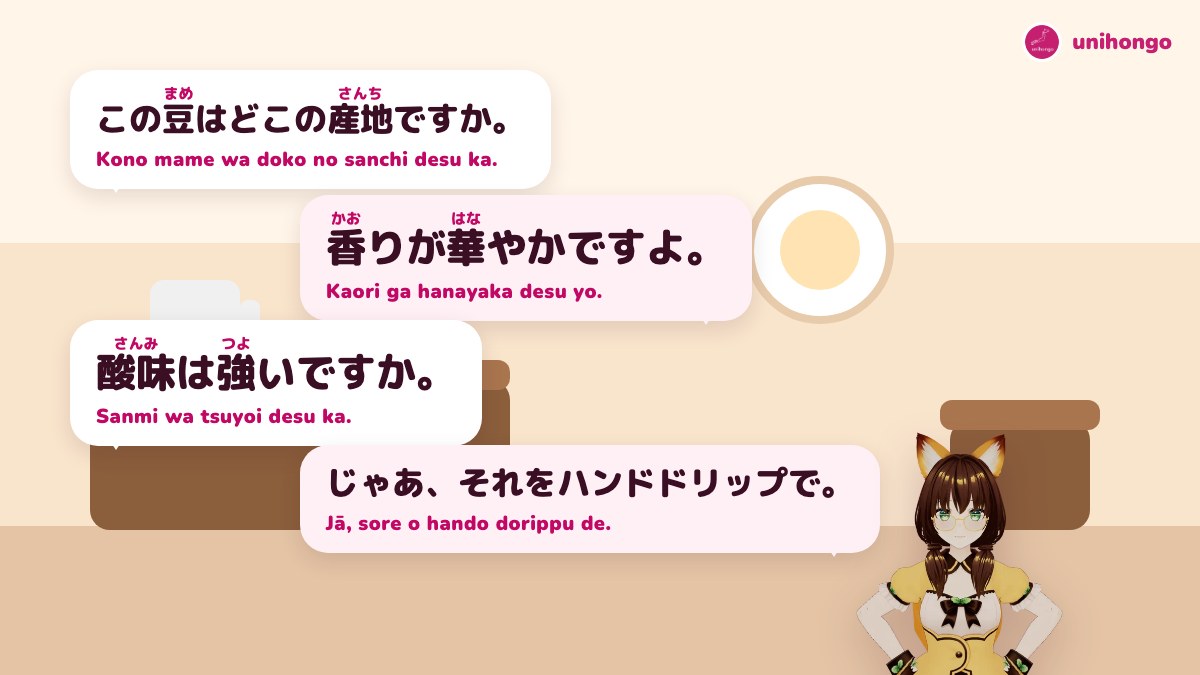
This is the conversation that makes coffee a language hobby rather than a transaction. You ask about the origin, the barista describes the aroma, you ask about acidity, and you choose. Baristas in specialty cafés are used to these questions and usually enjoy them, especially on a quiet afternoon. Keep your side short and let them talk; what they say is excellent listening practice full of the adjectives from the next section.
| Japanese | Romaji | Meaning |
|---|---|---|
| この豆はどこの産地ですか。 | Kono mame wa doko no sanchi desu ka. | You: Where are these beans from? |
| エチオピアです。香りが華やかですよ。 | Echiopia desu. Kaori ga hanayaka desu yo. | Barista: Ethiopia. The aroma is very bright. |
| 酸味は強いですか。 | Sanmi wa tsuyoi desu ka. | You: Is the acidity strong? |
| 少しありますが、まろやかです。 | Sukoshi arimasu ga, maroyaka desu. | Barista: A little, but it's mellow. |
| じゃあ、それをハンドドリップで。 | Jā, sore o hando dorippu de. | You: Then that one as a pour-over. |
| かしこまりました。少々お待ちください。 | Kashikomarimashita. Shōshō omachi kudasai. | Barista: Certainly. One moment, please. |
| 焙煎はいつですか。 | Baisen wa itsu desu ka. | You: When was it roasted? |
| 先週の金曜日です。 | Senshū no kin'yōbi desu. | Barista: Last Friday. |
Describing the taste
Taste words are where a hobby conversation lives. Japanese coffee talk uses a small set of adjectives, and most are also used for tea, sake and beer, so they pay off far beyond the café. The table gives the core set; the phrase rows show them inside sentences you can say back to a barista after the first sip.
| Japanese | Romaji | Meaning |
|---|---|---|
| すっきりしていて飲みやすいです。 | Sukkiri shite ite nomiyasui desu. | It's clean and easy to drink. |
| コクがあって、後味が長いです。 | Koku ga atte, atoaji ga nagai desu. | Full-bodied, with a long finish. |
| 香ばしい香りがしますね。 | Kōbashii kaori ga shimasu ne. | It has a lovely toasty aroma. |
| フルーティーで、紅茶みたいです。 | Furūtī de, kōcha mitai desu. | Fruity, almost like black tea. |
| ちょっと苦すぎるかも。 | Chotto nigasugiru kamo. | Might be a bit too bitter. (casual) |
| Word | Reading | Use it for |
|---|---|---|
| 酸味がある | sanmi ga aru | pleasant acidity, bright or fruity |
| 苦味 | nigami | bitterness, usually of a dark roast |
| コクがある | koku ga aru | body, richness, depth |
| すっきり | sukkiri | clean, light, no heaviness |
| まろやか | maroyaka | mellow, smooth, rounded |
| 香ばしい | kōbashii | toasty, roasted aroma |
| 後味 | atoaji | aftertaste, finish |
| 華やか | hanayaka | bright, floral, lively aroma |
Notice the pattern adjective plus te form plus second adjective: sukkiri shite ite nomiyasui, koku ga atte atoaji ga nagai. Two qualities joined this way sound like a real tasting note rather than a list.
Mistakes and register notes
- Suppai for acidity. Suppai means sour in the lemon or gone-off sense; for the pleasant brightness of a light roast, say sanmi ga aru. Baristas will understand suppai, but it sounds like a complaint.
- Esupuresso for strong coffee. If you just want your drip coffee stronger, say koime de. Espresso is a method, not a strength.
- Hotto with the long vowel dropped. Hotto has a small tsu; hoto sounds like a different word. The same goes for aisu, which is iced, not ice cream in this context.
- Over-polite questions to a kissaten master. Dore ga osusume desu ka is enough; long keigo questions make a small shop feel formal. Save the humble forms for listening, since the staff use them.
- Saying oishii on every sip. One oishii is warm; a tasting word after it, such as sukkiri shite imasu ne, shows you actually tasted it and opens the conversation.
- Asking for okawari in a specialty café. Refills are a kissaten custom and are not standard in most specialty cafés, which brew each cup by hand. Ask Okawari dekimasu ka only where you see other customers doing it.
Make coffee your daily Japanese
The great thing about a coffee hobby is that it happens every day, which is exactly what language study needs. Narrate the brew: today's beans, the roast, the grind, one taste sentence after the first sip. That is thirty seconds of Japanese you will never forget to do, because you never forget the coffee.
To build the words, sign in to Unihongo and ask Mocchi, the study assistant, to make cards from the bag in front of you: type /create-flashcards, add a photo of the label, and ask for cards for the roast, origin and flavour words on it. Mocchi keeps track of which ones you miss, so a week later the review starts with the words you actually forgot. When the words feel solid, take the conversation to AI Sensei: pick Sakura-sensei, ask Sakura-sensei to play a specialty-café barista, and run the bean-buying exchange, then ask Sakura-sensei to describe a different origin so you have to answer with the taste adjectives. The session report afterwards lists the sentences she corrected, which you can bring to your next real café visit. A free account at unihongo.com/login is all you need to start with tonight's cup.
Your turn
Say these out loud with your next coffee, in Japanese, before you look back at the phrase rows.
- What roast do you drink at home, and why?
- Describe your last café coffee in two joined adjectives.
- Ask a barista where the beans are from and when they were roasted.
- Order two hundred grams, ground for the brewer you use.
- Tell a friend whether you are a kissaten person or a specialty-café person.